Oman Industrial Machinery Market Size, Share & Growth Rate
The Oman Industrial Machinery Market was estimated at USD 241 Million in 2025 and is projected to reach USD 263 Million by 2032, growing at a CAGR of 1.3% from 2026 to 2032. This growth trajectory is primarily driven by the ongoing expansion in key sectors such as construction and manufacturing, which demand high-quality machinery. The increasing focus on automation and efficiency further accelerates the need for advanced industrial solutions, positioning the market favorably for future investments.
Oman Industrial Machinery Market Year-wise Growth Rate and Key Drivers
This graph highlights how the Oman Industrial Machinery Market has steadily grown over the years, supported by major growth factors.
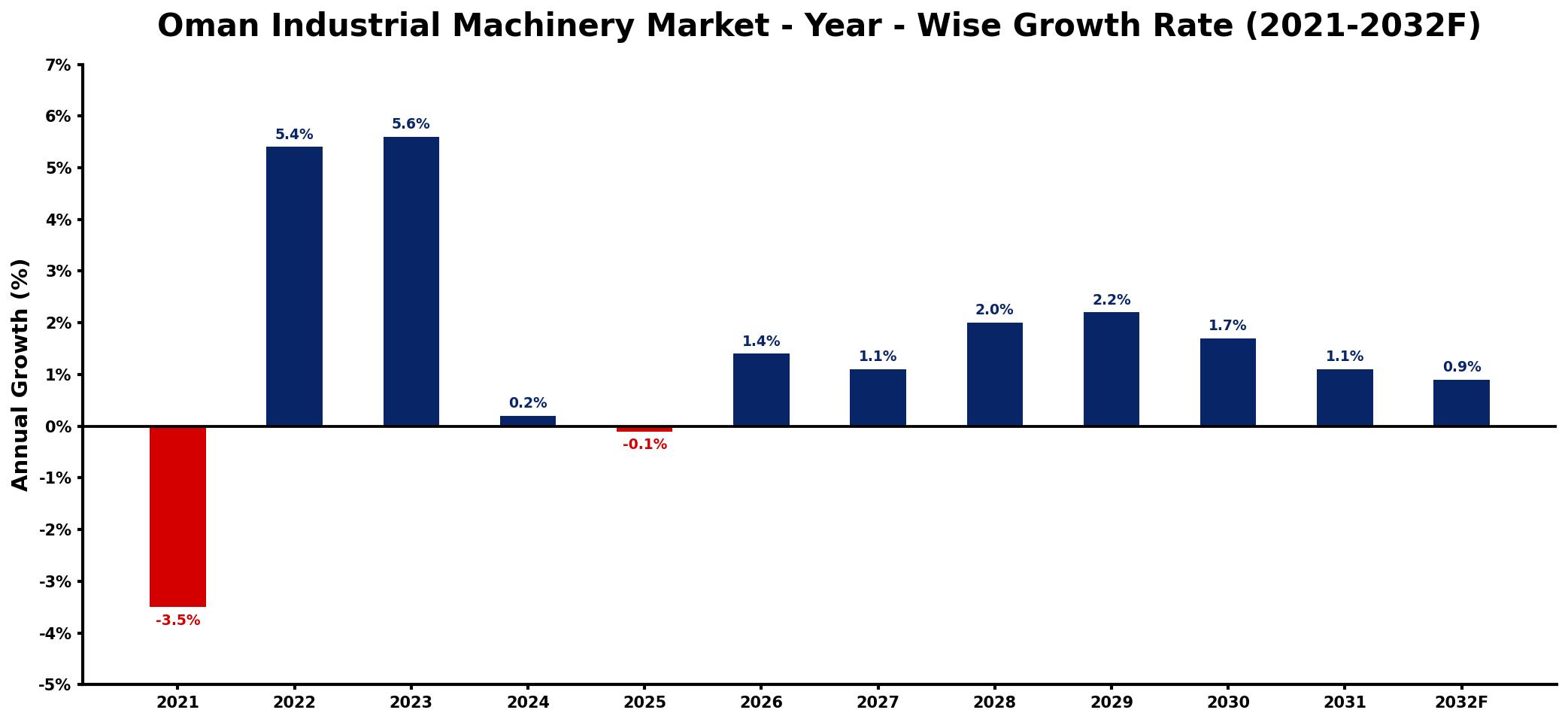
The table below presents the year‑wise growth rates along with the key drivers influencing the market
| Year | Growth Rate | Major Drivers |
| 2021 | -3.5% | decreased demand from construction sector |
| 2022 | 5.4% | increased government infrastructure investments |
| 2023 | 5.6% | rising energy sector projects |
| 2024 | 0.2% | expansion of manufacturing capabilities |
| 2025 | -0.1% | lower investments in new projects |
| 2026 | 1.4% | growing focus on renewable energy |
| 2027 | 1.1% | enhanced logistics and distribution networks |
| 2028 | 2.0% | increased foreign direct investments |
| 2029 | 2.2% | development of local supply chains |
| 2030 | 1.7% | boost in export-oriented industries |
| 2031 | 1.1% | growing demand for automation solutions |
| 2032 | 0.9% | rising end-use demand growth |
Note: Market size estimations and growth projections presented in this report are based on 6Wresearch's proprietary forecasting methodology, utilizing the latest available industry data, government publications, and primary research inputs.
Oman Industrial Machinery Market Synopsis
Currently, the Oman Industrial Machinery Market is in a phase of significant transformation, spurred by the government's commitment to infrastructure development. As Oman seeks to diversify its economy away from oil dependency, the need for robust machinery in manufacturing and construction becomes increasingly critical.
The interplay of local production incentives and technological advancements has fostered a landscape where innovation is essential. With the rise of automated solutions, industries are adapting to enhance productivity, thereby driving the market towards a more competitive and efficient future.
Oman Industrial Machinery Market Key Takeaways
- The market is witnessing steady growth fueled by robust infrastructure investments.
- Technological innovation is essential for meeting the demand for customized industrial machinery.
- Government policies play a vital role in supporting local manufacturing capabilities.
- Increasing automation across sectors is reshaping demand dynamics.
- The ongoing expansion of the mining sector adds further impetus to market growth.
Evaluation of Restraints in Oman Industrial Machinery Market
The growth of the Oman Industrial Machinery Market faces several real constraints. Primarily, there is a continuous need for manufacturers to keep pace with rapid technological advancements. As industries demand more sophisticated machinery, suppliers must ensure reliability and performance, which can be a significant challenge. Moreover, the necessity for customized solutions across various sectors introduces complexity, often leading to longer lead times and increased costs. These factors collectively impact the agility with which the market can respond to emerging trends and demands.
Oman Industrial Machinery Market Trends
Several trends are currently shaping the Oman Industrial Machinery Market. A major trend is the increasing integration of smart technologies, such as IoT and AI, into machinery, enhancing operational efficiency and data analysis capabilities. There is also a rising emphasis on sustainability, prompting manufacturers to develop eco-friendly machines and processes. Additionally, the shift towards modular and adaptable machinery solutions is enabling industries to respond quickly to changing demands, streamlining operations and reducing downtime.
Oman Industrial Machinery Market Opportunities
The Oman Industrial Machinery Market presents numerous growth and investment opportunities. The ongoing infrastructure projects, particularly in construction and logistics, are significant drivers, creating a robust demand for specialized machinery. Additionally, the mining sector's expansion offers lucrative prospects for suppliers, as the need for advanced equipment increases. Furthermore, investments in training programs for the workforce can enhance skills, ensuring a reliable talent pool capable of optimizing and maintaining new technologies.
Government Initiatives in the Oman Industrial Machinery Market
The government of Oman has introduced several initiatives to bolster the industrial machinery market. Policies aimed at promoting local production are pivotal, offering financial incentives to manufacturers while ensuring adherence to high-quality standards. Funding for research and development in advanced machinery technologies is increasingly available, allowing for innovation in the sector. Additionally, government training programs aim to enhance the skills of industry professionals, ensuring they can effectively utilize modern machinery, thus supporting overall market growth.
Future Insights of the Oman Industrial Machinery Market
Looking ahead to 2026-2032, the Oman Industrial Machinery Market is poised for steady growth characterized by technological integration and an expanding industrial base. As industries increasingly adopt automation and smart technologies, the market is expected to evolve, demanding innovative solutions that enhance productivity. With the government's continued support for local production and infrastructure development, the market is likely to attract further investments, enabling companies to remain competitive in an ever-changing landscape.
Oman Industrial Machinery Market Latest Developments (2025 - 2026)
Recent developments in the Oman Industrial Machinery Market indicate a concerted push towards modernization, with various sectors implementing advanced machinery solutions. Public-private partnerships are increasingly being formed to leverage technological advancements, focusing on sustainability and efficiency. Additionally, trade exhibitions and conferences are showcasing new products, highlighting innovation as a key focal point for future growth and collaboration in the industry.
Oman Industrial Machinery Market - Key Attractiveness of the Report
- 10 Years of Market Numbers
- Historical Data Starting from 2022 to 2025
- Base Year: 2025
- Forecast Data until 2032
- Key Performance Indicators Impacting the Market
- Major Upcoming Developments and Projects
Key Highlights of the Report:
- Oman Industrial Machinery Market Outlook
- Market Size of Oman Industrial Machinery Market, 2025
- Forecast of Oman Industrial Machinery Market, 2032
- Historical Data and Forecast of Oman Industrial Machinery Revenues & Volume for the Period 2022-2032F
- Oman Industrial Machinery Market Trend Evolution
- Oman Industrial Machinery Market Drivers and Challenges
- Oman Industrial Machinery Price Trends
- Oman Industrial Machinery Porter's Five Forces
- Oman Industrial Machinery Industry Life Cycle
- Historical Data and Forecast of Oman Industrial Machinery Market Revenues & Volume By Application for the Period 2022-2032F
- Historical Data and Forecast of Oman Industrial Machinery Market Revenues & Volume By Agriculture for the Period 2022-2032F
- Historical Data and Forecast of Oman Industrial Machinery Market Revenues & Volume By Construction for the Period 2022-2032F
- Historical Data and Forecast of Oman Industrial Machinery Market Revenues & Volume By Packaging for the Period 2022-2032F
- Historical Data and Forecast of Oman Industrial Machinery Market Revenues & Volume By Food Processing for the Period 2022-2032F
- Historical Data and Forecast of Oman Industrial Machinery Market Revenues & Volume By Mining for the Period 2022-2032F
- Historical Data and Forecast of Oman Industrial Machinery Market Revenues & Volume By Semiconductor Manufacturing for the Period 2022-2032F
- Oman Industrial Machinery Import Export Trade Statistics
- Market Opportunity Assessment By Application
- Oman Industrial Machinery Top Companies Market Share
- Oman Industrial Machinery Competitive Benchmarking By Technical and Operational Parameters
- Oman Industrial Machinery Company Profiles
- Oman Industrial Machinery Key Strategic Recommendations






































