Russia Industrial Machinery Market Size, Share & Growth Rate
The Russia Industrial Machinery Market was estimated at USD 211 Million in 2025 and is projected to reach USD 231 Million by 2032, growing at a CAGR of 1.3% from 2026 to 2032. This growth trajectory is driven by the country's ongoing industrialization initiatives and the increasing adoption of advanced technologies, such as automation and IoT, to enhance production efficiency. Moreover, the push for sustainability and energy-efficient machinery is also playing a crucial role in shaping the market dynamics.
Russia Industrial Machinery Market Year-wise Growth Rate and Key Drivers
This graph highlights how the Russia Industrial Machinery Market has steadily grown over the years, supported by major growth factors.
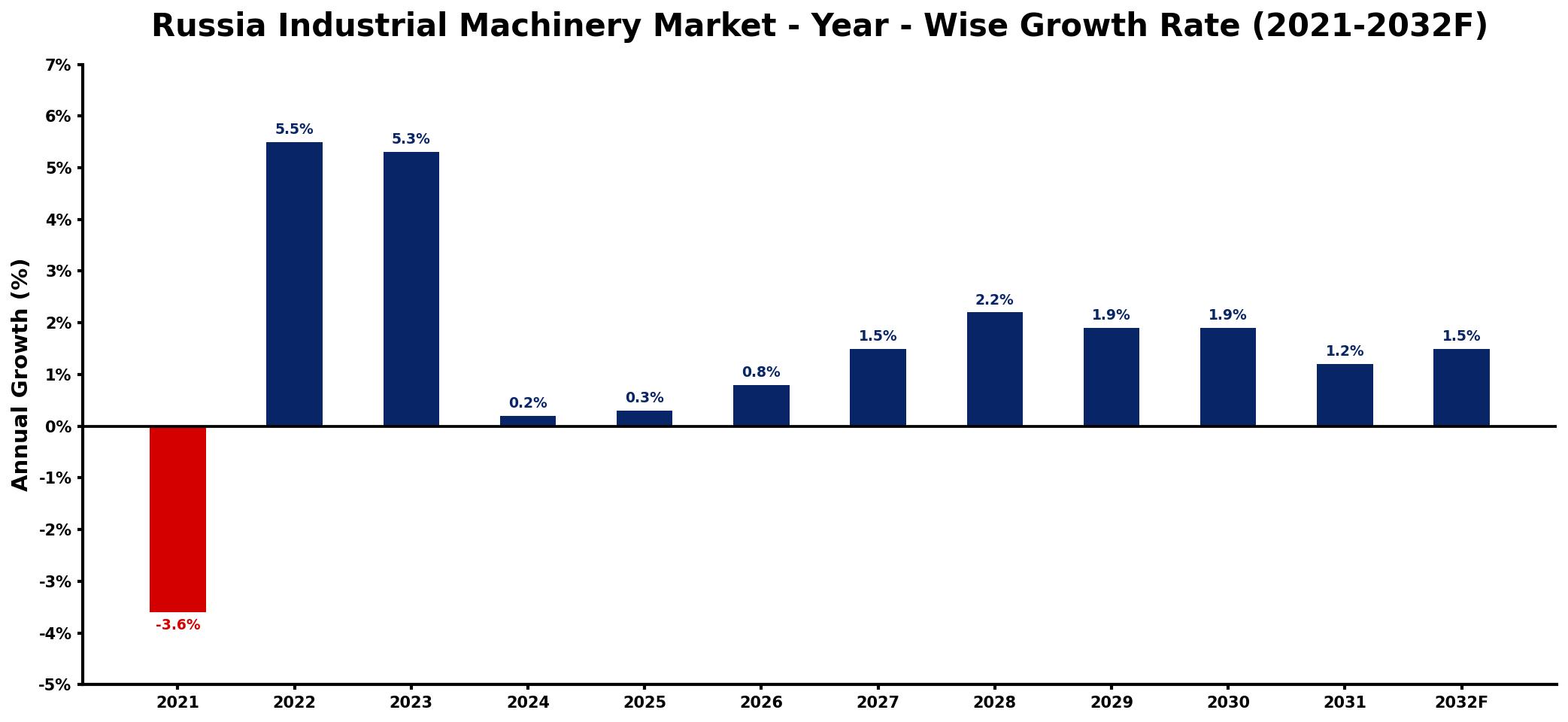
The table below presents the year‑wise growth rates along with the key drivers influencing the market
| Year | Growth Rate | Major Drivers |
| 2021 | -3.6% | decreased demand for construction projects |
| 2022 | 5.5% | expansion of renewable energy investments |
| 2023 | 5.3% | rising automation in manufacturing sectors |
| 2024 | 0.2% | increased infrastructure development initiatives |
| 2025 | 0.3% | growing domestic manufacturing capabilities |
| 2026 | 0.8% | enhanced technological advancements adoption |
| 2027 | 1.5% | surge in foreign direct investments |
| 2028 | 2.2% | increased focus on sustainability practices |
| 2029 | 1.9% | growing demand for smart factories |
| 2030 | 1.9% | increased pharmaceutical industry usage |
| 2031 | 1.2% | rising demand for advanced robotics |
| 2032 | 1.5% | increased collaboration with global partners |
Note: Market size estimations and growth projections presented in this report are based on 6Wresearch's proprietary forecasting methodology, utilizing the latest available industry data, government publications, and primary research inputs.
Russia Industrial Machinery Market Synopsis
In the heart of Russias diverse economy, the Industrial Machinery Market stands out as a vital component fueling development across multiple sectors. Spanning manufacturing, construction, mining, and agriculture, this market features a blend of robust domestic production alongside a reliance on imports, creating a competitive landscape.
Current trends point towards an increasing demand for innovative machinery that integrates automation and energy efficiency, reflecting broader global industrial shifts. Local manufacturers are seeking to modernize their offerings, while international companies are exploring entry into this growing market.
Russia Industrial Machinery Market Key Takeaways
- The market is set to grow steadily due to industrialization and technological advancements.
- Automation and sustainability are key focus areas driving machinery innovation.
- There is a significant shift towards customization to meet diverse industry needs.
- Government support enhances local production capabilities and competitive standing.
- Investment opportunities arise from digitalization initiatives and infrastructure projects.
Evaluation of Restraints in Russia Industrial Machinery Market
Despite its potential, the Russia Industrial Machinery Market faces several significant challenges. Economic instability linked to oil price fluctuations continues to create uncertainties for businesses. Additionally, geopolitical tensions have led to disrupted trade relationships, which affect the availability of imported machinery and components. Regulatory complexities and bureaucratic hurdles also limit operational efficiency and innovation, forcing companies to navigate a labyrinth of compliance requirements. Moreover, access to skilled labor and financing remains inconsistent, posing further challenges for market players striving to enhance their competitive edge.
Russia Industrial Machinery Market Trends
The ongoing transformation of the Russia Industrial Machinery Market is marked by several pivotal trends. A pronounced shift towards automation and digitization is evident as industries strive to enhance productivity and operational efficiency. The incorporation of advanced technologies like IoT and AI is fostering predictive maintenance and optimizing performance. Moreover, manufacturers are increasingly prioritizing sustainability, opting for energy-efficient machinery to align with global environmental standards. Customization is also gaining traction, as businesses look to tailor machinery solutions to fit specific operational requirements across various sectors.
Russia Industrial Machinery Market Opportunities
The Russia Industrial Machinery Market presents numerous growth opportunities driven by increasing investments in infrastructure and industrial development. The growing demand for modern manufacturing solutions opens avenues for companies specializing in advanced technologies and automation. Foreign investors can significantly benefit from partnerships with local firms, leveraging established supply chains and market knowledge to navigate the landscape effectively. The ongoing push towards Industry 4.0 further fosters opportunities for smart manufacturing solutions that integrate cutting-edge technology and process optimization.
Government Initiatives in the Russia Industrial Machinery Market
The Russian government is actively promoting domestic production through a variety of initiatives aimed at reducing dependence on foreign machinery. Import substitution programs and incentives for local manufacturers are designed to bolster innovation within the industrial machinery sector. Regulatory frameworks are also being reinforced to ensure compliance with safety and quality standards. By providing tax breaks and preferential treatment to domestic suppliers, the government is working to enhance the competitiveness and sustainability of the local market while aiming to foster economic self-sufficiency.
Future Insights of the Russia Industrial Machinery Market
Looking ahead to 2026-2032, the outlook for the Russia Industrial Machinery Market is optimistic. The combination of rising industrialization and a robust focus on technological advancement will likely drive demand for innovative machinery across various sectors, including automotive and energy. The incorporation of automation and smart solutions will be critical as businesses seek to improve efficiency and responsiveness in production. However, stakeholders must remain cognizant of geopolitical risks and economic uncertainties that could pose challenges to market stability and growth.
Russia Industrial Machinery Market Latest Developments (2025 - 2026)
Recent developments in the Russia Industrial Machinery Market reflect a shift towards enhanced technological integration and automation across production processes. Several companies are launching initiatives to modernize their machinery offerings, with a keen focus on energy efficiency and sustainability. Collaborative efforts between domestic and foreign firms are gaining momentum, aiming to combine expertise and innovation to address market demands. This strategic pivot underscores the market's response to global trends and local needs, positioning it for future growth.
Russia Industrial Machinery Market - Key Attractiveness of the Report
- 10 Years of Market Numbers
- Historical Data Starting from 2022 to 2025
- Base Year: 2025
- Forecast Data until 2032
- Key Performance Indicators Impacting the Market
- Major Upcoming Developments and Projects
Key Highlights of the Report:
- Russia Industrial Machinery Market Outlook
- Market Size of Russia Industrial Machinery Market, 2025
- Forecast of Russia Industrial Machinery Market, 2032
- Historical Data and Forecast of Russia Industrial Machinery Revenues & Volume for the Period 2022-2032F
- Russia Industrial Machinery Market Trend Evolution
- Russia Industrial Machinery Market Drivers and Challenges
- Russia Industrial Machinery Price Trends
- Russia Industrial Machinery Porter's Five Forces
- Russia Industrial Machinery Industry Life Cycle
- Historical Data and Forecast of Russia Industrial Machinery Market Revenues & Volume By Application for the Period 2022-2032F
- Historical Data and Forecast of Russia Industrial Machinery Market Revenues & Volume By Agriculture for the Period 2022-2032F
- Historical Data and Forecast of Russia Industrial Machinery Market Revenues & Volume By Construction for the Period 2022-2032F
- Historical Data and Forecast of Russia Industrial Machinery Market Revenues & Volume By Packaging for the Period 2022-2032F
- Historical Data and Forecast of Russia Industrial Machinery Market Revenues & Volume By Food Processing for the Period 2022-2032F
- Historical Data and Forecast of Russia Industrial Machinery Market Revenues & Volume By Mining for the Period 2022-2032F
- Historical Data and Forecast of Russia Industrial Machinery Market Revenues & Volume By Semiconductor Manufacturing for the Period 2022-2032F
- Russia Industrial Machinery Import Export Trade Statistics
- Market Opportunity Assessment By Application
- Russia Industrial Machinery Top Companies Market Share
- Russia Industrial Machinery Competitive Benchmarking By Technical and Operational Parameters
- Russia Industrial Machinery Company Profiles
- Russia Industrial Machinery Key Strategic Recommendations






































