Egypt Industrial Machinery Market Size, Share & Growth Rate
The Egypt Industrial Machinery Market was estimated at USD 179 Million in 2025 and is projected to reach USD 196 Million by 2032, growing at a CAGR of 1.3% from 2026 to 2032. This growth trajectory is primarily driven by the increasing demand for automation and sophisticated manufacturing processes across various sectors. As industries embrace modernization and seek to elevate productivity and efficiency, investments in advanced machinery are witnessing an upward trend.
Egypt Industrial Machinery Market Year-wise Growth Rate and Key Drivers
This graph highlights how the Egypt Industrial Machinery Market has steadily grown over the years, supported by major growth factors.
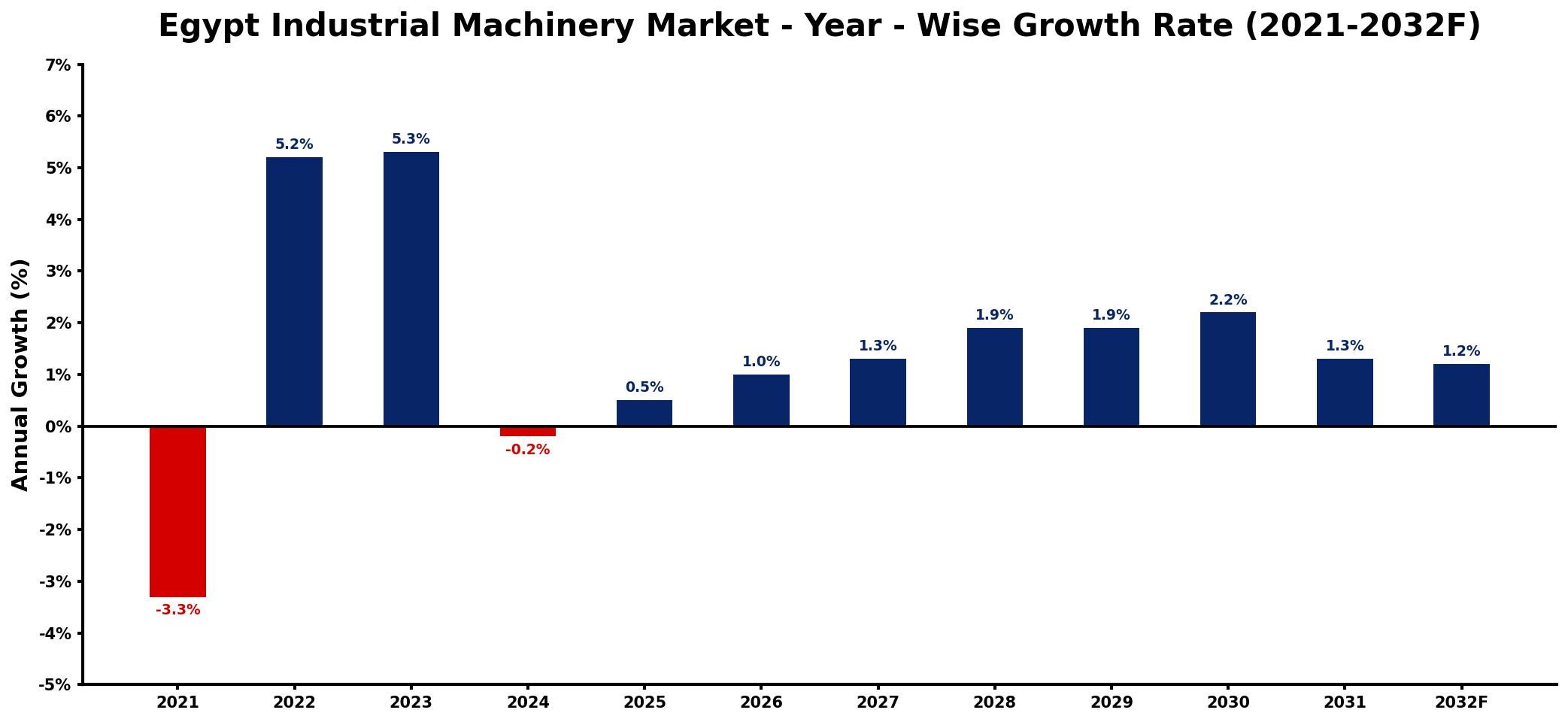
The table below presents the year‑wise growth rates along with the key drivers influencing the market
| Year | Growth Rate | Major Drivers |
| 2021 | -3.3% | decreased demand from construction sector |
| 2022 | 5.2% | increased investments in renewable energy |
| 2023 | 5.3% | growing automation in manufacturing processes |
| 2024 | -0.2% | reduced spending in infrastructure projects |
| 2025 | 0.5% | growing automotive sector requirements |
| 2026 | 1.0% | rising demand for advanced technologies |
| 2027 | 1.3% | increased overall sector activity |
| 2028 | 1.9% | increased focus on sustainability initiatives |
| 2029 | 1.9% | expanding agricultural mechanization efforts |
| 2030 | 2.2% | boost in urban development projects |
| 2031 | 1.3% | growing interest in smart factories |
| 2032 | 1.2% | increased collaboration with global partners |
Note: Market size estimations and growth projections presented in this report are based on 6Wresearch's proprietary forecasting methodology, utilizing the latest available industry data, government publications, and primary research inputs.
Egypt Industrial Machinery Market Synopsis
Recent momentum in the Egypt Industrial Machinery Market has been impressive, characterized by a surge in investments aimed at enhancing operational efficiencies. Looking ahead, the market is poised for further growth, bolstered by government initiatives and a relentless push towards automation.
However, this optimistic outlook contrasts with challenges such as limited awareness of modern machinery benefits among traditional sectors. As the market evolves, addressing these awareness gaps will be essential to unlocking its full potential.
Egypt Industrial Machinery Market Key Takeaways
- Strong growth projected with an estimated market size of USD 196 Million by 2032.
- Government initiatives are fostering increased investments in advanced industrial machinery.
- Technological advancements are driving innovation and competition within the market.
- Customization and automation are becoming crucial for industry players to remain competitive.
- Understanding regulatory compliance will be vital for new entrants to navigate the market.
Evaluation of Restraints in Egypt Industrial Machinery Market
Despite the positive growth indicators, the Egypt Industrial Machinery Market faces notable restraints. One of the primary limitations is the limited awareness of advanced machinery technologies among potential users in traditional sectors. This knowledge gap could result in a slower adoption rate of innovative solutions. Additionally, high production costs associated with specialized machinery pose a challenge for manufacturers, often deterring entry into the market. The complex regulatory landscape concerning product safety and environmental compliance further complicates the situation, requiring substantial investments in adherence measures. Moreover, dependence on imported components introduces risks associated with price volatility and supply chain disruptions, affecting the market's overall pricing and availability.
Egypt Industrial Machinery Market Trends
Current trends in the Egypt Industrial Machinery Market indicate a pronounced shift towards automation and digitalization, driven by the imperative for enhanced operational efficiency. Technologies such as IoT, AI, and data analytics are gradually becoming integral to machinery design and functionality, enabling industries to streamline processes and reduce costs. Additionally, a growing demand for customized machinery solutions is fostering innovation, as companies seek to tailor their offerings to meet specific sector requirements, particularly in manufacturing and agriculture.
Egypt Industrial Machinery Market Opportunities
The market presents genuine growth and investment opportunities, particularly in sectors poised for modernization. Manufacturers looking to capitalize on emerging technological advancements, such as robotics and smart automation, will find fertile ground in Egypt's evolving industrial landscape. Furthermore, as the government continues to focus on industrialization and infrastructure development, companies that align with these initiatives stand to benefit significantly from increased demand for advanced machinery solutions. Customization and specialized offerings tailored to specific industries present additional avenues for growth.
Government Initiatives in the Egypt Industrial Machinery Market
The Egyptian government plays a vital role in supporting the industrial machinery market through various initiatives. Policies are increasingly favoring investments in advanced machinery, providing financial incentives and tax relief to companies that contribute to enhancing productivity. Furthermore, the government prioritizes the development of machinery that meets international quality standards, ensuring that Egypt's manufacturing capabilities are bolstered. Continued public spending on infrastructure projects further underscores the states commitment to fostering an environment conducive to industrial growth.
Future Insights of the Egypt Industrial Machinery Market
Looking forward to the period between 2026 and 2032, the Egypt Industrial Machinery Market is poised for sustained growth, influenced by ongoing government support and increased industrialization efforts. As industries continue to prioritize modernization, the demand for advanced and automated solutions will likely surge, pushing the market towards new heights. Additionally, the increasing focus on sustainability and environmental compliance will shape the development and adoption of machinery, leading to a more competitive and innovative landscape.
Egypt Industrial Machinery Market Latest Developments (2025 - 2026)
Recent developments in the Egypt Industrial Machinery Market illustrate a growing momentum towards modernization and efficiency. Companies are actively exploring partnerships to leverage new technologies, with an emphasis on automation and data-driven solutions. Additionally, significant interest is being shown in initiatives that promote local manufacturing capabilities, aimed at reducing dependence on imports and enhancing overall market resilience. Emerging collaborations between the public and private sectors are also becoming more common, facilitating advancements that are set to drive the industry forward.
Egypt Industrial Machinery Market - Key Attractiveness of the Report
- 10 Years of Market Numbers
- Historical Data Starting from 2022 to 2025
- Base Year: 2025
- Forecast Data until 2032
- Key Performance Indicators Impacting the Market
- Major Upcoming Developments and Projects
Key Highlights of the Report:
- Egypt Industrial Machinery Market Outlook
- Market Size of Egypt Industrial Machinery Market, 2025
- Forecast of Egypt Industrial Machinery Market, 2032
- Historical Data and Forecast of Egypt Industrial Machinery Revenues & Volume for the Period 2022-2032F
- Egypt Industrial Machinery Market Trend Evolution
- Egypt Industrial Machinery Market Drivers and Challenges
- Egypt Industrial Machinery Price Trends
- Egypt Industrial Machinery Porter's Five Forces
- Egypt Industrial Machinery Industry Life Cycle
- Historical Data and Forecast of Egypt Industrial Machinery Market Revenues & Volume By Application for the Period 2022-2032F
- Historical Data and Forecast of Egypt Industrial Machinery Market Revenues & Volume By Agriculture for the Period 2022-2032F
- Historical Data and Forecast of Egypt Industrial Machinery Market Revenues & Volume By Construction for the Period 2022-2032F
- Historical Data and Forecast of Egypt Industrial Machinery Market Revenues & Volume By Packaging for the Period 2022-2032F
- Historical Data and Forecast of Egypt Industrial Machinery Market Revenues & Volume By Food Processing for the Period 2022-2032F
- Historical Data and Forecast of Egypt Industrial Machinery Market Revenues & Volume By Mining for the Period 2022-2032F
- Historical Data and Forecast of Egypt Industrial Machinery Market Revenues & Volume By Semiconductor Manufacturing for the Period 2022-2032F
- Egypt Industrial Machinery Import Export Trade Statistics
- Market Opportunity Assessment By Application
- Egypt Industrial Machinery Top Companies Market Share
- Egypt Industrial Machinery Competitive Benchmarking By Technical and Operational Parameters
- Egypt Industrial Machinery Company Profiles
- Egypt Industrial Machinery Key Strategic Recommendations






































