France Insulated Concrete Form Market Top 5 Importing Countries and Market Competition (HHI) Analysis
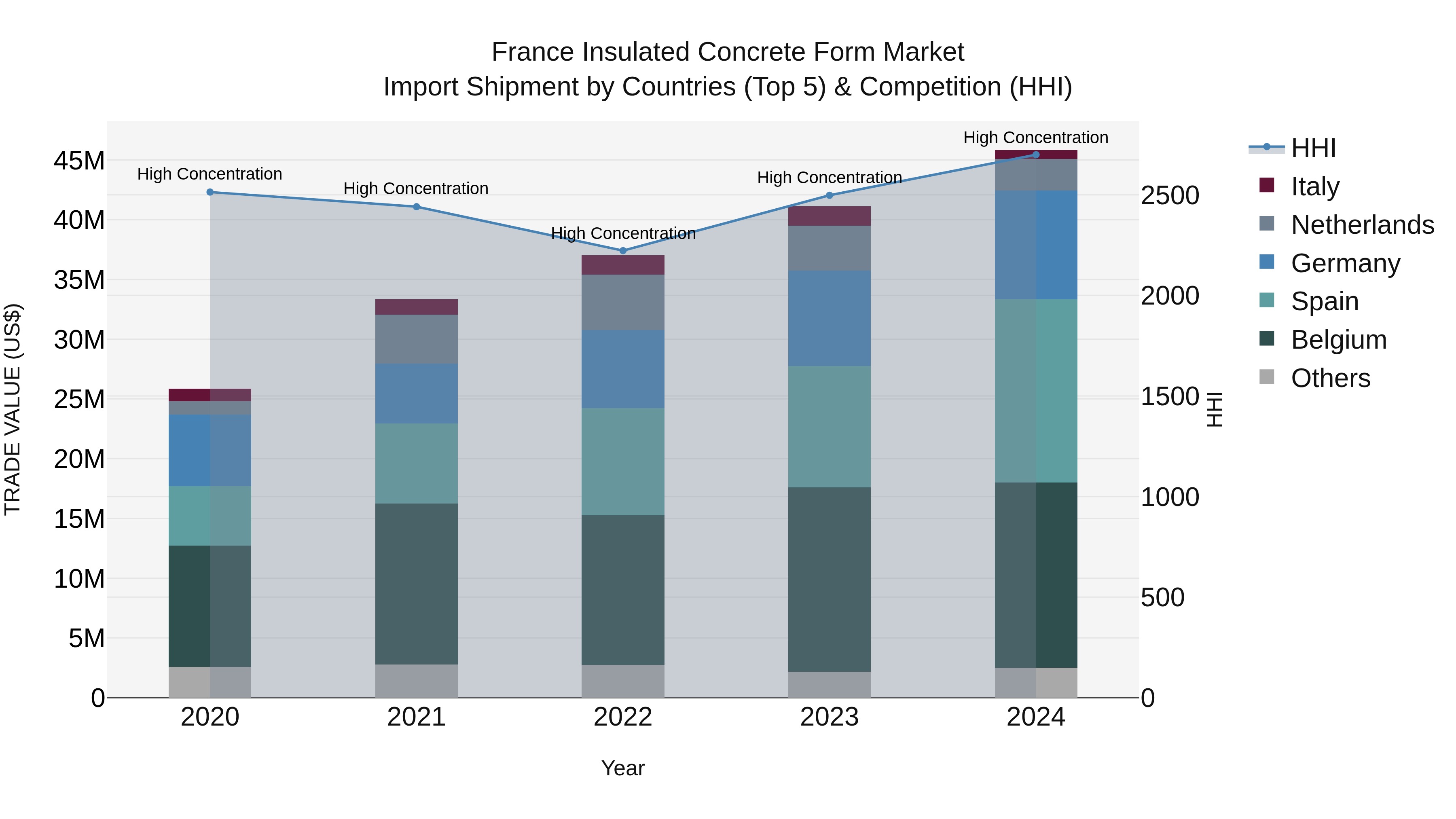
France`s insulated concrete form import market in 2024 continued to see significant concentration, with top exporting countries being Belgium, Spain, Germany, Netherlands, and Luxembourg. The high Herfindahl-Hirschman Index (HHI) indicates a consolidated market. The compound annual growth rate (CAGR) from 2020 to 2024 stood at an impressive 15.37%, with a notable growth rate of 11.38% from 2023 to 2024. This data suggests a strong and growing demand for insulated concrete forms in France, with key players from neighboring countries dominating the market.
France Insulated Concrete Form Market Overview
The France insulated concrete form (ICF) market is experiencing steady growth due to the increasing focus on energy-efficient and sustainable construction practices in the country. ICFs offer superior thermal performance, durability, and sound insulation compared to traditional construction methods, making them attractive to both residential and commercial builders. The market is driven by government initiatives promoting green building technologies and a growing awareness among consumers about the benefits of energy-efficient homes. Key players in the France ICF market include Nudura Corporation, Quad-Lock Building Systems, and Beco Products. The market is expected to continue expanding as more construction projects prioritize energy efficiency and environmental sustainability, creating opportunities for innovative ICF solutions and technologies.
France Insulated Concrete Form Market Trends
The insulated concrete form (ICF) market in France is experiencing a growing trend towards sustainable construction practices and energy-efficient buildings. Builders and developers are increasingly adopting ICFs due to their superior insulation properties, which can help reduce energy consumption and lower heating and cooling costs. Additionally, the demand for eco-friendly construction materials is driving the popularity of ICFs, as they are made from recycled materials and promote a more sustainable building process. The French government`s emphasis on reducing carbon emissions and promoting green building practices is also contributing to the growth of the ICF market in the country. Overall, the trend towards energy efficiency and sustainability is expected to continue driving the adoption of insulated concrete forms in France`s construction industry.
France Insulated Concrete Form Market Challenges
In the France insulated concrete form market, some challenges include limited awareness and acceptance of this construction method among builders and contractors, as well as higher initial costs compared to traditional building materials. Additionally, there may be regulatory hurdles or building code restrictions that need to be addressed to promote the widespread adoption of insulated concrete forms. Concerns about the long-term durability and performance of these structures in the French climate may also be a factor hindering their popularity. Educating stakeholders about the benefits of insulated concrete forms in terms of energy efficiency, sustainability, and resilience could help overcome these challenges and drive market growth in France.
France Insulated Concrete Form Market Investment Opportunities
The France insulated concrete form (ICF) market presents promising investment opportunities due to the increasing focus on sustainable construction practices and energy efficiency in the country. ICFs offer superior insulation properties, durability, and reduced environmental impact compared to traditional building materials, making them a preferred choice for residential and commercial construction projects. Investors can capitalize on the growing demand for energy-efficient buildings in France by investing in manufacturers and suppliers of ICFs, as well as companies offering ICF installation services. Additionally, there is potential for innovation and product development within the ICF market to cater to evolving building regulations and consumer preferences for eco-friendly construction solutions. Overall, the France ICF market offers a lucrative investment landscape driven by sustainability trends and the need for energy-efficient building solutions.
France Insulated Concrete Form Market Government Policy
In France, government policies related to the insulated concrete form market focus on promoting energy efficiency and sustainability in construction. The government has implemented various regulations and incentives to encourage the use of insulated concrete forms (ICFs) in building projects. These policies aim to reduce carbon emissions, increase energy savings, and improve the overall environmental performance of buildings. Additionally, there are financial incentives and grants available for builders and developers who incorporate ICFs into their projects. The government also provides support for research and development in the ICF industry to further enhance the technology and promote its widespread adoption in the construction sector. Overall, the French government is actively supporting the growth of the insulated concrete form market as part of its efforts to promote green building practices and combat climate change.
France Insulated Concrete Form Market Future Outlook
The France insulated concrete form (ICF) market is expected to witness steady growth in the coming years due to increasing demand for energy-efficient and sustainable construction solutions. ICFs offer superior thermal insulation properties, durability, and soundproofing benefits compared to traditional building materials, making them a popular choice for residential and commercial construction projects. Additionally, government initiatives promoting green building practices and stringent regulations aimed at reducing carbon emissions are likely to drive the adoption of ICFs in the construction sector. With ongoing technological advancements and innovation in ICF manufacturing processes, the market is poised for expansion, offering opportunities for key players to capitalize on the growing trend towards eco-friendly and energy-efficient buildings in France.
Key Highlights of the Report:
- France Insulated Concrete Form Market Outlook
- Market Size of France Insulated Concrete Form Market,2024
- Forecast of France Insulated Concrete Form Market, 2031
- Historical Data and Forecast of France Insulated Concrete Form Revenues & Volume for the Period 2021-2031
- France Insulated Concrete Form Market Trend Evolution
- France Insulated Concrete Form Market Drivers and Challenges
- France Insulated Concrete Form Price Trends
- France Insulated Concrete Form Porter's Five Forces
- France Insulated Concrete Form Industry Life Cycle
- Historical Data and Forecast of France Insulated Concrete Form Market Revenues & Volume By Concrete Shape for the Period 2021-2031
- Historical Data and Forecast of France Insulated Concrete Form Market Revenues & Volume By Flat wall system for the Period 2021-2031
- Historical Data and Forecast of France Insulated Concrete Form Market Revenues & Volume By Screen grid system for the Period 2021-2031
- Historical Data and Forecast of France Insulated Concrete Form Market Revenues & Volume By Waffle grid system for the Period 2021-2031
- Historical Data and Forecast of France Insulated Concrete Form Market Revenues & Volume By Post & Lintel system for the Period 2021-2031
- Historical Data and Forecast of France Insulated Concrete Form Market Revenues & Volume By Material for the Period 2021-2031
- Historical Data and Forecast of France Insulated Concrete Form Market Revenues & Volume By Polystyrene foam for the Period 2021-2031
- Historical Data and Forecast of France Insulated Concrete Form Market Revenues & Volume By Polyurethane foam for the Period 2021-2031
- Historical Data and Forecast of France Insulated Concrete Form Market Revenues & Volume By Post & Lintel system for the Period 2021-2031
- Historical Data and Forecast of France Insulated Concrete Form Market Revenues & Volume By Cement-bonded polystyrene beads for the Period 2021-2031
- Historical Data and Forecast of France Insulated Concrete Form Market Revenues & Volume By Application for the Period 2021-2031
- Historical Data and Forecast of France Insulated Concrete Form Market Revenues & Volume By Residential for the Period 2021-2031
- Historical Data and Forecast of France Insulated Concrete Form Market Revenues & Volume By Commercial for the Period 2021-2031
- Historical Data and Forecast of France Insulated Concrete Form Market Revenues & Volume By Industrial for the Period 2021-2031
- France Insulated Concrete Form Import Export Trade Statistics
- Market Opportunity Assessment By Concrete Shape
- Market Opportunity Assessment By Material
- Market Opportunity Assessment By Application
- France Insulated Concrete Form Top Companies Market Share
- France Insulated Concrete Form Competitive Benchmarking By Technical and Operational Parameters
- France Insulated Concrete Form Company Profiles
- France Insulated Concrete Form Key Strategic Recommendations






































