France LTE IoT Market Size & Growth Rate (2026-2032)
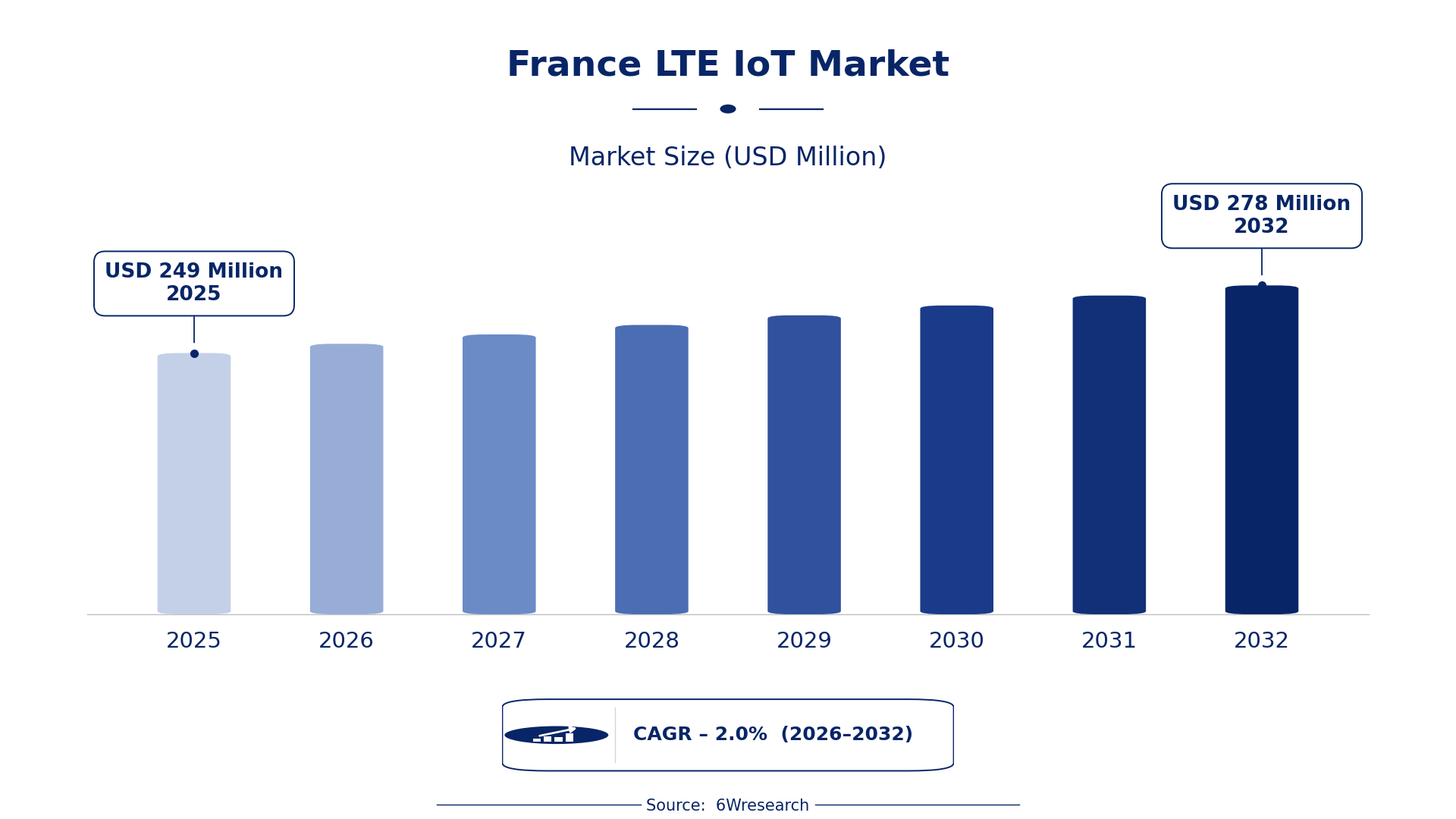
The France LTE IoT Market was estimated at USD 249 Million in 2025 and is projected to reach USD 278 Million by 2032, growing at a CAGR of 2.0% from 2026 to 2032.
France LTE IoT Market Synopsis
The primary force propelling the France LTE IoT market is the increasing adoption of IoT devices across diverse industries. Sectors such as agriculture, manufacturing, and healthcare are harnessing the power of LTE technologies to enhance connectivity and efficiency.
Telecom operators like Orange and SFR are driving advancements in network infrastructure with LTE-M and NB-IoT deployments. This development significantly broadens the scope of IoT applications, including smart metering and asset tracking, positioning LTE IoT as a cornerstone for digital transformation across various sectors.
France LTE IoT Market Year-wise Growth Rate and Key Drivers
This graph illustrates the annual growth rates of the France LTE IoT Market from 2021 to 2032, highlighting a steady upward trajectory and projected expansion over the forecast period.
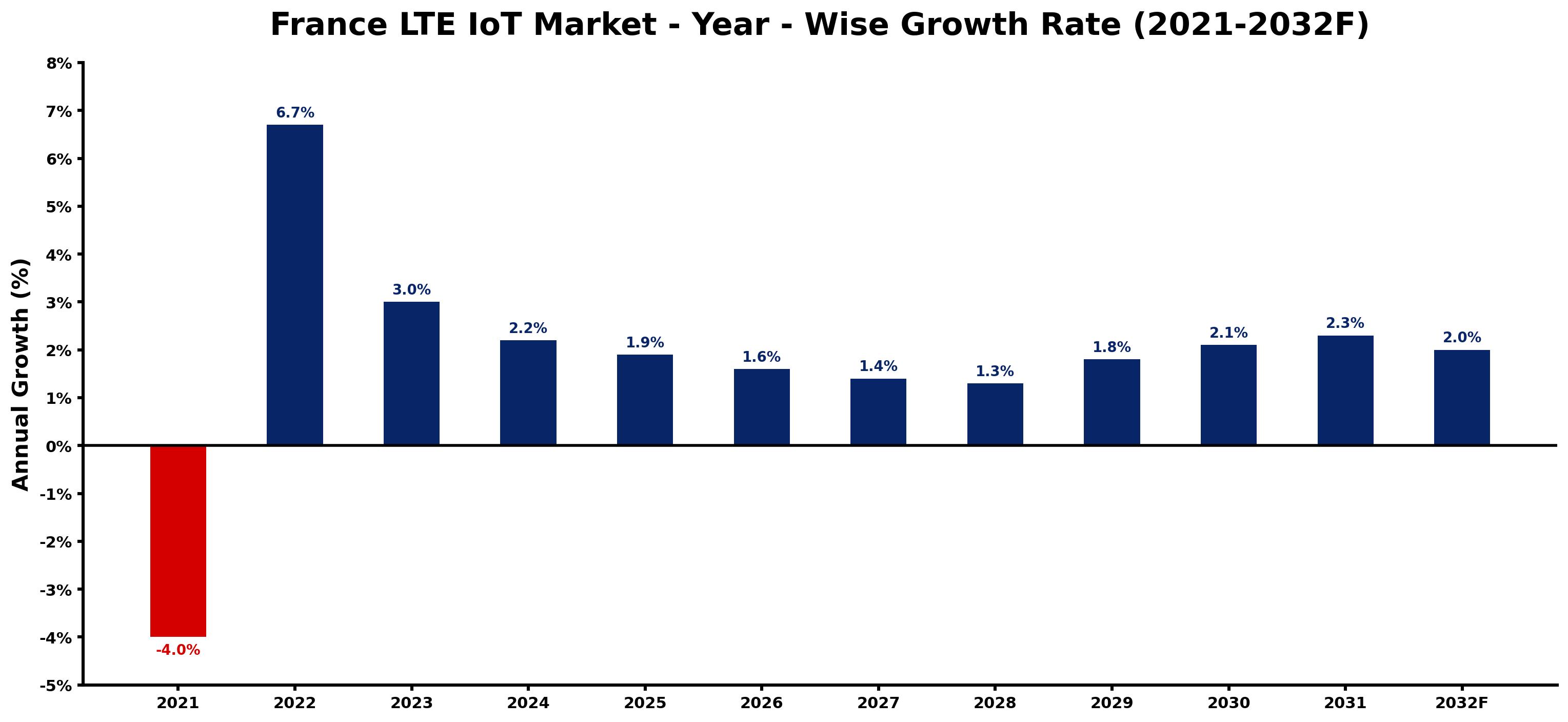
The table below presents the year‑wise growth rates along with the key drivers influencing the market
| Year | Growth Rate | Major Drivers |
| 2021 | -4.0% | France's ANFR delayed spectrum allocation for LTE IoT. |
| 2022 | 6.7% | Implementation of France's national IoT strategy initiative. |
| 2023 | 3.0% | Growing government funding for smart city IoT applications. |
| 2024 | 2.2% | Increased demand for connected devices in transportation sector. |
| 2025 | 1.9% | Adoption of advanced metering infrastructure for energy efficiency. |
| 2026 | 1.6% | Rising public awareness of connected health solutions. |
| 2027 | 1.4% | Expanding use of IoT in logistics and supply chain. |
| 2028 | 1.3% | Focus on enhancing smart home technology adoption rates. |
| 2029 | 1.8% | Development of new regulations supporting automotive IoT technologies. |
| 2030 | 2.1% | Growing interest in agriculture IoT due to climate policies. |
| 2031 | 2.3% | Increased collaboration between telecom operators and startups. |
| 2032 | 2.0% | Emphasis on security enhancements for IoT device connectivity. |
Note: Market size estimations and growth projections presented in this report are based on 6Wresearch's proprietary forecasting methodology, utilizing the latest available industry data, government publications, and primary research inputs.
France LTE IoT Market Key Takeaways
Below are some of the specific key takeaways from the market, including:
- The France LTE IoT market is supported by growing investments in telecom infrastructure and emerging technologies.
- Key industries driving growth include agriculture, healthcare, and smart cities, all seeking efficient IoT solutions.
- The integration of LTE-M and NB-IoT technologies fosters innovative applications, particularly in low-power scenarios.
- Government initiatives are creating a favorable regulatory environment, enhancing market growth prospects.
- The market is expected to witness an upsurge in demand as businesses seek real-time data analytics to drive decision-making.
Evaluation of Restraints in France LTE IoT Market
Despite the optimism surrounding the France LTE IoT market, several limitations are impacting its growth trajectory. Chief among these is the demand for a robust network infrastructure capable of supporting an increasing number of connected devices. Reliable connectivity and low latency are non-negotiable for many IoT applications, yet many areas continue to face challenges related to coverage.
Additionally, data privacy and security concerns persist, placing pressure on companies to implement stringent protective measures. The fragmented nature of the IoT ecosystem complicates the integration and interoperability of systems, which can hinder seamless implementation across different platforms. Addressing these issues is crucial for ensuring the successful adoption of LTE IoT technologies in France.
France LTE IoT Market Trends
Several trends are shaping the France LTE IoT market as companies adapt to the evolving technological environment. A notable trend is the ongoing expansion of 5G networks, which promise faster and more reliable connectivity for IoT devices, enhancing their functional capabilities.
Industries are increasingly recognizing the importance of IoT solutions in boosting operational efficiency and cutting costs. There's also a marked interest in developing new applications tailored for specific sectors, allowing for the extension of IoT functionalities in manufacturing, healthcare, and transportation.
France LTE IoT Market Opportunities
The landscape of investment opportunities in the France LTE IoT market is rich and varied. Key sectors ripe for growth include smart cities, industrial automation, and healthcare. Investors can explore avenues in developing low-power IoT devices, connectivity services, and innovative software solutions designed for real-time analytics and management.
There is significant potential in forming strategic partnerships with telecommunications firms and technology providers, which could unlock further avenues for innovation and market penetration. As demand for IoT devices continues to grow, businesses that strategically position themselves within this ecosystem stand to gain considerable advantages.
Government Initiatives in the France LTE IoT Market
Government policy in France plays a crucial role in shaping the LTE IoT market. Through targeted initiatives, the government is enhancing digital infrastructure and fostering innovation to support IoT growth. This supportive regulatory landscape not only attracts investment but also boosts consumer confidence in IoT solutions.
- A recently completed National Broadband Plan aimed at improving high-speed internet access across rural areas has enhanced connectivity for IoT applications.
- Currently ongoing is the France THD project, focused on expanding fiber network capabilities to bolster IoT infrastructure.
- A planned initiative for 2028 seeks to establish a national framework for IoT security, addressing data privacy concerns.
- The French Tech Initiative is facilitating R&D in IoT technologies, promoting collaboration between startups and established enterprises.
- Regulatory updates surrounding the General Data Protection Regulation (GDPR) have been aimed at ensuring the secure management of IoT data.
Future Insights of the France LTE IoT Market
Looking ahead, the future of the France LTE IoT market appears positive, with growth driven by an increasing embrace of IoT technologies across multiple sectors. As the rollout of 5G technology continues, enhanced connectivity, higher speeds, and increased capacity are set to emerge, further propelling market expansion.
Additionally, the push for digital transformation and the establishment of smart infrastructure will likely catalyze the adoption of LTE IoT solutions. The market stands at a crossroads where innovation and investment will converge to redefine operational capabilities in France’s leading industries.
France LTE IoT Market Latest Developments
In the last year, the France LTE IoT market has seen a wave of activity as companies intensify their focus on enhancing IoT capabilities. This growing momentum signals a shift towards more sophisticated applications and the integration of cutting-edge technologies.
- A major regional operator launched an initiative in early 2025 to expand its LTE-M network, enhancing coverage in remote areas.
- In mid-2025, a technology vendor began deploying new IoT sensors designed specifically for agricultural applications, improving data collection accuracy.
- An upcoming project set to commence in Q3 2026 aims to integrate LTE IoT solutions in urban transportation systems to optimize traffic management.
- A partnership formed in late 2025 between several industry players is focused on developing a cloud-based IoT management platform for healthcare providers.
- A completed infrastructure upgrade earlier this year has significantly boosted network capacity, enabling more devices to connect simultaneously.
France LTE IoT Market - Key Attractiveness of the Report
- 10 Years of Market Numbers
- Historical Data Starting from 2022 to 2025
- Base Year: 2025
- Forecast Data until 2032
- Key Performance Indicators Impacting the Market
- Major Upcoming Developments and Projects
Key Highlights of the Report:
- France LTE IoT Market Outlook
- Market Size of France LTE IoT Market, 2025
- Forecast of France LTE IoT Market, 2032
- Historical Data and Forecast of France LTE IoT Revenues & Volume for the Period 2022-2032F
- France LTE IoT Market Trend Evolution
- France LTE IoT Market Drivers and Challenges
- France LTE IoT Price Trends
- France LTE IoT Porter's Five Forces
- France LTE IoT Industry Life Cycle
- Historical Data and Forecast of France LTE IoT Market Revenues & Volume By Technology for the Period 2022-2032F
- Historical Data and Forecast of France LTE IoT Market Revenues & Volume By NB-IoT for the Period 2022-2032F
- Historical Data and Forecast of France LTE IoT Market Revenues & Volume By LTE-M for the Period 2022-2032F
- Historical Data and Forecast of France LTE IoT Market Revenues & Volume By Service for the Period 2022-2032F
- Historical Data and Forecast of France LTE IoT Market Revenues & Volume By Professional Services for the Period 2022-2032F
- Historical Data and Forecast of France LTE IoT Market Revenues & Volume By Managed Services for the Period 2022-2032F
- Historical Data and Forecast of France LTE IoT Market Revenues & Volume By Industry for the Period 2022-2032F
- Historical Data and Forecast of France LTE IoT Market Revenues & Volume By Manufacturing for the Period 2022-2032F
- Historical Data and Forecast of France LTE IoT Market Revenues & Volume By Energy and utilities for the Period 2022-2032F
- Historical Data and Forecast of France LTE IoT Market Revenues & Volume By Transportation and logistics for the Period 2022-2032F
- Historical Data and Forecast of France LTE IoT Market Revenues & Volume By Healthcare for the Period 2022-2032F
- Historical Data and Forecast of France LTE IoT Market Revenues & Volume By Agriculture for the Period 2022-2032F
- France LTE IoT Import Export Trade Statistics
- Market Opportunity Assessment By Technology
- Market Opportunity Assessment By Service
- Market Opportunity Assessment By Industry
- France LTE IoT Top Companies Market Share
- France LTE IoT Competitive Benchmarking By Technical and Operational Parameters
- France LTE IoT Company Profiles
- France LTE IoT Key Strategic Recommendations






































