Qatar LTE IoT Market Size & Growth Rate (2026-2032)
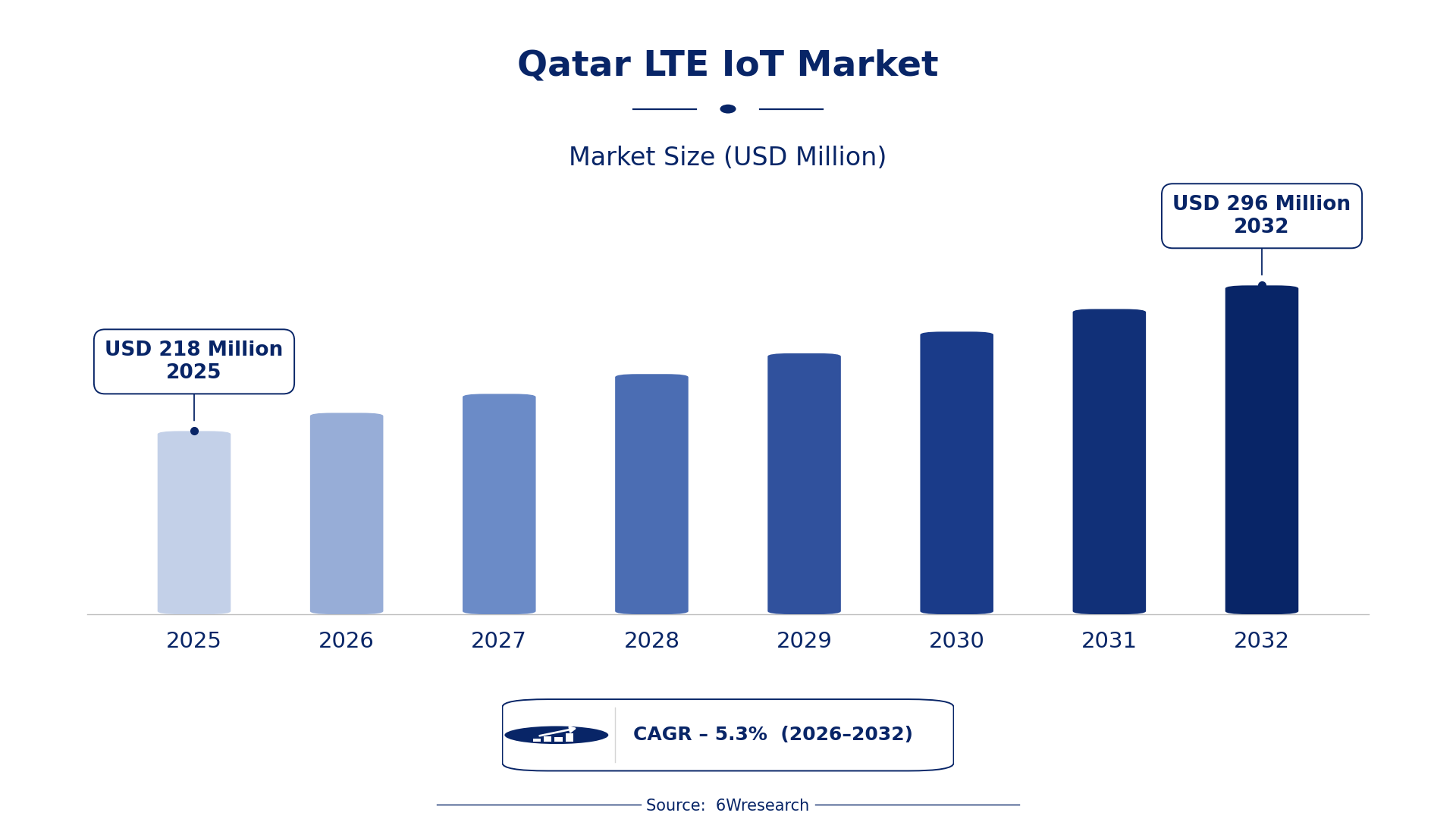
The Qatar LTE IoT Market was estimated at USD 218 Million in 2025 and is projected to reach USD 296 Million by 2032, growing at a CAGR of 5.3% from 2026 to 2032.
Qatar LTE IoT Market Synopsis
In recent years, the Qatar LTE IoT Market has experienced robust growth due to the increasing integration of IoT devices across various sectors. The rise of smart technologies has paved the way for enhanced connectivity and communication, providing ample opportunities for innovation and efficiency.
Looking ahead, the market is set for continued expansion, driven by governmental initiatives aimed at enhancing infrastructure and promoting smart city developments. As more industries recognize the potential of LTE IoT solutions, demand for secure and efficient connectivity is expected to increase significantly.
Qatar LTE IoT Market Year-wise Growth Rate and Key Drivers
This graph illustrates the annual growth rates of the Qatar LTE IoT Market from 2021 to 2032, highlighting a steady upward trajectory and projected expansion over the forecast period.
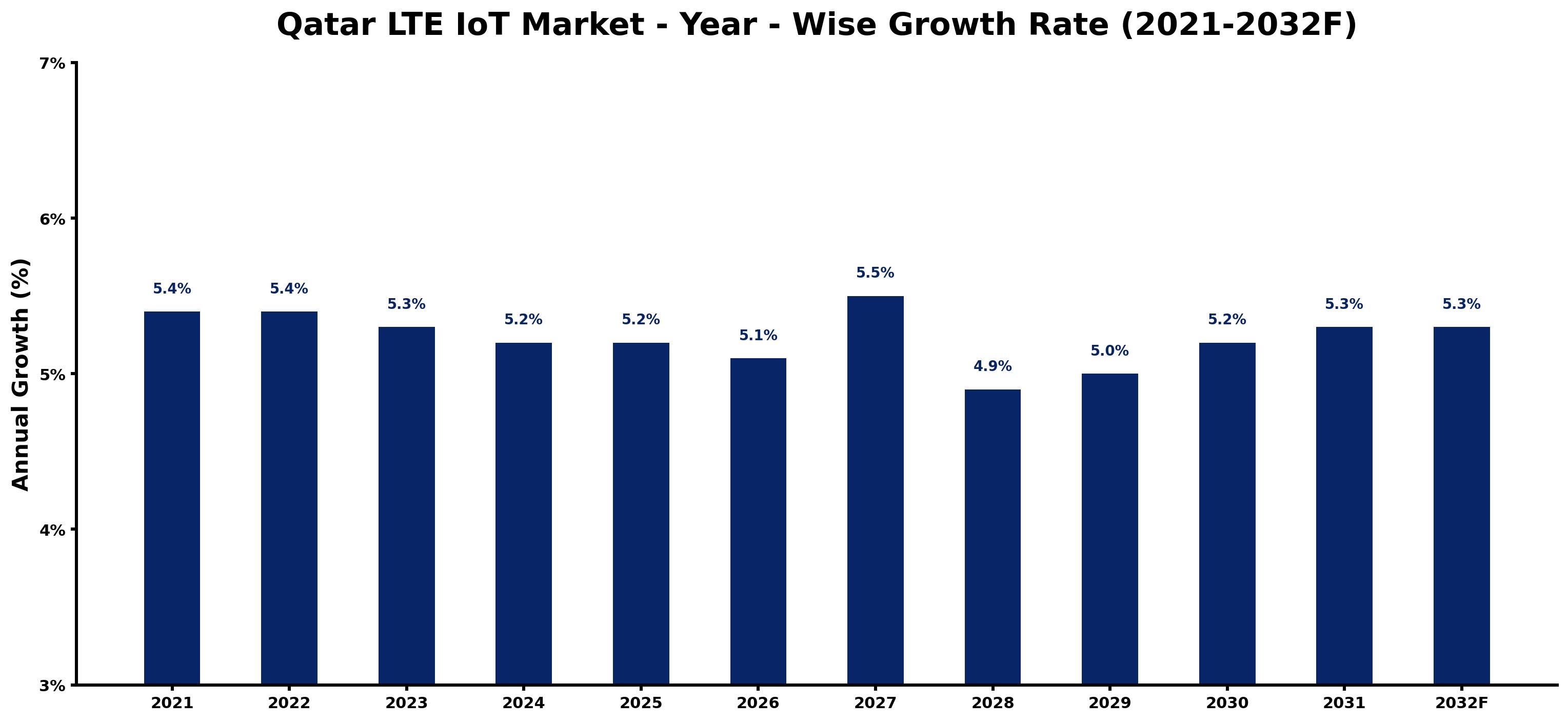
The table below presents the year‑wise growth rates along with the key drivers influencing the market
| Year | Growth Rate | Major Drivers |
| 2021 | 5.4% | Qatar National Vision 2030 promoting smart technologies |
| 2022 | 5.4% | Increased investment in smart city initiatives by government |
| 2023 | 5.3% | Demand for connected devices in healthcare sector rises |
| 2024 | 5.2% | Regulatory support for IoT applications from TRA |
| 2025 | 5.2% | Growing adoption of smart metering systems across industries |
| 2026 | 5.1% | Enhancements in network infrastructure by Ooredoo and Vodafone |
| 2027 | 5.5% | Qatar hosting major international events increasing IoT usage |
| 2028 | 4.9% | Public-private partnerships boosting IoT innovation projects |
| 2029 | 5.0% | Rise in startup ecosystem focused on IoT solutions |
| 2030 | 5.2% | Government initiatives for enhanced cloud services deployment |
| 2031 | 5.3% | Focus on digital twin technologies in urban planning |
| 2032 | 5.3% | Strategic investments in cybersecurity for IoT systems |
Note: Market size estimations and growth projections presented in this report are based on 6Wresearch's proprietary forecasting methodology, utilizing the latest available industry data, government publications, and primary research inputs.
Qatar LTE IoT Market Key Takeaways
Below are some of the specific key takeaways from the market, including:
- The adoption of LTE-M and NB-IoT technologies is transforming how industries deploy IoT solutions.
- Growing investments in smart cities are driving the demand for advanced connectivity options.
- Increased emphasis on secure IoT communications is becoming a critical factor for businesses.
- Qatar’s regulatory framework supports innovation in digital infrastructure, benefiting LTE IoT advancements.
- Healthcare, logistics, and agriculture sectors are becoming major adopters of LTE IoT technologies.
Evaluation of Restraints in Qatar LTE IoT Market
The Qatar LTE IoT Market faces several constraints, primarily stemming from the diverse needs of various applications. Network operators grapple with delivering scalable solutions that can cater to a wide range of IoT devices requiring different bandwidth and coverage levels. Furthermore, addressing security issues, such as data protection and device authentication, remains paramount. Without resolving these challenges, the growth potential of the market could be undermined.
Qatar LTE IoT Market Trends
Several trends are currently influencing the Qatar LTE IoT Market. A significant shift toward low-power wide-area networks is being observed, as more industries seek energy-efficient communication solutions. The integration of artificial intelligence in IoT applications is also on the rise, enhancing analytics and decision-making capabilities. Additionally, increased collaboration between technology providers and telecom operators is fueling innovation, making LTE IoT solutions more accessible.
Qatar LTE IoT Market Opportunities
There are promising growth avenues within the Qatar LTE IoT Market. The push for smart city projects presents extensive opportunities for IoT applications, particularly in sectors like urban mobility and public safety. Further, advancements in agricultural IoT solutions are gaining traction, as farmers adopt technologies for precision farming. The healthcare industry also presents avenues for growth, with telemedicine and remote monitoring becoming increasingly vital.
Government Initiatives in the Qatar LTE IoT Market
The Qatari government plays a crucial role in shaping the LTE IoT Market through various initiatives aimed at digital transformation. With a focus on smart city development and technology-driven infrastructure, the government is creating an environment conducive to IoT growth. Their commitment to regulatory clarity and public-private partnerships fosters trust and innovation across sectors.
- A national digital infrastructure upgrade programme launched in 2023 enhances connectivity nationwide.
- The Smart Qatar Programme, currently underway, aims to integrate IoT solutions into urban management systems.
- Plans for a regulatory framework expected to establish industry standards for IoT security by 2026 are underway.
- Investment in public-private partnerships to support IoT innovation in agriculture was recently completed in 2023.
- An initiative for enhancing mobile broadband access in rural areas is planned for implementation by 2027.
Future Insights of the Qatar LTE IoT Market
Looking toward 2026-2032, the Qatar LTE IoT Market is expected to evolve significantly. The continuous advancement of IoT technologies will drive new applications and enhance existing solutions. With a stable regulatory environment and increased investments in infrastructure, the market is positioned for steady growth. The demand for secure and efficient connectivity solutions will undoubtedly remain a priority as various industries further embrace digital transformation.
Qatar LTE IoT Market Latest Developments
In the past year, the Qatar LTE IoT Market has witnessed a surge in activity, reflecting a strong commitment to innovation and digital advancement. Key developments highlight the ongoing shift toward smarter solutions across various sectors. As operators enhance their networks and collaborate with technology firms, the market is evolving rapidly to meet growing demands.
- A major telecom operator began deploying advanced LTE IoT infrastructure in Q1 2023 to support smart city applications.
- A partnership between a leading technology firm and a regional operator is currently underway to enhance IoT security measures.
- An ongoing pilot program for agricultural IoT solutions, launched in mid-2023, is being evaluated for scalability.
- Plans for a new urban mobility project utilizing IoT connectivity are expected to roll out in late 2025.
- A service upgrade enhancing the performance of NB-IoT solutions was completed in early 2023.
Qatar LTE IoT Market - Key Attractiveness of the Report
- 10 Years of Market Numbers
- Historical Data Starting from 2022 to 2025
- Base Year: 2025
- Forecast Data until 2032
- Key Performance Indicators Impacting the Market
- Major Upcoming Developments and Projects
Key Highlights of the Report:
- Qatar LTE IoT Market Outlook
- Market Size of Qatar LTE IoT Market, 2025
- Forecast of Qatar LTE IoT Market, 2032
- Historical Data and Forecast of Qatar LTE IoT Revenues & Volume for the Period 2022-2032F
- Qatar LTE IoT Market Trend Evolution
- Qatar LTE IoT Market Drivers and Challenges
- Qatar LTE IoT Price Trends
- Qatar LTE IoT Porter's Five Forces
- Qatar LTE IoT Industry Life Cycle
- Historical Data and Forecast of Qatar LTE IoT Market Revenues & Volume By Technology for the Period 2022-2032F
- Historical Data and Forecast of Qatar LTE IoT Market Revenues & Volume By NB-IoT for the Period 2022-2032F
- Historical Data and Forecast of Qatar LTE IoT Market Revenues & Volume By LTE-M for the Period 2022-2032F
- Historical Data and Forecast of Qatar LTE IoT Market Revenues & Volume By Service for the Period 2022-2032F
- Historical Data and Forecast of Qatar LTE IoT Market Revenues & Volume By Professional Services for the Period 2022-2032F
- Historical Data and Forecast of Qatar LTE IoT Market Revenues & Volume By Managed Services for the Period 2022-2032F
- Historical Data and Forecast of Qatar LTE IoT Market Revenues & Volume By Industry for the Period 2022-2032F
- Historical Data and Forecast of Qatar LTE IoT Market Revenues & Volume By Manufacturing for the Period 2022-2032F
- Historical Data and Forecast of Qatar LTE IoT Market Revenues & Volume By Energy and utilities for the Period 2022-2032F
- Historical Data and Forecast of Qatar LTE IoT Market Revenues & Volume By Transportation and logistics for the Period 2022-2032F
- Historical Data and Forecast of Qatar LTE IoT Market Revenues & Volume By Healthcare for the Period 2022-2032F
- Historical Data and Forecast of Qatar LTE IoT Market Revenues & Volume By Agriculture for the Period 2022-2032F
- Qatar LTE IoT Import Export Trade Statistics
- Market Opportunity Assessment By Technology
- Market Opportunity Assessment By Service
- Market Opportunity Assessment By Industry
- Qatar LTE IoT Top Companies Market Share
- Qatar LTE IoT Competitive Benchmarking By Technical and Operational Parameters
- Qatar LTE IoT Company Profiles
- Qatar LTE IoT Key Strategic Recommendations






































