Saudi Arabia LTE IoT Market Size & Growth Rate (2026-2032)
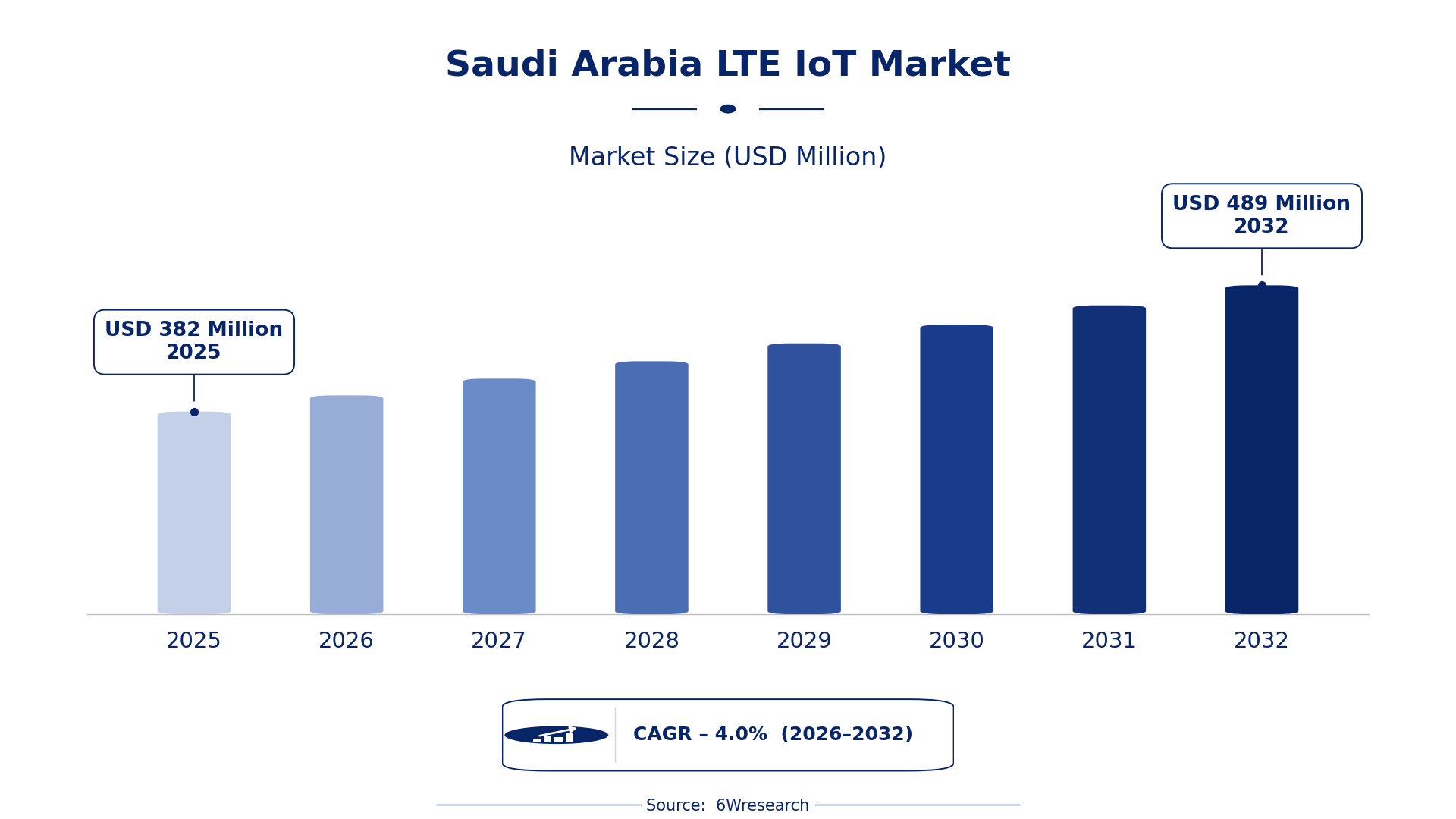
The Saudi Arabia LTE IoT Market was estimated at USD 382 Million in 2025 and is projected to reach USD 489 Million by 2032, growing at a CAGR of 4.0% from 2026 to 2032.
Saudi Arabia LTE IoT Market Synopsis
The LTE IoT market in Saudi Arabia is not just a trend; it represents a vital shift in how industries operate, marked by the increasing integration of IoT devices with LTE technology. From agriculture to smart cities, this market is gaining momentum, enabling a new level of communication efficiency and security.
With government backing and a regulatory environment geared toward innovation, the adoption of LTE IoT solutions is accelerating. Companies in various sectors are leveraging this technology to optimize their operations, reduce costs, and enhance service delivery, which is propelling growth in this dynamic market.
Saudi Arabia LTE IoT Market Year-wise Growth Rate and Key Drivers
This graph illustrates the annual growth rates of the Saudi Arabia LTE IoT Market from 2021 to 2032, highlighting a steady upward trajectory and projected expansion over the forecast period.
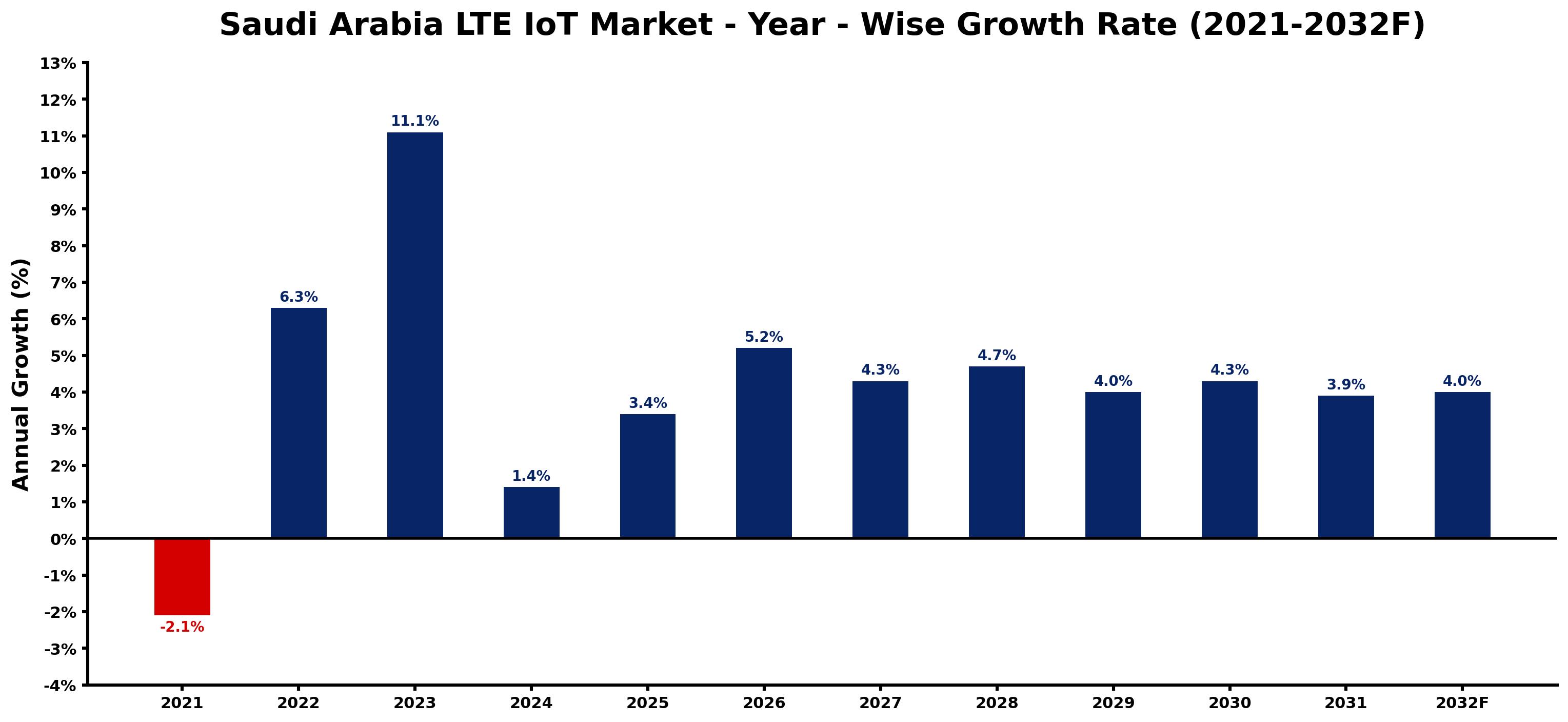
The table below presents the year‑wise growth rates along with the key drivers influencing the market
| Year | Growth Rate | Major Drivers |
| 2021 | -2.1% | STC's delayed 5G rollout affecting LTE IoT adoption. |
| 2022 | 6.3% | Saudi Vision 2030 promoting smart city applications. |
| 2023 | 11.1% | Increase in smart metering solutions for utilities. |
| 2024 | 1.4% | Giga-projects like NEOM driving IoT connectivity demands. |
| 2025 | 3.4% | Adoption of smart agriculture technologies in rural regions. |
| 2026 | 5.2% | Growth in connected health devices amid healthcare reforms. |
| 2027 | 4.3% | National IoT policy enhancing sector collaboration and investment. |
| 2028 | 4.7% | Increased demand for fleet management solutions in logistics. |
| 2029 | 4.0% | Telecommunication advancements supporting industrial automation integration. |
| 2030 | 4.3% | Rise in connected consumer devices boosting retail IoT. |
| 2031 | 3.9% | Local startups innovating in smart home technologies. |
| 2032 | 4.0% | Emerging regulatory frameworks supporting IoT data security. |
Note: Market size estimations and growth projections presented in this report are based on 6Wresearch's proprietary forecasting methodology, utilizing the latest available industry data, government publications, and primary research inputs.
Saudi Arabia LTE IoT Market Key Takeaways
Below are some of the specific key takeaways from the market, including:
- The market is benefiting from the robust growth of IoT applications across multiple sectors.
- Government initiatives are actively promoting the deployment of LTE IoT technologies.
- The emphasis on secure and efficient connectivity is driving innovations in the market.
- Challenges like managing large-scale deployments and ensuring security remain critical concerns.
- Healthcare and logistics sectors are seeing increased reliance on LTE IoT for real-time data exchange.
Evaluation of Restraints in Saudi Arabia LTE IoT Market
Despite the excitement surrounding LTE IoT, several constraints are hindering its potential in Saudi Arabia. First, ensuring power-efficient connectivity for numerous IoT devices is a technical hurdle that remains unsolved. Additionally, managing large-scale deployments across diverse sectors presents logistical challenges. The necessity for robust security protocols to protect sensitive data is paramount, as vulnerabilities could undermine trust in IoT solutions and stifle adoption.
Saudi Arabia LTE IoT Market Trends
The market is witnessing several notable trends that are shaping its trajectory. A shift towards smart city initiatives is driving demand for IoT solutions that improve urban living conditions. In parallel, the agriculture sector is increasingly adopting LTE IoT for precision farming, enhancing crop management through real-time data. The healthcare industry is also prioritizing IoT technologies to enable remote patient monitoring, further contributing to market growth.
Saudi Arabia LTE IoT Market Opportunities
The horizon looks promising for LTE IoT market investments in Saudi Arabia. Opportunities lie in developing tailored solutions for sectors like logistics, where real-time tracking can streamline operations. The agriculture industry presents fertile ground for advancements in smart farming technologies, while industrial automation continues to drive demand for innovative IoT applications. As digital transformation takes hold, businesses are encouraged to explore partnerships that leverage LTE IoT capabilities.
Government Initiatives in the Saudi Arabia LTE IoT Market
The Saudi Arabian government is taking significant steps to foster the LTE IoT market, recognizing its potential to enhance national infrastructure and drive economic growth. With a favorable regulatory environment, public policies are being designed to accelerate the deployment of IoT solutions across various sectors. This commitment to digital transformation underscores the government's ambition to position the Kingdom as a leader in technology innovation.
- A national digital infrastructure upgrade programme recently launched aims to enhance connectivity across urban and rural areas.
- The Ministry of Communications and Information Technology is currently implementing a regulatory framework that encourages investment in IoT technologies.
- A planned public-private initiative is expected to expand telecom infrastructure access by 2028, aimed at supporting LTE IoT deployments.
- A recently completed pilot project for smart city solutions showcased the effectiveness of LTE IoT in urban management.
- Ongoing initiatives are focusing on establishing IoT hubs in major cities to promote collaboration and innovation.
Future Insights of the Saudi Arabia LTE IoT Market
Looking ahead to the period from 2026 to 2032, the Saudi Arabia LTE IoT market is set for substantial evolution. As digital transformation efforts ramp up, more industries are likely to recognize the value of LTE IoT in enhancing operational efficiency. Investments in smart city initiatives and advanced agricultural practices will drive demand, while ongoing government support will provide a solid foundation for growth. The emphasis on security and power-efficient solutions will be pivotal as businesses look to adopt this technology.
Saudi Arabia LTE IoT Market Latest Developments
Recent activity in the Saudi Arabia LTE IoT market indicates a vibrant and rapidly evolving sector. In the past year, companies have increasingly focused on enhancing their IoT capabilities through strategic partnerships and technological innovations. As the market matures, these developments are expected to create new opportunities for stakeholders.
- A major technology vendor announced a collaboration in early 2025 to develop cutting-edge LTE IoT solutions tailored for the healthcare sector.
- In mid-2025, a leading regional operator launched a nationwide initiative aimed at improving LTE coverage in rural areas, supporting IoT applications.
- An ongoing effort started in Q3 2025 seeks to integrate LTE IoT systems with existing smart city technologies.
- A rollout of an upgraded IoT connectivity platform is expected to begin in early 2026, enhancing data transmission capabilities.
- A planned expansion of IoT services for the agricultural sector is slated for implementation in late 2026, focusing on precision farming technologies.
Saudi Arabia LTE IoT Market - Key Attractiveness of the Report
- 10 Years of Market Numbers
- Historical Data Starting from 2022 to 2025
- Base Year: 2025
- Forecast Data until 2032
- Key Performance Indicators Impacting the Market
- Major Upcoming Developments and Projects
Key Highlights of the Report:
- Saudi Arabia LTE IoT Market Outlook
- Market Size of Saudi Arabia LTE IoT Market, 2025
- Forecast of Saudi Arabia LTE IoT Market, 2032
- Historical Data and Forecast of Saudi Arabia LTE IoT Revenues & Volume for the Period 2022-2032F
- Saudi Arabia LTE IoT Market Trend Evolution
- Saudi Arabia LTE IoT Market Drivers and Challenges
- Saudi Arabia LTE IoT Price Trends
- Saudi Arabia LTE IoT Porter's Five Forces
- Saudi Arabia LTE IoT Industry Life Cycle
- Historical Data and Forecast of Saudi Arabia LTE IoT Market Revenues & Volume By Technology for the Period 2022-2032F
- Historical Data and Forecast of Saudi Arabia LTE IoT Market Revenues & Volume By NB-IoT for the Period 2022-2032F
- Historical Data and Forecast of Saudi Arabia LTE IoT Market Revenues & Volume By LTE-M for the Period 2022-2032F
- Historical Data and Forecast of Saudi Arabia LTE IoT Market Revenues & Volume By Service for the Period 2022-2032F
- Historical Data and Forecast of Saudi Arabia LTE IoT Market Revenues & Volume By Professional Services for the Period 2022-2032F
- Historical Data and Forecast of Saudi Arabia LTE IoT Market Revenues & Volume By Managed Services for the Period 2022-2032F
- Historical Data and Forecast of Saudi Arabia LTE IoT Market Revenues & Volume By Industry for the Period 2022-2032F
- Historical Data and Forecast of Saudi Arabia LTE IoT Market Revenues & Volume By Manufacturing for the Period 2022-2032F
- Historical Data and Forecast of Saudi Arabia LTE IoT Market Revenues & Volume By Energy and utilities for the Period 2022-2032F
- Historical Data and Forecast of Saudi Arabia LTE IoT Market Revenues & Volume By Transportation and logistics for the Period 2022-2032F
- Historical Data and Forecast of Saudi Arabia LTE IoT Market Revenues & Volume By Healthcare for the Period 2022-2032F
- Historical Data and Forecast of Saudi Arabia LTE IoT Market Revenues & Volume By Agriculture for the Period 2022-2032F
- Saudi Arabia LTE IoT Import Export Trade Statistics
- Market Opportunity Assessment By Technology
- Market Opportunity Assessment By Service
- Market Opportunity Assessment By Industry
- Saudi Arabia LTE IoT Top Companies Market Share
- Saudi Arabia LTE IoT Competitive Benchmarking By Technical and Operational Parameters
- Saudi Arabia LTE IoT Company Profiles
- Saudi Arabia LTE IoT Key Strategic Recommendations






































