Chile LTE IoT Market Size & Growth Rate (2026-2032)
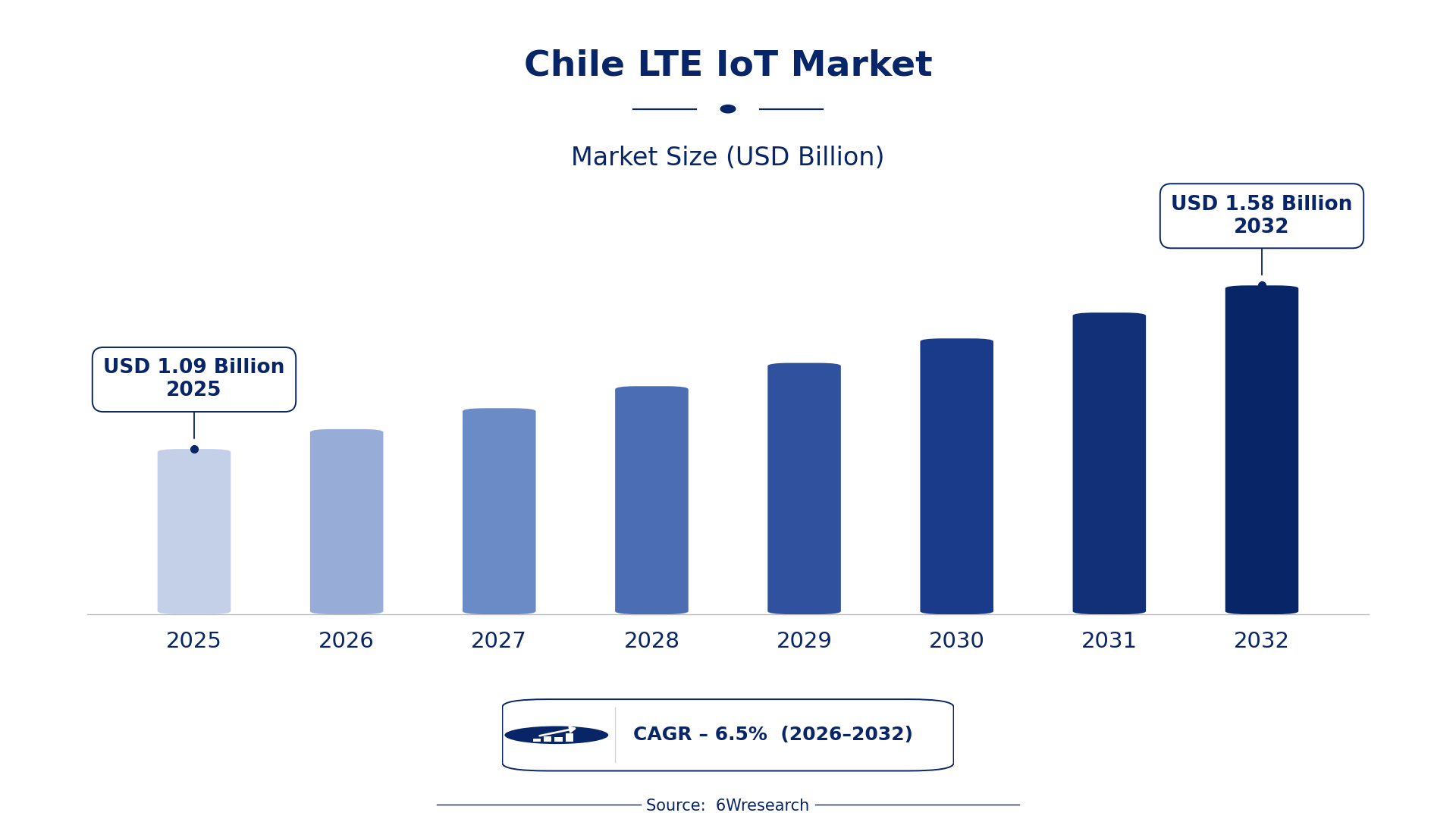
The Chile LTE IoT Market was estimated at USD 1091 Million in 2025 and is projected to reach USD 1577 Million by 2032, growing at a CAGR of 6.5% from 2026 to 2032.
Chile LTE IoT Market Synopsis
The driving force behind the Chile LTE IoT market is the rapid adoption of IoT technologies in vital sectors such as agriculture, manufacturing, and transportation. This trend is complemented by the deployment of advanced LTE networks, which provide the necessary infrastructure for high-speed connectivity and reliable data transmission.
As Chile embraces digital transformation, government initiatives aimed at smart city development and enhanced infrastructure play a crucial role in supporting the expansion of LTE IoT applications. This multifaceted growth is evident in the increasing demand for IoT-enabled solutions that enhance efficiency and productivity across various industries.
Chile LTE IoT Market Year-wise Growth Rate and Key Drivers
This graph illustrates the annual growth rates of the Chile LTE IoT Market from 2021 to 2032, highlighting a steady upward trajectory and projected expansion over the forecast period.
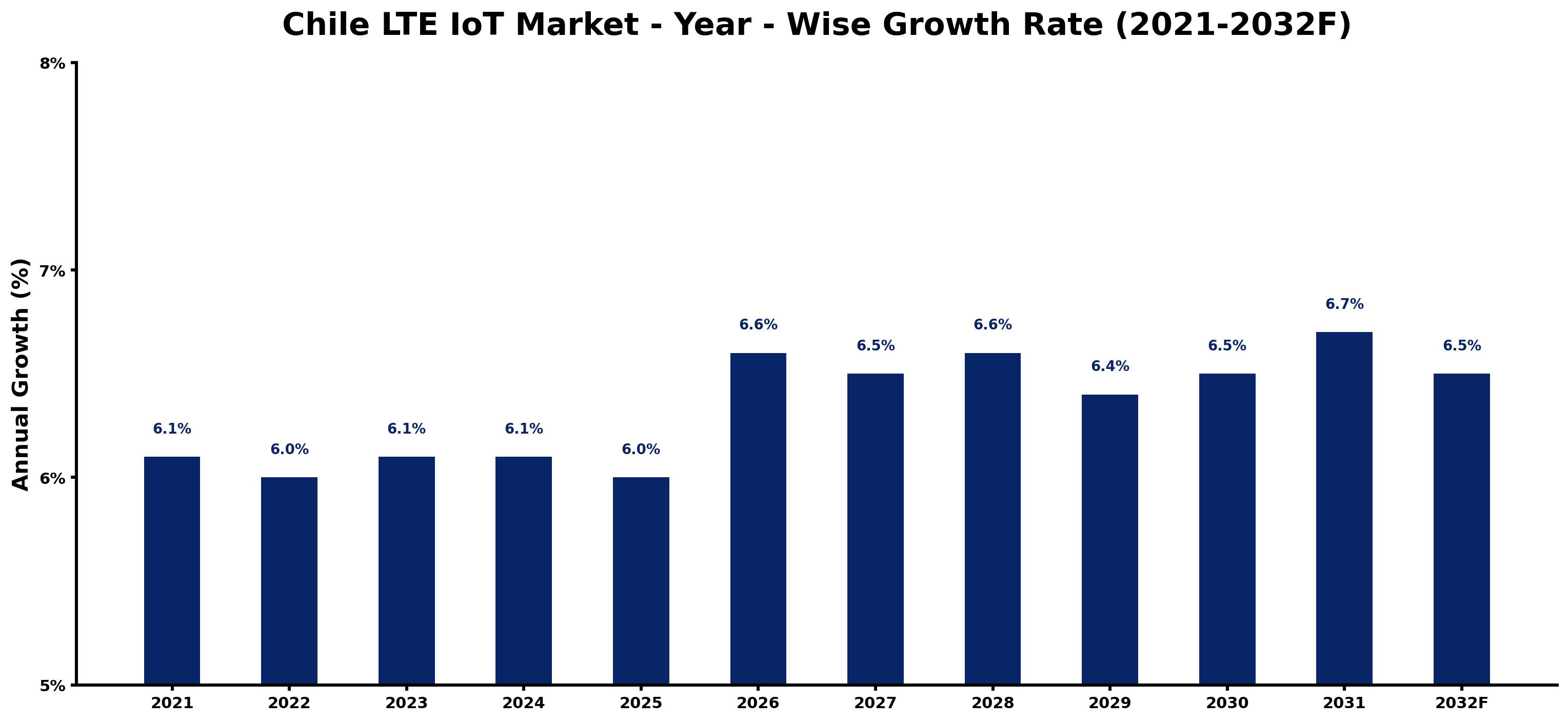
The table below presents the year‑wise growth rates along with the key drivers influencing the market
| Year | Growth Rate | Major Drivers |
| 2021 | 6.1% | Chile's National IoT Strategy promoting digital transformation. |
| 2022 | 6.0% | Increased investment in smart agriculture technologies. |
| 2023 | 6.1% | Growing adoption of smart city initiatives in Santiago. |
| 2024 | 6.1% | Telecommunications infrastructure upgrades by Movistar and Entel. |
| 2025 | 6.0% | Implementation of Chile's Digital Agenda enhancing connectivity. |
| 2026 | 6.6% | Increased focus on sustainability drives IoT innovation. |
| 2027 | 6.5% | Local mining operations adopting IoT for efficiency. |
| 2028 | 6.6% | Emergence of 5G technology enhances IoT capabilities. |
| 2029 | 6.4% | Government subsidies for smart metering initiatives. |
| 2030 | 6.5% | Rise in telemedicine solutions requiring robust connectivity. |
| 2031 | 6.7% | Partnerships between tech firms and local governments for IoT. |
| 2032 | 6.5% | Increased consumer demand for smart home devices. |
Note: Market size estimations and growth projections presented in this report are based on 6Wresearch's proprietary forecasting methodology, utilizing the latest available industry data, government publications, and primary research inputs.
Chile LTE IoT Market Key Takeaways
Below are some of the specific key takeaways from the market, including:
- High-speed LTE connectivity is becoming a backbone for IoT solutions in Chile.
- Government policies are actively promoting IoT infrastructure and digital transformation initiatives.
- Key sectors such as agriculture and transportation are leading in IoT adoption, leveraging LTE technology.
- Investment in IoT devices and services continues to rise, driven by the growing demand for smart applications.
- There is a critical need for regulatory frameworks to address data security and interoperability in IoT.
Evaluation of Restraints in Chile LTE IoT Market
Despite its promising growth trajectory, the Chile LTE IoT market faces certain constraints that hinder its full potential. One significant challenge is the limited network coverage, particularly in rural regions, which restricts access to reliable IoT services. Additionally, the high costs associated with IoT devices and connectivity remain a barrier for widespread adoption.
Data privacy and security concerns are paramount, as the proliferation of IoT devices increases vulnerability to cyber threats. Furthermore, the absence of comprehensive regulations tailored to IoT applications adds complexity for businesses looking to deploy effective solutions. Addressing these challenges is essential for fostering a more conducive environment for LTE IoT technologies.
Chile LTE IoT Market Trends
The LTE IoT market in Chile is characterized by several notable trends. First, there is a marked increase in the adoption of IoT solutions that enhance operational efficiency and data analytics capabilities. Businesses are increasingly recognizing the competitive advantages afforded by connected devices.
A noteworthy trend is the push toward smart agriculture, where IoT applications optimize resource management and improve crop yields. Additionally, advancements in LTE technology are paving the way for more sophisticated IoT applications, fostering innovation across various sectors.
Chile LTE IoT Market Opportunities
Investment opportunities abound in the Chile LTE IoT market, particularly in sectors poised for rapid technological advancement. Agriculture remains a key area for growth, where IoT solutions can significantly boost productivity. Healthcare also offers substantial potential, as digital health solutions gain traction.
The burgeoning demand for smart city solutions creates a fertile ground for investors and developers. Collaborations with local enterprises and participation in government-backed initiatives can further enhance market positioning and sustainability for businesses focusing on LTE IoT technologies.
Government Initiatives in the Chile LTE IoT Market
The Chilean government is actively shaping the LTE IoT market through various strategic initiatives aimed at fostering innovation and infrastructure development. By focusing on enhancing connectivity and addressing regulatory challenges, these policies are crucial for market advancement.
- A National IoT Strategy launched in early 2025 aims to boost innovation across multiple sectors.
- Current initiatives are underway to expand IoT infrastructure in rural areas, targeting improved network coverage by 2026.
- Ongoing funding programs are incentivizing private investment in IoT technology development.
- Regulatory frameworks to safeguard data privacy are being introduced, enhancing consumer confidence.
- Plans are set for a public-private collaboration expected to roll out smart city projects by late 2027.
Future Insights of the Chile LTE IoT Market
Looking ahead to the 2026-2032 period, the Chile LTE IoT market is expected to expand significantly. The increasing integration of IoT devices into various sectors, coupled with advancements in LTE and emerging 5G technologies, will drive new applications and services. Businesses will likely prioritize IoT solutions to enhance efficiency and streamline operations.
Furthermore, government support and investment in infrastructure development will play a critical role in sustaining market growth. As companies continue to embrace digital transformation, the demand for reliable LTE IoT connectivity will increase, solidifying Chile's position as a leader in IoT innovation within the region.
Chile LTE IoT Market Latest Developments
Recent activity in the Chile LTE IoT market has been vibrant, marked by significant developments that indicate a strong upward trajectory. Companies are increasingly focusing on technological advancements and partnerships that enhance service delivery and infrastructure capabilities.
- A major operator launched a new IoT service platform in Q1 2025, improving access to LTE connectivity for various applications.
- A partnership initiated in mid-2025 between technology providers aims to create innovative IoT solutions for agriculture, enhancing crop monitoring efficiency.
- Ongoing upgrades to LTE infrastructure are expected to be completed by late 2026, significantly improving network reliability.
- An upcoming initiative set for early 2027 is planned to establish a regulatory body dedicated to overseeing IoT device security standards.
- A pilot program for smart city applications is expected to kick off in mid-2026, showcasing potential use cases for urban management.
Chile LTE IoT Market - Key Attractiveness of the Report
- 10 Years of Market Numbers
- Historical Data Starting from 2022 to 2025
- Base Year: 2025
- Forecast Data until 2032
- Key Performance Indicators Impacting the Market
- Major Upcoming Developments and Projects
Key Highlights of the Report:
- Chile LTE IoT Market Outlook
- Market Size of Chile LTE IoT Market, 2025
- Forecast of Chile LTE IoT Market, 2032
- Historical Data and Forecast of Chile LTE IoT Revenues & Volume for the Period 2022-2032F
- Chile LTE IoT Market Trend Evolution
- Chile LTE IoT Market Drivers and Challenges
- Chile LTE IoT Price Trends
- Chile LTE IoT Porter's Five Forces
- Chile LTE IoT Industry Life Cycle
- Historical Data and Forecast of Chile LTE IoT Market Revenues & Volume By Technology for the Period 2022-2032F
- Historical Data and Forecast of Chile LTE IoT Market Revenues & Volume By NB-IoT for the Period 2022-2032F
- Historical Data and Forecast of Chile LTE IoT Market Revenues & Volume By LTE-M for the Period 2022-2032F
- Historical Data and Forecast of Chile LTE IoT Market Revenues & Volume By Service for the Period 2022-2032F
- Historical Data and Forecast of Chile LTE IoT Market Revenues & Volume By Professional Services for the Period 2022-2032F
- Historical Data and Forecast of Chile LTE IoT Market Revenues & Volume By Managed Services for the Period 2022-2032F
- Historical Data and Forecast of Chile LTE IoT Market Revenues & Volume By Industry for the Period 2022-2032F
- Historical Data and Forecast of Chile LTE IoT Market Revenues & Volume By Manufacturing for the Period 2022-2032F
- Historical Data and Forecast of Chile LTE IoT Market Revenues & Volume By Energy and utilities for the Period 2022-2032F
- Historical Data and Forecast of Chile LTE IoT Market Revenues & Volume By Transportation and logistics for the Period 2022-2032F
- Historical Data and Forecast of Chile LTE IoT Market Revenues & Volume By Healthcare for the Period 2022-2032F
- Historical Data and Forecast of Chile LTE IoT Market Revenues & Volume By Agriculture for the Period 2022-2032F
- Chile LTE IoT Import Export Trade Statistics
- Market Opportunity Assessment By Technology
- Market Opportunity Assessment By Service
- Market Opportunity Assessment By Industry
- Chile LTE IoT Top Companies Market Share
- Chile LTE IoT Competitive Benchmarking By Technical and Operational Parameters
- Chile LTE IoT Company Profiles
- Chile LTE IoT Key Strategic Recommendations






































