France Modular Kitchen Market Top 5 Importing Countries and Market Competition (HHI) Analysis
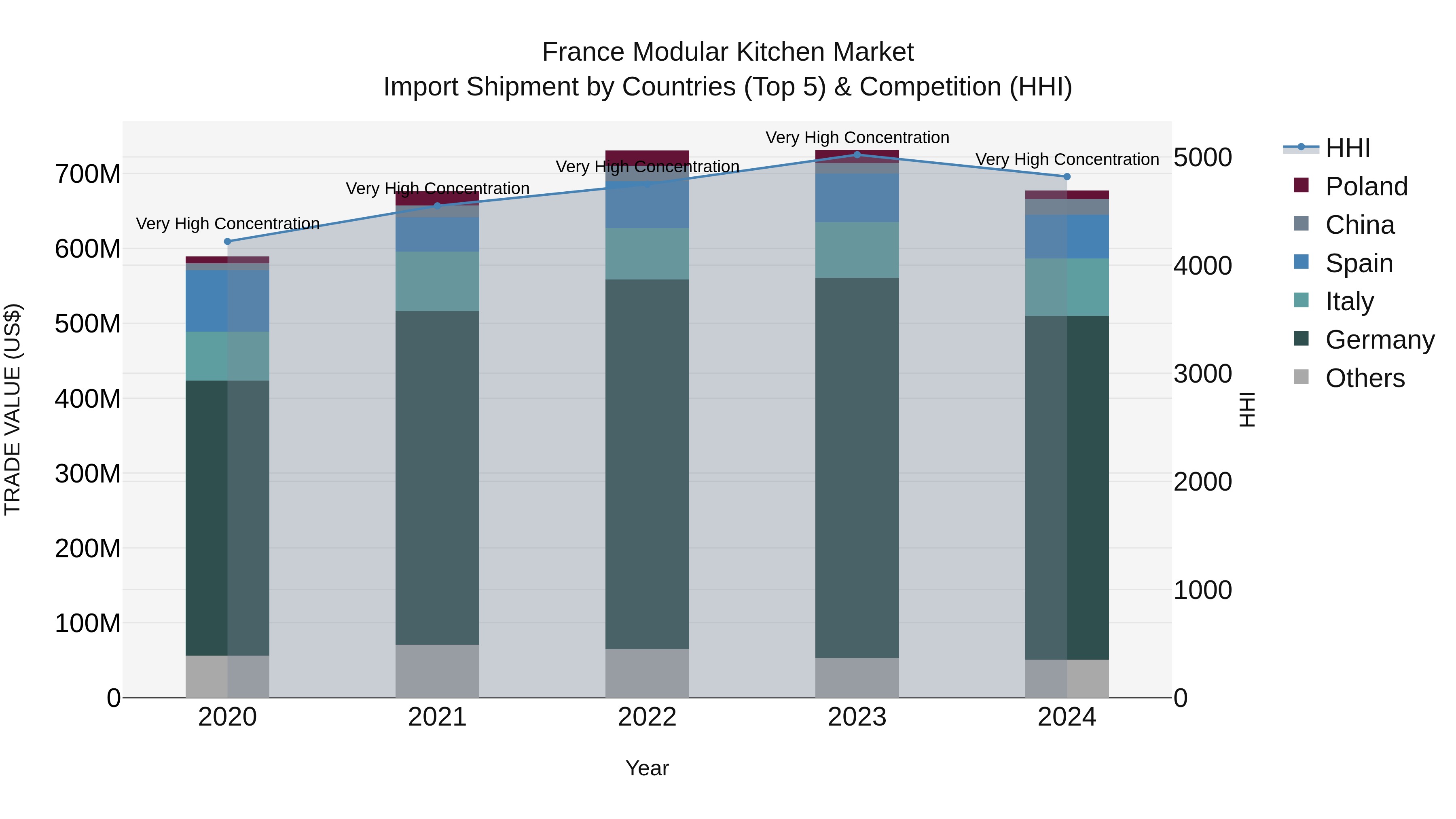
Despite a slight decline in growth rate in 2024, France`s import of modular kitchens continued to show steady growth with a CAGR of 3.55% from 2020 to 2024. The top exporting countries to France in 2024 were Germany, Italy, Spain, China, and Poland. The high concentration of the Herfindahl-Hirschman Index (HHI) indicates a competitive market landscape, reflecting the strong presence of key players. France`s reliance on these top exporting countries highlights the importance of international trade relationships in meeting the demand for modular kitchen imports.
France Modular Kitchen Market Overview
France modular kitchen market provides prefabricated kitchen solutions featuring standardized modules and components that can be assembled and customized to fit individual space and design preferences. Modular kitchens offer flexibility, functionality, and aesthetics, with a wide range of cabinet styles, finishes, and accessories to optimize storage, workflow, and ergonomics in residential and commercial kitchens. With a focus on modern living and urban lifestyles, French kitchen manufacturers and interior designers offer modular kitchen designs that combine style and functionality, enabling homeowners and chefs to create efficient and personalized culinary spaces that reflect their taste and lifestyle.
Drivers of the market
The France Modular Kitchen Market is influenced by factors such as changing consumer lifestyles, urbanization, and the demand for functional and space-efficient kitchen solutions. Modular kitchens, consisting of pre-fabricated units and components that can be assembled and customized to fit specific spaces and design preferences, offer advantages such as flexibility, convenience, and aesthetic appeal. With homeowners seeking to maximize storage space, optimize workflow, and enhance kitchen aesthetics, there`s a growing demand for modular kitchen solutions in the French market for residential renovations, new construction projects, and interior design upgrades.
Challenges of the market
The France modular kitchen market faces challenges related to meeting diverse customer preferences and design requirements for modular kitchen layouts and configurations, ensuring quality and durability in modular kitchen components and fittings, and addressing supply chain disruptions and material sourcing constraints. Modular kitchens are pre-designed kitchen units composed of standardized cabinets, countertops, and appliances that can be easily assembled and customized to fit different space and layout specifications, but their market dynamics are influenced by factors such as kitchen size, style preferences, and budget constraints. Moreover, ensuring ergonomic and space-efficient kitchen design, providing installation and after-sales services, and adapting to changing consumer lifestyles and kitchen trends pose ongoing challenges for modular kitchen manufacturers and retailers in this market.
Government Policy of the market
France government policies influence the modular kitchen market through regulations addressing housing, construction, and consumer safety. Standards for kitchen design, materials, and installation ensure compliance with building codes and safety regulations. Additionally, initiatives may promote research, innovation, and technology adoption to enhance modular kitchen functionality, space utilization, and aesthetic appeal to meet consumer preferences and lifestyle needs.
Key Highlights of the Report:
- France Modular Kitchen Market Outlook
- Market Size of France Modular Kitchen Market, 2024
- Forecast of France Modular Kitchen Market, 2031
- Historical Data and Forecast of France Modular Kitchen Revenues & Volume for the Period 2021-2031
- France Modular Kitchen Market Trend Evolution
- France Modular Kitchen Market Drivers and Challenges
- France Modular Kitchen Price Trends
- France Modular Kitchen Porter's Five Forces
- France Modular Kitchen Industry Life Cycle
- Historical Data and Forecast of France Modular Kitchen Market Revenues & Volume By Product for the Period 2021-2031
- Historical Data and Forecast of France Modular Kitchen Market Revenues & Volume By Floor Cabinet & Wall Cabinets for the Period 2021-2031
- Historical Data and Forecast of France Modular Kitchen Market Revenues & Volume By Tall Storage Cabinets for the Period 2021-2031
- Historical Data and Forecast of France Modular Kitchen Market Revenues & Volume By Others for the Period 2021-2031
- Historical Data and Forecast of France Modular Kitchen Market Revenues & Volume By End-User for the Period 2021-2031
- Historical Data and Forecast of France Modular Kitchen Market Revenues & Volume By Residential for the Period 2021-2031
- Historical Data and Forecast of France Modular Kitchen Market Revenues & Volume By Commercial for the Period 2021-2031
- Historical Data and Forecast of France Modular Kitchen Market Revenues & Volume By Distribution Channel for the Period 2021-2031
- Historical Data and Forecast of France Modular Kitchen Market Revenues & Volume By Offline (Contractors, Builders, and Others) for the Period 2021-2031
- Historical Data and Forecast of France Modular Kitchen Market Revenues & Volume By Online for the Period 2021-2031
- France Modular Kitchen Import Export Trade Statistics
- Market Opportunity Assessment By Product
- Market Opportunity Assessment By End-User
- Market Opportunity Assessment By Distribution Channel
- France Modular Kitchen Top Companies Market Share
- France Modular Kitchen Competitive Benchmarking By Technical and Operational Parameters
- France Modular Kitchen Company Profiles
- France Modular Kitchen Key Strategic Recommendations






































