France Natural Gas Storage Market Top 5 Importing Countries and Market Competition (HHI) Analysis
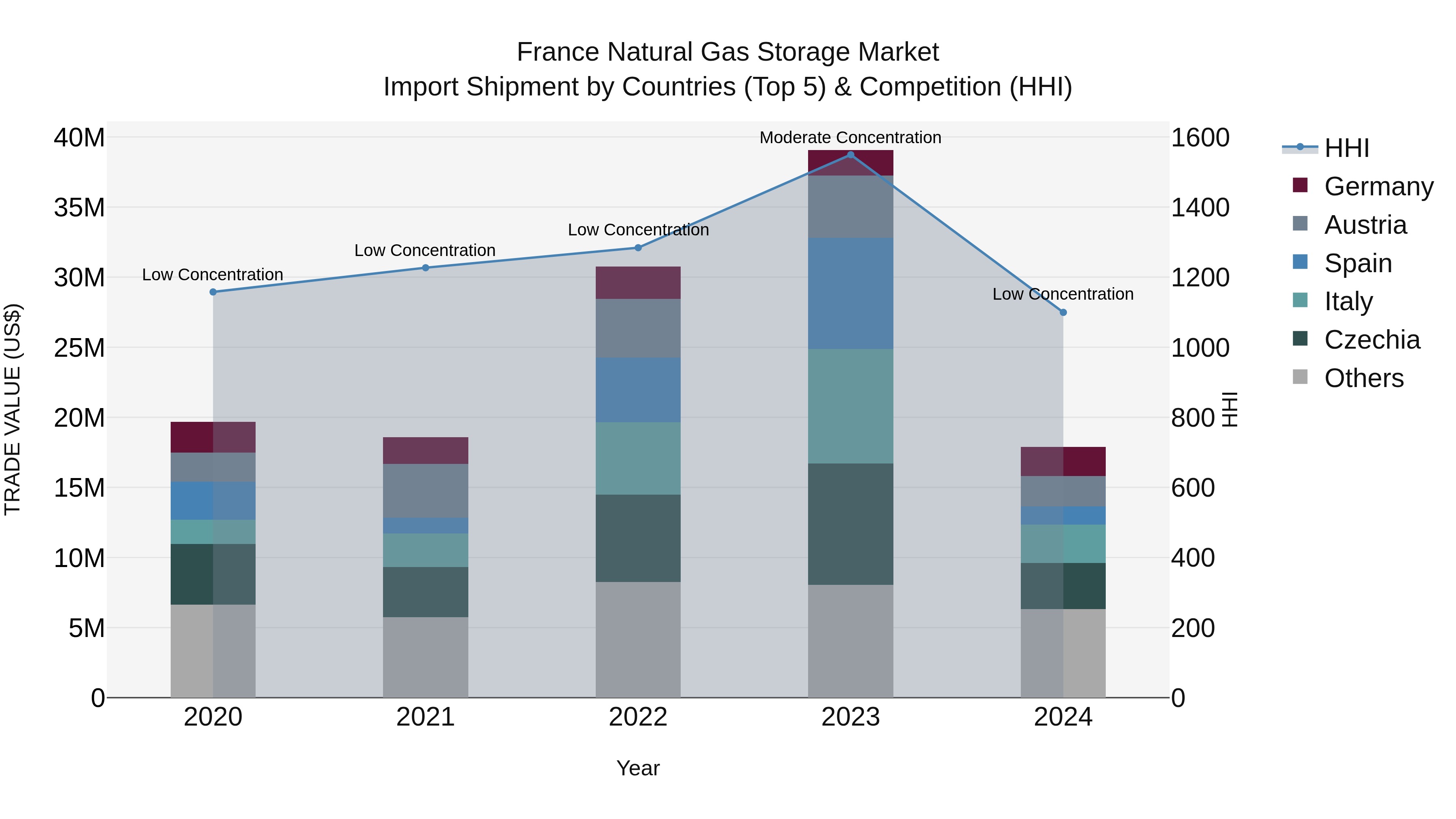
In 2024, France`s natural gas storage import shipments saw a shift in concentration from moderate to low, with top exporting countries being Czechia, Italy, Austria, Germany, and China. The negative CAGR from 2020 to 2024 highlights a decline in overall import volume, while the significant growth rate decrease from 2023 to 2024 indicates a sharp decline in shipments during that period. This data suggests a challenging market environment for natural gas storage imports in France, with potential implications for supply chain dynamics and market competitiveness.
France Natural Gas Storage Market Overview
The France natural gas storage market is characterized by a well-established infrastructure comprising both underground storage facilities and above-ground LNG terminals. The country`s strategic geographic location and significant natural gas consumption make storage facilities crucial for ensuring energy security and flexibility in supply. Key players in the market include Engie, Storengy, and EDF, who operate a network of storage facilities across the country. France`s storage capacity is primarily used for balancing seasonal demand fluctuations, ensuring supply during peak periods, and providing backup during supply disruptions. Regulatory frameworks, such as the EU`s Gas Directive, play a significant role in governing the operations and investments in the natural gas storage sector in France, with a focus on promoting competition and ensuring security of supply.
France Natural Gas Storage Market Trends
The natural gas storage market in France is currently witnessing several key trends. One of the most prominent trends is the increasing focus on expanding storage capacities to ensure energy security and supply reliability. The market is also seeing a growing emphasis on implementing advanced technologies such as smart storage solutions and digital monitoring systems to optimize operational efficiency and flexibility. Additionally, there is a rising interest in developing sustainable storage facilities and utilizing renewable energy sources to power storage operations, in line with France`s commitment to reducing carbon emissions. Overall, the France natural gas storage market is evolving towards more resilient, efficient, and environmentally friendly storage infrastructure to meet the country`s energy needs and sustainability goals.
France Natural Gas Storage Market Challenges
In the France natural gas storage market, one of the key challenges is the limited storage capacity available compared to the country`s demand for natural gas. This imbalance can lead to supply shortages during peak demand periods or unexpected disruptions in gas supply. Additionally, there are regulatory constraints and environmental concerns surrounding the expansion of storage facilities, making it difficult for companies to increase storage capacity quickly. The market also faces competition from alternative energy sources, such as renewable energy, which impacts the overall demand for natural gas storage services. Overall, balancing the need for sufficient storage capacity with regulatory hurdles and evolving market dynamics poses significant challenges for players in the France natural gas storage market.
France Natural Gas Storage Market Investment Opportunities
In the France natural gas storage market, there are various investment opportunities available for investors looking to capitalize on the country`s growing energy sector. One potential opportunity lies in expanding the existing storage infrastructure to meet the increasing demand for natural gas. Investing in the development of new storage facilities or upgrading the current ones can provide a steady income stream through storage fees and services. Another opportunity is to invest in technologies that improve the efficiency and security of natural gas storage facilities, such as advanced monitoring systems or innovative storage solutions. Additionally, investing in renewable energy projects that utilize natural gas as a transitional fuel can also be a lucrative option in the evolving energy landscape of France.
France Natural Gas Storage Market Government Policy
In France, the natural gas storage market is regulated by the government through policies aimed at ensuring energy security and promoting competition. The government has set up regulations that require gas storage operators to maintain a minimum level of gas in storage facilities to guarantee supply during peak demand periods and emergencies. Additionally, there are rules in place to facilitate third-party access to storage facilities, promoting market competition and preventing monopolistic practices. The government also monitors and evaluates the natural gas storage market to ensure compliance with environmental regulations and to adapt policies to evolving market conditions. Overall, the government`s policies in France aim to balance the need for energy security with promoting a competitive and sustainable natural gas storage market.
France Natural Gas Storage Market Future Outlook
The future outlook for the France natural gas storage market appears positive, driven by increasing demand for natural gas as a cleaner energy source and the country`s efforts to transition towards renewable energy sources. The market is expected to witness growth due to the need for efficient storage solutions to ensure energy security and stability in the face of fluctuating supply and demand dynamics. Additionally, the development of new technologies and infrastructure improvements in the natural gas storage sector are likely to enhance the market`s competitiveness and attract investments. As France continues to focus on reducing carbon emissions and achieving its energy transition goals, the natural gas storage market is poised to play a crucial role in supporting the country`s energy needs and ensuring a reliable supply of natural gas for both domestic and industrial consumers.
Key Highlights of the Report:
- France Natural Gas Storage Market Outlook
- Market Size of France Natural Gas Storage Market,2024
- Forecast of France Natural Gas Storage Market, 2031
- Historical Data and Forecast of France Natural Gas Storage Revenues & Volume for the Period 2021-2031
- France Natural Gas Storage Market Trend Evolution
- France Natural Gas Storage Market Drivers and Challenges
- France Natural Gas Storage Price Trends
- France Natural Gas Storage Porter's Five Forces
- France Natural Gas Storage Industry Life Cycle
- Historical Data and Forecast of France Natural Gas Storage Market Revenues & Volume By Storage Type for the Period 2021-2031
- Historical Data and Forecast of France Natural Gas Storage Market Revenues & Volume By Underground Storage for the Period 2021-2031
- Historical Data and Forecast of France Natural Gas Storage Market Revenues & Volume By Above-Ground Storage for the Period 2021-2031
- Historical Data and Forecast of France Natural Gas Storage Market Revenues & Volume By LNG Storage for the Period 2021-2031
- Historical Data and Forecast of France Natural Gas Storage Market Revenues & Volume By Floating Storage for the Period 2021-2031
- Historical Data and Forecast of France Natural Gas Storage Market Revenues & Volume By Pipeline Storage for the Period 2021 - 2029
- Historical Data and Forecast of France Natural Gas Storage Market Revenues & Volume By Capacity for the Period 2021-2031
- Historical Data and Forecast of France Natural Gas Storage Market Revenues & Volume By Large for the Period 2021-2031
- Historical Data and Forecast of France Natural Gas Storage Market Revenues & Volume By Medium for the Period 2021-2031
- Historical Data and Forecast of France Natural Gas Storage Market Revenues & Volume By Small for the Period 2021-2031
- Historical Data and Forecast of France Natural Gas Storage Market Revenues & Volume By Variable for the Period 2021-2031
- Historical Data and Forecast of France Natural Gas Storage Market Revenues & Volume By Continuous for the Period 2021 - 2029
- Historical Data and Forecast of France Natural Gas Storage Market Revenues & Volume By Location for the Period 2021-2031
- Historical Data and Forecast of France Natural Gas Storage Market Revenues & Volume By Subsurface Caverns for the Period 2021-2031
- Historical Data and Forecast of France Natural Gas Storage Market Revenues & Volume By Storage Tanks for the Period 2021-2031
- Historical Data and Forecast of France Natural Gas Storage Market Revenues & Volume By Gas Facilities for the Period 2021-2031
- Historical Data and Forecast of France Natural Gas Storage Market Revenues & Volume By Offshore Platforms for the Period 2021-2031
- Historical Data and Forecast of France Natural Gas Storage Market Revenues & Volume By Transmission Lines for the Period 2021 - 2029
- Historical Data and Forecast of France Natural Gas Storage Market Revenues & Volume By Storage Method for the Period 2021-2031
- Historical Data and Forecast of France Natural Gas Storage Market Revenues & Volume By Pressurized for the Period 2021-2031
- Historical Data and Forecast of France Natural Gas Storage Market Revenues & Volume By Cryogenic for the Period 2021-2031
- Historical Data and Forecast of France Natural Gas Storage Market Revenues & Volume By Liquefied for the Period 2021-2031
- Historical Data and Forecast of France Natural Gas Storage Market Revenues & Volume By LNG Ships for the Period 2021-2031
- Historical Data and Forecast of France Natural Gas Storage Market Revenues & Volume By Compressed for the Period 2021 - 2029
- Historical Data and Forecast of France Natural Gas Storage Market Revenues & Volume By End User for the Period 2021-2031
- Historical Data and Forecast of France Natural Gas Storage Market Revenues & Volume By Utilities for the Period 2021-2031
- Historical Data and Forecast of France Natural Gas Storage Market Revenues & Volume By Power Plants for the Period 2021-2031
- Historical Data and Forecast of France Natural Gas Storage Market Revenues & Volume By Industrial for the Period 2021-2031
- Historical Data and Forecast of France Natural Gas Storage Market Revenues & Volume By Maritime Transport for the Period 2021 - 2029
- Historical Data and Forecast of France Natural Gas Storage Market Revenues & Volume By Residential for the Period 2021 - 2029
- France Natural Gas Storage Import Export Trade Statistics
- Market Opportunity Assessment By Storage Type
- Market Opportunity Assessment By Capacity
- Market Opportunity Assessment By Location
- Market Opportunity Assessment By Storage Method
- Market Opportunity Assessment By End User
- France Natural Gas Storage Top Companies Market Share
- France Natural Gas Storage Competitive Benchmarking By Technical and Operational Parameters
- France Natural Gas Storage Company Profiles
- France Natural Gas Storage Key Strategic Recommendations






































