France Ploughing and Cultivating Machinery Market Size, Share & Growth Rate
The France Ploughing and Cultivating Machinery Market was estimated at USD 101 Million in 2025 and is projected to reach USD 112 Million by 2032, growing at a CAGR of 1.5% from 2026 to 2032. This upward trajectory is fueled by a combination of increased mechanization in agriculture and a growing focus on precision farming techniques, which enable farmers to optimize resources while enhancing productivity. The shift towards sustainable practices and advancements in digital solutions for farm management are also pivotal in shaping market dynamics.
France Ploughing and Cultivating Machinery Market Year-wise Growth Rate and Key Drivers
This graph highlights how the France Ploughing and Cultivating Machinery Market has steadily grown over the years, supported by major growth factors.
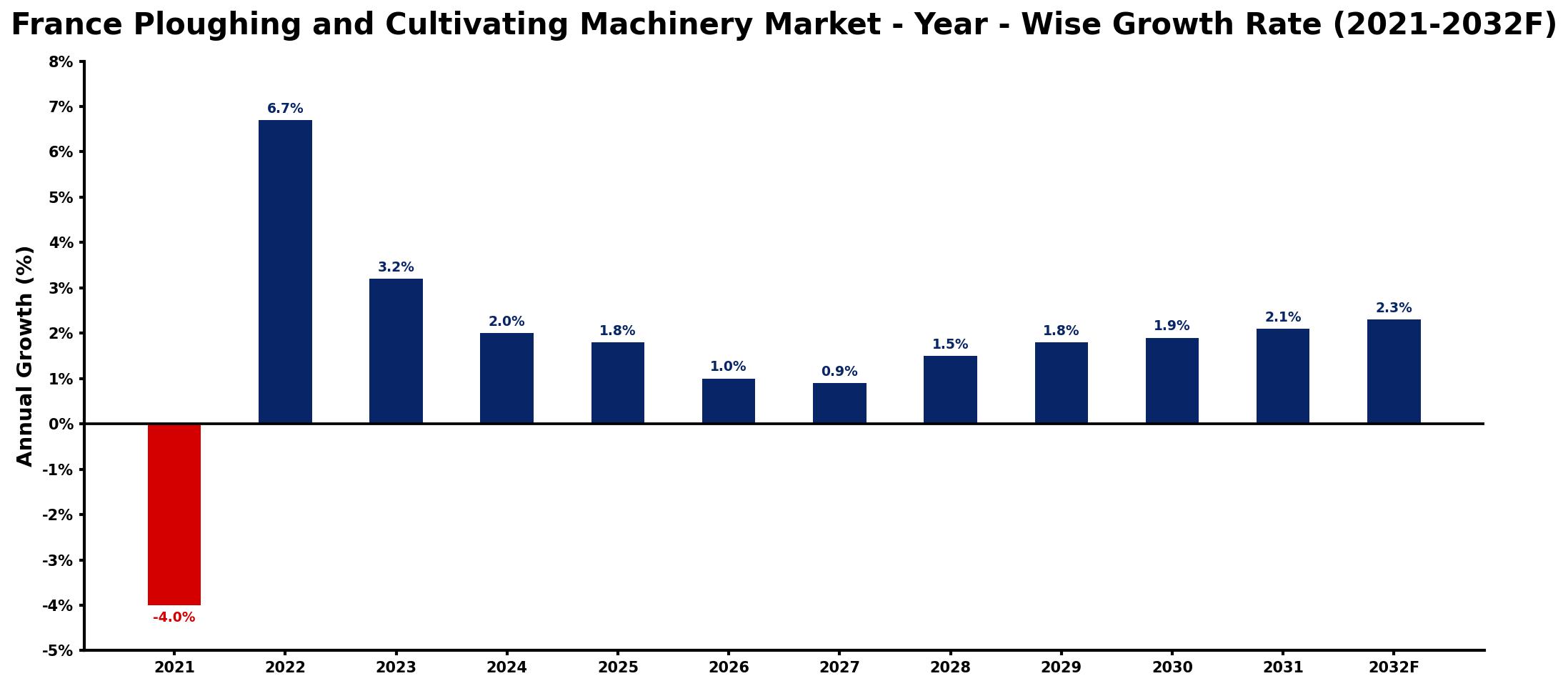
The table below presents the year‑wise growth rates along with the key drivers influencing the market
| Year | Growth Rate | Major Drivers |
| 2021 | -4.0% | reduced agricultural investment levels |
| 2022 | 6.7% | increased precision farming adoption |
| 2023 | 3.2% | growing organic farming practices |
| 2024 | 2.0% | rising demand for efficiency |
| 2025 | 1.8% | expansion of export markets |
| 2026 | 1.0% | advancements in automation technology |
| 2027 | 0.9% | increased focus on sustainability |
| 2028 | 1.5% | growing farmer cooperative initiatives |
| 2029 | 1.8% | increased government subsidies programs |
| 2030 | 1.9% | rising interest in agritech solutions |
| 2031 | 2.1% | increased production capacity utilization |
| 2032 | 2.3% | growth in agroecological practices |
Note: Market size estimations and growth projections presented in this report are based on 6Wresearch's proprietary forecasting methodology, utilizing the latest available industry data, government publications, and primary research inputs.
France Ploughing and Cultivating Machinery Market Synopsis
Currently, the French agricultural sector is undergoing a significant transformation, with mechanized solutions playing a crucial role in improving yields. The Ploughing and Cultivating Machinery Market is at the forefront of this change, providing innovative equipment tailored to the unique needs of French farmers.
As the agricultural landscape evolves, there is a marked shift towards sustainable and efficient technologies. This shift is pushing manufacturers to develop advanced machinery that not only enhances productivity but also aligns with environmentally friendly practices, making it a pivotal sector within France's agricultural machinery industry.
France Ploughing and Cultivating Machinery Market Key Takeaways
- The market is poised for steady growth, driven by the adoption of precision farming technologies.
- Government initiatives are promoting the modernization of agricultural practices through subsidies and incentives.
- There is an increasing demand for smart machinery incorporating data analytics and GPS technology.
- Focus on sustainable agriculture is steering investments towards eco-friendly machinery solutions.
- Investment opportunities are emerging in the development of autonomous and electric-powered equipment.
Evaluation of Restraints in France Ploughing and Cultivating Machinery Market
Despite the promising growth potential, the France Ploughing and Cultivating Machinery Market faces several restraints. Foreign competition, particularly from manufacturers offering lower-priced alternatives, places pressure on domestic players to innovate continuously. Additionally, strict environmental regulations can complicate manufacturing processes and increase compliance costs. The high upfront investment required for advanced machinery can deter smaller farms from upgrading, and market saturation in certain regions may slow adoption rates of newer technologies. Addressing these constraints will be crucial for players aiming to thrive in this competitive landscape.
France Ploughing and Cultivating Machinery Market Trends
A key trend shaping the France Ploughing and Cultivating Machinery Market is the increasing emphasis on sustainable and precision farming. Farmers are actively seeking equipment that not only boosts productivity but also minimizes environmental impact through efficient resource management. The rise of autonomous machinery is gaining traction, addressing labor shortages while enhancing operational efficiency. Moreover, the integration of digital technology is transforming traditional farming practices, paving the way for more data-driven decision-making processes in crop management.
France Ploughing and Cultivating Machinery Market Opportunities
Investment opportunities within the France Ploughing and Cultivating Machinery Market are abundant, particularly in the realms of precision farming and sustainable technology. Investors are encouraged to explore advancements in smart machinery that leverages data analytics to enhance operational efficiencies. The demand for equipment that focuses on improving soil health and productivity presents lucrative opportunities, especially as farmers strive to adapt to evolving agricultural challenges. Collaborating with local manufacturers can further facilitate market entry and expansion strategies.
Government Initiatives in the France Ploughing and Cultivating Machinery Market
The French government has implemented various policies designed to bolster the Ploughing and Cultivating Machinery Market. Subsidies and incentives are in place to encourage the adoption of modern machinery, aligning with national goals of enhancing agricultural productivity and sustainability. Regulatory frameworks are established to maintain safety and quality standards in machinery, promoting innovation and research within the sector. Such initiatives are crucial in fostering an environment that supports technological advancements and environmental responsibility in French agriculture.
Future Insights of the France Ploughing and Cultivating Machinery Market
Looking ahead to 2026-2032, the France Ploughing and Cultivating Machinery Market is expected to continue its growth trajectory. The ongoing demand for precision farming solutions, coupled with government support for modernizing agricultural practices, will propel market expansion. Furthermore, as farmers increasingly prioritize efficiency and sustainability, the integration of smart and autonomous technologies will reshape the landscape, making advanced ploughing and cultivating machinery indispensable in the future of French agriculture.
France Ploughing and Cultivating Machinery Market Latest Developments (2025 - 2026)
Recent developments in the France Ploughing and Cultivating Machinery Market have underscored a commitment to innovation and sustainability. Manufacturers are enhancing their product offerings by incorporating cutting-edge technologies that facilitate precision agriculture. There's a noticeable trend towards electric-powered machinery aimed at reducing carbon footprints. Additionally, collaborations between industry players are becoming more prevalent, fostering innovation and enhancing market reach as demand for modern equipment continues to grow.
France Ploughing and Cultivating Machinery Market - Key Attractiveness of the Report
- 10 Years of Market Numbers
- Historical Data Starting from 2022 to 2025
- Base Year: 2025
- Forecast Data until 2032
- Key Performance Indicators Impacting the Market
- Major Upcoming Developments and Projects
Key Highlights of the Report:
- France Ploughing and Cultivating Machinery Market Outlook
- Market Size of France Ploughing and Cultivating Machinery Market, 2025
- Forecast of France Ploughing and Cultivating Machinery Market, 2032
- Historical Data and Forecast of France Ploughing and Cultivating Machinery Revenues & Volume for the Period 2022-2032F
- France Ploughing and Cultivating Machinery Market Trend Evolution
- France Ploughing and Cultivating Machinery Market Drivers and Challenges
- France Ploughing and Cultivating Machinery Price Trends
- France Ploughing and Cultivating Machinery Porter's Five Forces
- France Ploughing and Cultivating Machinery Industry Life Cycle
- Historical Data and Forecast of France Ploughing and Cultivating Machinery Market Revenues & Volume By Type for the Period 2022-2032F
- Historical Data and Forecast of France Ploughing and Cultivating Machinery Market Revenues & Volume By Ploughs for the Period 2022-2032F
- Historical Data and Forecast of France Ploughing and Cultivating Machinery Market Revenues & Volume By Harrows for the Period 2022-2032F
- Historical Data and Forecast of France Ploughing and Cultivating Machinery Market Revenues & Volume By Others for the Period 2022-2032F
- Historical Data and Forecast of France Ploughing and Cultivating Machinery Market Revenues & Volume By Application for the Period 2022-2032F
- Historical Data and Forecast of France Ploughing and Cultivating Machinery Market Revenues & Volume By Soil Loosening for the Period 2022-2032F
- Historical Data and Forecast of France Ploughing and Cultivating Machinery Market Revenues & Volume By Clod Size Reduction for the Period 2022-2032F
- Historical Data and Forecast of France Ploughing and Cultivating Machinery Market Revenues & Volume By Clod Sorting for the Period 2022-2032F
- Historical Data and Forecast of France Ploughing and Cultivating Machinery Market Revenues & Volume By Others for the Period 2022-2032F
- France Ploughing and Cultivating Machinery Import Export Trade Statistics
- Market Opportunity Assessment By Type
- Market Opportunity Assessment By Application
- France Ploughing and Cultivating Machinery Top Companies Market Share
- France Ploughing and Cultivating Machinery Competitive Benchmarking By Technical and Operational Parameters
- France Ploughing and Cultivating Machinery Company Profiles
- France Ploughing and Cultivating Machinery Key Strategic Recommendations






































