France Small Wind Turbine Market Size, Share & Growth Rate
The France Small Wind Turbine Market was estimated at USD 166 Million in 2025 and is projected to reach USD 186 Million by 2032, growing at a CAGR of 1.6% from 2026 to 2032. This steady growth is largely fueled by the nation's commitment to renewable energy and ongoing government initiatives encouraging sustainable practices. As both residential and commercial sectors increasingly embrace small wind turbine technology, the market is becoming more dynamic, showcasing a diverse array of products that cater to various energy needs.
France Small Wind Turbine Market Year-wise Growth Rate and Key Drivers
This graph highlights how the France Small Wind Turbine Market has steadily grown over the years, supported by major growth factors.
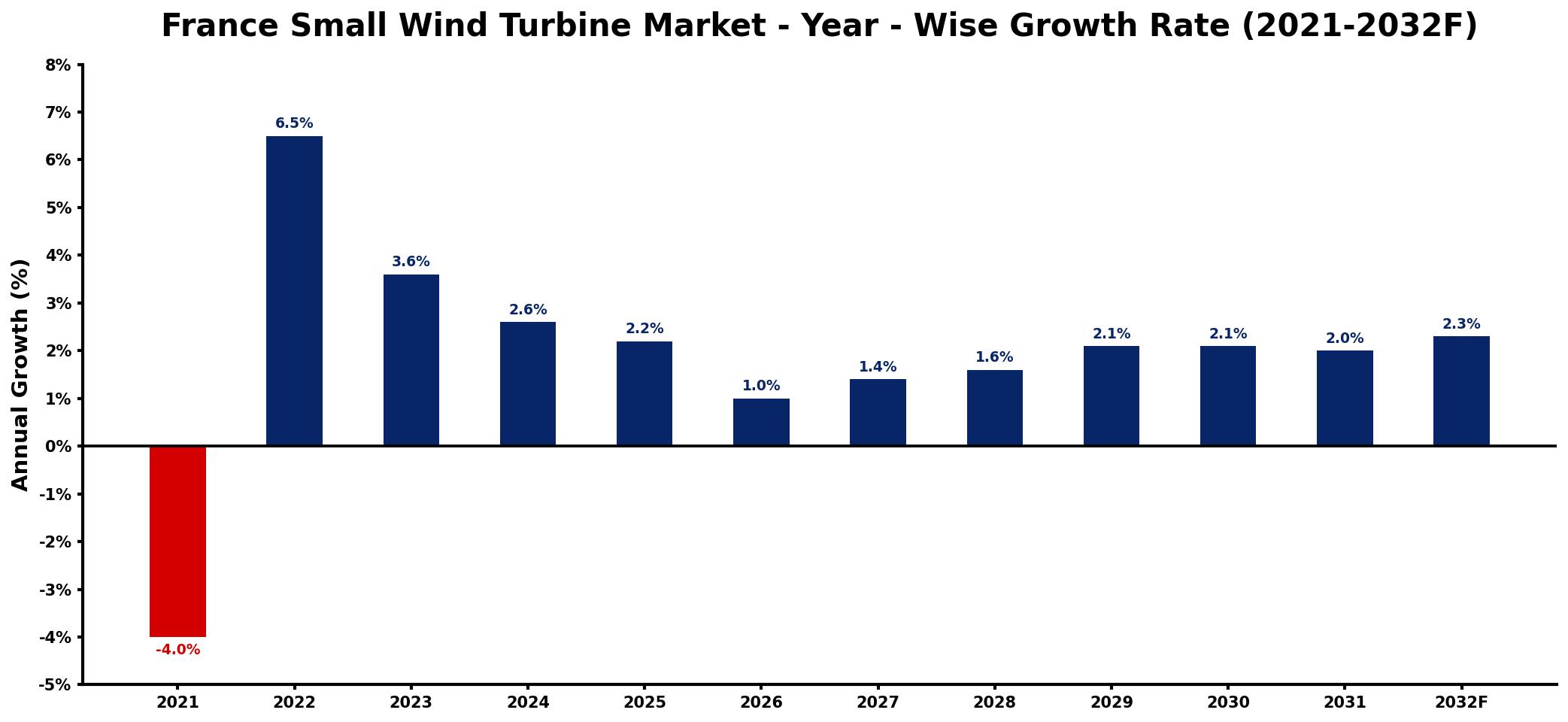
The table below presents the year‑wise growth rates along with the key drivers influencing the market
| Year | Growth Rate | Major Drivers |
| 2021 | -4.0% | decreased investments in renewable energy |
| 2022 | 6.5% | increased consumer interest in sustainability |
| 2023 | 3.6% | expansion of government incentives programs |
| 2024 | 2.6% | growth in residential energy solutions |
| 2025 | 2.2% | enhanced technological advancements adoption |
| 2026 | 1.0% | rise in energy independence awareness |
| 2027 | 1.4% | boost in local manufacturing initiatives |
| 2028 | 1.6% | surge in international partnerships forming |
| 2029 | 2.1% | development of innovative financing options |
| 2030 | 2.1% | growing urban energy diversification trends |
| 2031 | 2.0% | expanding healthcare application demand |
| 2032 | 2.3% | increased focus on energy resilience |
Note: Market size estimations and growth projections presented in this report are based on 6Wresearch's proprietary forecasting methodology, utilizing the latest available industry data, government publications, and primary research inputs.
France Small Wind Turbine Market Synopsis
In France, the demand for small wind turbines is gaining momentum as consumers seek efficient alternatives to traditional energy sources. With capacities typically ranging from a few kilowatts to 100 kW, these turbines are particularly appealing for decentralized energy solutions, making them an ideal fit for the country's rural areas.
In addition to residential applications, small wind turbines are increasingly being integrated into commercial and agricultural sectors. This trend highlights a growing recognition of wind energy's potential to provide cost-effective and sustainable energy, reinforcing France's commitment to achieving its renewable energy targets.
France Small Wind Turbine Market Key Takeaways
- Market growth is driven by increased consumer awareness and government incentives promoting renewable energy.
- Technological advancements are leading to enhanced efficiency and reduced maintenance costs for small wind turbines.
- The adoption of hybrid systems combining wind and solar energy is on the rise, reflecting innovative energy solutions.
- Decentralized energy generation is becoming a focal point, particularly in rural regions of France.
- Investment opportunities are abundant in manufacturing, distribution, and maintenance sectors of small wind turbine systems.
Evaluation of Restraints in France Small Wind Turbine Market
Despite the promising outlook, the France Small Wind Turbine Market faces several hurdles that can impede its growth. Regulatory complexities and the permitting process remain significant barriers for potential installers, making entry into the market cumbersome. Furthermore, densely populated areas often present challenges in finding suitable installation sites, which can limit expansion efforts. Initial investment costs for small wind turbine systems may also deter consumers who are uncertain about returns on investment. There exists a crucial need for heightened public education regarding the advantages of small wind technologies over other renewable options, such as solar power, to foster broader acceptance and understanding.
France Small Wind Turbine Market Trends
The current landscape of the France Small Wind Turbine Market is marked by several emerging trends. A notable shift towards hybrid energy systems that integrate both wind and solar technologies is gaining traction, driven by the need for reliable off-grid power solutions. Additionally, manufacturers are innovating to develop more aesthetically pleasing and efficient turbine designs, catering to consumer preferences for sustainable energy options. This is complemented by a growing focus on decentralized energy generation, particularly among agricultural businesses and rural households seeking independence from centralized power sources.
France Small Wind Turbine Market Opportunities
The investment landscape in the France Small Wind Turbine Market is robust, with numerous opportunities for growth. Government incentives for renewable energy adoption are creating favorable conditions for market entry. Moreover, as technology continues to evolve, small wind turbines are becoming increasingly efficient and cost-effective, presenting opportunities for manufacturers and service providers alike. Investors can explore avenues in areas such as turbine production, maintenance services, and the development of integrated energy solutions tailored to specific consumer needs.
Government Initiatives in the France Small Wind Turbine Market
The French government has rolled out various policies to stimulate the growth of the Small Wind Turbine Market. These include financial incentives like feed-in tariffs and tax credits designed to encourage investments in small wind technology. Streamlined regulatory frameworks are also being implemented to simplify the permitting process for new installations. In addition, the government invests in research and development initiatives aimed at driving innovation within the small wind sector, underlining its commitment to fostering a sustainable energy future.
Future Insights of the France Small Wind Turbine Market
Looking ahead to the period from 2026 to 2032, the future of the France Small Wind Turbine Market appears bright. The combination of heightened government support, technological advancements, and increasing awareness around environmental sustainability is expected to sustain market momentum. Moreover, the growing demand for off-grid power solutions, especially in rural communities, indicates a shift toward more localized energy production. As consumers continue to prioritize clean energy sources, the market is well-positioned for steady growth.
France Small Wind Turbine Market Latest Developments (2025 - 2026)
Recent developments in the France Small Wind Turbine Market indicate a strong push towards increasing installation capacities and enhancing technology. Initiatives aimed at educating consumers about the benefits of small wind systems are being launched, aimed at overcoming existing barriers to market entry. Additionally, the trend towards hybrid energy systems is seeing greater adoption as more companies explore innovative partnerships and product offerings in the renewable energy sector.
France Small Wind Turbine Market - Key Attractiveness of the Report
- 10 Years of Market Numbers
- Historical Data Starting from 2022 to 2025
- Base Year: 2025
- Forecast Data until 2032
- Key Performance Indicators Impacting the Market
- Major Upcoming Developments and Projects
Key Highlights of the Report:
- France Small Wind Turbine Market Outlook
- Market Size of France Small Wind Turbine Market, 2025
- Forecast of France Small Wind Turbine Market, 2032
- Historical Data and Forecast of France Small Wind Turbine Revenues & Volume for the Period 2022-2032F
- France Small Wind Turbine Market Trend Evolution
- France Small Wind Turbine Market Drivers and Challenges
- France Small Wind Turbine Price Trends
- France Small Wind Turbine Porter's Five Forces
- France Small Wind Turbine Industry Life Cycle
- Historical Data and Forecast of France Small Wind Turbine Market Revenues & Volume By Axis Type for the Period 2022-2032F
- Historical Data and Forecast of France Small Wind Turbine Market Revenues & Volume By Horizontal Axis Wind Turbine for the Period 2022-2032F
- Historical Data and Forecast of France Small Wind Turbine Market Revenues & Volume By Vertical Axis Wind Turbine for the Period 2022-2032F
- Historical Data and Forecast of France Small Wind Turbine Market Revenues & Volume By Application for the Period 2022-2032F
- Historical Data and Forecast of France Small Wind Turbine Market Revenues & Volume By On-grid for the Period 2022-2032F
- Historical Data and Forecast of France Small Wind Turbine Market Revenues & Volume By Off-grid for the Period 2022-2032F
- France Small Wind Turbine Import Export Trade Statistics
- Market Opportunity Assessment By Axis Type
- Market Opportunity Assessment By Application
- France Small Wind Turbine Top Companies Market Share
- France Small Wind Turbine Competitive Benchmarking By Technical and Operational Parameters
- France Small Wind Turbine Company Profiles
- France Small Wind Turbine Key Strategic Recommendations






































