Georgia Frozen Processed Meat Market Size, Share & Growth Rate
The Georgia Frozen Processed Meat Market was estimated at USD 1161 Million in 2025 and is projected to reach USD 1678 Million by 2032, growing at a CAGR of 5.4% from 2026 to 2032. This growth trajectory is fueled by a blend of consumer demands for convenient meal solutions and an increasing inclination towards ready-to-eat and frozen products. Busy lifestyles across Georgia's urban and suburban landscapes enhance the appeal of these offerings, making them a staple in both households and foodservice establishments.
Georgia Frozen Processed Meat Market Year-wise Growth Rate and Key Drivers
This graph highlights how the Georgia Frozen Processed Meat Market has steadily grown over the years, supported by major growth factors.
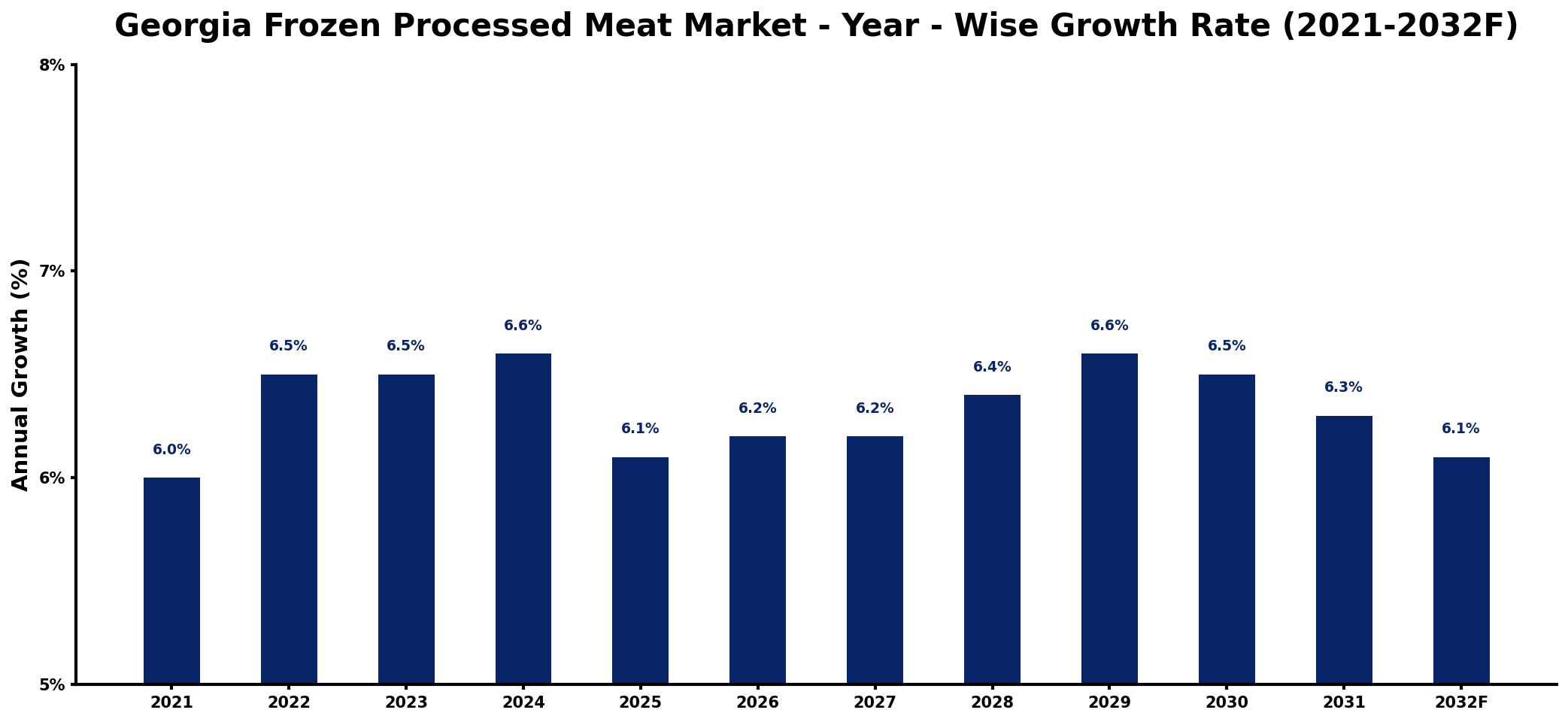
The table below presents the year‑wise growth rates along with the key drivers influencing the market
| Year | Growth Rate | Major Drivers |
| 2021 | 6.0% | Rising consumer convenience preferences |
| 2022 | 6.5% | Expansion of retail distribution channels |
| 2023 | 6.5% | Increased health consciousness among consumers |
| 2024 | 6.6% | Growth in online shopping platforms |
| 2025 | 6.1% | Investments in automation technologies |
| 2026 | 6.2% | Emergence of new culinary trends |
| 2027 | 6.2% | Surge in demand for alternatives |
| 2028 | 6.4% | Increase in meal kit subscriptions |
| 2029 | 6.6% | stronger distribution network expansion |
| 2030 | 6.5% | enhanced product quality standards |
| 2031 | 6.3% | rising export shipment volumes |
| 2032 | 6.1% | improved processing technologies adoption |
Note: Market size estimations and growth projections presented in this report are based on 6Wresearch's proprietary forecasting methodology, utilizing the latest available industry data, government publications, and primary research inputs.
Georgia Frozen Processed Meat Market Synopsis
In recent years, the Georgia Frozen Processed Meat Market has demonstrated notable resilience, reflecting the state's unique blend of culinary traditions and modern eating habits. The popularity of frozen meats such as sausages, nuggets, and meatballs has surged, resonating with consumers seeking both quality and convenience.
With an expanding range of products catering to diverse palates and dietary preferences, manufacturers are responding to shifting consumer trends. The rise of healthy eating, coupled with a demand for products free from artificial additives, is reshaping the landscape of frozen processed meats in Georgia.
Georgia Frozen Processed Meat Market Key Takeaways
- The market is experiencing steady growth driven by busy lifestyles and an increasing demand for convenient food options.
- Health-conscious consumers are influencing product innovation towards organic and preservative-free frozen meats.
- Strategic partnerships and innovations are key strategies adopted by market players to maintain competitiveness.
- Rising demand from restaurants and fast-food chains is significantly contributing to market expansion.
- Challenges like fluctuating raw material prices and regulatory compliance continue to shape market dynamics.
Evaluation of Restraints in Georgia Frozen Processed Meat Market
The Georgia Frozen Processed Meat Market faces several restraints that could impede its growth. Intense competition from both local and international brands creates a crowded landscape where differentiation becomes essential. Additionally, fluctuating prices of raw materials may impact profitability and cost structures for manufacturers. Shifting consumer preferences toward healthier options also requires continuous adaptation and product reformulation, which can strain resources. Moreover, compliance with stringent food safety regulations and maintaining quality throughout distribution channels present logistical challenges that require strategic solutions.
Georgia Frozen Processed Meat Market Trends
Current trends indicate a marked shift towards healthier and more sustainable frozen processed meat options. Consumers are actively seeking products that feature clean labels, indicating organic, grass-fed, or antibiotic-free sourcing. Furthermore, the plant-based protein movement is gaining traction, compelling manufacturers to innovate with plant-based alternatives that mimic traditional meat products. This convergence of health, sustainability, and convenience is influencing purchasing behaviors across various demographics in Georgia, making it imperative for companies to adapt their offerings accordingly.
Georgia Frozen Processed Meat Market Opportunities
The landscape of the Georgia Frozen Processed Meat Market is ripe with investment opportunities. As consumer preferences evolve towards convenient and nutritious food options, investing in modern processing facilities can enhance operational efficiency and product quality. There is also a substantial market for innovative product development aimed at health-conscious buyers, particularly in plant-based segments. Expanding distribution networks to tap into online grocery shopping can also offer significant advantages. Furthermore, deploying effective marketing strategies to build brand recognition and differentiate from competitors could greatly benefit investors looking to capitalize on the market's growth.
Government Initiatives in the Georgia Frozen Processed Meat Market
Government policies impacting the Georgia Frozen Processed Meat Market emphasize food safety, labeling compliance, and regulatory oversight. The Georgia Department of Agriculture plays a vital role in ensuring that frozen processed meats meet established quality and safety standards. Recent initiatives aim to enhance consumer trust through stringent labeling requirements, allowing for greater transparency regarding product origins and content. Additionally, regulations surrounding import and export help maintain high food safety protocols while promoting fair trade practices, ultimately fostering a more robust market environment.
Future Insights of the Georgia Frozen Processed Meat Market
Looking ahead to 2026-2032, the Georgia Frozen Processed Meat Market is poised for steady expansion, driven by rising disposable incomes and an increasing preference for frozen products due to their convenience and longer shelf life. As online grocery shopping continues to gain popularity, market players are expected to enhance their digital presence and optimize supply chains to cater to this shift. Innovation in healthier product offerings will be key to capturing the attention of the evolving consumer base. However, vigilance regarding regulatory landscapes and market competition will be critical for sustained growth.
Georgia Frozen Processed Meat Market Latest Developments (2025 - 2026)
Recent developments in the Georgia Frozen Processed Meat Market reflect a concerted effort by manufacturers to adapt to consumer preferences. Companies are increasingly investing in clean label initiatives, introducing a variety of healthier frozen meat alternatives. There is also a notable increase in collaborative ventures aimed at expanding distribution capabilities and enhancing product reach in emerging retail channels. Additionally, growing interest in plant-based frozen products has prompted several firms to expand their product lines to include meatless options, thus catering to the rising consumer demand.
Georgia Frozen Processed Meat Market - Key Attractiveness of the Report
- 10 Years of Market Numbers
- Historical Data Starting from 2022 to 2025
- Base Year: 2025
- Forecast Data until 2032
- Key Performance Indicators Impacting the Market
- Major Upcoming Developments and Projects
Key Highlights of the Report:
- Georgia Frozen Processed Meat Market Outlook
- Market Size of Georgia Frozen Processed Meat Market, 2025
- Forecast of Georgia Frozen Processed Meat Market, 2032
- Historical Data and Forecast of Georgia Frozen Processed Meat Revenues & Volume for the Period 2022-2032F
- Georgia Frozen Processed Meat Market Trend Evolution
- Georgia Frozen Processed Meat Market Drivers and Challenges
- Georgia Frozen Processed Meat Price Trends
- Georgia Frozen Processed Meat Porter's Five Forces
- Georgia Frozen Processed Meat Industry Life Cycle
- Historical Data and Forecast of Georgia Frozen Processed Meat Market Revenues & Volume By Product Type for the Period 2022-2032F
- Historical Data and Forecast of Georgia Frozen Processed Meat Market Revenues & Volume By Beef for the Period 2022-2032F
- Historical Data and Forecast of Georgia Frozen Processed Meat Market Revenues & Volume By Pork for the Period 2022-2032F
- Historical Data and Forecast of Georgia Frozen Processed Meat Market Revenues & Volume By Chicken for the Period 2022-2032F
- Historical Data and Forecast of Georgia Frozen Processed Meat Market Revenues & Volume By Mutton for the Period 2022-2032F
- Historical Data and Forecast of Georgia Frozen Processed Meat Market Revenues & Volume By Others for the Period 2022-2032F
- Historical Data and Forecast of Georgia Frozen Processed Meat Market Revenues & Volume By Application for the Period 2022-2032F
- Historical Data and Forecast of Georgia Frozen Processed Meat Market Revenues & Volume By Retail Store for the Period 2022-2032F
- Historical Data and Forecast of Georgia Frozen Processed Meat Market Revenues & Volume By Online Sale for the Period 2022-2032F
- Georgia Frozen Processed Meat Import Export Trade Statistics
- Market Opportunity Assessment By Product Type
- Market Opportunity Assessment By Application
- Georgia Frozen Processed Meat Top Companies Market Share
- Georgia Frozen Processed Meat Competitive Benchmarking By Technical and Operational Parameters
- Georgia Frozen Processed Meat Company Profiles
- Georgia Frozen Processed Meat Key Strategic Recommendations






































