Georgia Railway Maintenance Machinery Market Size, Share & Growth Rate
The Georgia Railway Maintenance Machinery Market was estimated at USD 371 Million in 2025 and is projected to reach USD 643 Million by 2032, growing at a CAGR of 8.2% from 2026 to 2032. This robust growth trajectory is primarily driven by ongoing infrastructure development projects within the state, which emphasize the need for advanced maintenance and repair equipment. The introduction of innovative technologies in maintenance practices also plays a significant role in enhancing operational efficiencies across the railway sector.
Georgia Railway Maintenance Machinery Market Year-wise Growth Rate and Key Drivers
This graph highlights how the Georgia Railway Maintenance Machinery Market has steadily grown over the years, supported by major growth factors.
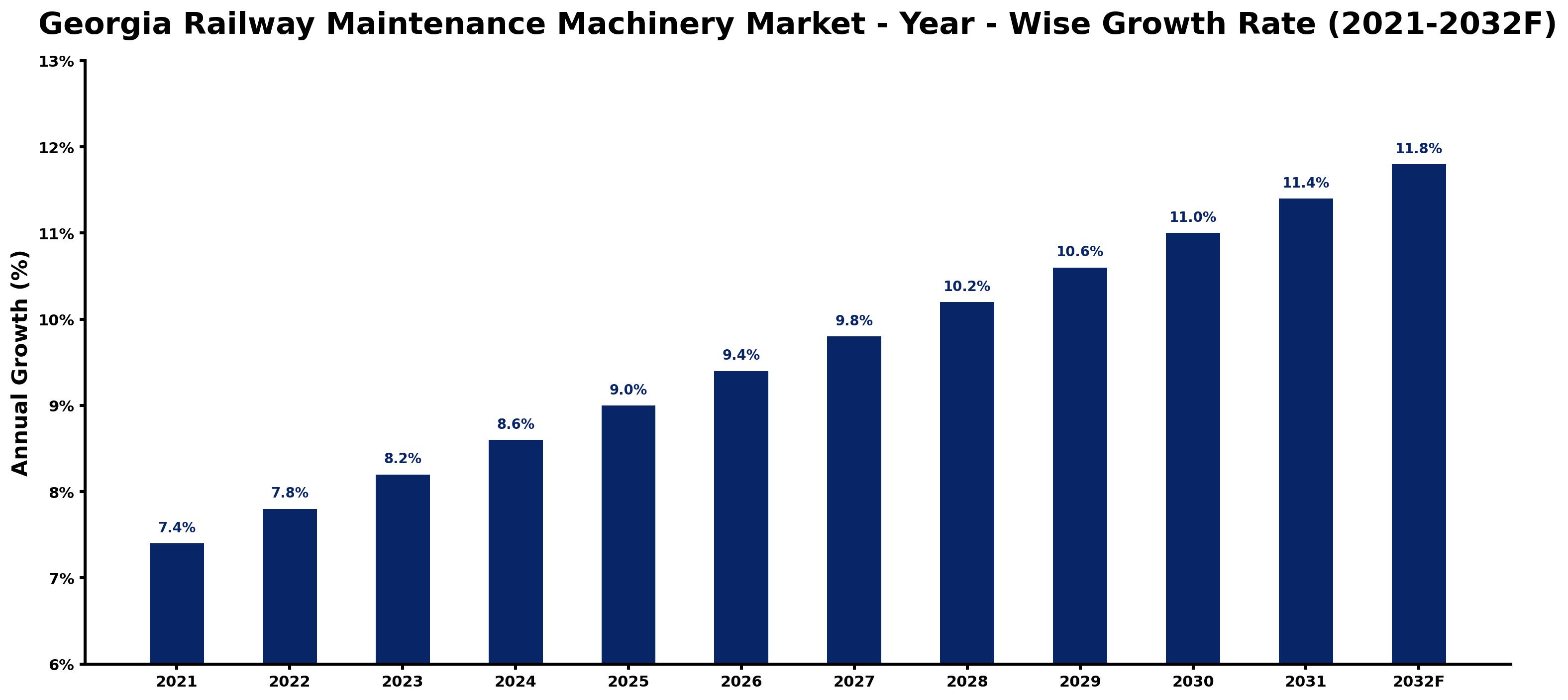
The table below presents the year‑wise growth rates along with the key drivers influencing the market
| Year | Growth Rate | Major Drivers |
| 2021 | 7.4% | Expansion of manufacturing activities |
| 2022 | 7.8% | Rising electricity demand across industries |
| 2023 | 8.2% | Increasing smart city development projects |
| 2024 | 8.6% | Increasing adoption of advanced technologies |
| 2025 | 9.0% | Growing urbanization and commercial development |
| 2026 | 9.4% | Expansion of transportation and logistics networks |
| 2027 | 9.8% | Expansion of commercial construction activities |
| 2028 | 10.2% | Growing renewable energy integration projects |
| 2029 | 10.6% | Rapid growth in telecom and data center sectors |
| 2030 | 11.0% | Rising electricity demand across industries |
| 2031 | 11.4% | Expansion of transportation and logistics networks |
| 2032 | 11.8% | Increasing industrial infrastructure investments |
Note - Market size estimations and growth projections presented in this report are based on 6Wresearch's advanced forecasting approach, validated with industry datasets as of June 2026.
Georgia Railway Maintenance Machinery Market Synopsis
Georgia's railway maintenance machinery landscape is currently vibrant, reflecting the state's commitment to modernizing its rail infrastructure. The increasing demand for effective maintenance solutions is underlined by the integration of smart technologies that enhance productivity and safety across railway operations.
As the state elevates its investment in transportation initiatives, market players are diversifying their offerings to meet specific needs of railway operators. This adaptability is crucial, given the competitive nature of the sector and the growing emphasis on sustainability.
Georgia Railway Maintenance Machinery Market Key Takeaways
- Continuous investment in railway infrastructure underpins the market's growth.
- Technological advancements are driving demand for automated and efficient maintenance solutions.
- Sustainability practices are becoming increasingly important in machinery development.
- Growing customization of maintenance machinery to meet operational needs is evident.
- Government regulations are shaping the industry's evolution towards higher safety and efficiency standards.
Evaluation of Restraints in Georgia Railway Maintenance Machinery Market
Despite the positive growth prospects, the Georgia Railway Maintenance Machinery Market faces several significant restraints. The constant demand for technological upgrades presents a challenge, as companies must continually innovate to keep pace with industry developments. Additionally, stringent regulatory frameworks governing safety standards impose further complexities in the design and manufacturing processes. These factors create hurdles for market participants, necessitating a strategic approach to remain competitive while adhering to compliance requirements.
Georgia Railway Maintenance Machinery Market Trends
The market is witnessing an encouraging trend towards digital transformation, with IoT sensors and predictive maintenance tools emerging as key components of modern railway machinery. Furthermore, there is a growing emphasis on eco-friendly practices, compelling manufacturers to adopt energy-efficient solutions in their product lines. The integration of automation technologies is not only enhancing operational efficiencies but also improving the safety profile of railway maintenance activities.
Georgia Railway Maintenance Machinery Market Opportunities
Investment opportunities abound in the Georgia Railway Maintenance Machinery Market, particularly in segments such as track maintenance and inspection equipment. The rise of sophisticated technologies, including AI-driven diagnostics, opens new avenues for product development. Furthermore, the strategic position of Georgia as a transport hub augurs well for attracting investments from domestic and international stakeholders eager to tap into the burgeoning railway sector.
Government Initiatives in the Georgia Railway Maintenance Machinery Market
Government policies play a pivotal role in shaping the Georgia Railway Maintenance Machinery Market. Emphasizing safety, efficiency, and environmental sustainability, these policies include stringent regulations for railway operations and incentives for adopting advanced machinery. The government is also promoting workforce training initiatives to elevate industry standards, thereby enhancing overall maintenance capabilities within the railway sector.
Future Insights of the Georgia Railway Maintenance Machinery Market
Looking ahead to 2026-2032, the Georgia Railway Maintenance Machinery Market is set for consistent growth, propelled by sustained investments in railway infrastructure and rising demands for innovative maintenance solutions. As technological advancements redefine maintenance capabilities, market participants must adapt to this rapidly evolving landscape. The government's ongoing commitment to enhancing rail transport efficiency further solidifies the optimistic outlook for this sector.
Georgia Railway Maintenance Machinery Market Latest Developments (May 2025 - June 2026)
Recent developments within the Georgia Railway Maintenance Machinery Market reflect a dynamic landscape, with an increasing shift towards automation and advanced monitoring systems. As companies prioritize the development of next-generation maintenance solutions, partnerships and collaborations are becoming common to foster innovation. The focus on sustainability is also driving the introduction of greener equipment that minimizes environmental impacts while maximizing efficiency.
Georgia Railway Maintenance Machinery Market - Key Attractiveness of the Report
- 10 Years of Market Numbers
- Historical Data Starting from 2022 to 2025
- Base Year: 2025
- Forecast Data until 2032
- Key Performance Indicators Impacting the Market
- Major Upcoming Developments and Projects
Key Highlights of the Report:
- Georgia Railway Maintenance Machinery Market Outlook
- Market Size of Georgia Railway Maintenance Machinery Market, 2025
- Forecast of Georgia Railway Maintenance Machinery Market, 2032F
- Historical Data and Forecast of Georgia Railway Maintenance Machinery Revenues & Volume for the Period 2022-2032F
- Georgia Railway Maintenance Machinery Market Trend Evolution
- Georgia Railway Maintenance Machinery Market Drivers and Challenges
- Georgia Railway Maintenance Machinery Price Trends
- Georgia Railway Maintenance Machinery Porter's Five Forces
- Georgia Railway Maintenance Machinery Industry Life Cycle
- Historical Data and Forecast of Georgia Railway Maintenance Machinery Market Revenues & Volume By Type for the Period 2022-2032F
- Historical Data and Forecast of Georgia Railway Maintenance Machinery Market Revenues & Volume By Tamping Machine for the Period 2022-2032F
- Historical Data and Forecast of Georgia Railway Maintenance Machinery Market Revenues & Volume By Stabilizing Machinery for the Period 2022-2032F
- Historical Data and Forecast of Georgia Railway Maintenance Machinery Market Revenues & Volume By Rail Handling Machinery for the Period 2022-2032F
- Historical Data and Forecast of Georgia Railway Maintenance Machinery Market Revenues & Volume By Ballast Cleaning Machine for the Period 2022-2032F
- Historical Data and Forecast of Georgia Railway Maintenance Machinery Market Revenues & Volume By Other for the Period 2022-2032F
- Historical Data and Forecast of Georgia Railway Maintenance Machinery Market Revenues & Volume By Applications for the Period 2022-2032F
- Historical Data and Forecast of Georgia Railway Maintenance Machinery Market Revenues & Volume By Ballast Track for the Period 2022-2032F
- Historical Data and Forecast of Georgia Railway Maintenance Machinery Market Revenues & Volume By Ballastless Track for the Period 2022-2032F
- Georgia Railway Maintenance Machinery Import Export Trade Statistics
- Market Opportunity Assessment By Type
- Market Opportunity Assessment By Applications
- Georgia Railway Maintenance Machinery Top Companies Market Share
- Georgia Railway Maintenance Machinery Competitive Benchmarking By Technical and Operational Parameters
- Georgia Railway Maintenance Machinery Company Profiles
- Georgia Railway Maintenance Machinery Key Strategic Recommendations






































