Germany Automotive Brake Pads Market Size Growth Rate
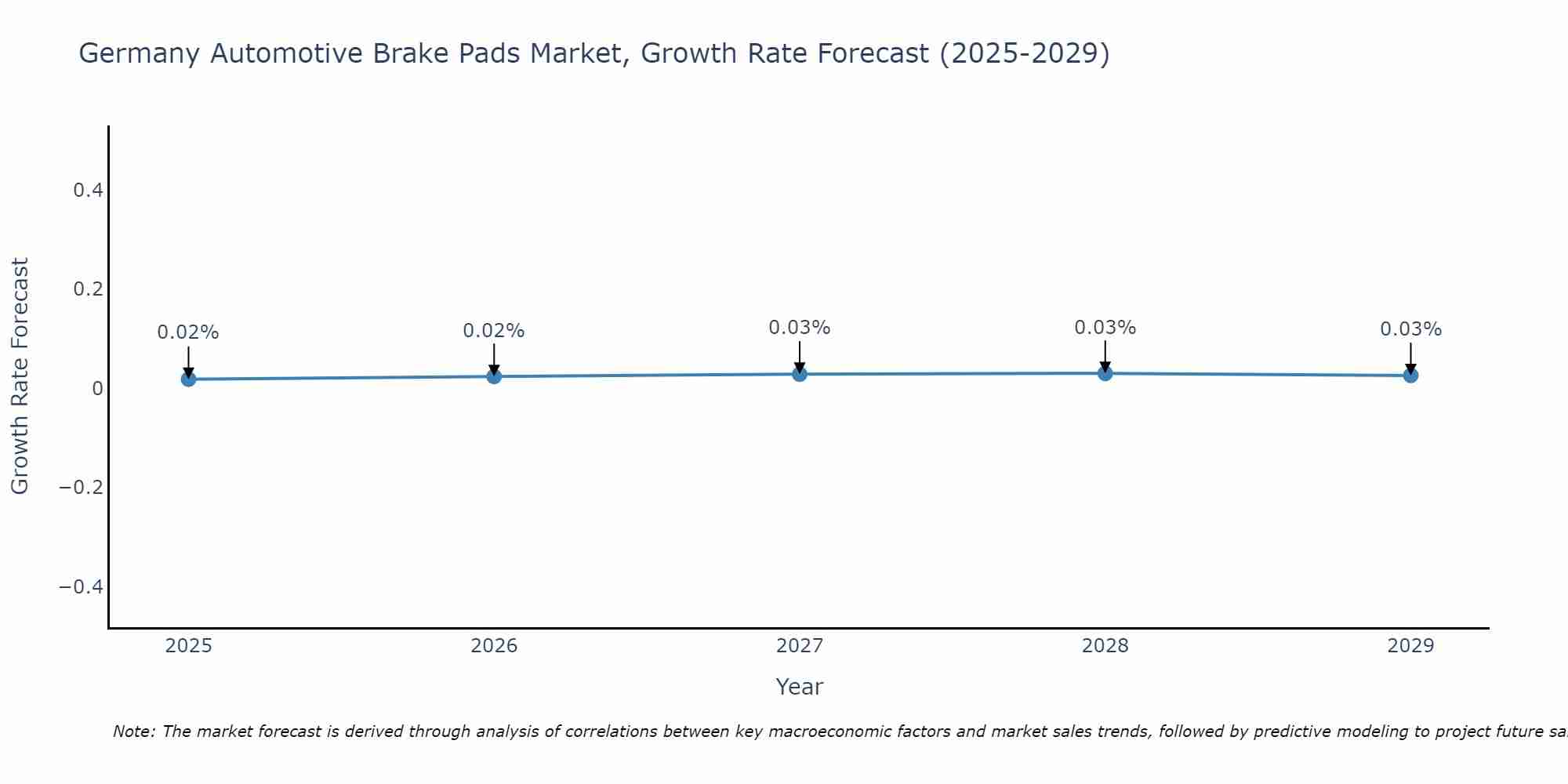
The Germany Automotive Brake Pads Market is projected to witness mixed growth rate patterns during 2025 to 2029. Starting at 0.02% in 2025, the market peaks at 0.03% in 2028, and settles at 0.03% by 2029.
Germany Automotive Brake Pads Market Overview
The Germany Automotive Brake Pads Market is a mature and highly competitive industry characterized by the presence of key players such as Bosch, Continental AG, and Akebono Brake Corporation. The market is driven by the country`s strong automotive manufacturing sector and strict safety regulations that prioritize the use of high-quality brake components. German consumers are increasingly focused on performance and durability, leading to a growing demand for advanced brake pad technologies such as ceramic and semi-metallic compounds. The market is also witnessing a shift towards eco-friendly and noise-reducing brake pads in line with sustainability trends. Industry players are investing in research and development to introduce innovative products and gain a competitive edge in the market, ensuring steady growth and evolution in the coming years.
Germany Automotive Brake Pads Market Trends
The Germany Automotive Brake Pads Market is currently experiencing a shift towards eco-friendly and high-performance brake pads. With an increasing focus on sustainability and environmental impact, there is a growing demand for brake pads made from materials such as ceramic and low-metallic compounds that offer better performance while reducing harmful emissions. Additionally, advancements in technology have led to the development of smart brake pads equipped with sensors for predictive maintenance and improved safety features. The market is also witnessing a rise in the adoption of electric vehicles, driving the demand for specialized brake pads tailored to the unique requirements of these vehicles. Overall, the Germany Automotive Brake Pads Market is evolving towards more efficient, durable, and environmentally friendly solutions to meet the changing needs of consumers and regulatory standards.
Germany Automotive Brake Pads Market Challenges
In the Germany Automotive Brake Pads Market, some key challenges include increasing competition from international manufacturers, stringent regulations related to environmental sustainability and safety standards, and the ongoing shift towards electric vehicles impacting the demand for traditional brake pads. Additionally, the market faces pressure to innovate and develop advanced brake pad technologies to meet the evolving needs of consumers for improved performance and durability. Price volatility of raw materials such as steel and friction materials also pose challenges in maintaining profit margins for manufacturers. Overall, navigating these challenges requires companies in the Germany Automotive Brake Pads Market to focus on innovation, sustainability, and strategic partnerships to stay competitive and meet the changing market demands.
Germany Automotive Brake Pads Market Investment Opportunities
The Germany Automotive Brake Pads Market offers various investment opportunities for market players. With increasing demand for advanced braking systems in the automotive sector due to safety and regulatory requirements, investing in innovative brake pad technologies such as ceramic or low-metallic formulations can be lucrative. Additionally, the growing trend towards electric vehicles and the need for specialized brake pads for these vehicles present another avenue for investment. Collaborating with automotive manufacturers to develop customized brake pad solutions tailored to specific vehicle models can also be a profitable strategy. Overall, the Germany Automotive Brake Pads Market is dynamic and offers opportunities for investors to capitalize on evolving trends and technological advancements in the automotive industry.
Germany Automotive Brake Pads Market Government Policy
Government policies in Germany related to the Automotive Brake Pads Market primarily focus on environmental regulations and safety standards. The German government has implemented stringent laws to reduce emissions and promote the use of environmentally friendly materials in automotive brake pads. Additionally, there are regulations in place to ensure the safety and quality of brake pads to protect consumers and maintain high standards in the automotive industry. Manufacturers in the Germany Automotive Brake Pads Market are required to comply with these policies to ensure sustainability, environmental protection, and consumer safety. Compliance with these government regulations is crucial for companies operating in the market to maintain their competitive edge and reputation.
Germany Automotive Brake Pads Market Future Outlook
The Germany Automotive Brake Pads Market is expected to witness steady growth in the coming years due to factors such as increasing vehicle production, growing demand for electric vehicles, and stringent regulations regarding vehicle safety standards. The market is also likely to benefit from technological advancements in brake pad materials, leading to improved performance and durability. Additionally, the shift towards sustainable and eco-friendly transportation solutions is projected to drive the demand for high-quality brake pads that offer enhanced efficiency and reduced environmental impact. Overall, the Germany Automotive Brake Pads Market is anticipated to expand as automotive manufacturers focus on enhancing vehicle safety and performance, creating opportunities for market players to innovate and cater to the evolving needs of consumers.
Key Highlights of the Report:
- Germany Automotive Brake Pads Market Outlook
- Market Size of Germany Automotive Brake Pads Market, 2021
- Forecast of Germany Automotive Brake Pads Market, 2031
- Historical Data and Forecast of Germany Automotive Brake Pads Revenues & Volume for the Period 2018 - 2031
- Germany Automotive Brake Pads Market Trend Evolution
- Germany Automotive Brake Pads Market Drivers and Challenges
- Germany Automotive Brake Pads Price Trends
- Germany Automotive Brake Pads Porter's Five Forces
- Germany Automotive Brake Pads Industry Life Cycle
- Historical Data and Forecast of Germany Automotive Brake Pads Market Revenues & Volume By Vehicle for the Period 2018 - 2031
- Historical Data and Forecast of Germany Automotive Brake Pads Market Revenues & Volume By Passenger Car for the Period 2018 - 2031
- Historical Data and Forecast of Germany Automotive Brake Pads Market Revenues & Volume By LCV for the Period 2018 - 2031
- Historical Data and Forecast of Germany Automotive Brake Pads Market Revenues & Volume By HCV for the Period 2018 - 2031
- Historical Data and Forecast of Germany Automotive Brake Pads Market Revenues & Volume By Two-wheelers for the Period 2018 - 2031
- Historical Data and Forecast of Germany Automotive Brake Pads Market Revenues & Volume By Material for the Period 2018 - 2031
- Historical Data and Forecast of Germany Automotive Brake Pads Market Revenues & Volume By Semi-metallic for the Period 2018 - 2031
- Historical Data and Forecast of Germany Automotive Brake Pads Market Revenues & Volume By Non-asbestos Organic (NAO) for the Period 2018 - 2031
- Historical Data and Forecast of Germany Automotive Brake Pads Market Revenues & Volume By Low-metallic NAO for the Period 2018 - 2031
- Historical Data and Forecast of Germany Automotive Brake Pads Market Revenues & Volume By Ceramic for the Period 2018 - 2031
- Historical Data and Forecast of Germany Automotive Brake Pads Market Revenues & Volume By Sales Outlet for the Period 2018 - 2031
- Historical Data and Forecast of Germany Automotive Brake Pads Market Revenues & Volume By OEM for the Period 2018 - 2031
- Historical Data and Forecast of Germany Automotive Brake Pads Market Revenues & Volume By Aftermarket for the Period 2018 - 2031
- Historical Data and Forecast of Germany Automotive Brake Pads Market Revenues & Volume By Position for the Period 2018 - 2031
- Historical Data and Forecast of Germany Automotive Brake Pads Market Revenues & Volume By Front for the Period 2018 - 2031
- Historical Data and Forecast of Germany Automotive Brake Pads Market Revenues & Volume By Front & Rear for the Period 2018 - 2031
- Germany Automotive Brake Pads Import Export Trade Statistics
- Market Opportunity Assessment By Vehicle
- Market Opportunity Assessment By Material
- Market Opportunity Assessment By Sales Outlet
- Market Opportunity Assessment By Position
- Germany Automotive Brake Pads Top Companies Market Share
- Germany Automotive Brake Pads Competitive Benchmarking By Technical and Operational Parameters
- Germany Automotive Brake Pads Company Profiles
- Germany Automotive Brake Pads Key Strategic Recommendations






































