South Africa Automotive Brake Pads Market Size Growth Rate
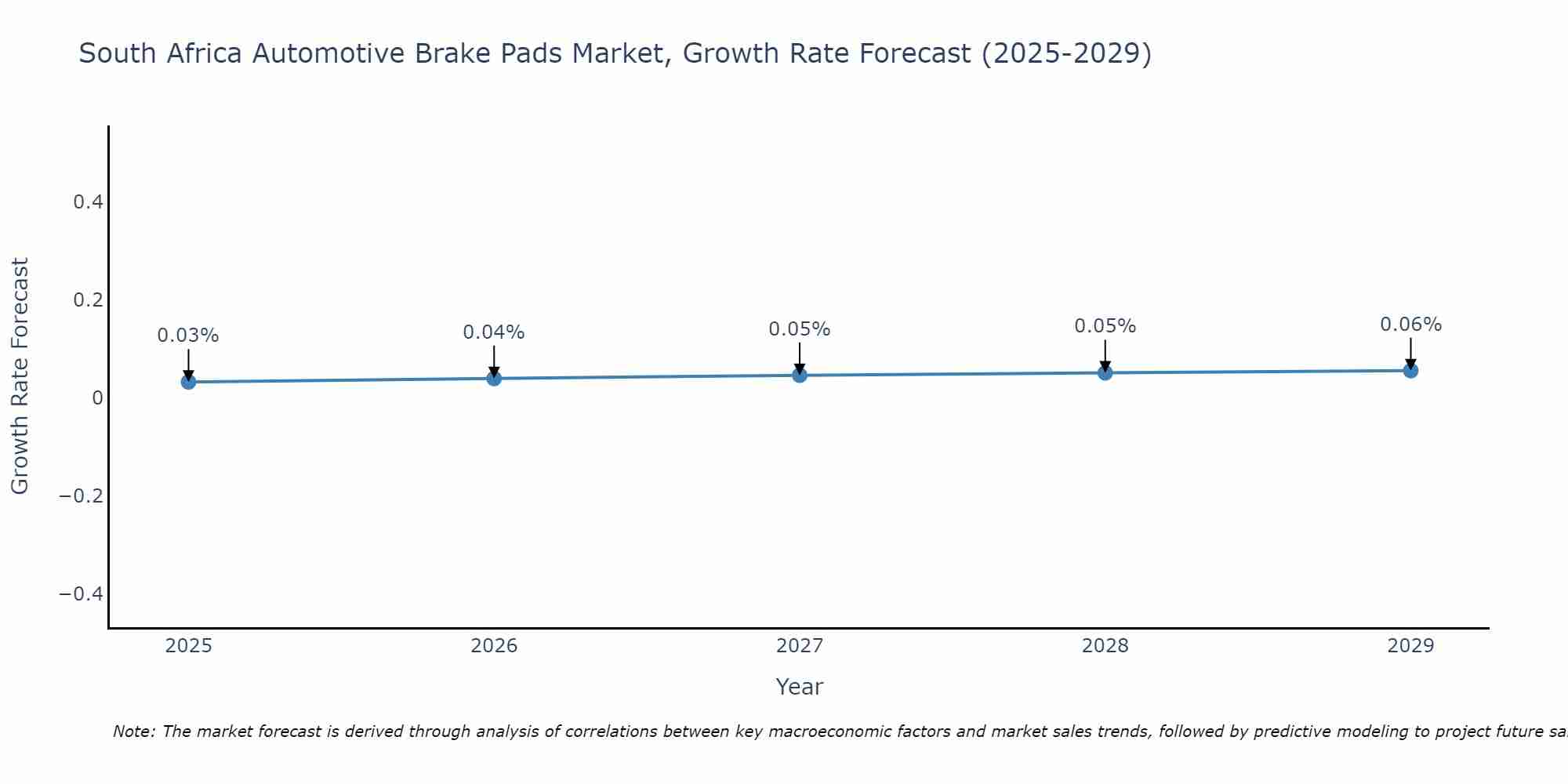
The South Africa Automotive Brake Pads Market is poised for steady growth rate improvements from 2025 to 2029. The growth rate starts at 0.03% in 2025 and reaches 0.06% by 2029.
South Africa Automotive Brake Pads Market Overview
The South Africa Automotive Brake Pads Market is witnessing steady growth driven by increasing vehicle sales and a growing demand for aftermarket brake pads due to the country`s expanding automotive industry. The market is characterized by the presence of both domestic and international key players such as ATE Brakes, Bosch, and Ferodo, who are continuously innovating to meet the evolving consumer preferences and stringent safety regulations. Factors such as rising consumer awareness regarding vehicle safety, technological advancements in brake pad materials, and the emphasis on reducing carbon emissions are expected to further fuel market growth. Additionally, the shift towards electric vehicles and the development of advanced braking systems are likely to offer lucrative opportunities for market expansion in the foreseeable future.
South Africa Automotive Brake Pads Market Trends
The South Africa Automotive Brake Pads Market is experiencing a shift towards eco-friendly and high-performance brake pads. There is a growing demand for low-noise, low-dust, and long-lasting brake pads that offer improved safety and performance. Manufacturers are increasingly focusing on developing advanced brake pad materials such as ceramic and semi-metallic compounds to meet these demands. Additionally, there is a rising preference for brake pads that are compatible with electric and hybrid vehicles, reflecting the increasing shift towards alternative fuel vehicles in the market. Overall, the South Africa Automotive Brake Pads Market is witnessing a trend towards innovative and sustainable brake pad solutions that cater to both performance and environmental concerns.
South Africa Automotive Brake Pads Market Challenges
The South Africa Automotive Brake Pads Market faces several challenges, including intense competition from both domestic and international manufacturers, fluctuating raw material prices, and increasing pressure to comply with stringent environmental regulations. The market is also impacted by the overall economic conditions in the country, leading to fluctuations in consumer demand for vehicles and aftermarket products like brake pads. Additionally, the presence of counterfeit products in the market poses a threat to legitimate manufacturers, impacting their market share and brand reputation. To succeed in this competitive landscape, companies in the South Africa Automotive Brake Pads Market need to focus on innovation, quality, and marketing strategies to differentiate themselves and attract customers amidst these challenges.
South Africa Automotive Brake Pads Market Investment Opportunities
The South Africa Automotive Brake Pads Market presents promising investment opportunities due to the growing demand for high-quality brake pads driven by an increasing number of vehicles on the road. With a focus on safety and performance, there is a preference for reliable and durable brake pads in the market. Investors can consider opportunities in manufacturing and distributing innovative brake pads using advanced materials and technologies to meet the evolving needs of consumers. Additionally, there is potential for growth in the aftermarket segment as vehicle owners seek replacement brake pads to ensure optimal vehicle performance and safety. Collaborating with local automotive manufacturers and suppliers to establish a strong distribution network and brand presence could further enhance investment prospects in the South Africa Automotive Brake Pads Market.
South Africa Automotive Brake Pads Market Government Policy
The South African government has implemented policies aimed at promoting the automotive industry, including the brake pads market. The Automotive Production and Development Programme (APDP) provides incentives to manufacturers for local production and assembly, encouraging investment in the sector. Additionally, the National Association of Automotive Component and Allied Manufacturers (NAACAM) works closely with the government to support local suppliers and enhance competitiveness. The government has also emphasized the importance of environmental sustainability in manufacturing processes, driving the adoption of eco-friendly materials for brake pads. Overall, these policies aim to stimulate growth in the South African automotive brake pads market by fostering local manufacturing, supporting suppliers, and promoting sustainability initiatives.
South Africa Automotive Brake Pads Market Future Outlook
The South Africa Automotive Brake Pads Market is expected to witness steady growth in the coming years due to several factors such as an increasing number of vehicles on the road, rising awareness about road safety, and advancements in brake pad technology. The growing demand for electric vehicles and the implementation of stringent regulations regarding vehicle safety standards are also likely to drive market growth. Additionally, the focus on reducing carbon emissions and improving fuel efficiency in vehicles is expected to propel the adoption of innovative brake pad materials. However, challenges such as economic uncertainties and fluctuations in raw material prices may hinder market expansion. Overall, the South Africa Automotive Brake Pads Market is poised for growth, driven by technological advancements and a heightened emphasis on vehicle safety and performance.
Key Highlights of the Report:
- South Africa Automotive Brake Pads Market Outlook
- Market Size of South Africa Automotive Brake Pads Market, 2021
- Forecast of South Africa Automotive Brake Pads Market, 2031
- Historical Data and Forecast of South Africa Automotive Brake Pads Revenues & Volume for the Period 2018 - 2031
- South Africa Automotive Brake Pads Market Trend Evolution
- South Africa Automotive Brake Pads Market Drivers and Challenges
- South Africa Automotive Brake Pads Price Trends
- South Africa Automotive Brake Pads Porter's Five Forces
- South Africa Automotive Brake Pads Industry Life Cycle
- Historical Data and Forecast of South Africa Automotive Brake Pads Market Revenues & Volume By Vehicle for the Period 2018 - 2031
- Historical Data and Forecast of South Africa Automotive Brake Pads Market Revenues & Volume By Passenger Car for the Period 2018 - 2031
- Historical Data and Forecast of South Africa Automotive Brake Pads Market Revenues & Volume By LCV for the Period 2018 - 2031
- Historical Data and Forecast of South Africa Automotive Brake Pads Market Revenues & Volume By HCV for the Period 2018 - 2031
- Historical Data and Forecast of South Africa Automotive Brake Pads Market Revenues & Volume By Two-wheelers for the Period 2018 - 2031
- Historical Data and Forecast of South Africa Automotive Brake Pads Market Revenues & Volume By Material for the Period 2018 - 2031
- Historical Data and Forecast of South Africa Automotive Brake Pads Market Revenues & Volume By Semi-metallic for the Period 2018 - 2031
- Historical Data and Forecast of South Africa Automotive Brake Pads Market Revenues & Volume By Non-asbestos Organic (NAO) for the Period 2018 - 2031
- Historical Data and Forecast of South Africa Automotive Brake Pads Market Revenues & Volume By Low-metallic NAO for the Period 2018 - 2031
- Historical Data and Forecast of South Africa Automotive Brake Pads Market Revenues & Volume By Ceramic for the Period 2018 - 2031
- Historical Data and Forecast of South Africa Automotive Brake Pads Market Revenues & Volume By Sales Outlet for the Period 2018 - 2031
- Historical Data and Forecast of South Africa Automotive Brake Pads Market Revenues & Volume By OEM for the Period 2018 - 2031
- Historical Data and Forecast of South Africa Automotive Brake Pads Market Revenues & Volume By Aftermarket for the Period 2018 - 2031
- Historical Data and Forecast of South Africa Automotive Brake Pads Market Revenues & Volume By Position for the Period 2018 - 2031
- Historical Data and Forecast of South Africa Automotive Brake Pads Market Revenues & Volume By Front for the Period 2018 - 2031
- Historical Data and Forecast of South Africa Automotive Brake Pads Market Revenues & Volume By Front & Rear for the Period 2018 - 2031
- South Africa Automotive Brake Pads Import Export Trade Statistics
- Market Opportunity Assessment By Vehicle
- Market Opportunity Assessment By Material
- Market Opportunity Assessment By Sales Outlet
- Market Opportunity Assessment By Position
- South Africa Automotive Brake Pads Top Companies Market Share
- South Africa Automotive Brake Pads Competitive Benchmarking By Technical and Operational Parameters
- South Africa Automotive Brake Pads Company Profiles
- South Africa Automotive Brake Pads Key Strategic Recommendations






































