Germany Cloud Managed Services Market Size & Growth Rate (2026-2032)
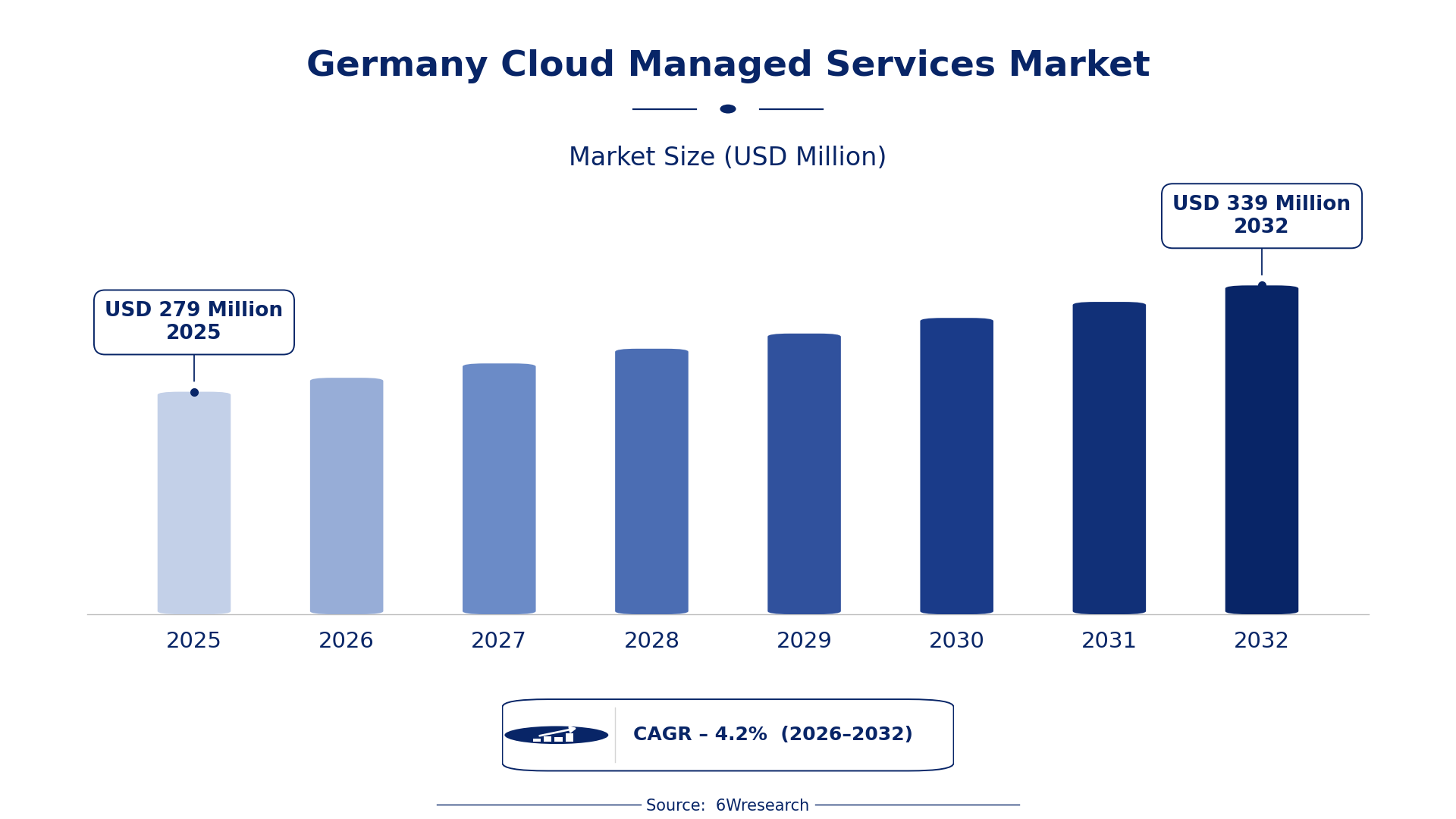
The Germany Cloud Managed Services Market was estimated at USD 279 Million in 2025 and is projected to reach USD 339 Million by 2032, growing at a CAGR of 4.2% from 2026 to 2032.
Germany Cloud Managed Services Market Synopsis
The Germany Cloud Managed Services Market is witnessing a notable shift as organizations increasingly rely on managed service providers (MSPs) to streamline their cloud operations. With the complexity of cloud environments on the rise, companies are eager to offload IT management tasks to focus on their core competencies and innovation.
The demand for managed services is driven by the need for enhanced security, cost optimization, and performance improvement. As businesses grapple with a shortage of skilled IT professionals, the role of MSPs in providing essential support becomes more critical. This trend is shaping the future of cloud management in Germany.
Germany Cloud Managed Services Market Year-wise Growth Rate and Key Drivers
This graph illustrates the annual growth rates of the Germany Cloud Managed Services Market from 2021 to 2032, highlighting a steady upward trajectory and projected expansion over the forecast period.
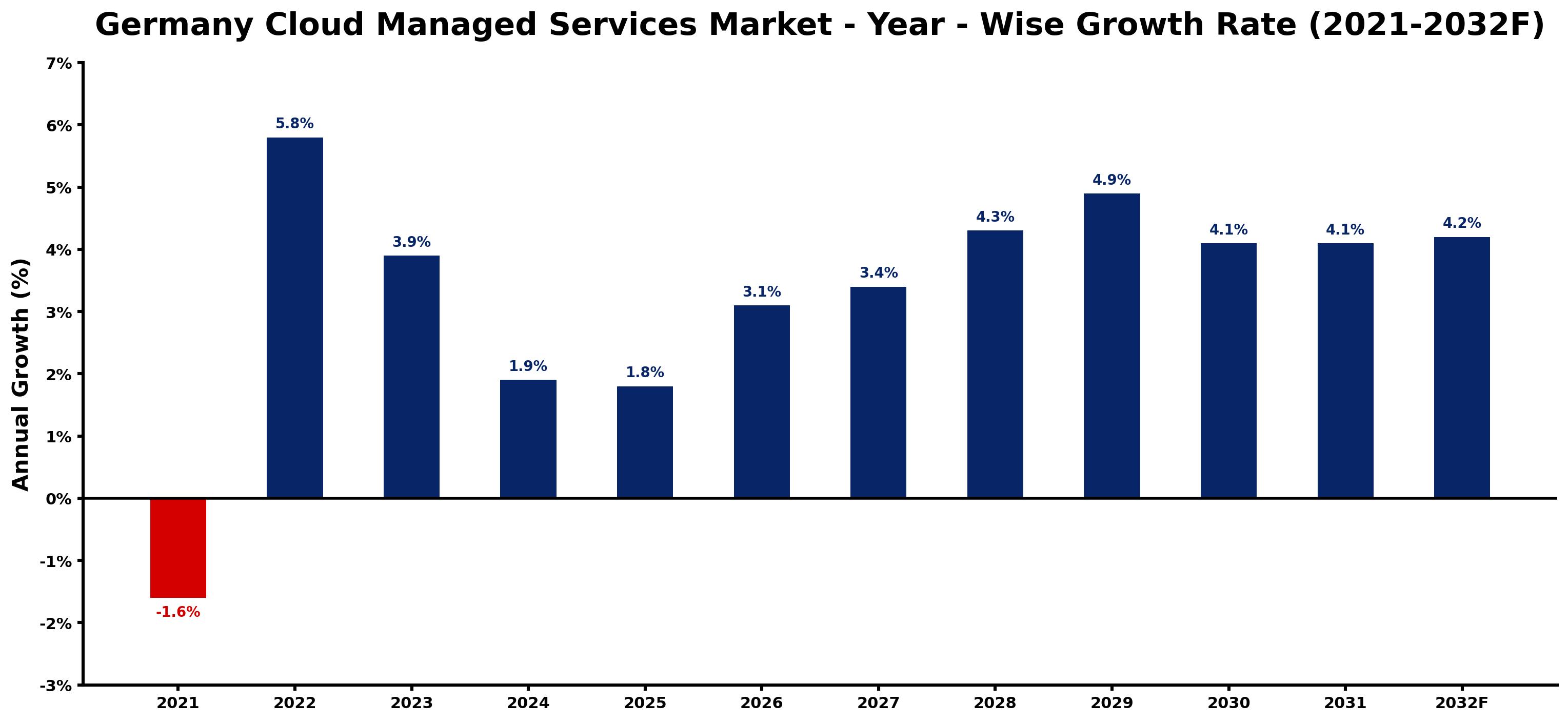
The table below presents the year‑wise growth rates along with the key drivers influencing the market
| Year | Growth Rate | Major Drivers |
| 2021 | -1.6% | Germany's strict data protection regulations hindered cloud adoption. |
| 2022 | 5.8% | German companies investing in cybersecurity for cloud services. |
| 2023 | 3.9% | Rising data protection regulations driving managed service demand. |
| 2024 | 1.9% | Increased cloud utilization among mid-sized German enterprises. |
| 2025 | 1.8% | Growth in IoT applications necessitating cloud management solutions. |
| 2026 | 3.1% | Sustainability initiatives promoting eco-friendly cloud services adoption. |
| 2027 | 3.4% | Government backing for cloud innovation accelerates market growth. |
| 2028 | 4.3% | Digital health initiatives fostering cloud solutions in healthcare. |
| 2029 | 4.9% | Adoption of Industry 4.0 solutions increasing cloud service needs. |
| 2030 | 4.1% | Increased digitization in retail boosting cloud service utilization. |
| 2031 | 4.1% | Rise of e-commerce leading to cloud infrastructure expansion. |
| 2032 | 4.2% | Enhanced collaboration tools driving demand for managed cloud services. |
Note: Market size estimations and growth projections presented in this report are based on 6Wresearch's proprietary forecasting methodology, utilizing the latest available industry data, government publications, and primary research inputs.
Germany Cloud Managed Services Market Key Takeaways
Below are some of the specific key takeaways from the market, including:
- The complexity of cloud management drives organizations to outsource their IT operations.
- Security concerns and data protection regulations are critical for MSPs to address.
- The shortage of skilled IT professionals amplifies the demand for managed services.
- MSPs must focus on differentiation to stand out in a competitive market.
- Government initiatives supporting digitalization and cybersecurity are propelling market growth.
Evaluation of Restraints in Germany Cloud Managed Services Market
Despite the growing demand for cloud managed services, several restraints hinder market growth. One primary concern is the challenge of differentiation among MSPs in a crowded marketplace. As many providers offer similar services, standing out becomes increasingly difficult. Additionally, scalability poses a significant challenge; MSPs must ensure that they can adapt to the evolving needs of their clients while maintaining high service quality.
Security remains a paramount issue, with increasing threats necessitating robust measures to protect sensitive data. Compliance with stringent data protection regulations adds another layer of complexity, requiring ongoing investment in security protocols. These factors collectively impact the ability of MSPs to capitalize fully on the market opportunities available.
Germany Cloud Managed Services Market Trends
Several trends are currently shaping the Germany Cloud Managed Services Market. The demand for specialized services, such as industry-specific solutions, is on the rise. Organizations are looking for MSPs that can provide tailored offerings that align with their unique requirements.
Another noteworthy trend is the increasing emphasis on cybersecurity solutions. As cyber threats become more sophisticated, businesses are prioritizing security in their cloud strategies. MSPs that can offer advanced security features and compliance support will have a competitive edge moving forward.
Germany Cloud Managed Services Market Opportunities
The future looks promising for the Germany Cloud Managed Services Market, especially for those who can capitalize on emerging opportunities. With the ongoing digital transformation across industries, there is a growing need for MSPs to offer integrated solutions that encompass cloud migration, monitoring, and management.
Investments in automation and AI-driven services present additional avenues for growth. MSPs that can harness these technologies to enhance service delivery will likely attract a broader client base. on top of that, the push for sustainability in IT operations opens doors for MSPs to provide eco-friendly cloud solutions.
Government Initiatives in the Germany Cloud Managed Services Market
The German government has taken significant steps to enhance digitalization and cybersecurity within the country, directly impacting the cloud managed services market. Recent policies focus on promoting IT resilience and ensuring compliance with stringent data protection standards, making it essential for organizations to adopt managed services for robust cloud management.
- A national digital infrastructure upgrade programme launched in early 2025 aims to enhance cloud connectivity and access.
- Current initiatives are underway to establish a regulatory framework for cloud service transparency and security compliance.
- A planned public-private partnership expected to roll out by 2026 aims to bolster cybersecurity training for IT professionals.
- The government is currently implementing a strategy to incentivize businesses to adopt cloud solutions for improved efficiency.
- Ongoing assessments of data protection regulations will further shape the landscape for cloud services in Germany.
Future Insights of the Germany Cloud Managed Services Market
Looking ahead to 2026-2032, the Germany Cloud Managed Services Market is expected to grow steadily as organizations increasingly recognize the value of outsourcing IT management. The focus will shift towards integrated services that not only enhance operational efficiency but also prioritize security and compliance.
MSPs that can adapt to changing market dynamics, embrace technological advancements, and offer specialized solutions will be well-positioned to thrive. The emphasis on sustainability and eco-friendly practices will also gain traction, influencing the direction of service offerings.
Germany Cloud Managed Services Market Latest Developments
Over the past year, the Germany Cloud Managed Services Market has seen significant activity as organizations increasingly seek reliable partners to manage their cloud environments. The focus has been on enhancing service offerings and addressing emerging security concerns.
- A major technology vendor launched a new suite of cybersecurity services in Q1 2025, aimed at bolstering cloud security for businesses.
- An initiative that began in mid-2025 and remains underway focuses on developing AI-driven tools to optimize cloud performance and cost-efficiency.
- A leading regional operator is currently expanding its cloud service portfolio to include more industry-specific solutions by late 2025.
- A public-private collaboration has been initiated to enhance training programs for IT professionals, expected to commence in early 2026.
- Upcoming projects are in the pipeline to establish new data centers across Germany to improve cloud service accessibility by 2027.
Germany Cloud Managed Services Market - Key Attractiveness of the Report
- 10 Years of Market Numbers
- Historical Data Starting from 2022 to 2025
- Base Year: 2025
- Forecast Data until 2032
- Key Performance Indicators Impacting the Market
- Major Upcoming Developments and Projects
Key Highlights of the Report:
- Germany Cloud Managed Services Market Outlook
- Market Size of Germany Cloud Managed Services Market, 2025
- Forecast of Germany Cloud Managed Services Market, 2032
- Historical Data and Forecast of Germany Cloud Managed Services Revenues & Volume for the Period 2022-2032F
- Germany Cloud Managed Services Market Trend Evolution
- Germany Cloud Managed Services Market Drivers and Challenges
- Germany Cloud Managed Services Price Trends
- Germany Cloud Managed Services Porter's Five Forces
- Germany Cloud Managed Services Industry Life Cycle
- Historical Data and Forecast of Germany Cloud Managed Services Market Revenues & Volume By Service Type for the Period 2022-2032F
- Historical Data and Forecast of Germany Cloud Managed Services Market Revenues & Volume By Managed Security Services for the Period 2022-2032F
- Historical Data and Forecast of Germany Cloud Managed Services Market Revenues & Volume By Managed Network Services for the Period 2022-2032F
- Historical Data and Forecast of Germany Cloud Managed Services Market Revenues & Volume By Managed Infrastructure Services for the Period 2022-2032F
- Historical Data and Forecast of Germany Cloud Managed Services Market Revenues & Volume By Managed Communication & Collaboration Services for the Period 2022-2032F
- Historical Data and Forecast of Germany Cloud Managed Services Market Revenues & Volume By Managed Mobility Services for the Period 2022-2032F
- Historical Data and Forecast of Germany Cloud Managed Services Market Revenues & Volume By Managed Business Services for the Period 2022-2032F
- Historical Data and Forecast of Germany Cloud Managed Services Market Revenues & Volume By Security Services for the Period 2022-2032F
- Historical Data and Forecast of Germany Cloud Managed Services Market Revenues & Volume By Managed Identity & Access Management for the Period 2022-2032F
- Historical Data and Forecast of Germany Cloud Managed Services Market Revenues & Volume By Managed Antivirus/Anti-Malware for the Period 2022-2032F
- Historical Data and Forecast of Germany Cloud Managed Services Market Revenues & Volume By Managed Firewall for the Period 2022-2032F
- Historical Data and Forecast of Germany Cloud Managed Services Market Revenues & Volume By Managed Risk & Compliance Management for the Period 2022-2032F
- Historical Data and Forecast of Germany Cloud Managed Services Market Revenues & Volume By Managed Vulnerability Management for the Period 2022-2032F
- Historical Data and Forecast of Germany Cloud Managed Services Market Revenues & Volume By Managed Security Information & Event Management for the Period 2022-2032F
- Historical Data and Forecast of Germany Cloud Managed Services Market Revenues & Volume By Managed Intrusion Detection System/Intrusion Prevention System for the Period 2022-2032F
- Historical Data and Forecast of Germany Cloud Managed Services Market Revenues & Volume By Managed Data Loss Prevention for the Period 2022-2032F
- Historical Data and Forecast of Germany Cloud Managed Services Market Revenues & Volume By Network Services for the Period 2022-2032F
- Historical Data and Forecast of Germany Cloud Managed Services Market Revenues & Volume By Managed Network Provisioning for the Period 2022-2032F
- Historical Data and Forecast of Germany Cloud Managed Services Market Revenues & Volume By Managed Network Monitoring & Management for the Period 2022-2032F
- Historical Data and Forecast of Germany Cloud Managed Services Market Revenues & Volume By Infrastructure Services for the Period 2022-2032F
- Historical Data and Forecast of Germany Cloud Managed Services Market Revenues & Volume By Storage Management for the Period 2022-2032F
- Historical Data and Forecast of Germany Cloud Managed Services Market Revenues & Volume By Server Management for the Period 2022-2032F
- Historical Data and Forecast of Germany Cloud Managed Services Market Revenues & Volume By Managed Print Services for the Period 2022-2032F
- Historical Data and Forecast of Germany Cloud Managed Services Market Revenues & Volume By Managed Communication & Collaboration Services for the Period 2022-2032F
- Historical Data and Forecast of Germany Cloud Managed Services Market Revenues & Volume By Managed Voice Over Internet Protocol for the Period 2022-2032F
- Historical Data and Forecast of Germany Cloud Managed Services Market Revenues & Volume By Managed Unified Communication as a Service for the Period 2022-2032F
- Historical Data and Forecast of Germany Cloud Managed Services Market Revenues & Volume By Managed Mobility Services for the Period 2022-2032F
- Historical Data and Forecast of Germany Cloud Managed Services Market Revenues & Volume By Device Management Services for the Period 2022-2032F
- Historical Data and Forecast of Germany Cloud Managed Services Market Revenues & Volume By Application Management Services for the Period 2022-2032F
- Historical Data and Forecast of Germany Cloud Managed Services Market Revenues & Volume By Managed Business Services for the Period 2022-2032F
- Historical Data and Forecast of Germany Cloud Managed Services Market Revenues & Volume By Business Process Services for the Period 2022-2032F
- Historical Data and Forecast of Germany Cloud Managed Services Market Revenues & Volume By Continuity & Disaster Recovery Services for the Period 2022-2032F
- Historical Data and Forecast of Germany Cloud Managed Services Market Revenues & Volume By Other Managed Business Services for the Period 2022-2032F
- Historical Data and Forecast of Germany Cloud Managed Services Market Revenues & Volume By Organization Size for the Period 2022-2032F
- Historical Data and Forecast of Germany Cloud Managed Services Market Revenues & Volume By SMEs for the Period 2022-2032F
- Historical Data and Forecast of Germany Cloud Managed Services Market Revenues & Volume By Large Enterprises for the Period 2022-2032F
- Germany Cloud Managed Services Import Export Trade Statistics
- Market Opportunity Assessment By Service Type
- Market Opportunity Assessment By Security Services
- Market Opportunity Assessment By Network Services
- Market Opportunity Assessment By Infrastructure Services
- Market Opportunity Assessment By Managed Communication & Collaboration Services
- Market Opportunity Assessment By Managed Mobility Services
- Market Opportunity Assessment By Managed Business Services
- Market Opportunity Assessment By Organization Size
- Germany Cloud Managed Services Top Companies Market Share
- Germany Cloud Managed Services Competitive Benchmarking By Technical and Operational Parameters
- Germany Cloud Managed Services Company Profiles
- Germany Cloud Managed Services Key Strategic Recommendations






































