Germany Connector Market: Import Trend Analysis
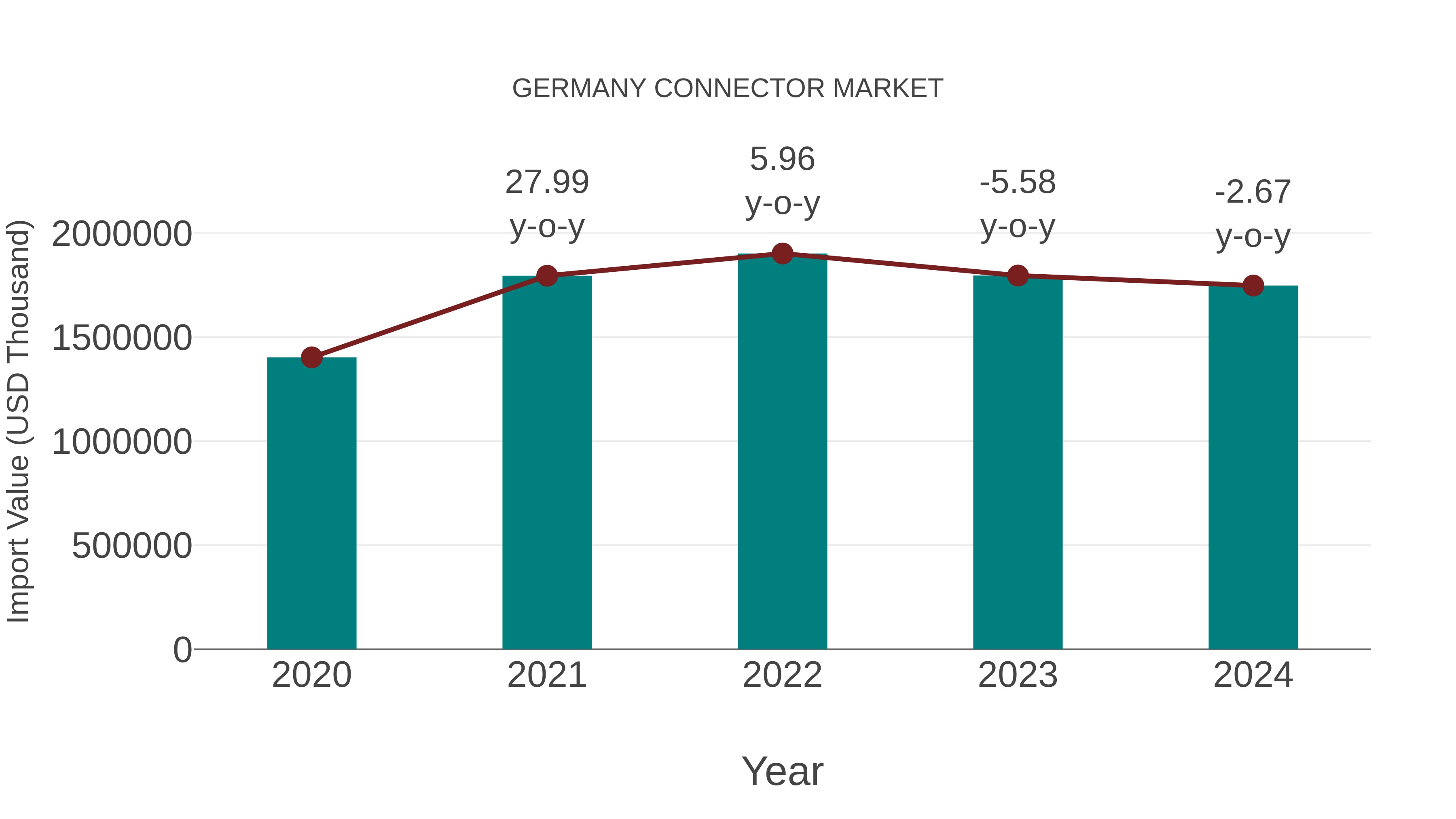
Germany`s import trend for the connector market experienced a slight decline from 2023 to 2024, with a growth rate of -2.67%. However, the compound annual growth rate (CAGR) for the period of 2020-2024 stood at a healthy 5.66%. This dip in import momentum could be attributed to temporary shifts in demand or adjustments in trade policies during that period.
Germany Connector Market Overview
The connector market in Germany is thriving, fueled by the country`s robust manufacturing sector and the adoption of advanced technologies across various industries. Connectors play a vital role in facilitating seamless connectivity in electronic devices, automotive systems, industrial machinery, and more. With increasing demand for high-speed data transmission, miniaturization, and reliability, Germany connector manufacturers are focusing on developing innovative solutions to meet diverse application requirements and stringent quality standards.
Drivers of the market
The Germany Connector Market is propelled by various factors such as the rapid digitization across industries, the proliferation of electronic devices, and the increasing demand for high-speed data transmission. Industries such as automotive, telecommunications, and consumer electronics are major consumers of connectors. Moreover, the emergence of advanced technologies like 5G, IoT, and autonomous vehicles further boosts the demand for connectors, especially those capable of handling high data rates and power transmission efficiently.
Challenges of the market
The connector market in Germany faces challenges related to technological advancements and evolving industry standards. As electronic devices become smaller and more complex, there is a growing demand for connectors that can support high-speed data transfer and power delivery while occupying minimal space. Manufacturers need to continually invest in research and development to stay ahead of these demands. Moreover, the market is highly competitive, with numerous players offering a wide range of connector solutions, making it essential for companies to differentiate their products through innovation and superior performance.
Government Policy of the market
The Germany connector market is witnessing steady growth, fueled by advancements in automotive, telecommunications, and industrial sectors. Connectors play a crucial role in establishing electrical and mechanical connections in various devices and systems, driving demand for high-quality, reliable solutions. Germany connector manufacturers are renowned for their engineering expertise and innovation, offering a diverse portfolio of products tailored to specific industry requirements. Moreover, the transition towards electric vehicles and Industry 4.0 initiatives is expected to further boost demand for connectors in the coming years, presenting lucrative opportunities for market players.
Key Highlights of the Report:
- Germany Connector Market Outlook
- Market Size of Germany Connector Market, 2024
- Forecast of Germany Connector Market, 2031
- Historical Data and Forecast of Germany Connector Revenues & Volume for the Period 2018 - 2031
- Germany Connector Market Trend Evolution
- Germany Connector Market Drivers and Challenges
- Germany Connector Price Trends
- Germany Connector Porter's Five Forces
- Germany Connector Industry Life Cycle
- Historical Data and Forecast of Germany Connector Market Revenues & Volume By Product for the Period 2018 - 2031
- Historical Data and Forecast of Germany Connector Market Revenues & Volume By PCB Connectors for the Period 2018 - 2031
- Historical Data and Forecast of Germany Connector Market Revenues & Volume By IO Connectors for the Period 2018 - 2031
- Historical Data and Forecast of Germany Connector Market Revenues & Volume By Circular Connectors for the Period 2018 - 2031
- Historical Data and Forecast of Germany Connector Market Revenues & Volume By Fiber Optic Connectors for the Period 2018 - 2031
- Historical Data and Forecast of Germany Connector Market Revenues & Volume By RF Coaxial Connectors for the Period 2018 - 2031
- Historical Data and Forecast of Germany Connector Market Revenues & Volume By Others for the Period 2018 - 2031
- Historical Data and Forecast of Germany Connector Market Revenues & Volume By End Use for the Period 2018 - 2031
- Historical Data and Forecast of Germany Connector Market Revenues & Volume By Telecom for the Period 2018 - 2031
- Historical Data and Forecast of Germany Connector Market Revenues & Volume By Transportation for the Period 2018 - 2031
- Historical Data and Forecast of Germany Connector Market Revenues & Volume By Automotive for the Period 2018 - 2031
- Historical Data and Forecast of Germany Connector Market Revenues & Volume By Industrial for the Period 2018 - 2031
- Historical Data and Forecast of Germany Connector Market Revenues & Volume By Computer & Peripherals for the Period 2018 - 2031
- Historical Data and Forecast of Germany Connector Market Revenues & Volume By Others for the Period 2018 - 2031
- Germany Connector Import Export Trade Statistics
- Market Opportunity Assessment By Product
- Market Opportunity Assessment By End Use
- Germany Connector Top Companies Market Share
- Germany Connector Competitive Benchmarking By Technical and Operational Parameters
- Germany Connector Company Profiles
- Germany Connector Key Strategic Recommendations






































