Germany Food & Grocery Retail Market Size, Share & Growth Rate
The Germany Food & Grocery Retail Market was estimated at USD 471 Million in 2025 and is projected to reach USD 593 Million by 2032, growing at a CAGR of 3.3% from 2026 to 2032. This robust growth trajectory is propelled by evolving consumer preferences toward organic and sustainable products, coupled with the increasing convenience of online grocery shopping. Retailers are adapting to these trends, enhancing their offerings to meet the demands of a more health-conscious and environmentally aware shopper.
Germany Food & Grocery Retail Market Year-wise Growth Rate and Key Drivers
This graph highlights how the Germany Food & Grocery Retail Market has steadily grown over the years, supported by major growth factors.
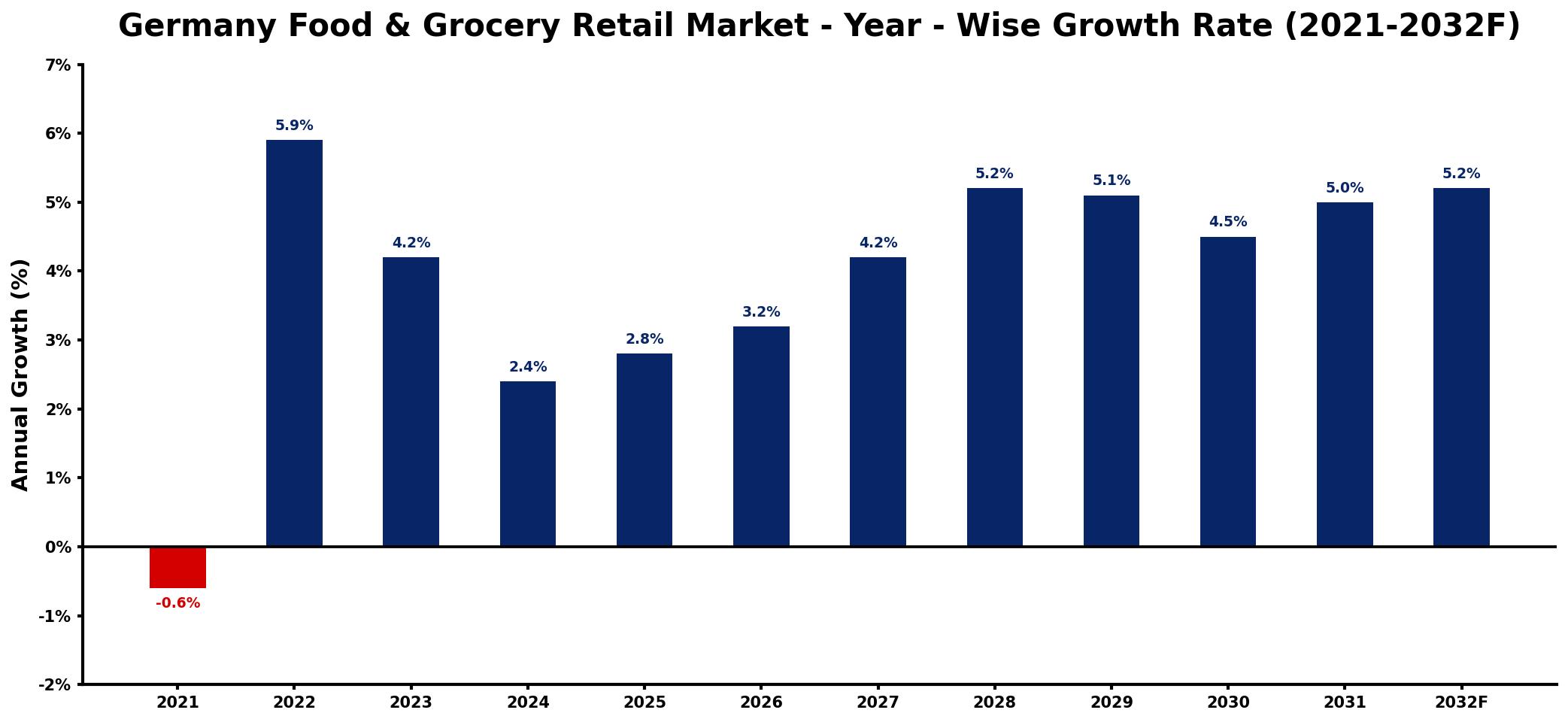
The table below presents the year‑wise growth rates along with the key drivers influencing the market
| Year | Growth Rate | Major Drivers |
| 2021 | -0.6% | decreased consumer spending on essentials |
| 2022 | 5.9% | rising demand for online shopping |
| 2023 | 4.2% | increased consumer interest in sustainability |
| 2024 | 2.4% | growth in convenience store formats |
| 2025 | 2.8% | expansion of private label offerings |
| 2026 | 3.2% | enhanced delivery service capabilities |
| 2027 | 4.2% | improved processing technologies adoption |
| 2028 | 5.2% | increased investment in automation |
| 2029 | 5.1% | rising popularity of local sourcing |
| 2030 | 4.5% | development of innovative packaging solutions |
| 2031 | 5.0% | growing regional consumption patterns |
| 2032 | 5.2% | surge in plant-based alternatives |
Note: Market size estimations and growth projections presented in this report are based on 6Wresearch's proprietary forecasting methodology, utilizing the latest available industry data, government publications, and primary research inputs.
Germany Food & Grocery Retail Market Synopsis
The strongest force currently shaping the Germany Food & Grocery Retail Market is the shift towards organic and sustainable products. As consumers become more educated about health and environmental issues, they are favoring retailers who prioritize ethical sourcing and quality ingredients. This trend is manifesting across all retail formats, from supermarkets to e-commerce platforms.
Additionally, the growth of online grocery shopping has fundamentally transformed the retail landscape. More consumers are seeking the convenience of home delivery and click-and-collect services, prompting retailers to invest significantly in their digital infrastructure. The interplay of these dynamics is redefining consumer expectations in Germany's grocery sector.
- The demand for organic and sustainable food options is driving significant changes in consumer purchasing habits.
- Online grocery shopping continues to expand, providing convenience that is reshaping traditional retail practices.
- Private label products are gaining popularity as consumers seek value without compromising on quality.
- Technology investments in the retail sector are enhancing customer experiences and operational efficiencies.
- Consumers are increasingly turning to meal kit services and food delivery options for ease in meal planning and preparation.
The Germany Food & Grocery Retail Market faces several restraints that could impede its growth. Intense competition from both discount supermarkets and burgeoning online retailers is pressuring margins and compelling traditional retailers to innovate. Furthermore, as consumer preferences shift toward organic and healthy products, retailers must navigate the complexities of sourcing and pricing in a market that demands transparency and ethical practices. Regulatory hurdles related to food safety and quality can also act as a barrier, requiring retailers to maintain stringent compliance while still pursuing profitability.
Several key trends are emerging in the Germany Food & Grocery Retail Market. First, the increasing consumer preference for organic and sustainable food items is prompting retailers to expand their product lines accordingly. Additionally, the rise of e-commerce has led to more innovative logistics solutions, improving the efficiency of delivery services. Consumers are also gravitating towards premium and specialty products, reflecting a desire for unique culinary experiences. Lastly, the rapid growth of meal kit services points to a broader interest in convenience and home cooking solutions among German shoppers.
The Germany Food & Grocery Retail Market presents lucrative investment opportunities, particularly in the realm of online grocery retail. As e-commerce continues to gain traction, there is significant potential for growth in this sector. Specialty and organic food stores are becoming increasingly attractive as consumers look for health-conscious options. Moreover, investing in technological advancements, such as automated checkout systems and personalized shopping experiences, can provide a competitive edge. Ultimately, the shifting consumer landscape offers diverse avenues for those looking to capitalize on emerging trends.
The German government has enacted various policies to regulate the Food & Grocery Retail Market, focusing on consumer protection and sustainability. Strict food safety and labeling regulations ensure transparency and high standards for product quality. Additionally, initiatives aimed at promoting healthy eating habits and combating obesity are influencing how foods are marketed, particularly to children. The government also supports eco-friendly practices, encouraging retailers to adopt sustainable sourcing methods and reduce food waste, creating a more responsible retail environment.
Looking ahead to 2026-2032, the future of the Germany Food & Grocery Retail Market appears promising. As consumers increasingly prioritize health and sustainability, retailers will need to innovate continually to meet evolving demands. The growth of online grocery shopping is expected to further reshape the retail landscape, allowing for greater competition and improved consumer experiences. With ongoing investments in technology and logistics, the market is poised for significant advancements that will enhance both the shopping experience and operational efficiencies.
Recent developments in the Germany Food & Grocery Retail Market indicate a heightened focus on sustainability initiatives among major retailers. Innovations in eco-friendly packaging and efforts to source products locally are gaining traction. Furthermore, many retailers are enhancing their e-commerce capabilities to provide improved customer service and more efficient delivery options. The collaboration between tech firms and grocery retailers is also increasing, aiming to integrate advanced analytics for personalized shopping experiences.
- 10 Years of Market Numbers
- Historical Data Starting from 2022 to 2025
- Base Year: 2025
- Forecast Data until 2032
- Key Performance Indicators Impacting the Market
- Major Upcoming Developments and Projects
Key Highlights of the Report:
- Germany Food & Grocery Retail Market Outlook
- Market Size of Germany Food & Grocery Retail Market, 2025
- Forecast of Germany Food & Grocery Retail Market, 2032
- Historical Data and Forecast of Germany Food & Grocery Retail Revenues & Volume for the Period 2022-2032F
- Germany Food & Grocery Retail Market Trend Evolution
- Germany Food & Grocery Retail Market Drivers and Challenges
- Germany Food & Grocery Retail Price Trends
- Germany Food & Grocery Retail Porter's Five Forces
- Germany Food & Grocery Retail Industry Life Cycle
- Historical Data and Forecast of Germany Food & Grocery Retail Market Revenues & Volume By Product for the Period 2022-2032F
- Historical Data and Forecast of Germany Food & Grocery Retail Market Revenues & Volume By Fresh Food for the Period 2022-2032F
- Historical Data and Forecast of Germany Food & Grocery Retail Market Revenues & Volume By Frozen Food for the Period 2022-2032F
- Historical Data and Forecast of Germany Food & Grocery Retail Market Revenues & Volume By Food Cupboard for the Period 2022-2032F
- Historical Data and Forecast of Germany Food & Grocery Retail Market Revenues & Volume By Beverages for the Period 2022-2032F
- Historical Data and Forecast of Germany Food & Grocery Retail Market Revenues & Volume By Cleaning & Household for the Period 2022-2032F
- Historical Data and Forecast of Germany Food & Grocery Retail Market Revenues & Volume By Others for the Period 2022-2032F
- Historical Data and Forecast of Germany Food & Grocery Retail Market Revenues & Volume By Distribution Channel for the Period 2022-2032F
- Historical Data and Forecast of Germany Food & Grocery Retail Market Revenues & Volume By Supermarkets & Hypermarkets for the Period 2022-2032F
- Historical Data and Forecast of Germany Food & Grocery Retail Market Revenues & Volume By Convenience Stores for the Period 2022-2032F
- Historical Data and Forecast of Germany Food & Grocery Retail Market Revenues & Volume By Departmental Stores & Clubs for the Period 2022-2032F
- Historical Data and Forecast of Germany Food & Grocery Retail Market Revenues & Volume By Online for the Period 2022-2032F
- Germany Food & Grocery Retail Import Export Trade Statistics
- Market Opportunity Assessment By Product
- Market Opportunity Assessment By Distribution Channel
- Germany Food & Grocery Retail Top Companies Market Share
- Germany Food & Grocery Retail Competitive Benchmarking By Technical and Operational Parameters
- Germany Food & Grocery Retail Company Profiles
- Germany Food & Grocery Retail Key Strategic Recommendations






































