Algeria Food & Grocery Retail Market Size, Share & Growth Rate
The Algeria Food & Grocery Retail Market was estimated at USD 921 Million in 2025 and is projected to reach USD 1570 Million by 2032, growing at a CAGR of 7.9% from 2026 to 2032. This growth trajectory is primarily fueled by rising urbanization, which is reshaping consumer habits, alongside an increase in disposable incomes that empowers a broader segment of the population to explore modern retail options. Additionally, an evolving demand for convenience and quality food products drives retailers to adapt to changing consumer preferences.
Algeria Food & Grocery Retail Market Year-wise Growth Rate and Key Drivers
This graph highlights how the Algeria Food & Grocery Retail Market has steadily grown over the years, supported by major growth factors.
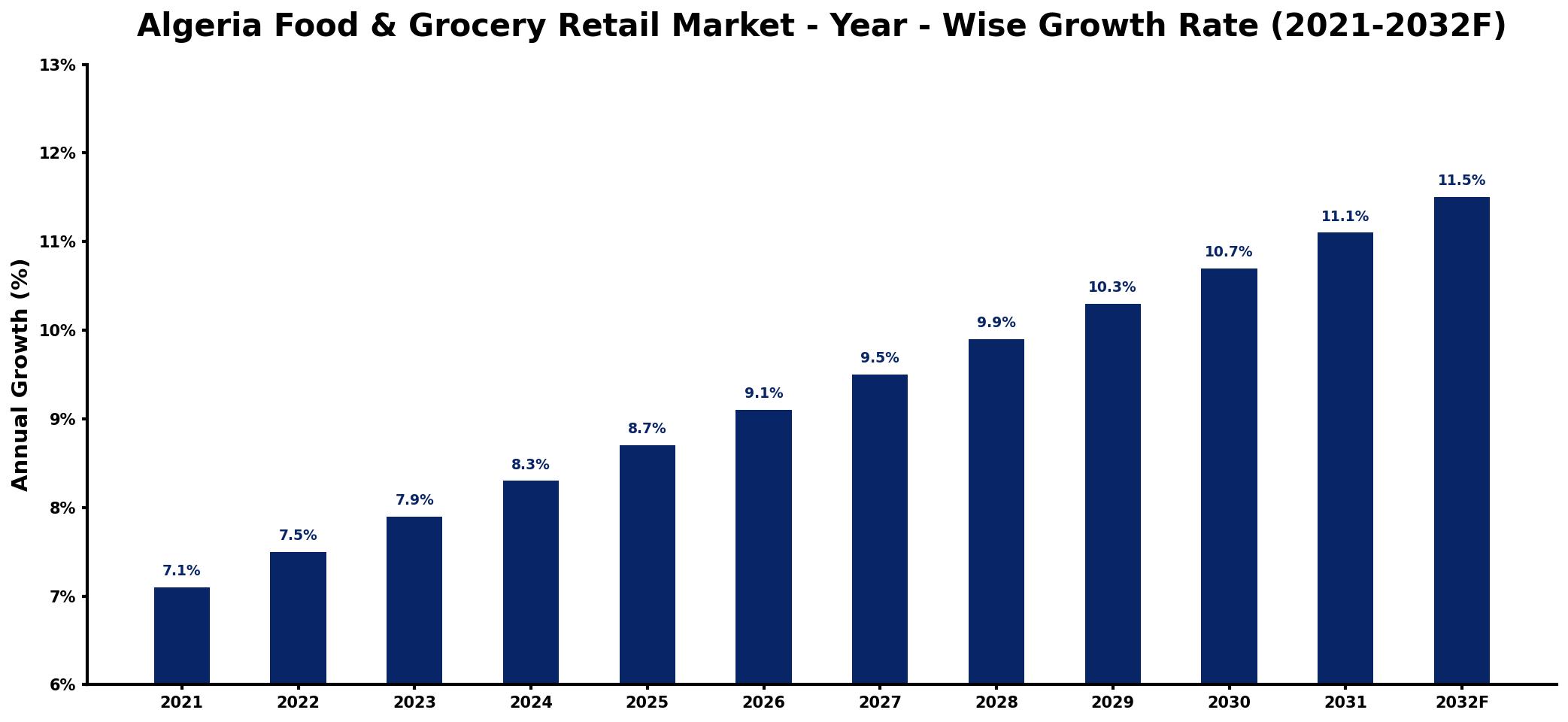
The table below presents the year‑wise growth rates along with the key drivers influencing the market
| Year | Growth Rate | Major Drivers |
| 2021 | 7.1% | Increase in disposable income levels |
| 2022 | 7.5% | Expansion of e-commerce platforms |
| 2023 | 7.9% | Rising urbanization trends observed |
| 2024 | 8.3% | Growing health consciousness among consumers |
| 2025 | 8.7% | Investment in logistics infrastructure |
| 2026 | 9.1% | Development of modern shopping formats |
| 2027 | 9.5% | Introduction of private label brands |
| 2028 | 9.9% | expanding manufacturing base activity |
| 2029 | 10.3% | Emergence of local artisan products |
| 2030 | 10.7% | Adoption of sustainable sourcing practices |
| 2031 | 11.1% | Enhancements in supply chain efficiency |
| 2032 | 11.5% | Growth of digital payment solutions |
Note: Market size estimations and growth projections presented in this report are based on 6Wresearch's proprietary forecasting methodology, utilizing the latest available industry data, government publications, and primary research inputs.
Algeria Food & Grocery Retail Market Synopsis
The Algeria Food & Grocery Retail Market has recently experienced a significant shift towards modern retail formats, showcasing a blend of traditional and contemporary shopping experiences. As the market heads into the coming years, the emphasis on e-commerce and home delivery services is likely to redefine consumer expectations and purchasing behaviors.
While the market is robust, challenges such as inflation and logistical issues present hurdles that require strategic attention. Nevertheless, the focus on health-conscious products and the introduction of private label items signify a vibrant transformation, promising a landscape where quality and convenience coexist with traditional shopping habits.
- The market is projected to grow significantly, reaching USD 1570 Million by 2032.
- Changing consumer preferences are steering a demand for convenience, organic, and health-conscious products.
- E-commerce is gaining traction as consumers increasingly favor online grocery shopping.
- Investment in logistics and technology infrastructure is vital for enhancing supply chain efficiency.
- Government policies aim to support local producers while ensuring consumer affordability.
The Algeria Food & Grocery Retail Market grapples with several constraints that hinder its growth potential. A notable challenge is the high level of informality within the sector, which complicates effective market regulation and quality assurance. Inconsistencies in food safety standards exacerbate consumer concerns, often deterring purchases from certain retailers. Furthermore, logistical limitations, particularly around cold storage and transportation infrastructure, impact the freshness and availability of perishable goods. These factors collectively create an environment that necessitates substantial investment in regulatory frameworks and infrastructure improvements to bolster market efficiency.
The current landscape of the Algeria Food & Grocery Retail Market is characterized by several emerging trends. Firstly, there is a marked increase in consumer interest in organic and health-oriented food options, prompting retailers to diversify their product lines accordingly. The shift towards convenience is reflected in the rising adoption of online shopping and home delivery services, as consumers seek to streamline their grocery shopping experience. Furthermore, private label products are becoming increasingly popular, as retailers strive to meet demand for affordable yet high-quality alternatives. Lastly, there is a growing appreciation for international cuisine, expanding the variety of offerings in supermarkets and hypermarkets.
Investment opportunities abound in the Algeria Food & Grocery Retail Market, particularly as urbanization continues to increase demand for modern retail formats like supermarkets and convenience stores. Retailers looking to cater to the evolving consumer base can capitalize on the burgeoning e-commerce sector by establishing or enhancing online grocery services. Additionally, improving logistics and supply chain management systems can create efficiencies that appeal to both consumers and retailers alike. Collaborations with local producers can ensure a steady supply of quality goods, supporting both sustainability and local economic development.
The Algerian government has undertaken several initiatives aimed at regulating the Food & Grocery Retail Market effectively. Policies promoting import restrictions on specific food items have been implemented to protect domestic producers and encourage local self-sufficiency. Additionally, the government enforces price controls on essential food products to maintain consumer affordability. Regular inspections are conducted to ensure compliance with food quality and safety regulations. Furthermore, incentives for investment in the retail sector have been introduced to stimulate local economic growth and create employment opportunities.
Looking forward to 2026-2032, the Algeria Food & Grocery Retail Market is anticipated to thrive, driven by ongoing population growth and rising disposable incomes. The trend toward modern retail formats, alongside the digital transformation of shopping experiences, will likely enhance consumer engagement and convenience. However, addressing infrastructure limitations and navigating regulatory challenges will be crucial for unlocking the market's full potential. Ultimately, as consumer demands evolve, the market is expected to adapt, offering diverse options and innovative solutions to meet the expectations of a dynamic populace.
Recent developments within the Algeria Food & Grocery Retail Market indicate a strategic shift towards enhancing e-commerce capabilities, with many retailers exploring online platforms to meet rising consumer demand. Additionally, there has been a noticeable increase in investment in logistics infrastructure, aimed at improving supply chain efficiency and food safety. Retailers are also diversifying their product offerings, focusing on health-oriented and international cuisines to cater to changing consumer preferences. These moves reflect an industry in transition, adapting to new market realities and consumer expectations.
- 10 Years of Market Numbers
- Historical Data Starting from 2022 to 2025
- Base Year: 2025
- Forecast Data until 2032
- Key Performance Indicators Impacting the Market
- Major Upcoming Developments and Projects
Key Highlights of the Report:
- Algeria Food & Grocery Retail Market Outlook
- Market Size of Algeria Food & Grocery Retail Market, 2025
- Forecast of Algeria Food & Grocery Retail Market, 2032
- Historical Data and Forecast of Algeria Food & Grocery Retail Revenues & Volume for the Period 2022-2032F
- Algeria Food & Grocery Retail Market Trend Evolution
- Algeria Food & Grocery Retail Market Drivers and Challenges
- Algeria Food & Grocery Retail Price Trends
- Algeria Food & Grocery Retail Porter's Five Forces
- Algeria Food & Grocery Retail Industry Life Cycle
- Historical Data and Forecast of Algeria Food & Grocery Retail Market Revenues & Volume By Product for the Period 2022-2032F
- Historical Data and Forecast of Algeria Food & Grocery Retail Market Revenues & Volume By Fresh Food for the Period 2022-2032F
- Historical Data and Forecast of Algeria Food & Grocery Retail Market Revenues & Volume By Frozen Food for the Period 2022-2032F
- Historical Data and Forecast of Algeria Food & Grocery Retail Market Revenues & Volume By Food Cupboard for the Period 2022-2032F
- Historical Data and Forecast of Algeria Food & Grocery Retail Market Revenues & Volume By Beverages for the Period 2022-2032F
- Historical Data and Forecast of Algeria Food & Grocery Retail Market Revenues & Volume By Cleaning & Household for the Period 2022-2032F
- Historical Data and Forecast of Algeria Food & Grocery Retail Market Revenues & Volume By Others for the Period 2022-2032F
- Historical Data and Forecast of Algeria Food & Grocery Retail Market Revenues & Volume By Distribution Channel for the Period 2022-2032F
- Historical Data and Forecast of Algeria Food & Grocery Retail Market Revenues & Volume By Supermarkets & Hypermarkets for the Period 2022-2032F
- Historical Data and Forecast of Algeria Food & Grocery Retail Market Revenues & Volume By Convenience Stores for the Period 2022-2032F
- Historical Data and Forecast of Algeria Food & Grocery Retail Market Revenues & Volume By Departmental Stores & Clubs for the Period 2022-2032F
- Historical Data and Forecast of Algeria Food & Grocery Retail Market Revenues & Volume By Online for the Period 2022-2032F
- Algeria Food & Grocery Retail Import Export Trade Statistics
- Market Opportunity Assessment By Product
- Market Opportunity Assessment By Distribution Channel
- Algeria Food & Grocery Retail Top Companies Market Share
- Algeria Food & Grocery Retail Competitive Benchmarking By Technical and Operational Parameters
- Algeria Food & Grocery Retail Company Profiles
- Algeria Food & Grocery Retail Key Strategic Recommendations






































