Kenya Food & Grocery Retail Market Size, Share & Growth Rate
The Kenya Food & Grocery Retail Market was estimated at USD 1463 Million in 2025 and is projected to reach USD 2577 Million by 2032, growing at a CAGR of 8.4% from 2026 to 2032. This robust growth trajectory can be attributed to the nation's ongoing urbanization, an expanding middle class, and shifting consumer preferences favoring convenience and quality. Coupled with increasing investments in technology and infrastructure, these factors are poised to reshape the retail landscape significantly.
Kenya Food & Grocery Retail Market Year-wise Growth Rate and Key Drivers
This graph highlights how the Kenya Food & Grocery Retail Market has steadily grown over the years, supported by major growth factors.
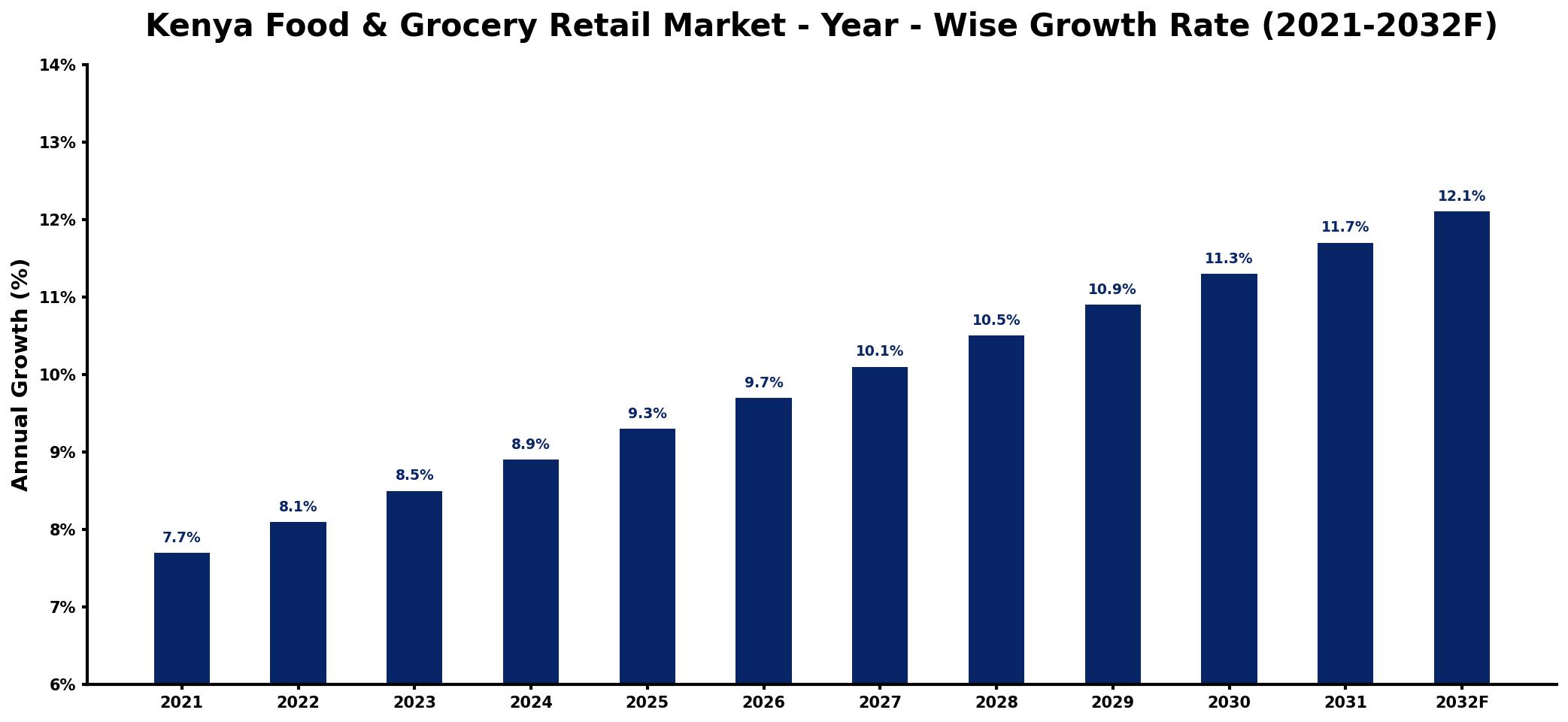
The table below presents the year‑wise growth rates along with the key drivers influencing the market
| Year | Growth Rate | Major Drivers |
| 2021 | 7.7% | Rising consumer disposable income |
| 2022 | 8.1% | Increased urban population growth |
| 2023 | 8.5% | Expansion of e-commerce platforms |
| 2024 | 8.9% | Growth in health-conscious consumers |
| 2025 | 9.3% | Investment in local supply chains |
| 2026 | 9.7% | Development of modern distribution networks |
| 2027 | 10.1% | Rising demand for convenience options |
| 2028 | 10.5% | Emergence of local brands |
| 2029 | 10.9% | Technological advancements in logistics |
| 2030 | 11.3% | Increased foreign direct investment |
| 2031 | 11.7% | strengthening underlying market demand |
| 2032 | 12.1% | Growing focus on sustainability initiatives |
Note: Market size estimations and growth projections presented in this report are based on 6Wresearch's proprietary forecasting methodology, utilizing the latest available industry data, government publications, and primary research inputs.
Kenya Food & Grocery Retail Market Synopsis
In recent years, the Kenya Food & Grocery Retail Market has shown remarkable momentum, with traditional shopping methods coexisting alongside modern retail formats. However, the market is transitioning towards more dynamic retail experiences that prioritize online shopping, convenience, and health-conscious choices. This evolution is set to further accelerate as consumer habits continue to shift.
Looking ahead, the market is positioned for substantial growth, driven by an increasing emphasis on e-commerce and technology integration. Retailers are likely to expand their online presence and enhance customer engagement through innovative solutions, which will redefine competition and customer loyalty in the sector.
- The market is projected to witness significant growth, reaching USD 2577 Million by 2032.
- Urbanization and a burgeoning middle class are pivotal in driving market expansion.
- Consumer preferences are shifting towards convenience foods and online grocery shopping.
- Increased competition is spurring innovation across retail channels.
- Government initiatives aim to bolster food security and support local agriculture.
Despite the promising growth trajectory, the Kenya Food & Grocery Retail Market faces significant restraints. One major challenge is the intense competition between formal and informal retail segments, which can limit profitability for formal retailers. Additionally, infrastructure inadequacies contribute to supply chain inefficiencies, leading to higher operating costs. Seasonal fluctuations in agricultural production further complicate inventory management, while regulatory compliance adds an additional layer of complexity for businesses operating in this evolving market.
Several key trends are shaping the Kenya Food & Grocery Retail Market. A prominent trend is the increasing consumer demand for convenience, which is propelling the growth of online grocery platforms and mobile applications. The rising awareness of health and wellness is also influencing purchasing decisions, driving interest in organic and natural products. Retailers are responding to these shifts by innovating their product offerings and enhancing customer experiences through technology, thus creating a more competitive environment.
The market presents substantial investment opportunities, particularly in sectors like supermarket chains, convenience stores, and online grocery platforms. With the growing urban population and increased disposable income, there is a clear demand for high-quality and diverse food products. Collaborations with local suppliers can streamline supply chains and foster sustainable practices. Moreover, technological advancements in e-commerce and payment solutions present avenues for further market penetration and consumer engagement.
The Kenyan government has implemented various policies to enhance food security and consumer protection in the retail market. Regulations under the Kenya Food, Drugs, and Chemical Substances Act are designed to ensure food safety and quality. Additionally, the Competition Authority of Kenya enforces fair competition to promote a level playing field among retailers. Initiatives like the Buy Kenya, Build Kenya policy encourage the purchase of locally produced goods, further strengthening local supply chains and supporting economic growth.
The Kenya Food & Grocery Retail Market is on track for significant transformation from 2026 to 2032, largely fueled by rapid urbanization and increasing consumer wealth. E-commerce is expected to play a crucial role, with the demand for online grocery shopping set to rise as digital infrastructure improves. As supermarket chains continue to expand their reach, both in urban and rural areas, the availability of diverse products will likely enhance the shopping experience. Nevertheless, retailers must remain agile in navigating challenges such as infrastructure limitations and economic fluctuations to fully leverage these opportunities.
In the recent months, the Kenya Food & Grocery Retail Market has witnessed several strategic developments aimed at enhancing customer experience and operational efficiency. Retailers are increasingly investing in digital platforms, optimizing their supply chains, and expanding delivery services to meet the rising demand for convenience. Additionally, there has been a notable focus on sustainability, with more players incorporating local sourcing strategies into their operations to align with consumer preferences for responsible consumption.
- 10 Years of Market Numbers
- Historical Data Starting from 2022 to 2025
- Base Year: 2025
- Forecast Data until 2032
- Key Performance Indicators Impacting the Market
- Major Upcoming Developments and Projects
Key Highlights of the Report:
- Kenya Food & Grocery Retail Market Outlook
- Market Size of Kenya Food & Grocery Retail Market, 2025
- Forecast of Kenya Food & Grocery Retail Market, 2032
- Historical Data and Forecast of Kenya Food & Grocery Retail Revenues & Volume for the Period 2022-2032F
- Kenya Food & Grocery Retail Market Trend Evolution
- Kenya Food & Grocery Retail Market Drivers and Challenges
- Kenya Food & Grocery Retail Price Trends
- Kenya Food & Grocery Retail Porter's Five Forces
- Kenya Food & Grocery Retail Industry Life Cycle
- Historical Data and Forecast of Kenya Food & Grocery Retail Market Revenues & Volume By Product for the Period 2022-2032F
- Historical Data and Forecast of Kenya Food & Grocery Retail Market Revenues & Volume By Fresh Food for the Period 2022-2032F
- Historical Data and Forecast of Kenya Food & Grocery Retail Market Revenues & Volume By Frozen Food for the Period 2022-2032F
- Historical Data and Forecast of Kenya Food & Grocery Retail Market Revenues & Volume By Food Cupboard for the Period 2022-2032F
- Historical Data and Forecast of Kenya Food & Grocery Retail Market Revenues & Volume By Beverages for the Period 2022-2032F
- Historical Data and Forecast of Kenya Food & Grocery Retail Market Revenues & Volume By Cleaning & Household for the Period 2022-2032F
- Historical Data and Forecast of Kenya Food & Grocery Retail Market Revenues & Volume By Others for the Period 2022-2032F
- Historical Data and Forecast of Kenya Food & Grocery Retail Market Revenues & Volume By Distribution Channel for the Period 2022-2032F
- Historical Data and Forecast of Kenya Food & Grocery Retail Market Revenues & Volume By Supermarkets & Hypermarkets for the Period 2022-2032F
- Historical Data and Forecast of Kenya Food & Grocery Retail Market Revenues & Volume By Convenience Stores for the Period 2022-2032F
- Historical Data and Forecast of Kenya Food & Grocery Retail Market Revenues & Volume By Departmental Stores & Clubs for the Period 2022-2032F
- Historical Data and Forecast of Kenya Food & Grocery Retail Market Revenues & Volume By Online for the Period 2022-2032F
- Kenya Food & Grocery Retail Import Export Trade Statistics
- Market Opportunity Assessment By Product
- Market Opportunity Assessment By Distribution Channel
- Kenya Food & Grocery Retail Top Companies Market Share
- Kenya Food & Grocery Retail Competitive Benchmarking By Technical and Operational Parameters
- Kenya Food & Grocery Retail Company Profiles
- Kenya Food & Grocery Retail Key Strategic Recommendations






































