Germany Modular Data Center Market Size, Share & Growth Rate
The Germany Modular Data Center Market was estimated at USD 202 Million in 2025 and is projected to reach USD 233 Million by 2032, growing at a CAGR of 2.1% from 2026 to 2032. This growth trajectory is primarily driven by the increasing demand for rapid deployment of IT infrastructure and the need for cost-effective solutions that align with the evolving digital landscape. As organizations strive for scalability and flexibility, modular data centers are becoming a favored choice, responding swiftly to the dynamic demands of the IT ecosystem.
Germany Modular Data Center Market Year-wise Growth Rate and Key Drivers
This graph highlights how the Germany Modular Data Center Market has steadily grown over the years, supported by major growth factors.
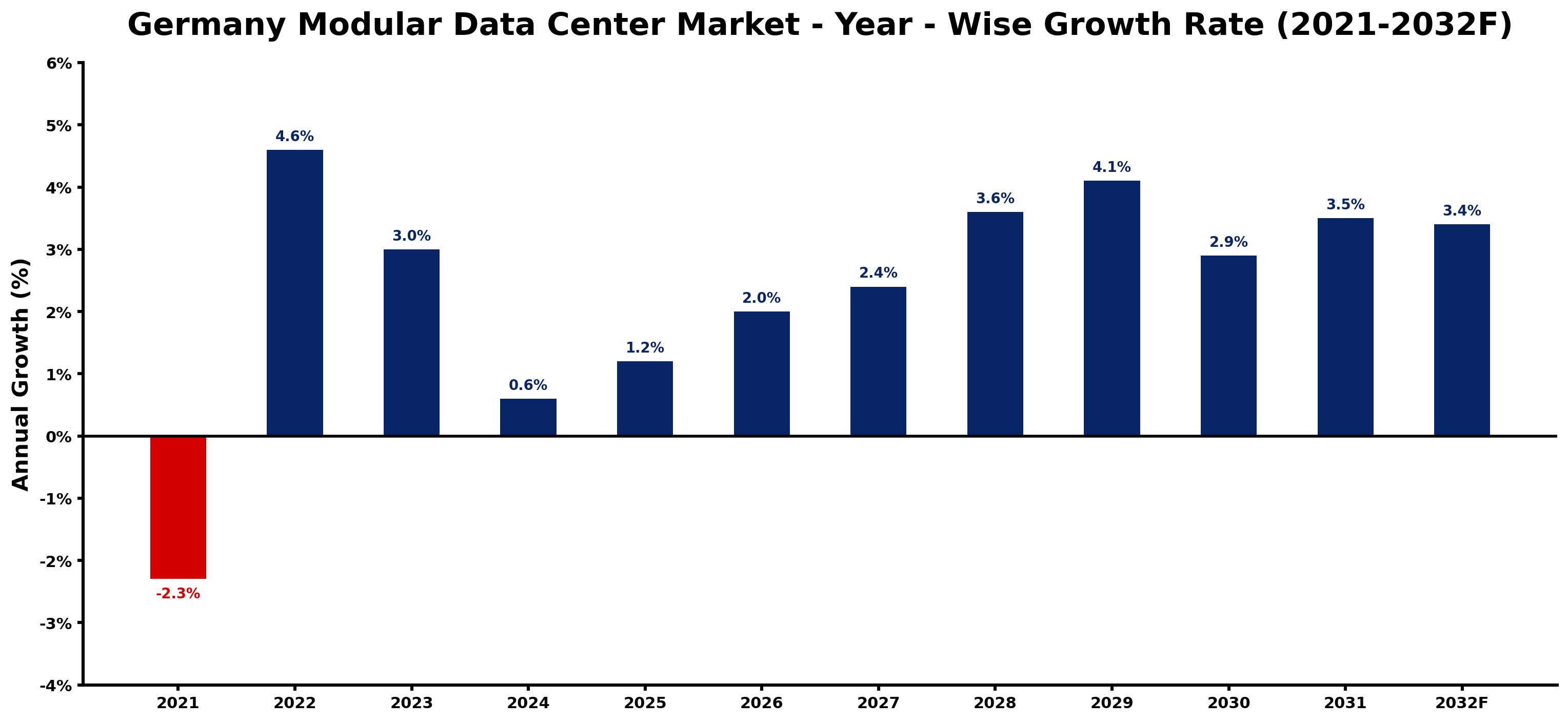
The table below presents the year‑wise growth rates along with the key drivers influencing the market
| Year | Growth Rate | Major Drivers |
| 2021 | -2.3% | Increasing industrial automation investments |
| 2022 | 4.6% | Growing urbanization and commercial development |
| 2023 | 3.0% | Expansion of transportation and logistics networks |
| 2024 | 0.6% | Increasing adoption of advanced technologies |
| 2025 | 1.2% | Increasing smart city development projects |
| 2026 | 2.0% | Increasing smart city development projects |
| 2027 | 2.4% | Expansion of transportation and logistics networks |
| 2028 | 3.6% | Rapid growth in telecom and data center sectors |
| 2029 | 4.1% | Expansion of commercial construction activities |
| 2030 | 2.9% | Expansion of transportation and logistics networks |
| 2031 | 3.5% | Increasing industrial infrastructure investments |
| 2032 | 3.4% | Increasing industrial infrastructure investments |
Note - Market size estimations and growth projections presented in this report are based on 6Wresearch’s advanced forecasting approach, validated with industry datasets as of June 2026.
Germany Modular Data Center Market Synopsis
Currently, the most significant force shaping the Germany modular data center market is the imperative for agile and scalable IT solutions. Enterprises, cloud providers, and colocation facilities are increasingly seeking ways to enhance operational efficiency while managing costs effectively.
Furthermore, the German government's emphasis on energy efficiency and digital infrastructure is acting as a catalyst for market expansion. This focus not only encourages the adoption of innovative modular solutions but also reinforces the commitment to sustainability within the sector.
Germany Modular Data Center Market Key Takeaways
- The market is poised for steady growth, driven by the demand for cost-effective and scalable solutions.
- Energy efficiency and rapid deployment remain key priorities for enterprises investing in modular data centers.
- Data privacy and compliance with evolving regulations are critical considerations for market stakeholders.
- Integration challenges with existing IT ecosystems necessitate a focus on interoperability and compliance.
- Government policies promoting cloud and edge computing are expected to further stimulate market adoption.
Evaluation of Restraints in Germany Modular Data Center Market
Despite its potential, the Germany modular data center market faces several restraints that could hinder its full realization. Key among these are scalability concerns, particularly related to existing infrastructure integration. Additionally, organizations must navigate complex regulatory landscapes concerning data sovereignty and security, which may complicate deployment timelines and project costs. Cybersecurity remains a significant challenge, as businesses are tasked with safeguarding data across various jurisdictions while ensuring compliance with stringent laws. These factors can create uncertainty for enterprises looking to invest in modular solutions.
Germany Modular Data Center Market Trends
The demand for modular data centers is increasingly influenced by trends such as edge computing and the need for enhanced energy efficiency. Organizations are prioritizing solutions that can swiftly adapt to their evolving storage and processing requirements while minimizing energy consumption. Additionally, technological advancements in cooling methods and modular design are shaping the market, enabling providers to offer innovative solutions that are both reliable and scalable.
Germany Modular Data Center Market Opportunities
Significant growth opportunities lie in addressing the rising demand for edge computing solutions, as businesses seek to optimize their IT environments for better latency and performance. The increasing focus on digitalization initiatives presents further avenues for investment, particularly in modular architectures that can seamlessly integrate with existing cloud services. Furthermore, aligning with sustainability goals through energy-efficient designs will attract organizations eager to improve their environmental footprint while capitalizing on cost-saving benefits.
Government Initiatives in the Germany Modular Data Center Market
The German government has implemented several initiatives aimed at enhancing digital infrastructure and promoting energy efficiency within the data center sector. Policies encouraging cloud adoption and edge computing initiatives are pivotal in driving the market forward. Moreover, regulations surrounding data protection and privacy are evolving, necessitating that providers adopt compliant modular solutions. These governmental efforts not only bolster market growth but also reinforce the importance of sustainability and digital transformation within the country.
Future Insights of the Germany Modular Data Center Market
As we look toward 2026-2032, the Germany modular data center market is likely to witness substantial advancements fueled by ongoing digitalization efforts and an increasing reliance on scalable IT solutions. The trend toward decentralized computing will likely gain momentum, prompting organizations to invest in modular infrastructures that offer flexibility and rapid scalability. Furthermore, as energy efficiency remains a critical factor, we expect to see innovative approaches emerge, enhancing the overall sustainability of modular data center operations.
Germany Modular Data Center Market Latest Developments (May 2025 - June 2026)
In the period between May 2025 and June 2026, the Germany modular data center market has seen a significant uptick in interest, with several enterprises exploring partnerships to enhance their IT infrastructure capabilities. As more companies pivot towards hybrid cloud solutions, discussions around modular systems have intensified. Moreover, advancements in cooling technologies and energy-efficient designs have gained traction, positioning modular data centers as a viable alternative for organizations focused on sustainability.
Germany Modular Data Center Market - Key Attractiveness of the Report
- 10 Years of Market Numbers
- Historical Data Starting from 2022 to 2025
- Base Year: 2025
- Forecast Data until 2032
- Key Performance Indicators Impacting the Market
- Major Upcoming Developments and Projects
Key Highlights of the Report:
- Germany Modular Data Center Market Outlook
- Market Size of Germany Modular Data Center Market, 2025
- Forecast of Germany Modular Data Center Market, 2032
- Historical Data and Forecast of Germany Modular Data Center Revenues & Volume for the Period 2022-2032F
- Germany Modular Data Center Market Trend Evolution
- Germany Modular Data Center Market Drivers and Challenges
- Germany Modular Data Center Price Trends
- Germany Modular Data Center Porter's Five Forces
- Germany Modular Data Center Industry Life Cycle
- Historical Data and Forecast of Germany Modular Data Center Market Revenues & Volume By Functional module solution for the Period 2022-2032F
- Historical Data and Forecast of Germany Modular Data Center Market Revenues & Volume By All-in One Functional Module for the Period 2022-2032F
- Historical Data and Forecast of Germany Modular Data Center Market Revenues & Volume By Individual Functional Module for the Period 2022-2032F
- Historical Data and Forecast of Germany Modular Data Center Market Revenues & Volume By Service for the Period 2022-2032F
- Historical Data and Forecast of Germany Modular Data Center Market Revenues & Volume By Infrastructure Management for the Period 2022-2032F
- Historical Data and Forecast of Germany Modular Data Center Market Revenues & Volume By Integration & Deployment for the Period 2022-2032F
- Historical Data and Forecast of Germany Modular Data Center Market Revenues & Volume By Consulting for the Period 2022-2032F
- Historical Data and Forecast of Germany Modular Data Center Market Revenues & Volume By Industry for the Period 2022-2032F
- Historical Data and Forecast of Germany Modular Data Center Market Revenues & Volume By BFSI for the Period 2022-2032F
- Historical Data and Forecast of Germany Modular Data Center Market Revenues & Volume By Retail for the Period 2022-2032F
- Historical Data and Forecast of Germany Modular Data Center Market Revenues & Volume By Government for the Period 2022-2032F
- Historical Data and Forecast of Germany Modular Data Center Market Revenues & Volume By Healthcare for the Period 2022-2032F
- Historical Data and Forecast of Germany Modular Data Center Market Revenues & Volume By Telecommunication for the Period 2022-2032F
- Historical Data and Forecast of Germany Modular Data Center Market Revenues & Volume By Utilities for the Period 2022-2032F
- Historical Data and Forecast of Germany Modular Data Center Market Revenues & Volume By Others for the Period 2022-2032F
- Germany Modular Data Center Import Export Trade Statistics
- Market Opportunity Assessment By Functional module solution
- Market Opportunity Assessment By Service
- Market Opportunity Assessment By Industry
- Germany Modular Data Center Top Companies Market Share
- Germany Modular Data Center Competitive Benchmarking By Technical and Operational Parameters
- Germany Modular Data Center Company Profiles
- Germany Modular Data Center Key Strategic Recommendations






































