Germany Policy Management in Telecom Market Size & Growth Rate (2026-2032)
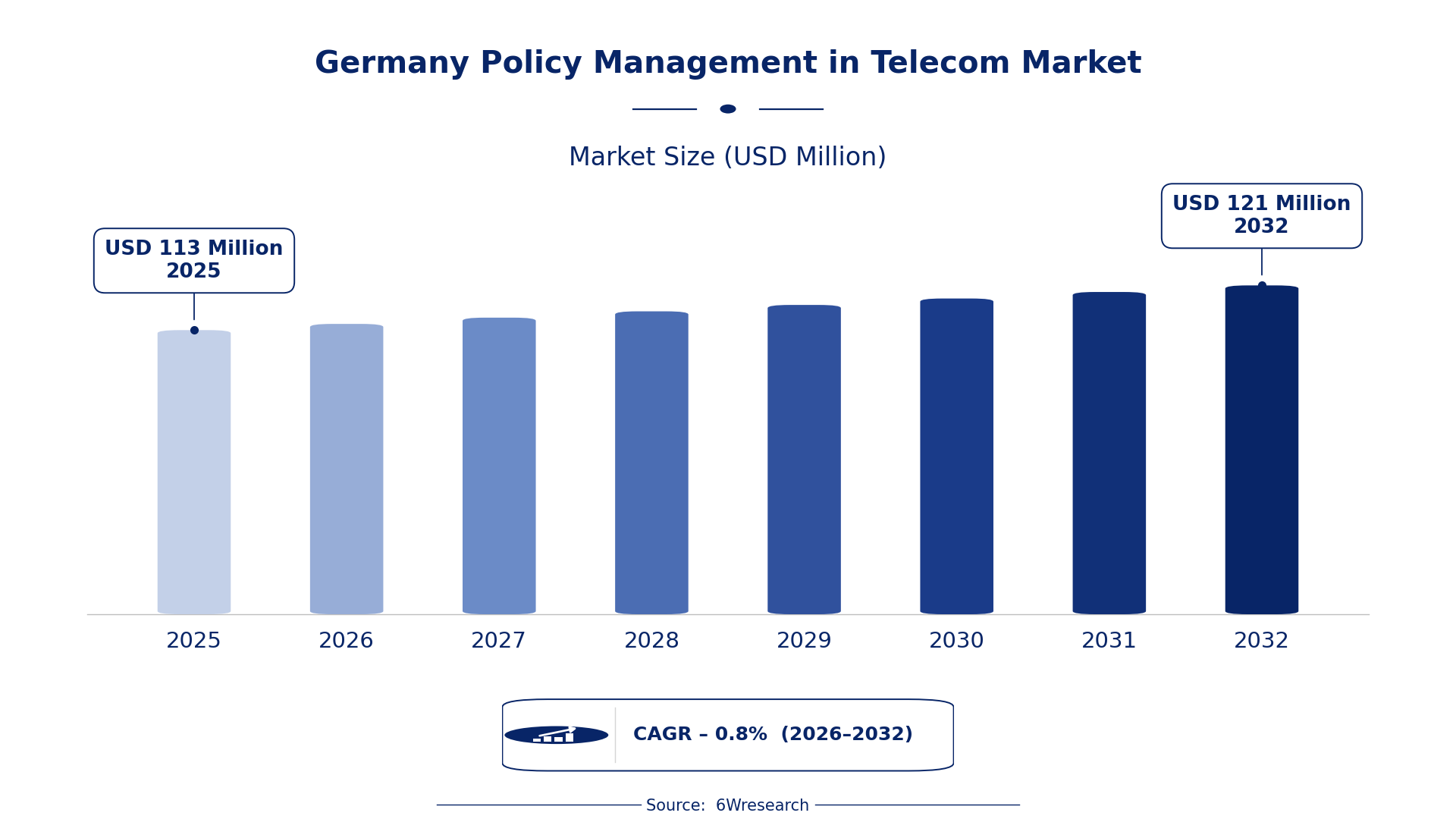
The Germany Policy Management in Telecom Market was estimated at USD 113 Million in 2025 and is projected to reach USD 121 Million by 2032, growing at a CAGR of 0.8% from 2026 to 2032.
Germany Policy Management in Telecom Market Synopsis
The Germany policy management in telecom market is characterized by a pressing need for telecom operators to adapt to intricate network structures and evolving regulatory frameworks. As operators seek to enhance service quality and meet consumer expectations, policy management solutions become indispensable tools in their operational arsenal.
The growing emphasis on data privacy and personalized services is particularly evident in Germany, where operators face a dual challenge of adhering to stringent regulations while optimizing network performance. This dynamic environment fosters a fertile ground for innovation, pushing the adoption of advanced policy management technologies.
Germany Policy Management in Telecom Market Year-wise Growth Rate and Key Drivers
This graph illustrates the annual growth rates of the Germany Policy Management in Telecom Market from 2021 to 2032, highlighting a steady upward trajectory and projected expansion over the forecast period.
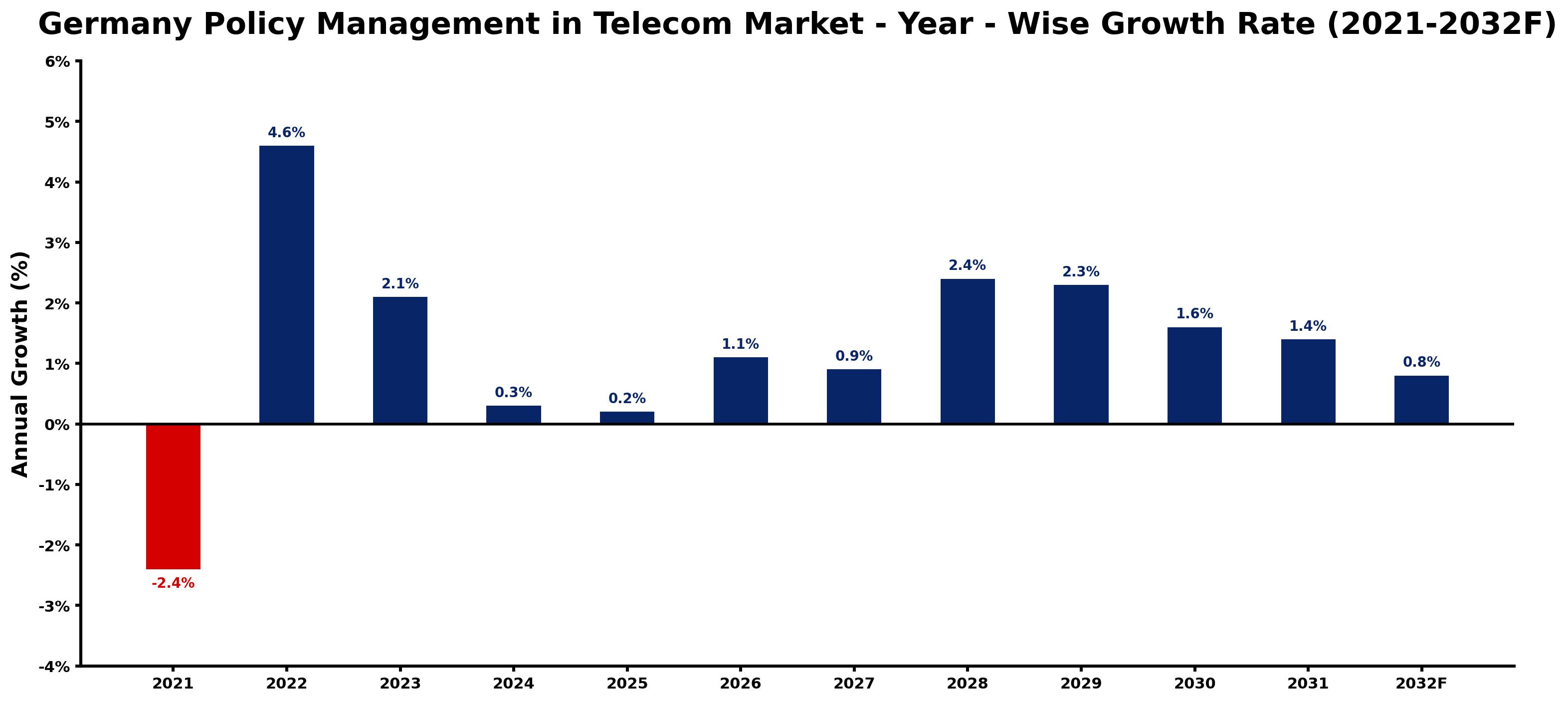
The table below presents the year‑wise growth rates along with the key drivers influencing the market
| Year | Growth Rate | Major Drivers |
| 2021 | -2.4% | Bundesnetzagentur imposed stricter regulations on pricing strategies. |
| 2022 | 4.6% | Bundesnetzagentur's broadband strategy boosting regulatory frameworks. |
| 2023 | 2.1% | Increased competition prompting regulatory updates in telecom sector. |
| 2024 | 0.3% | New data protection laws shaping telecom policy needs. |
| 2025 | 0.2% | 5G rollout accelerating regulatory compliance requirements. |
| 2026 | 1.1% | Digitalization initiatives driving new telecom policy frameworks. |
| 2027 | 0.9% | Sustainability mandates influencing telecom industry regulations. |
| 2028 | 2.4% | Social media regulations requiring updated telecom management policies. |
| 2029 | 2.3% | Evolving privacy laws affecting telecom service policy adjustments. |
| 2030 | 1.6% | Rise in cybersecurity threats prompting stricter telecom regulations. |
| 2031 | 1.4% | Government incentives for digital infrastructure impacting policy direction. |
| 2032 | 0.8% | Increased user demand for mobile data influencing telecom regulations. |
Note: Market size estimations and growth projections presented in this report are based on 6Wresearch's proprietary forecasting methodology, utilizing the latest available industry data, government publications, and primary research inputs.
Germany Policy Management in Telecom Market Key Takeaways
Below are some of the specific key takeaways from the market, including:
- Strong demand for policy management solutions is driven by increased network complexity and regulatory pressures.
- Operators are prioritizing data-driven analytics for effective traffic management and customer engagement.
- The convergence of IT and telecommunications is a key factor fueling market growth.
- Technological advancements, such as AI and machine learning, are redefining policy control capabilities.
- Regulatory compliance remains a major concern, influencing investment strategies in policy management.
Evaluation of Restraints in Germany Policy Management in Telecom Market
Several challenges are currently hampering the growth of the Germany policy management in telecom market. Firstly, the escalating complexity of network architectures complicates the enforcement of policies, leading to inefficiencies in traffic management and quality of service. Telecom operators face hurdles in adapting their systems to ensure compliance with evolving regulations while maintaining user satisfaction.
Additionally, as telecom companies strive to personalize services, the requirement for dynamic policy updates can strain existing infrastructure. This need for rapid adaptability contrasts sharply with the rigidities of current policy management systems, posing significant operational challenges.
Germany Policy Management in Telecom Market Trends
Several key trends are shaping the future of the Germany policy management in telecom market. The integration of AI and machine learning is enhancing data analytics capabilities, enabling operators to make smarter, data-driven decisions. These technologies allow for real-time adjustments to service policies, crucial in a rapidly changing digital environment.
Another notable trend is the increasing focus on data privacy, influenced by regulations such as the GDPR. As consumer awareness rises, telecom operators must prioritize compliance while delivering personalized experiences. This need is driving demand for sophisticated policy management solutions that can balance regulatory requirements with customer expectations.
Germany Policy Management in Telecom Market Opportunities
The market presents various opportunities for growth and innovation. With the expansion of 5G networks and the rise of IoT connectivity, there is a pressing demand for advanced policy management systems that can handle the associated complexities. Companies that develop solutions tailored to these emerging technologies stand to gain a competitive edge.
Investments in network analytics and customer-centric solutions will enable telecom operators to optimize their offerings, improve customer satisfaction, and maximize revenue streams. Additionally, as digital transformation initiatives accelerate, the integration of policy management with other IT systems will open new avenues for efficiency and innovation.
Government Initiatives in the Germany Policy Management in Telecom Market
Germany's regulatory environment is playing a crucial role in shaping the policy management landscape within the telecom sector. The government is focused on promoting fair competition, consumer protection, and technological advancement through specific initiatives. As regulatory frameworks evolve, they significantly impact how telecom operators manage policies.
- A regulatory framework introduced in 2025 mandating stricter data privacy measures across telecom services.
- A national digital infrastructure upgrade program now in its rollout phase, aimed at enhancing network performance and resilience.
- Current efforts to revise licensing requirements for new market entrants to foster competition and innovation.
- A planned public-private initiative expected to expand telecom infrastructure access by 2028, focusing on underserved areas.
- Recent consultations on net neutrality regulations that are reshaping how telecom companies manage service tiers and customer data.
Future Insights of the Germany Policy Management in Telecom Market
Looking ahead to 2026-2032, the Germany policy management in telecom market is likely to experience steady advancements driven by technological innovations and regulatory adaptations. As the demand for seamless connectivity and tailored services grows, operators will increasingly turn to advanced policy management systems to enhance operational efficiency.
The integration of AI and machine learning into policy management will not only streamline processes but also facilitate real-time decision-making. As these technologies become more prevalent, operators will be better positioned to respond to market demands and compliance requirements, thereby ensuring sustainable growth.
Germany Policy Management in Telecom Market Latest Developments
Recent months have seen considerable activity in the Germany policy management in telecom market, as companies adapt to evolving demands and regulatory landscapes. The focus has increasingly shifted towards implementing advanced technology solutions that enhance service delivery and compliance.
- A major telecom operator launched an AI-driven policy management tool in early 2025, designed to improve customer engagement and operational efficiency.
- Currently underway is a collaborative project between telecom providers aimed at establishing standardized policy frameworks to enhance interoperability across networks.
- A new initiative expected to begin in the second half of 2026 focuses on integrating policy management systems with emerging IoT technologies.
- In late 2025, a leading telecom firm completed the rollout of a next-gen policy analytics platform that allows for real-time adjustments to service offerings.
- Ongoing discussions among regulatory bodies about refining compliance protocols are expected to impact market operations through 2026.
Germany Policy Management in Telecom Market - Key Attractiveness of the Report
- 10 Years of Market Numbers
- Historical Data Starting from 2022 to 2025
- Base Year: 2025
- Forecast Data until 2032
- Key Performance Indicators Impacting the Market
- Major Upcoming Developments and Projects
Key Highlights of the Report:
- Germany Policy Management in Telecom Market Outlook
- Market Size of Germany Policy Management in Telecom Market, 2025
- Forecast of Germany Policy Management in Telecom Market, 2032
- Historical Data and Forecast of Germany Policy Management in Telecom Revenues & Volume for the Period 2022-2032F
- Germany Policy Management in Telecom Market Trend Evolution
- Germany Policy Management in Telecom Market Drivers and Challenges
- Germany Policy Management in Telecom Price Trends
- Germany Policy Management in Telecom Porter's Five Forces
- Germany Policy Management in Telecom Industry Life Cycle
- Historical Data and Forecast of Germany Policy Management in Telecom Market Revenues & Volume By Network for the Period 2022-2032F
- Historical Data and Forecast of Germany Policy Management in Telecom Market Revenues & Volume By Fixed for the Period 2022-2032F
- Historical Data and Forecast of Germany Policy Management in Telecom Market Revenues & Volume By Wireless for the Period 2022-2032F
- Historical Data and Forecast of Germany Policy Management in Telecom Market Revenues & Volume By Component for the Period 2022-2032F
- Historical Data and Forecast of Germany Policy Management in Telecom Market Revenues & Volume By Solutions for the Period 2022-2032F
- Historical Data and Forecast of Germany Policy Management in Telecom Market Revenues & Volume By Services for the Period 2022-2032F
- Historical Data and Forecast of Germany Policy Management in Telecom Market Revenues & Volume By Deployment for the Period 2022-2032F
- Historical Data and Forecast of Germany Policy Management in Telecom Market Revenues & Volume By Cloud for the Period 2022-2032F
- Historical Data and Forecast of Germany Policy Management in Telecom Market Revenues & Volume By On-Premises for the Period 2022-2032F
- Germany Policy Management in Telecom Import Export Trade Statistics
- Market Opportunity Assessment By Network
- Market Opportunity Assessment By Component
- Market Opportunity Assessment By Deployment
- Germany Policy Management in Telecom Top Companies Market Share
- Germany Policy Management in Telecom Competitive Benchmarking By Technical and Operational Parameters
- Germany Policy Management in Telecom Company Profiles
- Germany Policy Management in Telecom Key Strategic Recommendations






































