Germany Virtualization Security Market Size & Growth Rate (2026-2032)
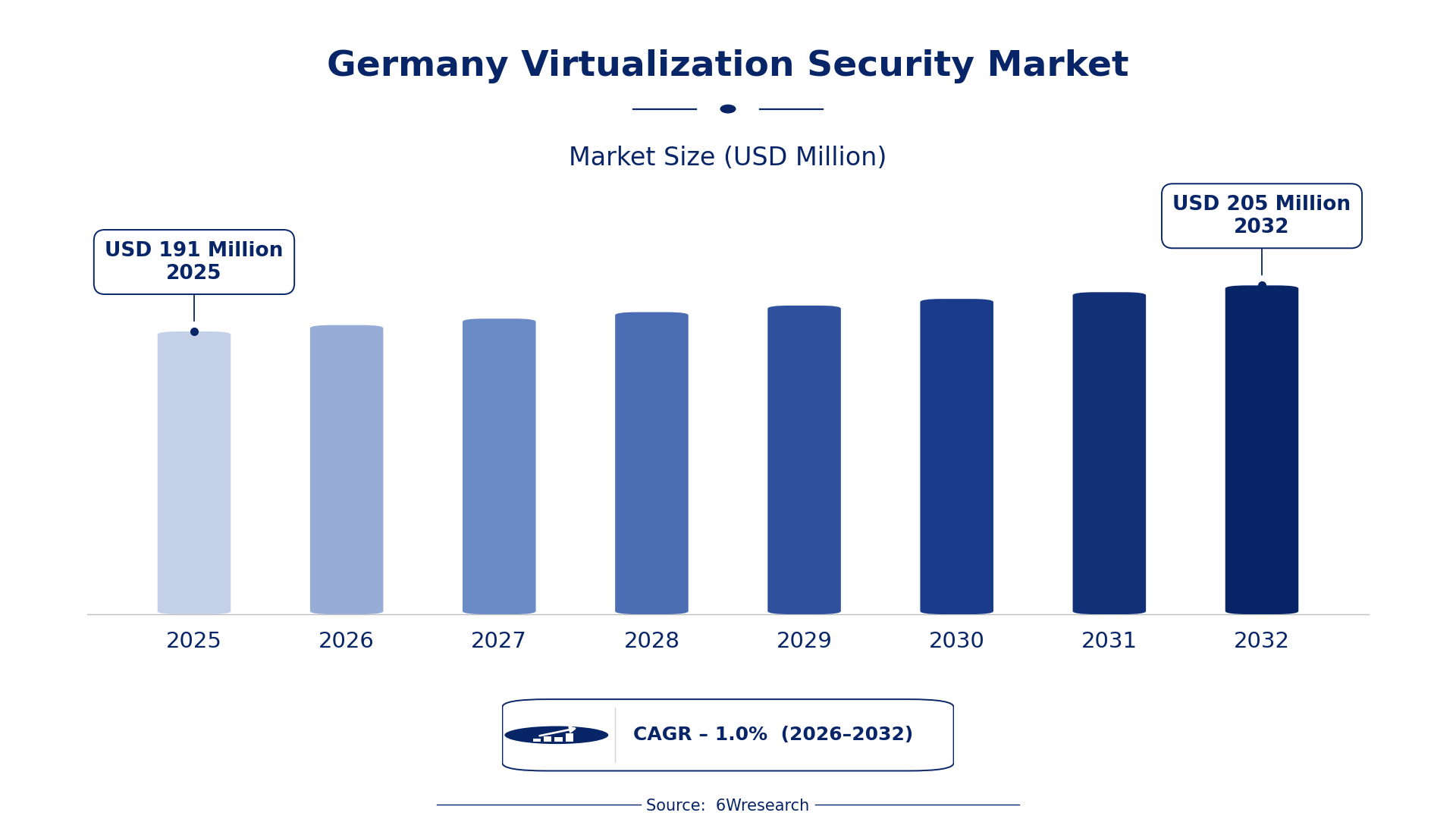
The Germany Virtualization Security Market was estimated at USD 191 Million in 2025 and is projected to reach USD 205 Million by 2032, growing at a CAGR of 1.0% from 2026 to 2032.
Germany Virtualization Security Market Synopsis
The increasing adoption of virtualization technologies in various sectors is the primary factor driving the Germany Virtualization Security Market. As organizations seek to enhance efficiency and reduce costs, the demand for security solutions tailored for virtualized environments is gaining momentum.
In addition, regulatory compliance requirements are pushing businesses to prioritize security in their virtual infrastructures. As laws evolve and cyber threats become more sophisticated, companies recognize that robust virtualization security is not just a luxury; it’s a necessity.
Germany Virtualization Security Market Year-wise Growth Rate and Key Drivers
This graph illustrates the annual growth rates of the Germany Virtualization Security Market from 2021 to 2032, highlighting a steady upward trajectory and projected expansion over the forecast period.
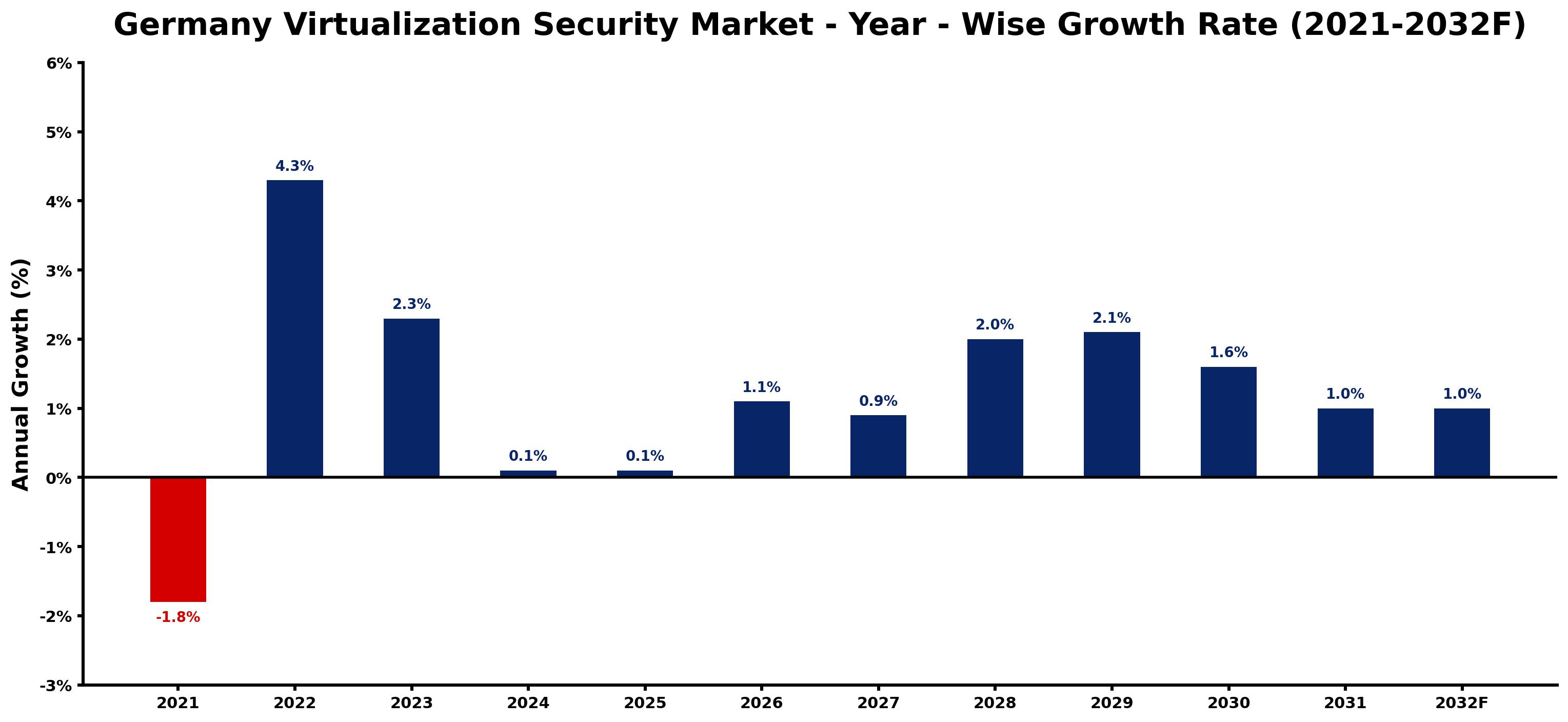
The table below presents the year‑wise growth rates along with the key drivers influencing the market
| Year | Growth Rate | Major Drivers |
| 2021 | -1.8% | German IT security regulations increased compliance costs significantly. |
| 2022 | 4.3% | Increased regulation from BSI on data protection. |
| 2023 | 2.3% | Rising complexity of multi-cloud environments demands advanced security. |
| 2024 | 0.1% | Surge in cyber threats targeting virtualized infrastructures. |
| 2025 | 0.1% | Adoption of GDPR motivates stringent security protocols. |
| 2026 | 1.1% | Boost in investment for cybersecurity workforce development programs. |
| 2027 | 0.9% | Focus on enhancing digital identity verification mechanisms. |
| 2028 | 2.0% | Demand for compliance with EU privacy laws grows. |
| 2029 | 2.1% | Emergence of quantum computing fuels need for innovative security. |
| 2030 | 1.6% | Utilization of AI-driven security solutions becomes mainstream. |
| 2031 | 1.0% | Shift towards zero-trust architecture in enterprise IT frameworks. |
| 2032 | 1.0% | Increasing reliance on virtualization for IT resource efficiency. |
Note: Market size estimations and growth projections presented in this report are based on 6Wresearch's proprietary forecasting methodology, utilizing the latest available industry data, government publications, and primary research inputs.
Germany Virtualization Security Market Key Takeaways
Below are some of the specific key takeaways from the market, including:
- The surge in cloud adoption is significantly elevating the need for virtualization security solutions.
- Micro-segmentation and advanced encryption methods are enhancing the capabilities of security technologies.
- Compliance with regulations such as GDPR is a key driver for businesses adopting virtualization security measures.
- Organizations are grappling with visibility and control issues in virtualized environments, posing challenges for security teams.
- Continuous threat intelligence updates are essential to counter emerging threats targeting virtual infrastructures.
Evaluation of Restraints in Germany Virtualization Security Market
Visibility and control in virtual environments remain persistent hurdles for organizations. Security teams often struggle to monitor and manage threats effectively due to the complex nature of virtualized infrastructures. Additionally, achieving compliance with various regulations requires consistent diligence and the right set of tools, which can strain resources. As the threat landscape evolves, organizations must remain agile and proactive, which can prove challenging when balancing cost and security investments.
Germany Virtualization Security Market Trends
Several trends are shaping the future of the Germany Virtualization Security Market. The shift towards zero-trust security models emphasizes the need for stringent access controls and continuous monitoring. on top of that, the integration of Artificial Intelligence (AI) and Machine Learning (ML) into security solutions is enhancing threat detection capabilities, enabling organizations to respond to threats more swiftly and accurately.
Also noteworthy is the growing trend of hybrid cloud environments, which is compelling organizations to adopt security solutions that provide comprehensive visibility across both on-premises and cloud-based assets.
Germany Virtualization Security Market Opportunities
There are ample opportunities within the Germany Virtualization Security Market, particularly for vendors who can innovate solutions that simplify security management in complex virtual environments. As remote work remains prevalent, solutions catering to secure remote access and ensuring compliance will be essential.
on top of that, organizations are increasingly seeking integrated security platforms that can centralize management, making the path for investment in comprehensive solutions attractive. Partnerships between cybersecurity firms and cloud service providers also present avenues for growth as businesses aim for enhanced security without sacrificing performance.
Government Initiatives in the Germany Virtualization Security Market
Government initiatives in Germany are increasingly focused on addressing the cybersecurity risks associated with virtualization. The regulatory environment is evolving, with an emphasis on standards and policies that enhance data protection and security in virtual environments. As these frameworks take shape, they guide organizations toward implementing effective security measures.
- A national cybersecurity strategy, recently completed, introduced standardized guidelines for protecting virtual infrastructures.
- The Federal Office for Information Security (BSI) is currently developing a framework focused on enhancing the security of cloud services, applicable to all virtualization technologies.
- Upcoming plans include a comprehensive review of existing data protection regulations to tighten compliance measures for virtualization technologies.
- A public-private partnership aimed at fostering innovation in cybersecurity solutions for virtual environments is underway, focusing on joint development initiatives.
- The German government is set to launch training programs for IT professionals to improve expertise in securing virtual infrastructures in early 2026.
Future Insights of the Germany Virtualization Security Market
Looking ahead to 2026-2032, the Germany Virtualization Security Market is expected to expand as businesses increasingly recognize the importance of safeguarding their virtual assets. Emerging technologies like AI will play a crucial role, both in enhancing security measures and in streamlining compliance processes.
on top of that, as cyber threats continue to evolve, the demand for sophisticated, adaptable security solutions will escalate, encouraging continuous innovation. Organizations will likely invest heavily in training their workforce to better manage these advanced systems, ensuring that security remains a top priority in their digital transformation journeys.
Germany Virtualization Security Market Latest Developments
Over the last 12-14 months, activity within the Germany Virtualization Security Market has intensified, with companies focusing on enhancing their offerings to meet the growing demand for robust security solutions. Innovations have been driven not only by customer needs but also by shifting regulatory landscapes that require organizations to adapt swiftly.
- A major technology vendor launched an advanced micro-segmentation solution in Q2 2025, enhancing protection for virtualized applications.
- A collaborative initiative between cybersecurity firms and local governments began in mid-2025, aimed at developing best practices for virtualization security.
- A leading regional operator is currently expanding its encryption capabilities across its virtualization platform, slated for completion by late 2025.
- In early 2026, a major rollout of an integrated security management platform is expected, designed specifically for hybrid environments.
- A new research project focused on AI-driven threat detection is planned to kick off in late 2025, with the goal of improving proactive defenses against virtualization threats.
Germany Virtualization Security Market - Key Attractiveness of the Report
- 10 Years of Market Numbers
- Historical Data Starting from 2022 to 2025
- Base Year: 2025
- Forecast Data until 2032
- Key Performance Indicators Impacting the Market
- Major Upcoming Developments and Projects
Key Highlights of the Report:
- Germany Virtualization Security Market Outlook
- Market Size of Germany Virtualization Security Market, 2025
- Forecast of Germany Virtualization Security Market, 2032
- Historical Data and Forecast of Germany Virtualization Security Revenues & Volume for the Period 2022-2032F
- Germany Virtualization Security Market Trend Evolution
- Germany Virtualization Security Market Drivers and Challenges
- Germany Virtualization Security Price Trends
- Germany Virtualization Security Porter's Five Forces
- Germany Virtualization Security Industry Life Cycle
- Historical Data and Forecast of Germany Virtualization Security Market Revenues & Volume By Component for the Period 2022-2032F
- Historical Data and Forecast of Germany Virtualization Security Market Revenues & Volume By Solution (Virtual Infrastructure & Lifecycle Protection) for the Period 2022-2032F
- Historical Data and Forecast of Germany Virtualization Security Market Revenues & Volume By Services (Professional & Managed) for the Period 2022-2032F
- Historical Data and Forecast of Germany Virtualization Security Market Revenues & Volume By Organization Size for the Period 2022-2032F
- Historical Data and Forecast of Germany Virtualization Security Market Revenues & Volume By SMEs for the Period 2022-2032F
- Historical Data and Forecast of Germany Virtualization Security Market Revenues & Volume By Large Enterprises for the Period 2022-2032F
- Historical Data and Forecast of Germany Virtualization Security Market Revenues & Volume By End User for the Period 2022-2032F
- Historical Data and Forecast of Germany Virtualization Security Market Revenues & Volume By Service Providers for the Period 2022-2032F
- Historical Data and Forecast of Germany Virtualization Security Market Revenues & Volume By Enterprises for the Period 2022-2032F
- Historical Data and Forecast of Germany Virtualization Security Market Revenues & Volume By Deployment for the Period 2022-2032F
- Historical Data and Forecast of Germany Virtualization Security Market Revenues & Volume By On-premises for the Period 2022-2032F
- Historical Data and Forecast of Germany Virtualization Security Market Revenues & Volume By Cloud for the Period 2022-2032F
- Germany Virtualization Security Import Export Trade Statistics
- Market Opportunity Assessment By Component
- Market Opportunity Assessment By Organization Size
- Market Opportunity Assessment By End User
- Market Opportunity Assessment By Deployment
- Germany Virtualization Security Top Companies Market Share
- Germany Virtualization Security Competitive Benchmarking By Technical and Operational Parameters
- Germany Virtualization Security Company Profiles
- Germany Virtualization Security Key Strategic Recommendations






































