Germany Workspace as a Service Market Size & Growth Rate (2026-2032)
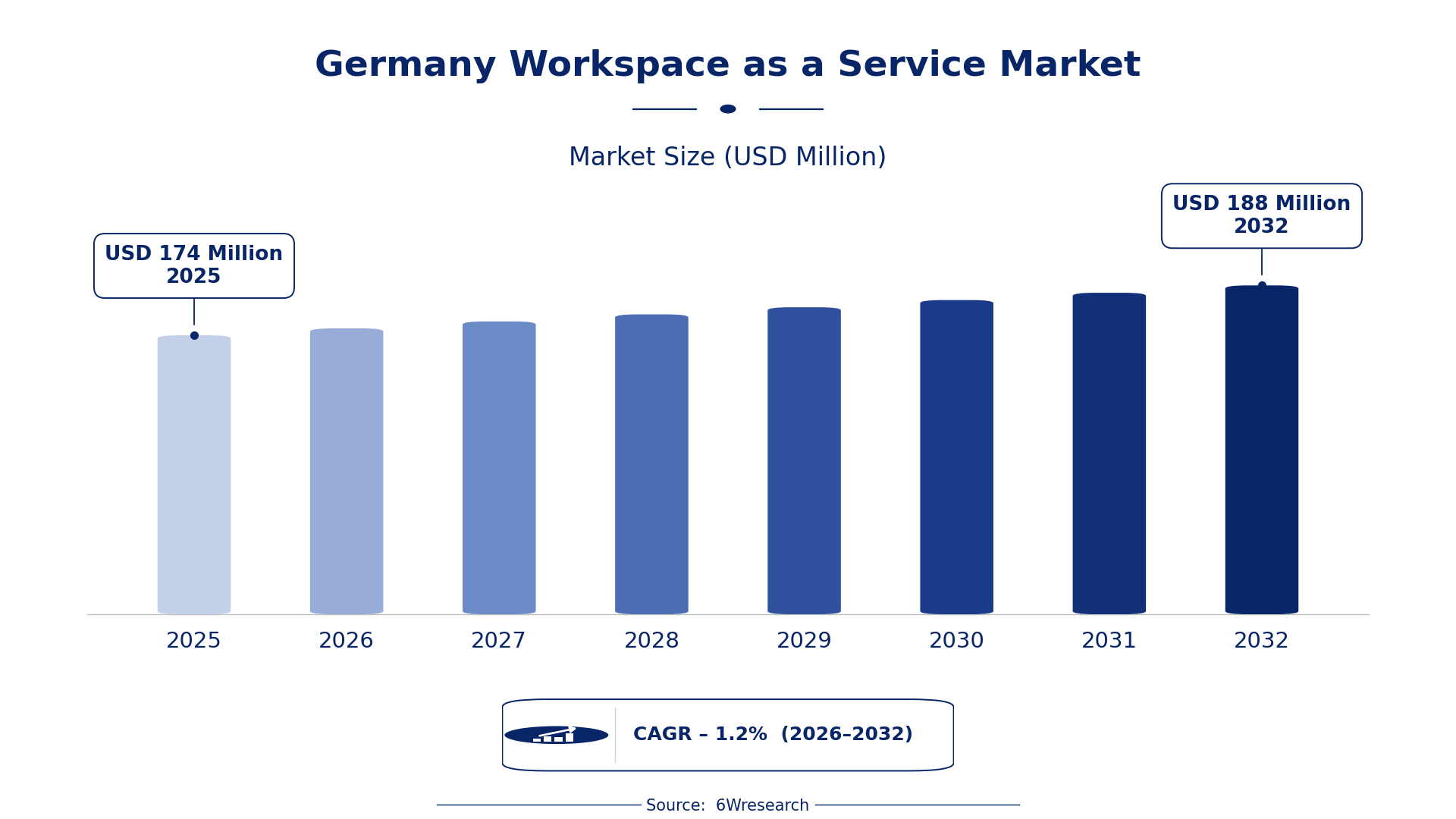
The Germany Workspace as a Service Market was estimated at USD 174 Million in 2025 and is projected to reach USD 188 Million by 2032, growing at a CAGR of 1.2% from 2026 to 2032.
Germany Workspace as a Service Market Synopsis
The Germany Workspace as a Service (WaaS) market is undergoing a notable transformation as organizations shift their operational strategies to accommodate remote work and digital collaboration. This momentum reflects a broader trend where flexibility and efficiency are paramount, yet the market's future trajectory indicates a need for continuous adaptation and innovation to meet evolving demands.
While businesses in Germany have embraced WaaS solutions for their scalability and cost-effectiveness, a host of challenges remains. As competition intensifies, the focus will likely shift to enhancing user experiences, ensuring data security, and optimizing service delivery models to meet diverse IT requirements.
Germany Workspace as a Service Market Year-wise Growth Rate and Key Drivers
This graph illustrates the annual growth rates of the Germany Workspace as a Service Market from 2021 to 2032, highlighting a steady upward trajectory and projected expansion over the forecast period.
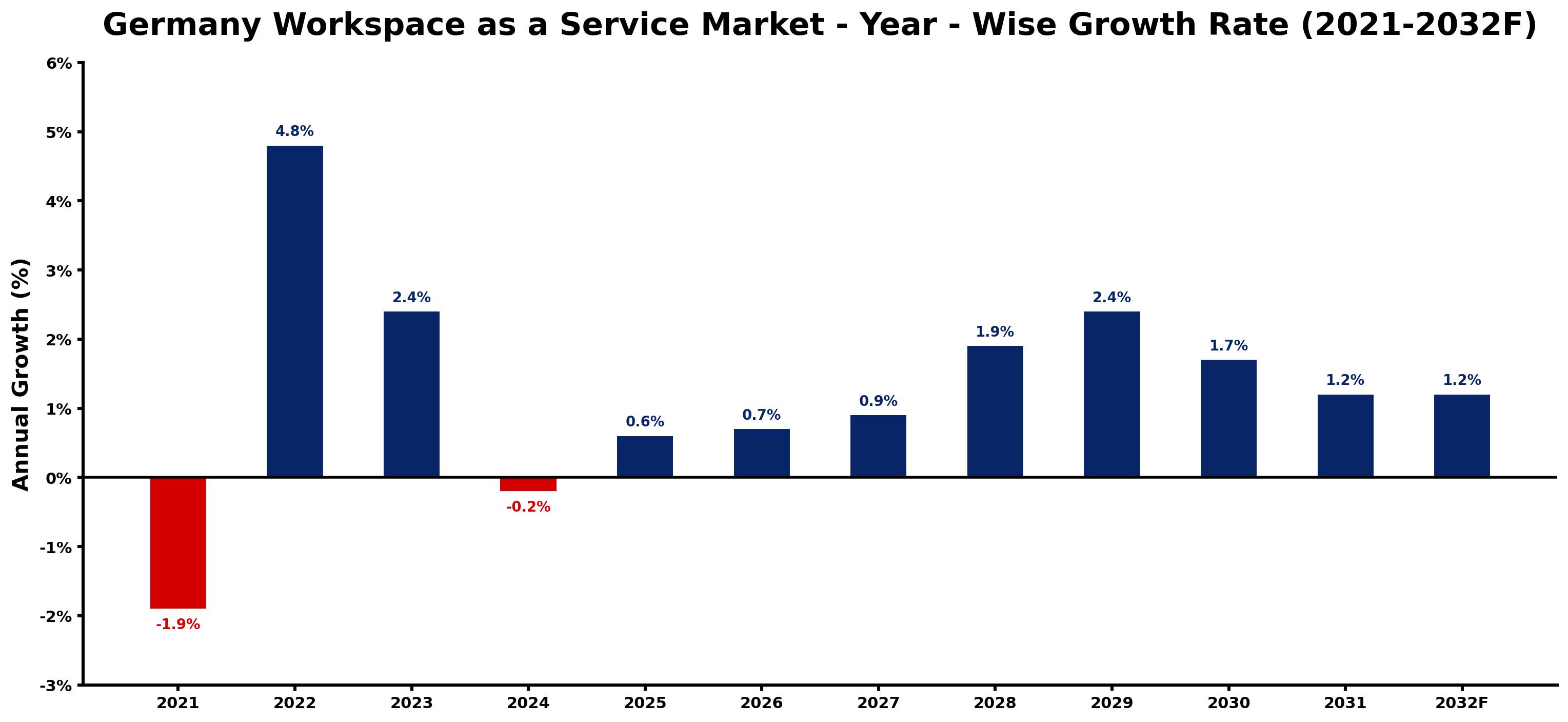
The table below presents the year‑wise growth rates along with the key drivers influencing the market
| Year | Growth Rate | Major Drivers |
| 2021 | -1.9% | Cloud infrastructure limitations by Bundesnetzagentur regulations |
| 2022 | 4.8% | Government focus on digital transformation in Germany |
| 2023 | 2.4% | Increased adoption of flexible workspace solutions post-pandemic |
| 2024 | -0.2% | Rising energy costs impacting service pricing in Germany |
| 2025 | 0.6% | ESC regulations supporting remote work technologies |
| 2026 | 0.7% | Growing interest in employee well-being and work-life balance |
| 2027 | 0.9% | Investment in IT infrastructure by German SMEs |
| 2028 | 1.9% | Rise of eco-friendly office solutions in urban areas |
| 2029 | 2.4% | Integration of AI in workplace management systems |
| 2030 | 1.7% | Supportive policies from German IT associations promoting WaaS |
| 2031 | 1.2% | Increased use of cloud services by the public sector |
| 2032 | 1.2% | Collaboration between startups and corporates enhancing innovation |
Note: Market size estimations and growth projections presented in this report are based on 6Wresearch's proprietary forecasting methodology, utilizing the latest available industry data, government publications, and primary research inputs.
Germany Workspace as a Service Market Key Takeaways
Below are some of the specific key takeaways from the market, including:
- The demand for WaaS solutions is largely driven by the adoption of hybrid work models and BYOD policies.
- Data security and compliance remain critical concerns as organizations navigate remote work environments.
- Investment in cloud-based collaboration tools is expected to rise, enhancing productivity across sectors.
- WaaS providers are focusing on innovative pricing models to attract and retain customers in a competitive market.
- Technological advancements in virtualization and cybersecurity are shaping the future of WaaS offerings.
Evaluation of Restraints in Germany Workspace as a Service Market
Despite its growth potential, the Germany Workspace as a Service market faces several restraints that could impede its progress. A primary concern is the compatibility of WaaS solutions with legacy systems, which can create integration challenges for organizations transitioning to cloud-based environments. Additionally, achieving optimal performance across diverse networks and ensuring compliance with data residency regulations are ongoing hurdles for providers. User mobility and device diversity also complicate the delivery of a consistent experience. Consequently, companies must innovate continuously to overcome these challenges while meeting customer expectations for transparency and support.
Germany Workspace as a Service Market Trends
Current trends indicate a marked shift towards enhanced security measures in WaaS solutions, driven by rising concerns over data breaches. Organizations are prioritizing solutions that provide robust cybersecurity frameworks, especially as remote work becomes the norm. Additionally, the integration of artificial intelligence and machine learning into WaaS offerings is gaining traction, facilitating improved user experiences and operational efficiencies. Another trend is the growing emphasis on sustainable IT practices, with businesses seeking eco-friendly solutions that align with their corporate social responsibility goals.
Germany Workspace as a Service Market Opportunities
The opportunities for growth in the Germany Workspace as a Service market are abundant. A significant area lies in the burgeoning demand for tailored WaaS solutions that cater to specific industry needs, particularly in sectors like healthcare, finance, and education. As organizations increasingly adopt hybrid work models, there’s room for innovation in service delivery and customer engagement. Additionally, partnerships between WaaS providers and technology vendors can lead to enhanced offerings that drive customer loyalty and expand market reach. Finally, investment in local data centers and infrastructure can create a competitive edge by ensuring compliance with stringent data protection regulations.
Government Initiatives in the Germany Workspace as a Service Market
Government policies in Germany significantly influence the Workspace as a Service market, primarily through regulations focused on data protection and cybersecurity. As digital transformation accelerates, the need for clear guidelines on compliance and security has become paramount. These regulations are crucial for fostering trust and encouraging businesses to adopt WaaS solutions, ensuring they meet stringent local requirements.
- A national data protection regulation enacted in 2023 emphasizes the importance of encryption standards for cloud services.
- Currently, the government is undertaking a cybersecurity framework revision to enhance protection for businesses utilizing cloud computing.
- A planned public-private initiative aims to establish a national digital infrastructure upgrade program by 2026.
- Recent discussions in the Bundestag have led to proposals for incentives to promote the adoption of green cloud solutions.
- Ongoing workshops by the Ministry of Digital and Transport focus on improving digital literacy among businesses to facilitate smoother transitions to WaaS.
Future Insights of the Germany Workspace as a Service Market
Looking ahead to 2026-2032, the Germany Workspace as a Service market is likely to experience steady growth as businesses continue to refine their operational strategies. The push for enhanced security and compliance will drive innovations in WaaS solutions, making them more attractive to organizations wary of data breaches. on top of that, with increased investment in digital infrastructure, the market is expected to witness the emergence of new players offering specialized services. As the concept of work evolves, organizations that adapt to these changes will benefit from the efficiencies and flexibility that WaaS provides.
Germany Workspace as a Service Market Latest Developments
In the past year, the Germany Workspace as a Service market has seen considerable activity, reflecting a strong commitment to enhancing service offerings and addressing emerging customer needs. Providers are innovating rapidly, with a focus on improving security measures and user experiences as remote work continues to be a dominant trend.
- A major technology vendor announced a new suite of cloud services aimed at enhancing remote collaboration, launched in Q1 2025.
- An initiative that began in early 2025 focuses on integrating AI-driven analytics into WaaS solutions to optimize performance for users.
- By mid-2026, a rollout is expected for a new compliance tool designed to help organizations meet stringent data protection regulations.
- A partnership between regional operators and cybersecurity firms was established in late 2024 to bolster security offerings for WaaS clients.
- Plans for a cloud infrastructure expansion project have been confirmed, with construction expected to begin in early 2026.
Germany Workspace as a Service Market - Key Attractiveness of the Report
- 10 Years of Market Numbers
- Historical Data Starting from 2022 to 2025
- Base Year: 2025
- Forecast Data until 2032
- Key Performance Indicators Impacting the Market
- Major Upcoming Developments and Projects
Key Highlights of the Report:
- Germany Workspace as a Service Market Outlook
- Market Size of Germany Workspace as a Service Market, 2025
- Forecast of Germany Workspace as a Service Market, 2032
- Historical Data and Forecast of Germany Workspace as a Service Revenues & Volume for the Period 2022-2032F
- Germany Workspace as a Service Market Trend Evolution
- Germany Workspace as a Service Market Drivers and Challenges
- Germany Workspace as a Service Price Trends
- Germany Workspace as a Service Porter's Five Forces
- Germany Workspace as a Service Industry Life Cycle
- Historical Data and Forecast of Germany Workspace as a Service Market Revenues & Volume By Solutions for the Period 2022-2032F
- Historical Data and Forecast of Germany Workspace as a Service Market Revenues & Volume By VDI and Applications for the Period 2022-2032F
- Historical Data and Forecast of Germany Workspace as a Service Market Revenues & Volume By Desktop as a Service for the Period 2022-2032F
- Historical Data and Forecast of Germany Workspace as a Service Market Revenues & Volume By Hosted Applications (Unified Communication Applications) for the Period 2022-2032F
- Historical Data and Forecast of Germany Workspace as a Service Market Revenues & Volume By Security Solutions for the Period 2022-2032F
- Historical Data and Forecast of Germany Workspace as a Service Market Revenues & Volume By Others (Browser-based WaaS solutions) for the Period 2022-2032F
- Historical Data and Forecast of Germany Workspace as a Service Market Revenues & Volume By Services for the Period 2022-2032F
- Historical Data and Forecast of Germany Workspace as a Service Market Revenues & Volume By System Integration for the Period 2022-2032F
- Historical Data and Forecast of Germany Workspace as a Service Market Revenues & Volume By Consulting services for the Period 2022-2032F
- Historical Data and Forecast of Germany Workspace as a Service Market Revenues & Volume By Managed services for the Period 2022-2032F
- Historical Data and Forecast of Germany Workspace as a Service Market Revenues & Volume By Deployment Type for the Period 2022-2032F
- Historical Data and Forecast of Germany Workspace as a Service Market Revenues & Volume By Public for the Period 2022-2032F
- Historical Data and Forecast of Germany Workspace as a Service Market Revenues & Volume By Private for the Period 2022-2032F
- Historical Data and Forecast of Germany Workspace as a Service Market Revenues & Volume By Hybrid for the Period 2022-2032F
- Historical Data and Forecast of Germany Workspace as a Service Market Revenues & Volume By End-Users for the Period 2022-2032F
- Historical Data and Forecast of Germany Workspace as a Service Market Revenues & Volume By Enterprises for the Period 2022-2032F
- Historical Data and Forecast of Germany Workspace as a Service Market Revenues & Volume By Small and medium businesses(SMB) for the Period 2022-2032F
- Historical Data and Forecast of Germany Workspace as a Service Market Revenues & Volume By Verticals for the Period 2022-2032F
- Historical Data and Forecast of Germany Workspace as a Service Market Revenues & Volume By Banking, Financial Services and Insurance (BFSI) for the Period 2022-2032F
- Historical Data and Forecast of Germany Workspace as a Service Market Revenues & Volume By Retail for the Period 2022-2032F
- Historical Data and Forecast of Germany Workspace as a Service Market Revenues & Volume By Government for the Period 2022-2032F
- Historical Data and Forecast of Germany Workspace as a Service Market Revenues & Volume By Healthcare for the Period 2022-2032F
- Historical Data and Forecast of Germany Workspace as a Service Market Revenues & Volume By Manufacturing for the Period 2022-2032F
- Historical Data and Forecast of Germany Workspace as a Service Market Revenues & Volume By Telecom and IT for the Period 2022-2032F
- Historical Data and Forecast of Germany Workspace as a Service Market Revenues & Volume By Utilities for the Period 2022-2032F
- Historical Data and Forecast of Germany Workspace as a Service Market Revenues & Volume By Travel and Hospitality for the Period 2022-2032F
- Germany Workspace as a Service Import Export Trade Statistics
- Market Opportunity Assessment By Solutions
- Market Opportunity Assessment By Services
- Market Opportunity Assessment By Deployment Type
- Market Opportunity Assessment By End-Users
- Market Opportunity Assessment By Verticals
- Germany Workspace as a Service Top Companies Market Share
- Germany Workspace as a Service Competitive Benchmarking By Technical and Operational Parameters
- Germany Workspace as a Service Company Profiles
- Germany Workspace as a Service Key Strategic Recommendations






































