Ghana Accounting Software Market Size, Share & Growth Rate
The Ghana Accounting Software Market was estimated at USD 1221 Million in 2025 and is projected to reach USD 1761 Million by 2032, growing at a CAGR of 5.4% from 2026 to 2032. This robust growth is primarily fueled by the increasing embrace of digital solutions among businesses, reflecting a strong shift toward operational efficiency and accuracy in financial management. The urgency for compliance with local regulations and the growing awareness of the benefits of automated financial processes are also pivotal factors stimulating this upward trajectory.
Ghana Accounting Software Market Year-wise Growth Rate and Key Drivers
This graph highlights how the Ghana Accounting Software Market has steadily grown over the years, supported by major growth factors.
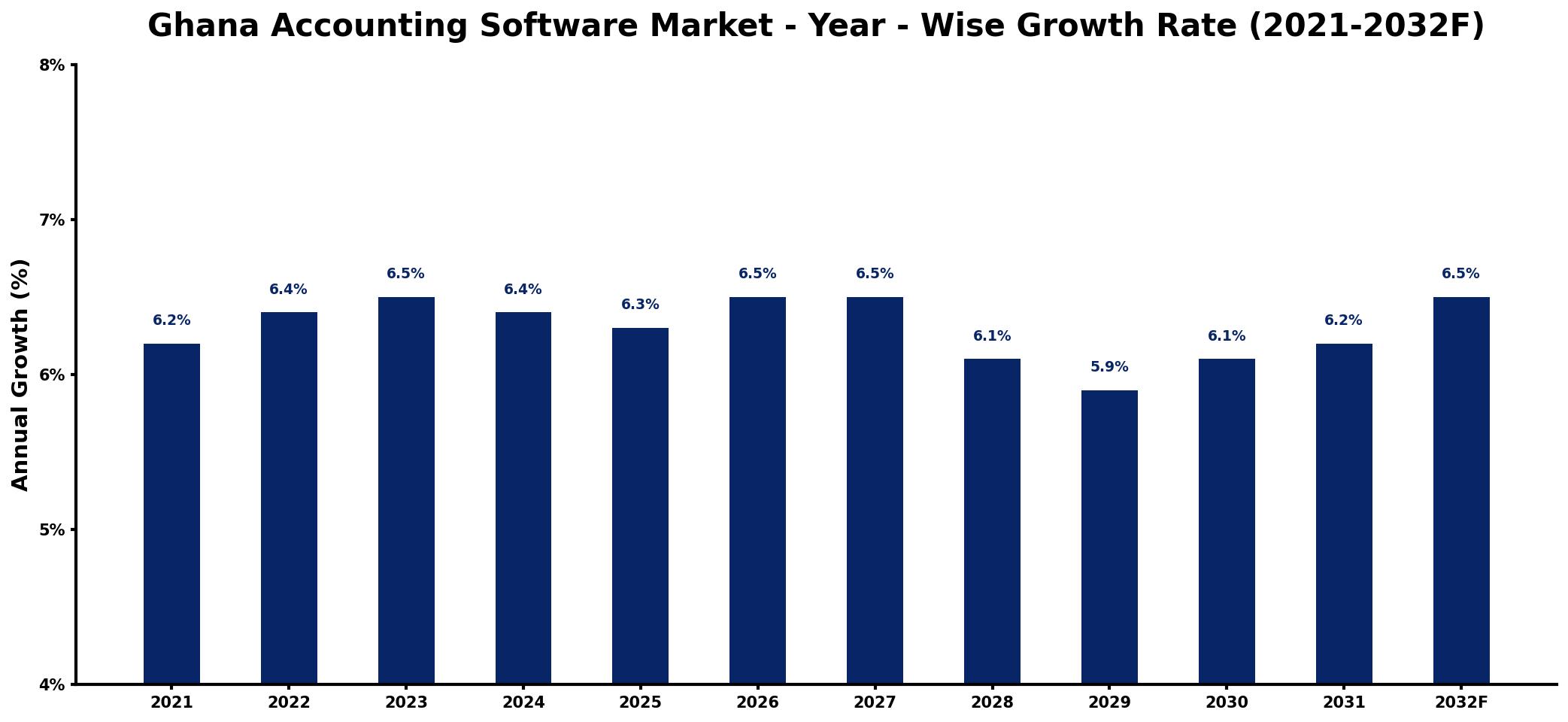
The table below presents the year‑wise growth rates along with the key drivers influencing the market
| Year | Growth Rate | Major Drivers |
| 2021 | 6.2% | Rising small business investments |
| 2022 | 6.4% | Increased digital transformation initiatives |
| 2023 | 6.5% | Growing demand for automation solutions |
| 2024 | 6.4% | Expansion of e-commerce platforms |
| 2025 | 6.3% | Higher adoption of cloud solutions |
| 2026 | 6.5% | Surging interest in mobile applications |
| 2027 | 6.5% | Enhanced regulatory compliance requirements |
| 2028 | 6.1% | Growing popularity of remote work |
| 2029 | 5.9% | Emerging startup ecosystem growth |
| 2030 | 6.1% | Increased focus on financial literacy |
| 2031 | 6.2% | increased pharmaceutical industry usage |
| 2032 | 6.5% | Rising need for data analytics |
Note: Market size estimations and growth projections presented in this report are based on 6Wresearch's proprietary forecasting methodology, utilizing the latest available industry data, government publications, and primary research inputs.
Ghana Accounting Software Market Synopsis
A key demand driver in the Ghana Accounting Software Market is the pressing need for real-time financial insights among small and medium enterprises (SMEs). Many businesses recognize that efficient financial management can significantly enhance decision-making and overall productivity.
On the supply side, an increasing variety of software options is available, tailored to meet the specific requirements of Ghanaian firms. The rise of cloud-based solutions has notably improved accessibility and affordability, allowing more businesses to benefit from advanced accounting functionalities.
Ghana Accounting Software Market Key Takeaways
- The market is experiencing significant growth due to the increasing adoption of cloud-based accounting solutions.
- SMEs are prioritizing software that offers integrated features such as invoicing, payroll management, and inventory tracking.
- Key trends include the integration of AI and automation for enhanced efficiency in financial tasks.
- Challenges related to affordability and awareness are impacting adoption rates among local businesses.
- Government initiatives are increasingly supporting the digital transformation of financial management practices.
Evaluation of Restraints in Ghana Accounting Software Market
Despite the promising growth, several factors restrain market expansion. Limited understanding of the benefits of accounting software among SMEs leads to slow adoption rates, impeding the full potential of the market. Moreover, affordability remains a critical challenge, as many local businesses struggle with the costs associated with implementing new software solutions. Integration with existing systems poses technical difficulties, while a lack of skilled personnel to manage and maintain these solutions can further hinder progress. Furthermore, concerns regarding data security and privacy create reluctance in adopting digital solutions, underscoring the necessity for targeted educational initiatives and the development of user-friendly, affordable products.
Ghana Accounting Software Market Trends
The trends shaping the Ghana Accounting Software Market include a strong shift towards automation and enhanced integration capabilities. Businesses are increasingly seeking solutions that not only streamline financial processes but also provide insightful analytics for better decision-making. The growing preference for mobile-compatible software reflects the need for flexibility and accessibility in managing financial tasks. Moreover, as businesses aim for compliance with regulations, the demand for software that offers robust reporting and auditing features is also rising.
Ghana Accounting Software Market Opportunities
There are significant investment opportunities in the Ghana Accounting Software Market, particularly for solutions that cater to the unique needs of local businesses. The demand for customized software capable of multi-currency support and tax compliance is on the rise. Additionally, partnerships with local accounting firms can enhance the implementation process, providing necessary training and support. Software providers that prioritize user-friendly designs and scalable solutions are well-positioned to capture a growing segment of this expanding market.
Government Initiatives in the Ghana Accounting Software Market
The Ghanaian government has introduced various initiatives to promote the adoption of accounting software. These include efforts to enhance digital literacy and technology uptake among businesses. Furthermore, tax incentives are available for companies investing in advanced accounting solutions, which is aimed at improving financial transparency and operational efficiency. By supporting local software developers and facilitating the creation of tailored solutions, the government is fostering an environment conducive to growth in the accounting software sector.
Future Insights of the Ghana Accounting Software Market
Looking ahead to 2026-2032, the outlook for the Ghana Accounting Software Market remains optimistic. The ongoing shift towards digitalization is expected to intensify, driven by the demand for more sophisticated financial management tools. Cloud-based solutions will likely become the standard due to their flexibility and cost benefits, particularly for SMEs. As businesses increasingly recognize the importance of accurate financial reporting, the market for advanced accounting software is set to flourish, inviting innovative solutions that can meet the dynamic needs of Ghanaian enterprises.
Ghana Accounting Software Market Latest Developments (2025 - 2026)
In the past year, the Ghana Accounting Software Market has seen a surge in the launch of new digital solutions focusing on user experience and affordability. Companies are increasingly prioritizing mobile compatibility to accommodate the growing workforce that values flexibility. There have been advancements in features like automation and AI integration, which are now standard in many offerings. Additionally, collaborations between local businesses and software providers are on the rise, paving the way for better implementation support and training initiatives.
Ghana Accounting Software Market - Key Attractiveness of the Report
- 10 Years of Market Numbers
- Historical Data Starting from 2022 to 2025
- Base Year: 2025
- Forecast Data until 2032
- Key Performance Indicators Impacting the Market
- Major Upcoming Developments and Projects
Key Highlights of the Report:
- Ghana Accounting Software Market Outlook
- Market Size of Ghana Accounting Software Market, 2025
- Forecast of Ghana Accounting Software Market, 2032
- Historical Data and Forecast of Ghana Accounting Software Revenues & Volume for the Period 2022-2032F
- Ghana Accounting Software Market Trend Evolution
- Ghana Accounting Software Market Drivers and Challenges
- Ghana Accounting Software Price Trends
- Ghana Accounting Software Porter's Five Forces
- Ghana Accounting Software Industry Life Cycle
- Historical Data and Forecast of Ghana Accounting Software Market Revenues & Volume By Component for the Period 2022-2032F
- Historical Data and Forecast of Ghana Accounting Software Market Revenues & Volume By Software for the Period 2022-2032F
- Historical Data and Forecast of Ghana Accounting Software Market Revenues & Volume By Services for the Period 2022-2032F
- Historical Data and Forecast of Ghana Accounting Software Market Revenues & Volume By Enterprise Size for the Period 2022-2032F
- Historical Data and Forecast of Ghana Accounting Software Market Revenues & Volume By Large for the Period 2022-2032F
- Historical Data and Forecast of Ghana Accounting Software Market Revenues & Volume By Small & Medium for the Period 2022-2032F
- Historical Data and Forecast of Ghana Accounting Software Market Revenues & Volume By Type for the Period 2022-2032F
- Historical Data and Forecast of Ghana Accounting Software Market Revenues & Volume By Spreadsheets for the Period 2022-2032F
- Historical Data and Forecast of Ghana Accounting Software Market Revenues & Volume By ERP for the Period 2022-2032F
- Historical Data and Forecast of Ghana Accounting Software Market Revenues & Volume By Custom Accounting Software for the Period 2022-2032F
- Historical Data and Forecast of Ghana Accounting Software Market Revenues & Volume By Tax Management Software for the Period 2022-2032F
- Historical Data and Forecast of Ghana Accounting Software Market Revenues & Volume By End-use Industry for the Period 2022-2032F
- Historical Data and Forecast of Ghana Accounting Software Market Revenues & Volume By BFSI for the Period 2022-2032F
- Historical Data and Forecast of Ghana Accounting Software Market Revenues & Volume By IT & Telecommunication for the Period 2022-2032F
- Historical Data and Forecast of Ghana Accounting Software Market Revenues & Volume By Government & Public Sector for the Period 2022-2032F
- Historical Data and Forecast of Ghana Accounting Software Market Revenues & Volume By Automotive for the Period 2022-2032F
- Historical Data and Forecast of Ghana Accounting Software Market Revenues & Volume By Retail & Consumer Goods for the Period 2022-2032F
- Historical Data and Forecast of Ghana Accounting Software Market Revenues & Volume By Oil & Gas for the Period 2022-2032F
- Historical Data and Forecast of Ghana Accounting Software Market Revenues & Volume By Manufacturing for the Period 2022-2032F
- Historical Data and Forecast of Ghana Accounting Software Market Revenues & Volume By Others for the Period 2022-2032F
- Ghana Accounting Software Import Export Trade Statistics
- Market Opportunity Assessment By Component
- Market Opportunity Assessment By Enterprise Size
- Market Opportunity Assessment By Type
- Market Opportunity Assessment By End-use Industry
- Ghana Accounting Software Top Companies Market Share
- Ghana Accounting Software Competitive Benchmarking By Technical and Operational Parameters
- Ghana Accounting Software Company Profiles
- Ghana Accounting Software Key Strategic Recommendations






































