Ghana Apiculture Market Size, Share & Growth Rate
The Ghana Apiculture Market was estimated at USD 436 Million in 2025 and is projected to reach USD 569 Million by 2032, growing at a CAGR of 3.9% from 2026 to 2032. This growth trajectory is propelled by increasing consumer awareness regarding the numerous health benefits of honey and natural bee products. Furthermore, the expanding number of both small-scale and commercial beekeepers, supported by favorable climatic conditions and biodiversity in Ghana, plays a significant role in bolstering production capacity.
Ghana Apiculture Market Year-wise Growth Rate and Key Drivers
This graph highlights how the Ghana Apiculture Market has steadily grown over the years, supported by major growth factors.
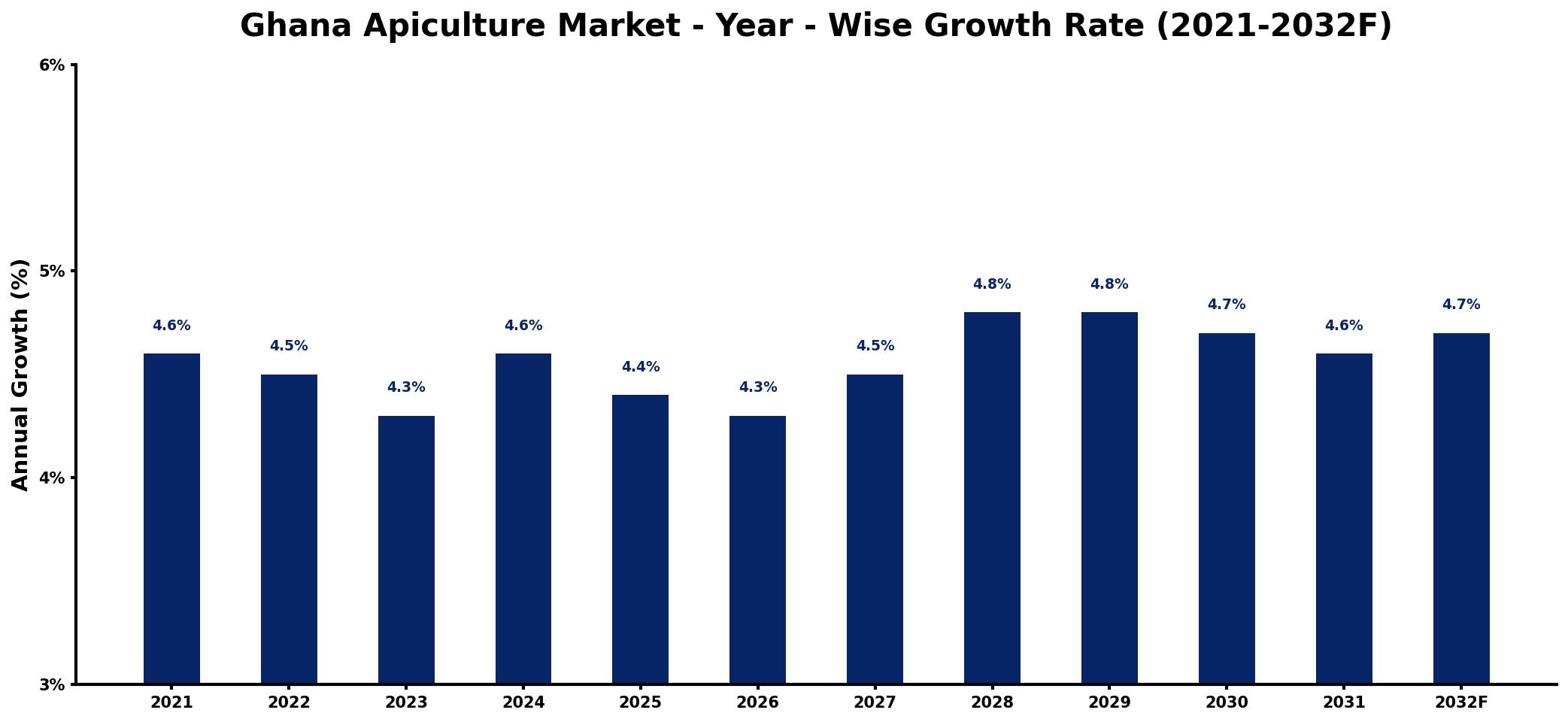
The table below presents the year‑wise growth rates along with the key drivers influencing the market
| Year | Growth Rate | Major Drivers |
| 2021 | 4.6% | Rising health consciousness among consumers |
| 2022 | 4.5% | Increased investment in sustainable practices |
| 2023 | 4.3% | Expansion of organic farming techniques |
| 2024 | 4.6% | Growth in natural sweetener demand |
| 2025 | 4.4% | Emergence of new market players |
| 2026 | 4.3% | Strengthening of export opportunities |
| 2027 | 4.5% | Heightened interest in local sourcing |
| 2028 | 4.8% | Growing popularity of wellness products |
| 2029 | 4.8% | Advancements in bee breeding techniques |
| 2030 | 4.7% | Boost in agricultural education programs |
| 2031 | 4.6% | Enhanced government support initiatives |
| 2032 | 4.7% | Integration of technology in farming |
Note: Market size estimations and growth projections presented in this report are based on 6Wresearch's proprietary forecasting methodology, utilizing the latest available industry data, government publications, and primary research inputs.
Ghana Apiculture Market Synopsis
The Ghanaian apiculture market is currently witnessing a robust surge in interest as the health-conscious population increasingly opts for natural sweeteners over processed alternatives. This shift is complemented by a growing appreciation for the unique flavors of Ghanaian honey, attributed to the country's diverse floral sources.
In addition to honey, the popularity of by-products like beeswax, propolis, and royal jelly is on the rise, driven by their applications in medicinal and cosmetic sectors. While the market shows great promise, the industry grapples with challenges such as inadequate training for beekeepers and inconsistent government support, which may impede further growth.
Ghana Apiculture Market Key Takeaways
- Growing consumer awareness about the health benefits of honey and bee products is driving demand.
- The rise of sustainable beekeeping practices is reshaping production methods in the sector.
- Value-added products like propolis and royal jelly are attracting niche markets focused on natural health.
- Investments in training and equipment for beekeepers are critical for market competitiveness.
- Government initiatives are fostering growth, enhancing both local production capabilities and market access.
Evaluation of Restraints in Ghana Apiculture Market
Despite the promising potential of the Ghana Apiculture Market, several restraints inhibit its progress. A significant issue is the limited access to modern beekeeping equipment, which hampers productivity and efficiency. Additionally, many beekeepers lack adequate training and education, resulting in suboptimal honey production practices. The inconsistency of government policies and support can also create uncertainty, making it challenging for beekeepers to navigate the market effectively. Furthermore, challenges related to bee health, including diseases and pests, pose risks to colony sustainability, further restraining the industry's growth.
Ghana Apiculture Market Trends
The Ghana Apiculture Market is witnessing a notable shift towards sustainable and environmentally-friendly beekeeping practices. Local beekeepers are increasingly incorporating modern techniques, focusing on improving both honey quality and production efficiency. Concurrently, there is a growing consumer trend toward organic and locally sourced honey, creating opportunities for small-scale beekeepers to tap into this demand. The emergence of value-added products from bee by-products, catering to health and beauty markets, is also gaining traction, illustrating an evolving consumer landscape.
Ghana Apiculture Market Opportunities
The Ghana Apiculture Market offers substantial investment opportunities fueled by a rising demand for honey and related products. As consumers increasingly turn towards natural options, the market for beekeeping activities is expanding. Investors can explore avenues such as establishing bee farms, setting up honey processing facilities, or investing in the training of local beekeepers to enhance production capabilities. Additionally, government support in the form of incentives and subsidies creates a favorable environment for potential investors looking to contribute to sustainable agricultural practices in Ghana.
Government Initiatives in the Ghana Apiculture Market
The government of Ghana has displayed a proactive stance towards developing the apiculture sector. Through initiatives like the National Beekeeping Programme, the Ministry of Food and Agriculture provides training, technical assistance, and access to equipment for beekeepers. The establishment of the Ghana Beekeepers Association further supports industry collaboration and knowledge sharing. Additionally, regulatory measures are in place to ensure the safety and quality of honey products, reflecting a commitment to foster growth within the apiculture industry.
Future Insights of the Ghana Apiculture Market
Looking ahead to 2026-2032, the Ghana Apiculture Market is poised for considerable growth driven by escalating demand for high-quality, sustainably-produced honey. Increasing consumer awareness about the importance of natural products in health and wellness will further enhance market dynamics. The government's ongoing efforts to support beekeepers through training and incentives are expected to bolster production capabilities, thereby expanding the reach of Ghanaian honey in both local and international markets. As urbanization continues, there is potential for greater honey consumption in urban areas, further contributing to market growth.
Ghana Apiculture Market Latest Developments (2025 - 2026)
Recent developments in the Ghana Apiculture Market indicate a growing focus on sustainability and quality assurance. Various initiatives aimed at enhancing the skills of local beekeepers are underway, with training sessions being organized in collaboration with local NGOs. Moreover, there has been an uptick in the establishment of cooperatives, enabling small-scale beekeepers to pool resources and enhance their market presence. Additionally, the government is working on policies to support exports of honey products, opening new avenues for growth.
Ghana Apiculture Market - Key Attractiveness of the Report
- 10 Years of Market Numbers
- Historical Data Starting from 2022 to 2025
- Base Year: 2025
- Forecast Data until 2032
- Key Performance Indicators Impacting the Market
- Major Upcoming Developments and Projects
Key Highlights of the Report:
- Ghana Apiculture Market Outlook
- Market Size of Ghana Apiculture Market, 2025
- Forecast of Ghana Apiculture Market, 2032
- Historical Data and Forecast of Ghana Apiculture Revenues & Volume for the Period 2022-2032F
- Ghana Apiculture Market Trend Evolution
- Ghana Apiculture Market Drivers and Challenges
- Ghana Apiculture Price Trends
- Ghana Apiculture Porter's Five Forces
- Ghana Apiculture Industry Life Cycle
- Historical Data and Forecast of Ghana Apiculture Market Revenues & Volume By Product Type for the Period 2022-2032F
- Historical Data and Forecast of Ghana Apiculture Market Revenues & Volume By Honey for the Period 2022-2032F
- Historical Data and Forecast of Ghana Apiculture Market Revenues & Volume By Beeswax for the Period 2022-2032F
- Historical Data and Forecast of Ghana Apiculture Market Revenues & Volume By Live-bees for the Period 2022-2032F
- Historical Data and Forecast of Ghana Apiculture Market Revenues & Volume By Others for the Period 2022-2032F
- Historical Data and Forecast of Ghana Apiculture Market Revenues & Volume By Application for the Period 2022-2032F
- Historical Data and Forecast of Ghana Apiculture Market Revenues & Volume By Medical for the Period 2022-2032F
- Historical Data and Forecast of Ghana Apiculture Market Revenues & Volume By Food Beverages for the Period 2022-2032F
- Historical Data and Forecast of Ghana Apiculture Market Revenues & Volume By Cosmetics for the Period 2022-2032F
- Historical Data and Forecast of Ghana Apiculture Market Revenues & Volume By Others for the Period 2022-2032F
- Ghana Apiculture Import Export Trade Statistics
- Market Opportunity Assessment By Product Type
- Market Opportunity Assessment By Application
- Ghana Apiculture Top Companies Market Share
- Ghana Apiculture Competitive Benchmarking By Technical and Operational Parameters
- Ghana Apiculture Company Profiles
- Ghana Apiculture Key Strategic Recommendations






































