Ghana Rubber Molding Market Size, Share & Growth Rate
The Ghana Rubber Molding Market was estimated at USD 483 Million in 2025 and is projected to reach USD 637 Million by 2032, growing at a CAGR of 4.0% from 2026 to 2032. This growth trajectory is primarily fueled by heightened demand across key sectors such as automotive, construction, and healthcare, where high-quality rubber products are essential. Government initiatives aimed at infrastructure enhancement and a surge in foreign investment are further propelling this market forward.
Ghana Rubber Molding Market Year-wise Growth Rate and Key Drivers
This graph highlights how the Ghana Rubber Molding Market has steadily grown over the years, supported by major growth factors.
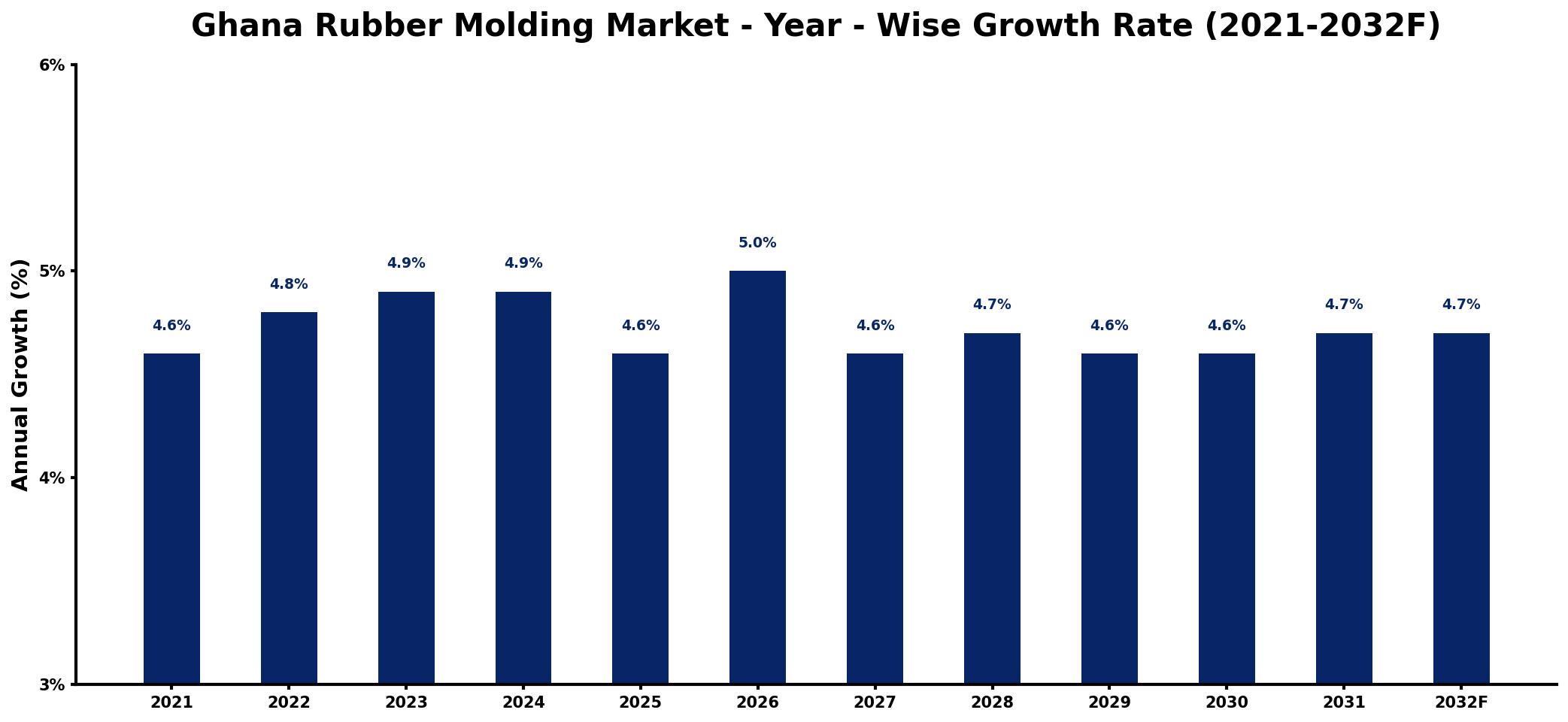
The table below presents the year‑wise growth rates along with the key drivers influencing the market
| Year | Growth Rate | Major Drivers |
| 2021 | 4.6% | Rising automotive manufacturing activities |
| 2022 | 4.8% | Increased construction project investments |
| 2023 | 4.9% | Growing consumer electronics demand |
| 2024 | 4.9% | Expansion of renewable energy sector |
| 2025 | 4.6% | Surge in healthcare equipment needs |
| 2026 | 5.0% | Boost in logistics and transportation |
| 2027 | 4.6% | Higher industrial automation adoption |
| 2028 | 4.7% | Emerging markets for consumer goods |
| 2029 | 4.6% | Enhanced agricultural machinery usage |
| 2030 | 4.6% | Strengthened infrastructure development initiatives |
| 2031 | 4.7% | Growing demand for packaging solutions |
| 2032 | 4.7% | Increased focus on sustainability practices |
Note: Market size estimations and growth projections presented in this report are based on 6Wresearch's proprietary forecasting methodology, utilizing the latest available industry data, government publications, and primary research inputs.
Ghana Rubber Molding Market Synopsis
The most significant driving force behind the Ghana Rubber Molding Market is the burgeoning demand for custom rubber products across various industries. As local manufacturers increasingly invest in advanced technologies, the quality and efficiency of production are set to improve, meeting the evolving needs of consumers.
Additionally, the market is witnessing a shift towards sustainable and eco-friendly materials as environmental awareness grows. Coupled with innovations in molding techniques, the emphasis on durable and cost-effective solutions positions the Ghana Rubber Molding Market for substantial growth in the years to come.
Ghana Rubber Molding Market Key Takeaways
- The market is projected to grow from USD 483 Million in 2025 to USD 637 Million by 2032.
- Growing demand from the automotive, construction, and healthcare sectors drives market expansion.
- Technological advancements are promoting innovative molding techniques and efficient production.
- Sustainability trends are influencing the adoption of eco-friendly rubber materials.
- Government policies supporting local manufacturing are enhancing the investment landscape.
Evaluation of Restraints in Ghana Rubber Molding Market
Despite the promising outlook, the Ghana Rubber Molding Market faces several constraints. Limited access to raw materials poses significant challenges, as does the volatility of rubber prices, which can impact production costs. Additionally, infrastructural inadequacies, such as suboptimal transportation and storage facilities, complicate operational efficiency. Moreover, an inconsistent power supply can disrupt manufacturing schedules, further hindering productivity. Addressing these issues through strategic partnerships and investments in infrastructure will be crucial for the markets growth.
Ghana Rubber Molding Market Trends
Current trends indicate a strong inclination towards customization in rubber products, particularly within the automotive and healthcare sectors. Manufacturers are increasingly focusing on developing bespoke solutions to meet specific client demands. Furthermore, the adoption of automation and digitalization is revolutionizing production processes, enhancing both efficiency and product quality. The move towards sustainable practices is also gaining traction, with many companies exploring biodegradable and eco-friendly rubber options, thereby aligning with global sustainability goals.
Ghana Rubber Molding Market Opportunities
The Ghana Rubber Molding Market is rich with investment opportunities, particularly as industrial demand for rubber products continues to rise. The increasing focus on custom rubber components presents a lucrative avenue for companies willing to innovate and adapt. Additionally, as Ghana's infrastructure develops and technology in manufacturing advances, investors can capitalize on modern production methodologies that promise efficiency and reduced costs. The favorable government stance on local manufacturing further encourages long-term investments in this sector.
Government Initiatives in the Ghana Rubber Molding Market
Ghana's government has undertaken several initiatives to bolster the rubber molding industry. These include establishing the Ghana Rubber Estate Limited (GREL) to ensure a reliable supply of raw materials, along with implementing tax incentives that promote local production and exports. Furthermore, the government is committed to enhancing skills within the sector through technical training programs. By improving infrastructure, such as transportation and power supply, the administration is laying the groundwork for a more competitive rubber molding market.
Future Insights of the Ghana Rubber Molding Market
Looking ahead to 2026-2032, the Ghana Rubber Molding Market is expected to thrive, driven by escalating demand across various sectors, including automotive and construction. With ongoing industrialization and government support for local manufacturers, the market is well-positioned for sustained growth. Furthermore, technological advancements in molding processes and materials will enhance product offerings and competitiveness. However, stakeholders should remain vigilant of fluctuations in raw material costs and global economic trends that could potentially impact growth.
Ghana Rubber Molding Market Latest Developments (2025 - 2026)
Recent developments in the Ghana Rubber Molding Market indicate a continued push for innovation. Key players are increasingly adopting automation to streamline production processes, which promises improved efficiency and cost management. Additionally, theres a noticeable trend towards collaboration between local manufacturers and international firms, aimed at sharing technology and best practices. These partnerships are expected to enrich the local market, enhancing both quality and capability in rubber molding applications.
Ghana Rubber Molding Market - Key Attractiveness of the Report
- 10 Years of Market Numbers
- Historical Data Starting from 2022 to 2025
- Base Year: 2025
- Forecast Data until 2032
- Key Performance Indicators Impacting the Market
- Major Upcoming Developments and Projects
Key Highlights of the Report:
- Ghana Rubber Molding Market Outlook
- Market Size of Ghana Rubber Molding Market, 2025
- Forecast of Ghana Rubber Molding Market, 2032
- Historical Data and Forecast of Ghana Rubber Molding Revenues & Volume for the Period 2022-2032F
- Ghana Rubber Molding Market Trend Evolution
- Ghana Rubber Molding Market Drivers and Challenges
- Ghana Rubber Molding Price Trends
- Ghana Rubber Molding Porter's Five Forces
- Ghana Rubber Molding Industry Life Cycle
- Historical Data and Forecast of Ghana Rubber Molding Market Revenues & Volume By Components for the Period 2022-2032F
- Historical Data and Forecast of Ghana Rubber Molding Market Revenues & Volume By Hoses for the Period 2022-2032F
- Historical Data and Forecast of Ghana Rubber Molding Market Revenues & Volume By Gaskets for the Period 2022-2032F
- Historical Data and Forecast of Ghana Rubber Molding Market Revenues & Volume By Diaphragm for the Period 2022-2032F
- Historical Data and Forecast of Ghana Rubber Molding Market Revenues & Volume By Bellows for the Period 2022-2032F
- Historical Data and Forecast of Ghana Rubber Molding Market Revenues & Volume By Seals for the Period 2022-2032F
- Historical Data and Forecast of Ghana Rubber Molding Market Revenues & Volume By Weather Strips for the Period 2022-2032F
- Historical Data and Forecast of Ghana Rubber Molding Market Revenues & Volume By Types for the Period 2022-2032F
- Historical Data and Forecast of Ghana Rubber Molding Market Revenues & Volume By Liquid Injection Molding for the Period 2022-2032F
- Historical Data and Forecast of Ghana Rubber Molding Market Revenues & Volume By Compression Molding for the Period 2022-2032F
- Historical Data and Forecast of Ghana Rubber Molding Market Revenues & Volume By Transfer Molding for the Period 2022-2032F
- Historical Data and Forecast of Ghana Rubber Molding Market Revenues & Volume By Others for the Period 2022-2032F
- Historical Data and Forecast of Ghana Rubber Molding Market Revenues & Volume By Material for the Period 2022-2032F
- Historical Data and Forecast of Ghana Rubber Molding Market Revenues & Volume By Ethylene Propylene Diene Terpolymer (Epdm) for the Period 2022-2032F
- Historical Data and Forecast of Ghana Rubber Molding Market Revenues & Volume By Natural Rubber (Nr) for the Period 2022-2032F
- Historical Data and Forecast of Ghana Rubber Molding Market Revenues & Volume By Styrene Butadiene Rubber (Sbr) for the Period 2022-2032F
- Historical Data and Forecast of Ghana Rubber Molding Market Revenues & Volume By Others for the Period 2022-2032F
- Historical Data and Forecast of Ghana Rubber Molding Market Revenues & Volume By Vehicle Type for the Period 2022-2032F
- Historical Data and Forecast of Ghana Rubber Molding Market Revenues & Volume By Passenger Vehicle for the Period 2022-2032F
- Historical Data and Forecast of Ghana Rubber Molding Market Revenues & Volume By Commercial Vehicle for the Period 2022-2032F
- Ghana Rubber Molding Import Export Trade Statistics
- Market Opportunity Assessment By Components
- Market Opportunity Assessment By Types
- Market Opportunity Assessment By Material
- Market Opportunity Assessment By Vehicle Type
- Ghana Rubber Molding Top Companies Market Share
- Ghana Rubber Molding Competitive Benchmarking By Technical and Operational Parameters
- Ghana Rubber Molding Company Profiles
- Ghana Rubber Molding Key Strategic Recommendations






































