Ghana Tire Machinery Market Size, Share & Growth Rate
The Ghana Tire Machinery Market was estimated at USD 156 Million in 2025 and is projected to reach USD 218 Million by 2032, growing at a CAGR of 4.9% from 2026 to 2032. This robust growth trajectory is driven by the expanding automotive sector, which has led to an increase in tire demand. The ongoing investments in tire manufacturing technology and government initiatives aimed at boosting domestic production are also significant contributors to this positive outlook.
Ghana Tire Machinery Market Year-wise Growth Rate and Key Drivers
This graph highlights how the Ghana Tire Machinery Market has steadily grown over the years, supported by major growth factors.
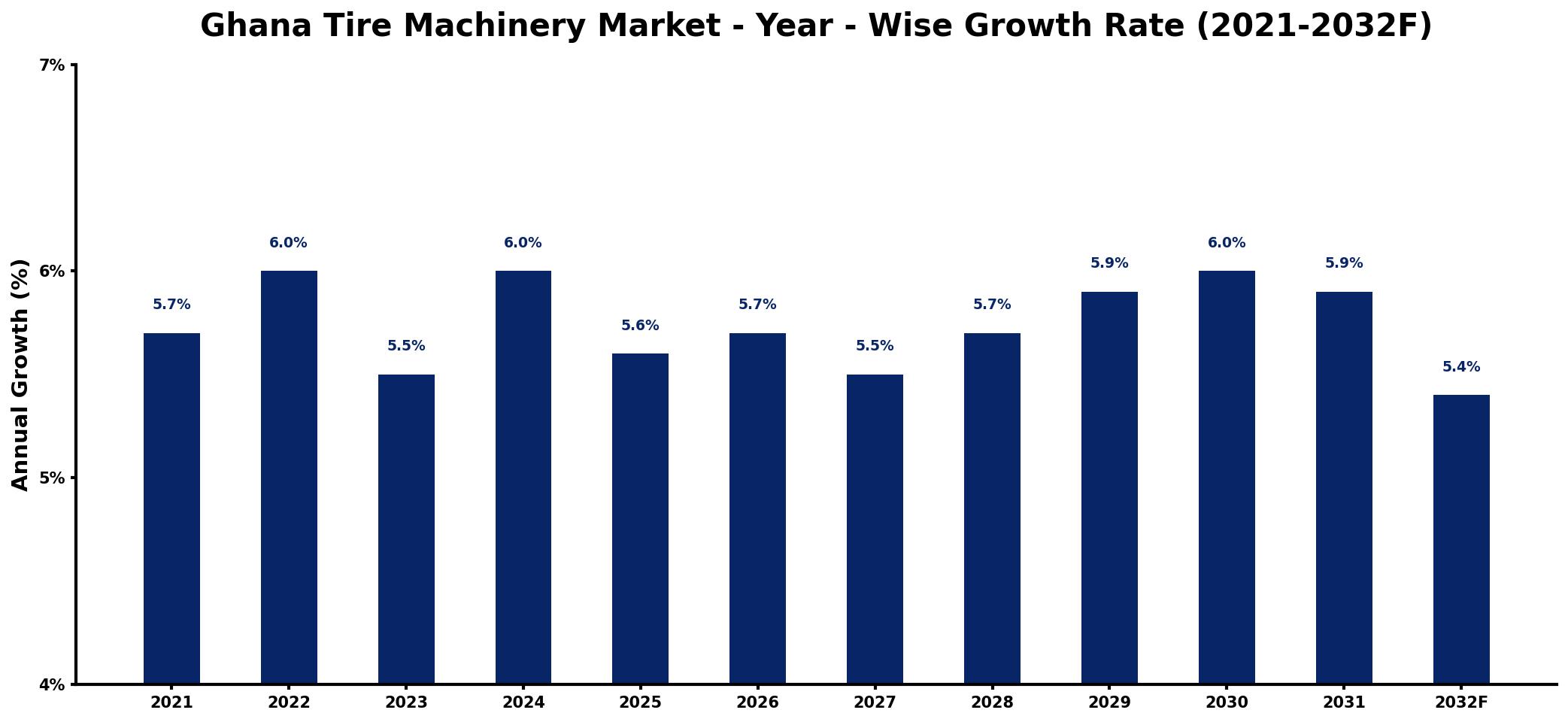
The table below presents the year‑wise growth rates along with the key drivers influencing the market
| Year | Growth Rate | Major Drivers |
| 2021 | 5.7% | Rising automotive manufacturing sector |
| 2022 | 6.0% | Increased infrastructure development projects |
| 2023 | 5.5% | Growing demand for transportation solutions |
| 2024 | 6.0% | strengthening underlying market demand |
| 2025 | 5.6% | Investment in renewable energy initiatives |
| 2026 | 5.7% | Strengthening local production capabilities |
| 2027 | 5.5% | Boost in urban mobility solutions |
| 2028 | 5.7% | Surge in e-commerce activities |
| 2029 | 5.9% | Enhanced government support programs |
| 2030 | 6.0% | Growth in export opportunities |
| 2031 | 5.9% | Emergence of electric vehicle market |
| 2032 | 5.4% | Focus on sustainable manufacturing practices |
Note: Market size estimations and growth projections presented in this report are based on 6Wresearch's proprietary forecasting methodology, utilizing the latest available industry data, government publications, and primary research inputs.
Ghana Tire Machinery Market Synopsis
The Ghana Tire Machinery Market is experiencing a dynamic transformation, spurred by an upsurge in automotive activities. Manufacturers are adapting to evolving technological standards by embracing modern tire production machinery, which enhances both efficiency and product quality.
Current trends reflect a strong inclination towards automation and sustainable practices. Local producers are not only upgrading their equipment but also investing in innovative practices to meet the increasing demand for high-performance tires, positioning themselves competitively within the global marketplace.
Ghana Tire Machinery Market Key Takeaways
- The Ghana Tire Machinery Market is witnessing significant growth fueled by automotive sector expansion.
- Automation and sustainability are becoming central themes in tire manufacturing processes.
- Investment in innovative tire machinery and technology is essential for local manufacturers.
- Government initiatives are designed to enhance domestic production and competitiveness.
- Challenges such as import tariffs and infrastructure constraints still need addressing for sustainable growth.
Evaluation of Restraints in Ghana Tire Machinery Market
While the Ghana Tire Machinery Market is on an upward trend, it faces several notable constraints. High import tariffs on machinery impose additional costs on local manufacturers, making modern equipment less accessible. Furthermore, limited financing options restrict the ability of businesses to upgrade their technology effectively. The skills gap in the workforce also hinders the efficient operation of advanced machinery. Lastly, inadequate infrastructure, particularly in terms of power supply and transportation, can disrupt manufacturing processes, leading to delays and inefficiencies.
Ghana Tire Machinery Market Trends
The Ghana Tire Machinery Market is increasingly characterized by trends favoring automation and digitalization. Manufacturers are adopting automated systems that not only improve production efficiency but also enhance quality control measures. There is a palpable shift towards eco-friendly practices, with companies focused on sustainability by developing innovative, environmentally friendly materials for tire production. Additionally, the demand for custom high-performance tires is rising, necessitating machinery capable of meeting diverse specifications.
Ghana Tire Machinery Market Opportunities
Investment opportunities abound within the Ghana Tire Machinery Market. As the automotive industry expands, there is a pressing need for modern, efficient tire manufacturing equipment. Local and foreign investors can capitalize on opportunities in producing and distributing advanced tire manufacturing machinery. Moreover, providing maintenance and repair services presents a lucrative avenue for investment. Collaborating with local manufacturers to enhance production capabilities or importing state-of-the-art machinery are also attractive strategies for potential investors.
Government Initiatives in the Ghana Tire Machinery Market
The Ghanaian government is actively promoting local manufacturing through various initiatives aimed at reducing reliance on imports. Policies such as tariffs and import restrictions incentivize the domestic production of tire machinery. Additionally, the government offers tax incentives and financing options to support local manufacturers, enhancing their competitiveness. Emphasizing sustainability, the government encourages eco-friendly technologies and practices within the tire machinery sector, thereby fostering a robust industry framework.
Future Insights of the Ghana Tire Machinery Market
Looking ahead, the Ghana Tire Machinery Market is poised for continued expansion from 2026 to 2032. Growth factors include an increasing vehicle ownership rate and ongoing infrastructure development projects that will further drive demand for tires. Technological advancements are likely to spur innovation, leading to more efficient manufacturing processes. With a growing focus on sustainability and eco-friendly practices, the market is expected to incorporate green technologies into tire manufacturing, positioning it favorably for the future.
Ghana Tire Machinery Market Latest Developments (2025 - 2026)
In recent months, the Ghana Tire Machinery Market has seen a heightened focus on modernizing production capabilities. Manufacturers are increasingly investing in automated technologies to streamline operations and improve quality. Furthermore, there is a growing interest in partnerships aimed at enhancing local production capabilities, reflecting a collaborative approach to meet the rising demand for innovative tire solutions. Additionally, initiatives centered around sustainability and eco-friendly practices are gaining traction among industry players.
Ghana Tire Machinery Market - Key Attractiveness of the Report
- 10 Years of Market Numbers
- Historical Data Starting from 2022 to 2025
- Base Year: 2025
- Forecast Data until 2032
- Key Performance Indicators Impacting the Market
- Major Upcoming Developments and Projects
Key Highlights of the Report:
- Ghana Tire Machinery Market Outlook
- Market Size of Ghana Tire Machinery Market, 2025
- Forecast of Ghana Tire Machinery Market, 2032
- Historical Data and Forecast of Ghana Tire Machinery Revenues & Volume for the Period 2022-2032F
- Ghana Tire Machinery Market Trend Evolution
- Ghana Tire Machinery Market Drivers and Challenges
- Ghana Tire Machinery Price Trends
- Ghana Tire Machinery Porter's Five Forces
- Ghana Tire Machinery Industry Life Cycle
- Historical Data and Forecast of Ghana Tire Machinery Market Revenues & Volume By Type for the Period 2022-2032F
- Historical Data and Forecast of Ghana Tire Machinery Market Revenues & Volume By Mixing Machine/ Rubber Mixers for the Period 2022-2032F
- Historical Data and Forecast of Ghana Tire Machinery Market Revenues & Volume By Calendaring Machine for the Period 2022-2032F
- Historical Data and Forecast of Ghana Tire Machinery Market Revenues & Volume By Extrusion Machines for the Period 2022-2032F
- Historical Data and Forecast of Ghana Tire Machinery Market Revenues & Volume By Multi Extrusion Lines for the Period 2022-2032F
- Historical Data and Forecast of Ghana Tire Machinery Market Revenues & Volume By Inner Liner Lines for the Period 2022-2032F
- Historical Data and Forecast of Ghana Tire Machinery Market Revenues & Volume By Extruders for the Period 2022-2032F
- Historical Data and Forecast of Ghana Tire Machinery Market Revenues & Volume By Cooling Units for the Period 2022-2032F
- Historical Data and Forecast of Ghana Mixing Machine/ Rubber Mixers Tire Machinery Market Revenues & Volume By Cutting Machines for the Period 2022-2032F
- Historical Data and Forecast of Ghana Tire Machinery Market Revenues & Volume By Tire Type for the Period 2022-2032F
- Historical Data and Forecast of Ghana Tire Machinery Market Revenues & Volume By Radial Tire for the Period 2022-2032F
- Historical Data and Forecast of Ghana Tire Machinery Market Revenues & Volume By Bias Tire for the Period 2022-2032F
- Historical Data and Forecast of Ghana Tire Machinery Market Revenues & Volume By Application for the Period 2022-2032F
- Historical Data and Forecast of Ghana Tire Machinery Market Revenues & Volume By Two-wheeler tires for the Period 2022-2032F
- Historical Data and Forecast of Ghana Tire Machinery Market Revenues & Volume By Passenger Vehicle Tires for the Period 2022-2032F
- Historical Data and Forecast of Ghana Tire Machinery Market Revenues & Volume By Hatchback for the Period 2022-2032F
- Historical Data and Forecast of Ghana Tire Machinery Market Revenues & Volume By Sedan for the Period 2022-2032F
- Historical Data and Forecast of Ghana Tire Machinery Market Revenues & Volume By Utility Vehicles for the Period 2022-2032F
- Historical Data and Forecast of Ghana Tire Machinery Market Revenues & Volume By Light Commercial Vehicle Tires for the Period 2022-2032F
- Historical Data and Forecast of Ghana Tire Machinery Market Revenues & Volume By Medium & Heavy Commercial Vehicle Tires for the Period 2022-2032F
- Historical Data and Forecast of Ghana Tire Machinery Market Revenues & Volume By Off-road Vehicle Tires for the Period 2022-2032F
- Ghana Tire Machinery Import Export Trade Statistics
- Market Opportunity Assessment By Type
- Market Opportunity Assessment By Tire Type
- Market Opportunity Assessment By Application
- Ghana Tire Machinery Top Companies Market Share
- Ghana Tire Machinery Competitive Benchmarking By Technical and Operational Parameters
- Ghana Tire Machinery Company Profiles
- Ghana Tire Machinery Key Strategic Recommendations






































