Ghana Washable Markers Market Size, Share & Growth Rate
The Ghana Washable Markers Market was estimated at USD 301 Million in 2025 and is projected to reach USD 412 Million by 2032, growing at a CAGR of 4.6% from 2026 to 2032. This growth trajectory is primarily fueled by the rising awareness among parents and educators regarding the importance of non-toxic and child-friendly art supplies. As a result, the demand for washable markers is intensifying, particularly in educational and creative environments, where safety and ease of use are paramount.
Ghana Washable Markers Market Year-wise Growth Rate and Key Drivers
This graph highlights how the Ghana Washable Markers Market has steadily grown over the years, supported by major growth factors.
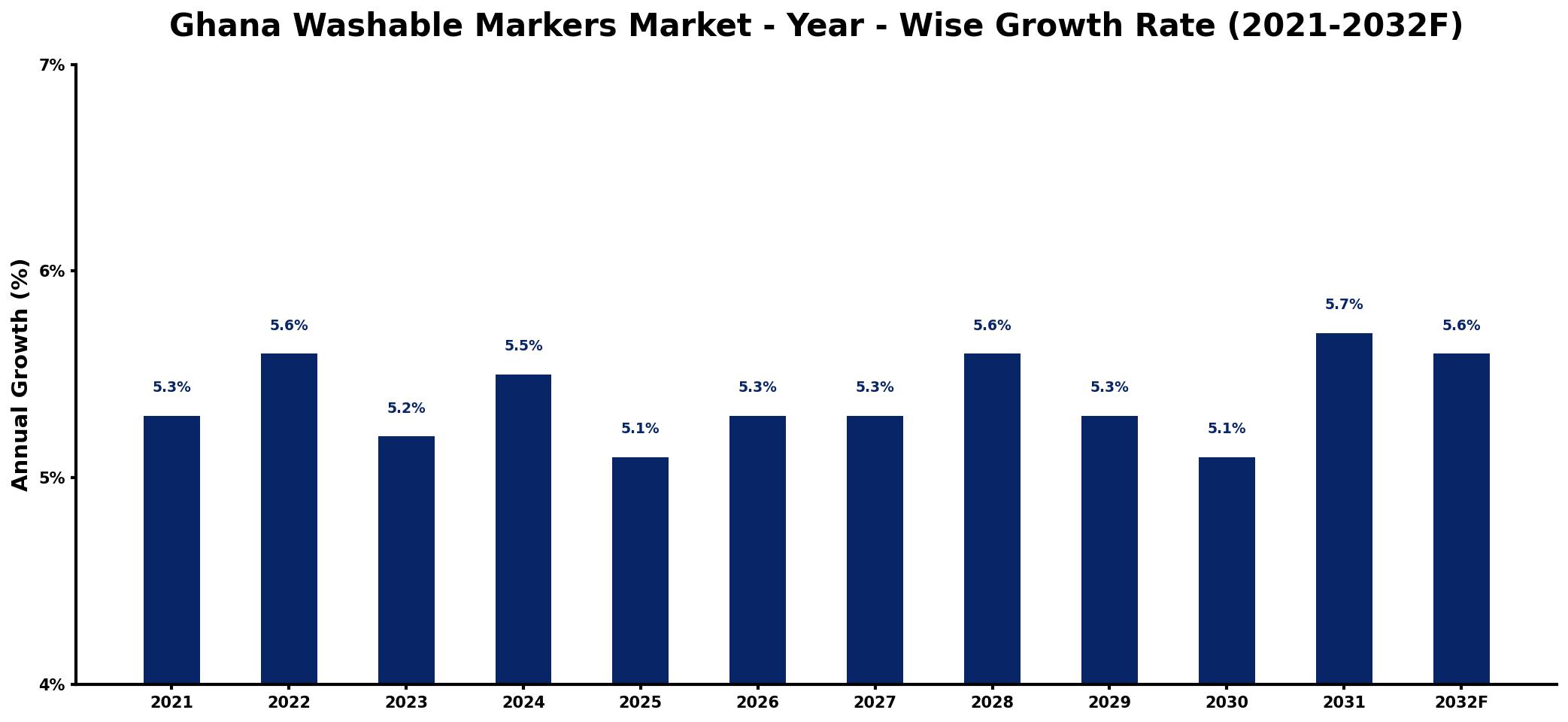
The table below presents the year‑wise growth rates along with the key drivers influencing the market
| Year | Growth Rate | Major Drivers |
| 2021 | 5.3% | Increased demand from schools |
| 2022 | 5.6% | Growing popularity in arts education |
| 2023 | 5.2% | Expansion of retail distribution channels |
| 2024 | 5.5% | Rise in creative activities participation |
| 2025 | 5.1% | Increased investment in educational supplies |
| 2026 | 5.3% | Growth in online shopping platforms |
| 2027 | 5.3% | Surge in promotional activities |
| 2028 | 5.6% | Increased focus on sustainable products |
| 2029 | 5.3% | growing regional consumption patterns |
| 2030 | 5.1% | rising export shipment volumes |
| 2031 | 5.7% | increased domestic production output |
| 2032 | 5.6% | Increased collaboration with influencers |
Note: Market size estimations and growth projections presented in this report are based on 6Wresearch's proprietary forecasting methodology, utilizing the latest available industry data, government publications, and primary research inputs.
Ghana Washable Markers Market Synopsis
Currently, the Ghana Washable Markers Market is witnessing a notable shift towards products that emphasize safety and environmental responsibility. With the increasing availability of colorful and innovative markers, both educators and parents are gravitating toward options that offer vibrancy without compromising on cleanliness and child safety.
The market is characterized by a dynamic interplay between international and local brands, all vying to capture the attention of consumers. This competitive landscape is further enriched by emerging trends in sustainability, as consumers increasingly prefer markers made from eco-friendly materials that align with modern values regarding environmental consciousness.
Ghana Washable Markers Market Key Takeaways
- The market is benefiting from a growing preference for non-toxic, child-safe art supplies.
- Consumer demand is shifting towards eco-friendly markers made from sustainable materials.
- Innovative product designs, including dual-tip markers, are gaining traction.
- Strategic partnerships and educational campaigns are vital for enhancing consumer awareness.
- The market is poised for growth driven by increasing disposable incomes and expanding retail channels.
Evaluation of Restraints in Ghana Washable Markers Market
Despite its growth prospects, the Ghana Washable Markers Market faces several critical constraints. The influx of counterfeit products poses significant threats to consumer trust and brand loyalty, as inferior products diminish the overall market reputation. Additionally, many consumers remain unaware of the substantial benefits of washable markers compared to traditional options, leading to suboptimal market penetration. The lack of access to high-quality raw materials for local manufacturers further complicates the landscape, as does the competitive pricing of imported markers, which continues to challenge local production viability.
Ghana Washable Markers Market Trends
The trend towards eco-friendly markers is shaping the future of the Ghana Washable Markers Market. Consumers are increasingly attracted to products that emphasize sustainability, including options made from recycled materials. Another emerging trend is the demand for vibrant colors and markers that offer a long-lasting performance, enhancing the creative experience for users of all ages. Additionally, refillable and dual-tip markers are gaining popularity as consumers look for versatile options that cater to various artistic needs while promoting a waste-reduction mindset.
Ghana Washable Markers Market Opportunities
The Ghana Washable Markers Market presents substantial opportunities for investment and growth. A strategic focus on developing innovative products that meet local consumer preferences can yield significant returns. Additionally, expanding distribution channels, particularly through online platforms, can enhance market access and reach. Partnerships with educational institutions and art programs are also promising avenues for capturing the growing interest in arts and crafts, further solidifying market presence and diversifying product offerings.
Government Initiatives in the Ghana Washable Markers Market
Government policies in Ghana are playing a crucial role in shaping the landscape of the Washable Markers Market. Regulations implemented by the Ghana Standards Authority ensure that products meet safety and quality benchmarks, thereby protecting consumers. Additionally, the government is promoting environmentally-friendly practices in manufacturing, encouraging the use of non-toxic materials that align with global sustainability goals. Consumer protection laws further enhance market integrity by addressing issues related to misleading advertising and ensuring quality standards are upheld.
Future Insights of the Ghana Washable Markers Market
Looking ahead to 2026-2032, the Ghana Washable Markers Market is set for continuous growth, propelled by evolving consumer preferences and an expanding arts culture. Factors such as rising disposable incomes, increased educational spending, and the growing popularity of arts and crafts will continue to drive demand. As awareness of the benefits of washable markers increases, coupled with ongoing innovations in product design and functionality, the market is likely to see an influx of new and diverse offerings that cater to a wide array of consumers.
Ghana Washable Markers Market Latest Developments (2025 - 2026)
Recent industry developments highlight a growing emphasis on product innovation within the Ghana Washable Markers Market. Companies are exploring advancements in marker design, focusing on user-friendly features that enhance the overall user experience. Additionally, there has been a marked increase in marketing campaigns aimed at educating consumers about the safety and environmental benefits of washable markers, further bolstering market growth. Such initiatives indicate a commitment to meeting consumer demands while navigating the evolving market landscape.
Ghana Washable Markers Market - Key Attractiveness of the Report
- 10 Years of Market Numbers
- Historical Data Starting from 2022 to 2025
- Base Year: 2025
- Forecast Data until 2032
- Key Performance Indicators Impacting the Market
- Major Upcoming Developments and Projects
Key Highlights of the Report:
- Ghana Washable Markers Market Outlook
- Market Size of Ghana Washable Markers Market, 2025
- Forecast of Ghana Washable Markers Market, 2032
- Historical Data and Forecast of Ghana Washable Markers Revenues & Volume for the Period 2022-2032F
- Ghana Washable Markers Market Trend Evolution
- Ghana Washable Markers Market Drivers and Challenges
- Ghana Washable Markers Price Trends
- Ghana Washable Markers Porter's Five Forces
- Ghana Washable Markers Industry Life Cycle
- Historical Data and Forecast of Ghana Washable Markers Market Revenues & Volume By Washability for the Period 2022-2032F
- Historical Data and Forecast of Ghana Washable Markers Market Revenues & Volume By Basic- Washable for the Period 2022-2032F
- Historical Data and Forecast of Ghana Washable Markers Market Revenues & Volume By Super-washable for the Period 2022-2032F
- Historical Data and Forecast of Ghana Washable Markers Market Revenues & Volume By End User for the Period 2022-2032F
- Historical Data and Forecast of Ghana Washable Markers Market Revenues & Volume By Children for the Period 2022-2032F
- Historical Data and Forecast of Ghana Washable Markers Market Revenues & Volume By Professionals for the Period 2022-2032F
- Ghana Washable Markers Import Export Trade Statistics
- Market Opportunity Assessment By Washability
- Market Opportunity Assessment By End User
- Ghana Washable Markers Top Companies Market Share
- Ghana Washable Markers Competitive Benchmarking By Technical and Operational Parameters
- Ghana Washable Markers Company Profiles
- Ghana Washable Markers Key Strategic Recommendations






































