Ghana Wax Market Size, Share & Growth Rate
The Ghana Wax Market was estimated at USD 364 Million in 2025 and is projected to reach USD 520 Million by 2032, growing at a CAGR of 5.2% from 2026 to 2032. This upward trajectory is primarily driven by the increasing demand for wax in cosmetics, pharmaceuticals, and food packaging, where its unique properties enhance product performance. Additionally, the shift towards natural and sustainable wax sources resonates with consumer preferences, fueling further market expansion.
Ghana Wax Market Year-wise Growth Rate and Key Drivers
This graph highlights how the Ghana Wax Market has steadily grown over the years, supported by major growth factors.
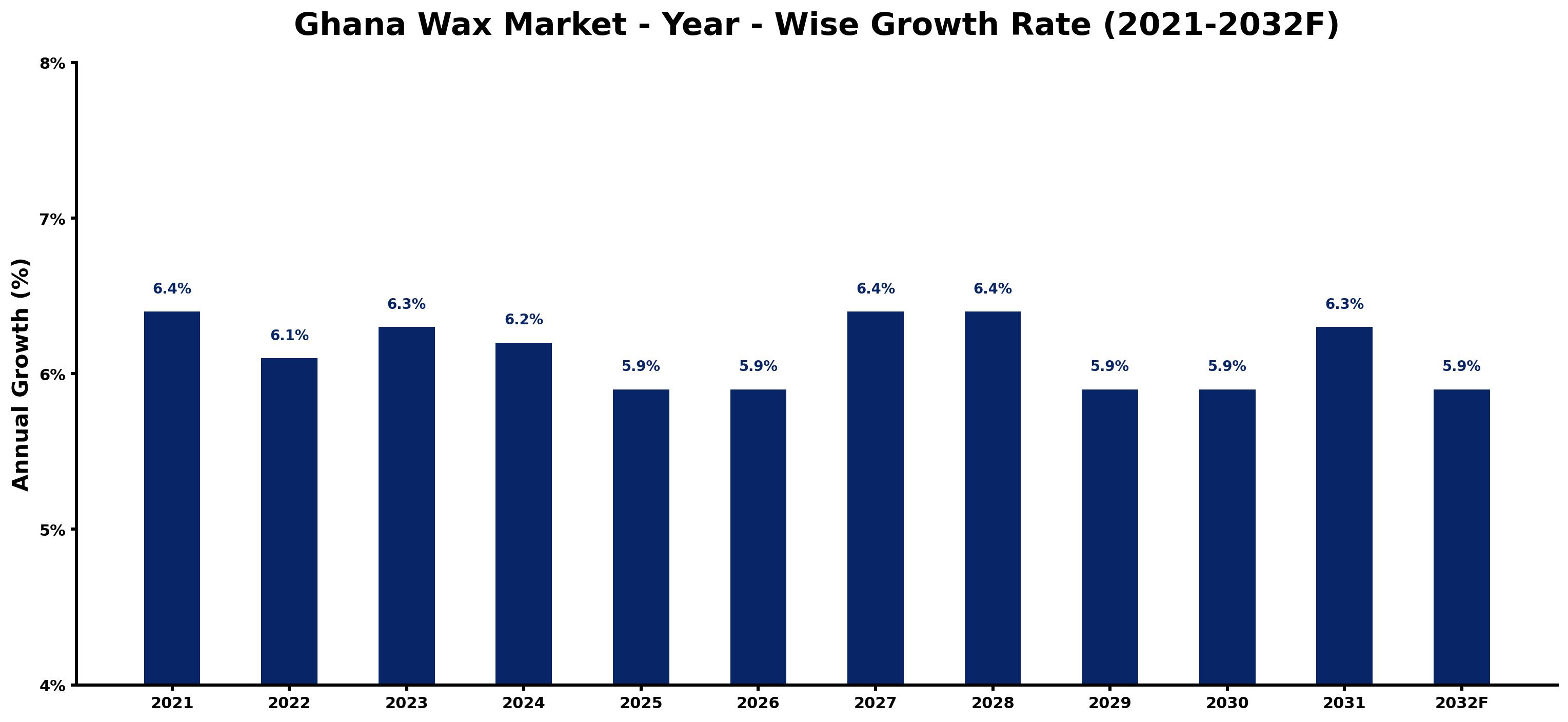
The table below presents the year‑wise growth rates along with the key drivers influencing the market
| Year | Growth Rate | Major Drivers |
| 2021 | 6.4% | Growing urbanization and commercial development |
| 2022 | 6.1% | Growing renewable energy integration projects |
| 2023 | 6.3% | Expansion of transportation and logistics networks |
| 2024 | 6.2% | Increasing industrial automation investments |
| 2025 | 5.9% | Increasing industrial automation investments |
| 2026 | 5.9% | Increasing industrial automation investments |
| 2027 | 6.4% | Rapid growth in telecom and data center sectors |
| 2028 | 6.4% | Growing urbanization and commercial development |
| 2029 | 5.9% | Growing urbanization and commercial development |
| 2030 | 5.9% | Increasing smart city development projects |
| 2031 | 6.3% | Growing urbanization and commercial development |
| 2032 | 5.9% | Increasing industrial infrastructure investments |
Note - Market size estimations and growth projections presented in this report are based on 6Wresearch's advanced forecasting approach, validated with industry datasets as of June 2026.
Ghana Wax Market Synopsis
The strongest force shaping the Ghana wax market today is the robust growth in demand for natural and sustainable waxes. As consumers become increasingly health-conscious and environmentally aware, there is a discernible shift away from synthetic options, favoring plant-based and beeswax alternatives. This trend not only appeals to consumers but also supports local economies that engage in responsible harvesting practices.
Moreover, the versatility of waxes in applications ranging from food packaging to high-end cosmetics further bolsters market dynamics. As companies innovate in product formulations to meet these diverse needs, the demand for high-quality wax—both natural and synthetic—continues to rise, presenting a promising outlook for the industry.
Ghana Wax Market Key Takeaways
- The Ghana Wax Market is set for significant growth, anticipated to reach USD 520 Million by 2032.
- Increased adoption of natural waxes is a key factor driving market expansion.
- Waxes are vital across multiple sectors, enhancing product performance and sustainability.
- Advancements in processing techniques are enabling better product quality and diversification.
- Government policies are increasingly supportive of local producers, enhancing market competitiveness.
Evaluation of Restraints in Ghana Wax Market
Despite the promising growth outlook, the Ghana wax market grapples with certain restraints. Quality and purity concerns of wax products remain paramount, as manufacturers must adhere to stringent standards across various applications. Furthermore, sourcing challenges—particularly for natural waxes—can impact production reliability. The competitive landscape is also evolving with alternative materials, posing a threat to traditional wax applications in industries like cosmetics and packaging.
Ghana Wax Market Trends
Current trends in the Ghana wax market are characterized by a marked shift towards natural and bio-based waxes, driven by consumer demand for eco-friendly products. Innovations in processing technology are enhancing the efficiency and quality of wax production, enabling manufacturers to offer more refined products. Moreover, the incorporation of wax in emerging applications, such as biodegradable packaging solutions, is creating new avenues for growth.
Ghana Wax Market Opportunities
The market presents substantial opportunities for investment, particularly in developing local supply chains for natural wax production. As consumer preferences lean toward sustainable options, businesses that can effectively position themselves in this niche are likely to thrive. Additionally, expansion into international markets, supported by government initiatives, provides local producers the chance to increase their market share and reach.
Government Initiatives in the Ghana Wax Market
The Ghanaian government has implemented policies aimed at promoting sustainable practices within the wax market. These initiatives focus on responsible sourcing and processing, encouraging local producers to adopt environmentally friendly methods. Furthermore, efforts to enhance product quality and market access are evident, facilitating a more robust domestic industry that can compete on both local and international stages.
Future Insights of the Ghana Wax Market
Looking ahead to 2026-2032, the Ghana wax market is poised for a transformative phase. With consumer preferences firmly shifting towards sustainable products, those investing in eco-friendly wax options will be at the forefront of the market. The integration of innovative technologies in production processes will enhance product capabilities, making waxes even more appealing to diverse industries. Overall, the trajectory indicates a vibrant and evolving marketplace, rich with potential.
Ghana Wax Market Latest Developments (May 2025 - June 2026)
Recent developments in the Ghana wax market reflect an increasing focus on sustainability and product diversification. Stakeholders are exploring innovative applications for wax in both traditional and emerging sectors. Furthermore, discussions around regulatory frameworks are gaining momentum, aimed at enhancing product standards and environmental responsibility among local manufacturers.
Ghana Wax Market - Key Attractiveness of the Report
- 10 Years of Market Numbers
- Historical Data Starting from 2022 to 2025
- Base Year: 2025
- Forecast Data until 2032
- Key Performance Indicators Impacting the Market
- Major Upcoming Developments and Projects
Key Highlights of the Report:
- Ghana Wax Market Outlook
- Market Size of Ghana Wax Market, 2025
- Forecast of Ghana Wax Market, 2032
- Historical Data and Forecast of Ghana Wax Revenues & Volume for the Period 2022-2032F
- Ghana Wax Market Trend Evolution
- Ghana Wax Market Drivers and Challenges
- Ghana Wax Price Trends
- Ghana Wax Porter's Five Forces
- Ghana Wax Industry Life Cycle
- Historical Data and Forecast of Ghana Wax Market Revenues & Volume By Product for the Period 2022-2032F
- Historical Data and Forecast of Ghana Wax Market Revenues & Volume By Mineral for the Period 2022-2032F
- Historical Data and Forecast of Ghana Wax Market Revenues & Volume By Synthetic for the Period 2022-2032F
- Historical Data and Forecast of Ghana Wax Market Revenues & Volume By Natural for the Period 2022-2032F
- Historical Data and Forecast of Ghana Wax Market Revenues & Volume By Applications for the Period 2022-2032F
- Historical Data and Forecast of Ghana Wax Market Revenues & Volume By Candles for the Period 2022-2032F
- Historical Data and Forecast of Ghana Wax Market Revenues & Volume By Packaging for the Period 2022-2032F
- Historical Data and Forecast of Ghana Wax Market Revenues & Volume By Plastic & Rubber for the Period 2022-2032F
- Historical Data and Forecast of Ghana Wax Market Revenues & Volume By Cosmetics & Toiletries for the Period 2022-2032F
- Historical Data and Forecast of Ghana Wax Market Revenues & Volume By Fire Logs for the Period 2022-2032F
- Historical Data and Forecast of Ghana Wax Market Revenues & Volume By Adhesives for the Period 2022-2032F
- Historical Data and Forecast of Ghana Wax Market Revenues & Volume By Others for the Period 2022-2032F
- Ghana Wax Import Export Trade Statistics
- Market Opportunity Assessment By Product
- Market Opportunity Assessment By Applications
- Ghana Wax Top Companies Market Share
- Ghana Wax Competitive Benchmarking By Technical and Operational Parameters
- Ghana Wax Company Profiles
- Ghana Wax Key Strategic Recommendations






































