Global Access Control Market Highlights
| Market Size (2025) | USD 10.5 Billion |
| Forecast Size (2032) | USD 17.5 Billion |
| CAGR | 7.60% |
| Base Year | 2025 |
| Forecast Period | 2026-2032 |
| Largest Region | North America |
| Fastest Growing Region | Asia-Pacific |
| Largest Segment | Hardware |
| Fastest Growing Segment | Software |
| Leading Companies | Assa Abloy, Honeywell, Johnson Controls, dormakaba, Allegion |
Global Access Control Market Size & Growth Rate (2026-2032)
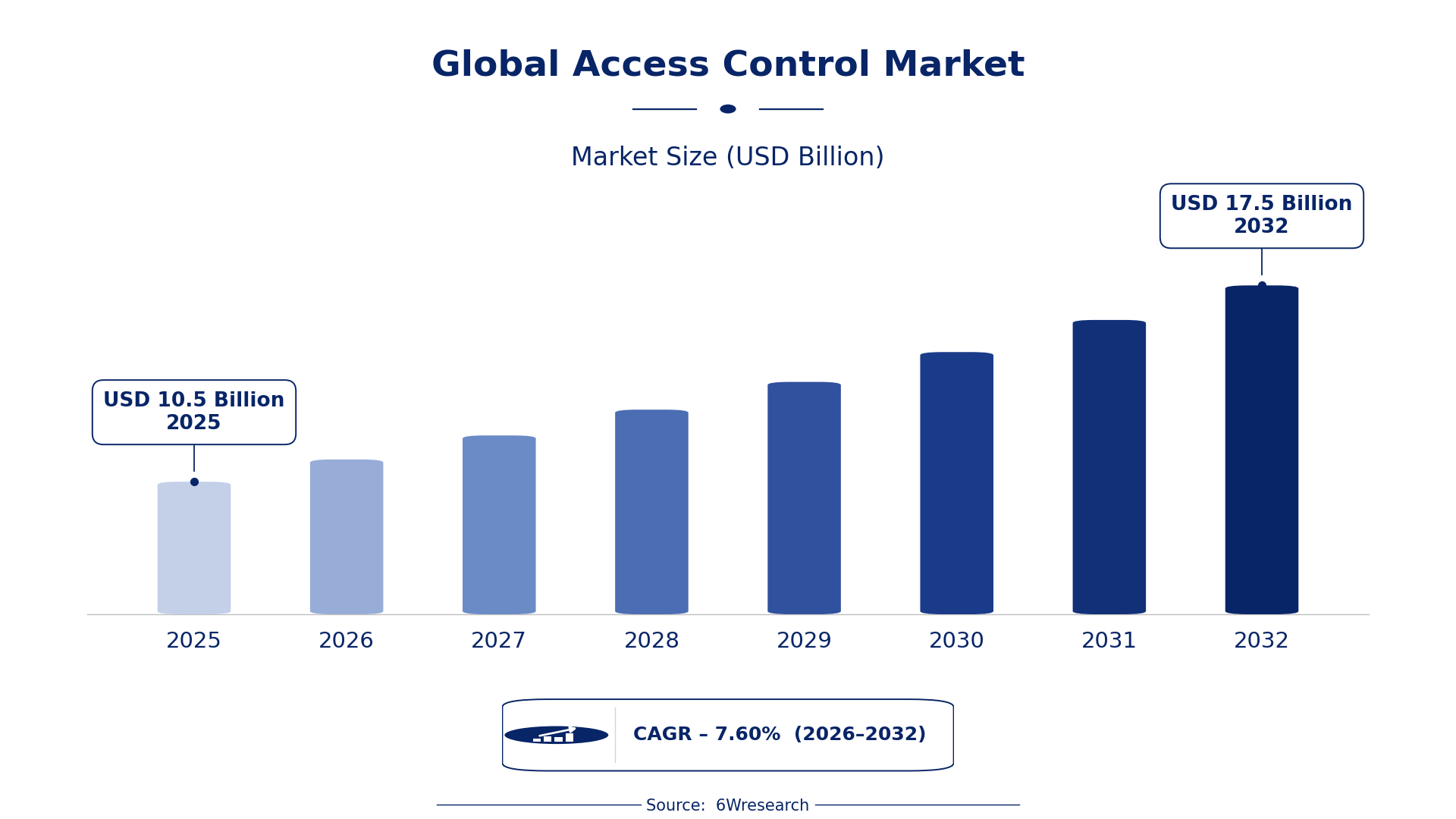
The Global Access Control Market was estimated at USD 10.5 Billion in 2025 and is projected to reach USD 17.5 Billion by 2032, growing at a CAGR of 7.60% from 2026 to 2032.
Global Access Control Market Synopsis
The Global Access Control Market is currently positioned at a pivotal juncture, influenced by evolving security needs across industries such as healthcare and transportation. Rapid urbanization and the emergent focus on smart city initiatives facilitate its growth potential, particularly in regions with robust infrastructure development.
Moreover, the increasing integration of access control systems with IoT technologies demonstrates a marked shift towards smarter, more efficient security solutions. Companies in the market are increasingly adopting cloud-based access systems, enabling remote management and scalability, thereby optimizing operational efficiency.
Global Access Control Market Year-wise Growth Rate and Key Drivers
This graph illustrates the annual growth rates of the Global Access Control Market from 2022 to 2032, highlighting a steady upward trajectory and projected expansion over the forecast period.
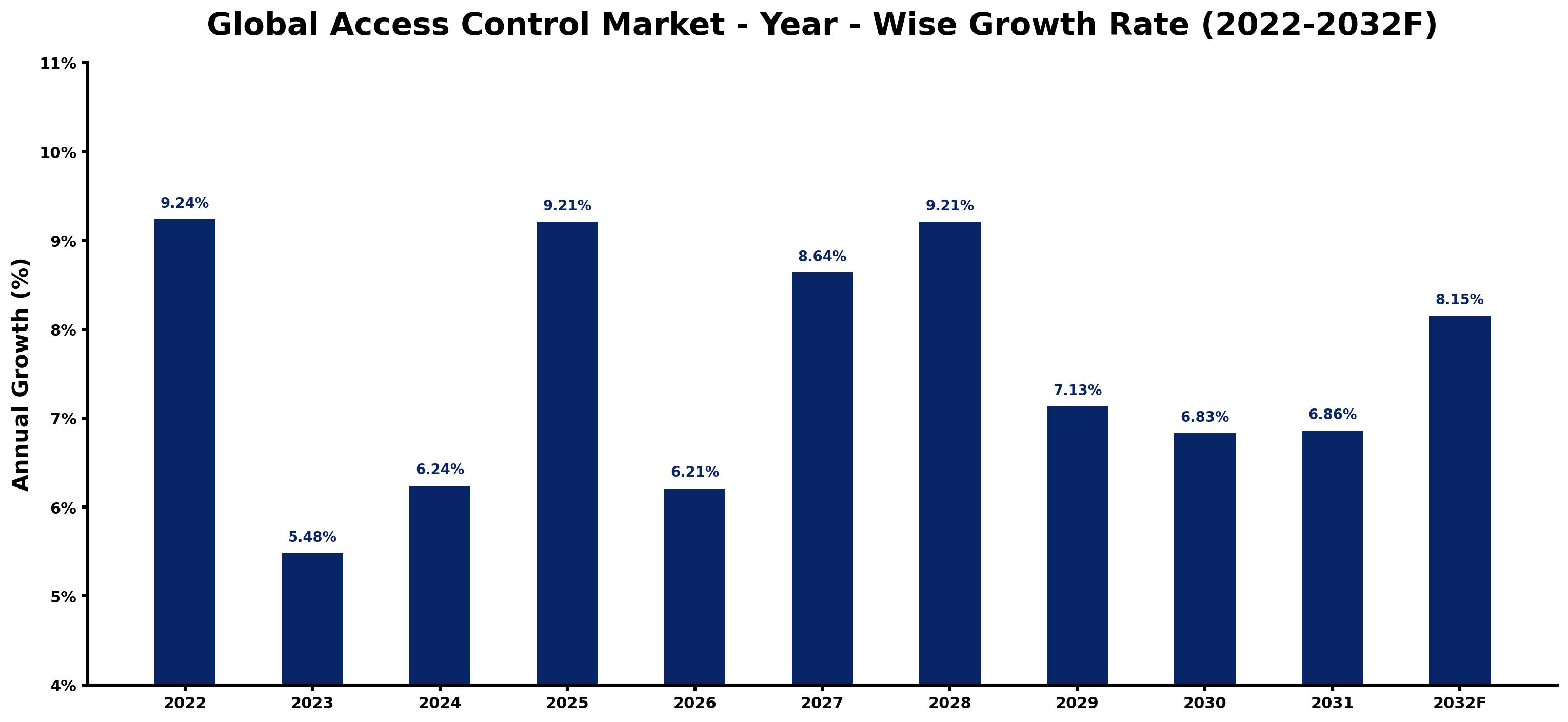
The table below presents the year‑wise growth rates along with the key drivers influencing the market
| Year | Growth Rate (%) | Major Drivers |
| 2022 | 9.24 | A skilled workforce shortage in cybersecurity limits access control system implementation. |
| 2023 | 5.48 | Cloud migration efforts among enterprises are heightening interest in access control solutions. |
| 2024 | 6.24 | Data centers seeking efficiency are increasingly investing in advanced access control technologies. |
| 2025 | 9.21 | Telecom companies are pursuing acquisitions to enhance their access control offerings. |
| 2026 | 6.21 | Increasing user awareness of cybersecurity threats is shifting preferences toward advanced access control. |
| 2027 | 8.64 | Manufacturers are repositioning themselves to provide innovative access control products and services. |
| 2028 | 9.21 | Heightened scrutiny on data privacy is prompting regulatory adjustments in access control protocols. |
| 2029 | 7.13 | Expanding access control technologies enable organizations to enhance network security measures. |
| 2030 | 6.83 | In the context of sustainability, organizations prioritize eco-friendly access control solutions. |
| 2031 | 6.86 | While supply chain constraints persist, access control technology suppliers adapt their strategies. |
| 2032 | 8.15 | A shift toward regional expansions in telecom is creating new opportunities for access control. |
Note - Market size estimations and growth projections presented in this report are based on 6Wresearch's proprietary research methodology, combining internal industry data, secondary research, and primary validation, updated periodically to reflect current market conditions. As markets evolve rapidly, figures for certain industries may vary slightly and are intended as informed estimates rather than absolute figures. For the most current market sizing, we recommend validating figures with a 6Wresearch analyst.
Global Access Control Market Key Takeaways
Below are some of the specific key takeaways from the market, including:
- As of 2025, the hardware segment occupies approximately ~63% of the total market share.
- Asia-Pacific is expected to exhibit the highest growth rate, with a projected CAGR of 9.8% from 2026 to 2032.
- Energy-efficient solutions are gaining traction, with major players like Honeywell focusing on eco-friendly access technologies.
- The health sector is anticipated to increase its share in access control investments by 12% annually, spurred by stricter security regulations.
Evaluation of Restraints in Global Access Control Market
The Global Access Control Market faces substantial restraints, notably the high cost of implementing advanced systems. Certain enterprises report costs exceeding $100,000 for comprehensive access solutions, steering many businesses towards less secure alternatives. For example, complex integrations between legacy systems and modern solutions often lead to lengthy deployment timelines and increased operational costs, inhibiting growth for small and medium-sized enterprises. Furthermore, regulatory compliance challenges, including data privacy laws such as the GDPR, create additional hurdles for market entrants.
Global Access Control Market Trends
One prominent trend reshaping the Global Access Control Market is the rise of biometric authentication methods, driven by increasing demands for personalized security measures. Companies like NEC Corporation have reported a surge in biometric sales, achieving a 15% increase in revenue in 2023 alone. Additionally, the integration of artificial intelligence with access systems is becoming prevalent, enhancing decision-making and monitoring capabilities. For instance, AI-driven analytics within access systems are being employed to optimize security protocols and response times, addressing previously unmanageable risks. Furthermore, the shift towards mobile access control solutions has gained traction, allowing users to grant access remotely. This trend is particularly critical as organizations leverage the convenience of mobile devices, thereby fostering user engagement and simplifying workflows.
Global Access Control Market Opportunities
Considerable opportunities exist within the Global Access Control Market, particularly in the healthcare and industrial sectors. The demand for secure, compliant electronic monitoring systems, driven by regulatory pressures, presents a lucrative landscape. For example, in 2026, the market for healthcare-focused access control solutions is projected to grow by 14% annually, as hospitals seek effective methods to secure patient data. Emerging trends in renewable energy can also create demand for integrated access control systems in new solar and wind energy facilities, enabling enhanced security and monitoring. Companies developing access solutions tailored for critical infrastructure can capitalize on this growing opportunity, potentially securing contracts worth millions as such deployments surge.
Global Access Control Market by Types
The hardware segment leads the Global Access Control Market, commanding approximately ~63% share in 2025. This dominance stems from its critical applications in physical security systems across various sectors, including banking and government. Conversely, the software segment is projected as the fastest-growing component, expected to experience a robust CAGR of 11.2% from 2026 to 2032. The rising trend towards cloud-based solutions contributes to this rapid growth, as organizations increasingly recognize the advantages of software-defined access management systems.
Global Access Control Market by Technology
In the Global Access Control Market, authentication systems represent the largest technology segment, with an estimated ~40% share in 2025. This segment's significance is primarily due to its essential role in preventing unauthorized access, an absolute necessity for various industries. On the other hand, alarm panels are anticipated to be the fastest-growing technology segment, projected to witness a CAGR of 9.5% from 2026 to 2032. Their increasing integration with smart systems and user-friendly management interfaces are key factors driving this growth.
Global Access Control Market by Applications
The commercial sector dominates the Global Access Control Market, with roughly ~52% share in 2025, as businesses prioritize security to safeguard assets and data. This demand is propelled by growing concerns over workplace safety and theft. Meanwhile, the residential segment is forecasted to be the fastest-growing application area, with an expected CAGR of 10.4% from 2026 to 2032, driven by the rising trend in smart home technologies and increased consumer awareness around security products.
Global Access Control Market by Region
North America leads the Global Access Control Market, holding a share of approximately ~48% in 2025. This dominance is due to a robust regulatory environment and a concentration of major players. Conversely, Asia-Pacific is emerging as the fastest-growing region, with a projected CAGR of 9.7% from 2026 to 2032, primarily fueled by significant infrastructure investments and the growing prevalence of smart city initiatives. Countries like China and India are prioritizing advanced security solutions in urban planning.
Government Initiatives in the Global Access Control Market
The regulatory landscape surrounding the Global Access Control Market is evolving, with various government initiatives aimed at enhancing security measures across sectors. These initiatives play a critical role in shaping market dynamics and investment flows, emphasizing the importance of compliance and innovation.
- U.S. Department of Homeland Security, "Cybersecurity Framework for Critical Infrastructure", 2018 – This initiative encourages the integration of access control systems within critical infrastructure to enhance cybersecurity resilience.
- European Commission, "General Data Protection Regulation (GDPR)", 2018 – Implementing stringent data privacy regulations that necessitate stronger access control for data handling and processing.
- Government of India, "Smart Cities Mission", 2015 – A program aimed at developing advanced urban areas with smart security systems, including access controls for public and private installations.
- UK Home Office, "Anti-Social Behavior, Crime and Policing Act", 2014 – Establishes frameworks for enhanced community safety, pushing for improved security measures in residential and community settings.
Future Insights of the Global Access Control Market
Future dynamics within the Global Access Control Market will be heavily influenced by advancements in technology and shifting regulatory landscapes. By 2032, the integration of artificial intelligence into access control systems is expected to enhance predictive analytics capabilities, enabling proactive security measures. For instance, partnerships like that of Allegion with leading tech firms focus on smart building solutions, thereby positioning the company to capture a larger segment of the market as urban infrastructures demand more sophisticated systems.
Global Access Control Market Latest Developments
Several companies are making noteworthy strides in the Global Access Control Market, reflecting their commitment to technological advancements and regional expansion.
- Assa Abloy recently expanded its cloud-based access control solutions, launching new features aimed at enhancing user experience, expected to roll out in late 2023. This not only strengthens their technology position but also solidifies customer reliance on comprehensive cloud systems.
- Honeywell is actively integrating IoT functionality into its access control systems, with an upcoming launch planned for mid-2024. By doing so, they enhance system interconnectivity, fostering a safer environment for customers and positioning themselves as leaders in smart security solutions.
- Johnson Controls is set to unveil an innovative biometric access solution in early 2025, leveraging advanced machine learning algorithms. This product aims to address security challenges in high-risk environments, thereby giving the company a competitive edge in focused sectors.
- dormakaba is expanding its market presence in Asia-Pacific, with plans to establish new regional offices by late 2023. This strategy not only increases market penetration but also addresses the growing demand for enhanced security solutions in urban developments across Asia.
Global Access Control Market Key Players and Industry Positioning
The Global Access Control Market features a mix of consolidated and fragmented structures, characterized by notable key players along with emerging specialists. Major companies dominate through technological advancements and substantial market share, while smaller firms innovate niche solutions. This competitive interplay fosters an environment ripe for strategic partnerships, mergers, and product diversification.
| Leading Company | Core Strength | Strategic Focus |
|---|---|---|
| Assa Abloy | Pioneering in smart lock technology | Expanding cloud-based solutions |
| Honeywell | Strong presence in building management | Integration of IoT with access systems |
| Johnson Controls | Expertise in building security solutions | Focus on innovative biometric systems |
| dormakaba | Diverse access control portfolio | Regional expansion in Asia-Pacific |
| Allegion | Strength in electronic security systems | Partnerships for smart building technologies |
With these established players leading the charge, the Global Access Control Market is poised for dynamic advancements, with companies positioning themselves to capture additional market share through innovation and strategic initiatives.
Key Attractiveness of the Report
- 10 Years of Market Numbers
- Historical Data Starting from 2022 to 2025
- Base Year: 2025
- Forecast Data until 2032
- Key Performance Indicators Impacting the Market
- Major Upcoming Developments and Projects
Key Highlights of the Report:
- Global Access Control Market Overview
- Global Access Control Market Outlook
- Global Access Control Market Forecast
- Historical Data of Global Access Control Market Revenues & Volume for the Period 2022-2032F
- Global Access Control Market Size and Global Access Control Market Forecast of Revenues & Volume, Until 2022-2032F
- Historical Data of Global Access Control Market Revenues & Volume, by Types, for the Period 2022-2032F
- Market Size & Forecast of Global Access Control Market Revenues & Volume, by Types, Until 2022-2032F
- Historical Data of Global Access Control Market Revenues, By Applications, for the Period 2022-2032F
- Market Size & Forecast of Global Access Control Market Revenues, By Applications, Until 2022-2032F
- Historical Data of North America Access Control Market Revenues and Volume, for the Period 2022-2032F
- Market Size & Forecast of North America Access Control Market Revenues and Volume, Until 2022-2032F
- Historical Data of Latin America Access Control Market Revenues and Volume, for the Period 2022-2032F
- Market Size & Forecast of Latin America Access Control Market Revenues and Volume, Until 2022-2032F
- Historical Data of Europe Access Control Market Revenues and Volume, for the Period 2022-2032F
- Market Size & Forecast of Europe Access Control Market Revenues and Volume, Until 2022-2032F
- Historical Data of Asia Pacific Access Control Market Revenues and Volume, for the Period 2022-2032F
- Market Size & Forecast of Asia Pacific Access Control Market Revenues and Volume, Until 2022-2032F
- Historical Data of the Middle East & Africa Access Control Market Revenues and Volume, for the Period 2022-2032F
- Market Size & Forecast of the Middle East & Africa Access Control Market Revenues and Volume, Until 2022-2032F
- Market Drivers and Restraints
- Global Access Control Market Trends and Industry Life Cycle
- Porter's Five Force Analysis
- Market Opportunity Assessment
- Global Access Control Market Share, By Players
- Global Access Control Market Share, By Regions
- Global Access Control Market Overview on Competitive Benchmarking
- Company Profiles
- Key Strategic Recommendations
Markets Covered
The Global Access Control Market report provides a detailed analysis of the following market segments:
By Regions and Countries:
- North America
- Europe
- LATAM
- Middle East
- Asia
- Africa
By Types:
- Hardware
- Software
By Technology:
- Authentication
- detection
- Alarm Panels
- Communication Devices
- Perimeter Security System
By Applications:
- Homeland Security
- Commercial
- Industrial
- Residential






































