Global Defence Market Highlights
| Market Size (2025) | USD 635 Billion |
| Forecast Size (2032) | USD 880 Billion |
| CAGR | 6.40% |
| Base Year | 2025 |
| Forecast Period | 2026-2032 |
| Largest Region | North America |
| Fastest Growing Region | Asia |
| Largest Segment | Aerospace |
| Fastest Growing Segment | Cybersecurity |
| Leading Companies | Lockheed Martin, Raytheon Technologies, Boeing, Northrop Grumman, Thales Group |
Global Defence Market Size & Growth Rate (2026-2032)
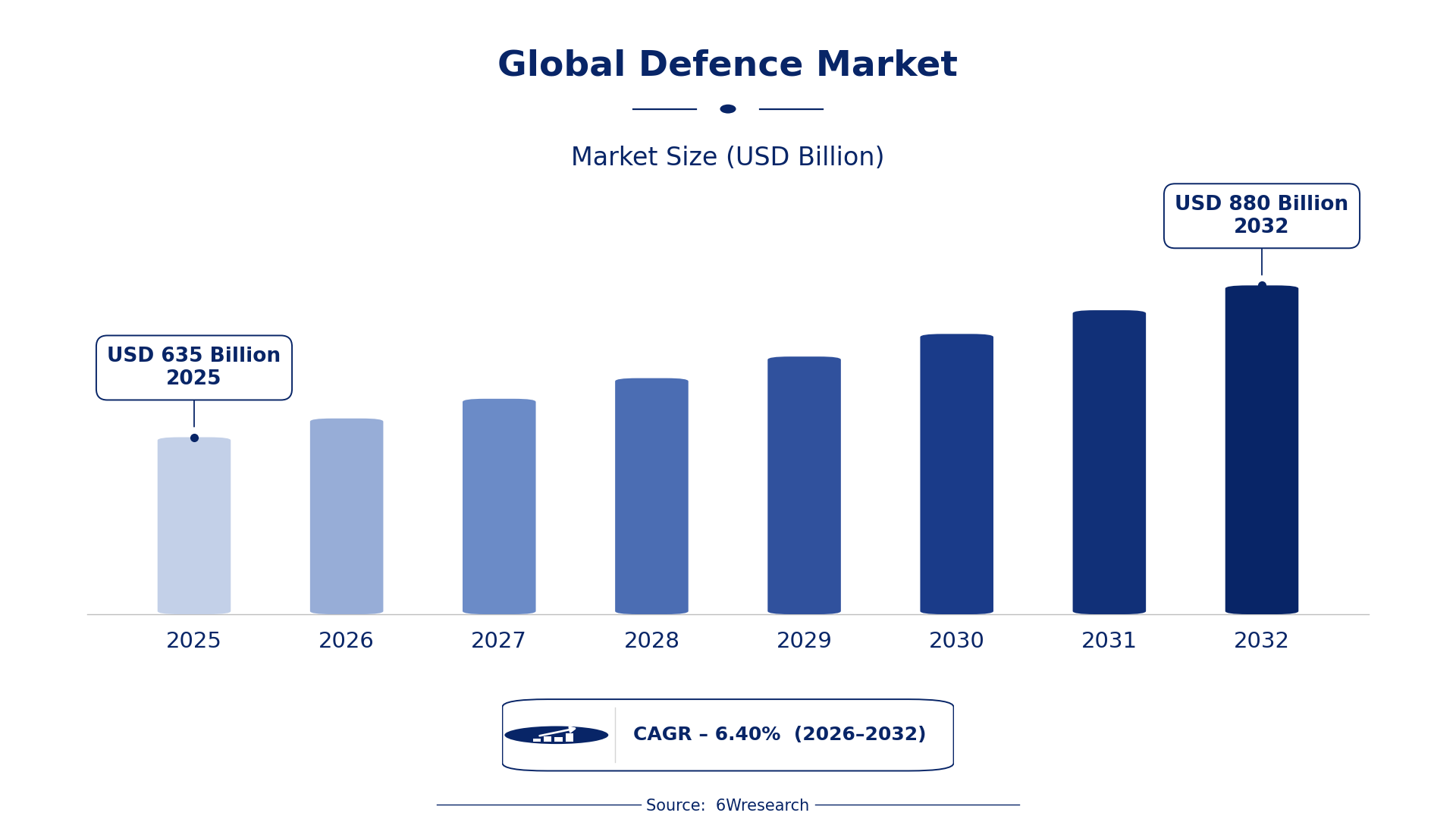
The Global Defence Market was estimated at USD 635 Billion in 2025 and is projected to reach USD 880 Billion by 2032, growing at a CAGR of 6.40% from 2026 to 2032.
Global Defence Market Synopsis
The Global Defence Market is undergoing a transformation driven by escalating geopolitical tensions and a pressing need for modernization among military forces worldwide. With nations responding to increasingly sophisticated threats, there’s a strong emphasis on next-generation technologies and advanced military systems. The competition between nations for defense supremacy has created a robust demand for cutting-edge solutions in areas such as cybersecurity, unmanned systems, and multi-domain operations.
This market’s significance extends beyond military applications; it also underpins critical industries, including cybersecurity, aerospace, and advanced manufacturing. As the reliance on integrated systems and allied interoperability grows, strategic partnerships between defense contractors and technology firms are becoming essential. This interdependence is elevating investment levels and altering traditional procurement channels, further differentiating the Global Defence Market from adjacent sectors.
Global Defence Market Year-wise Growth Rate and Key Drivers
This graph illustrates the annual growth rates of the Global Defence Market from 2022 to 2032, highlighting a steady upward trajectory and projected expansion over the forecast period.
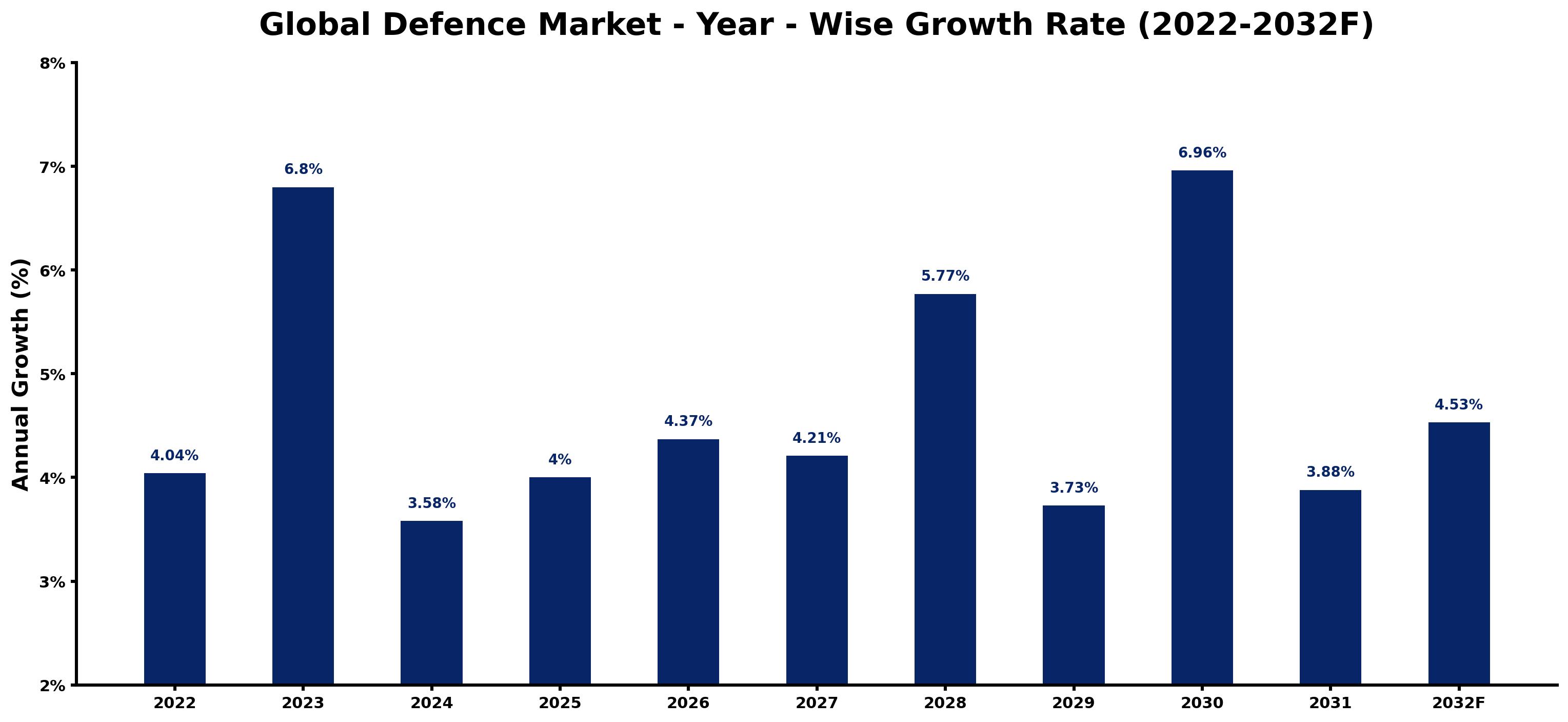
The table below presents the year‑wise growth rates along with the key drivers influencing the market
| Year | Growth Rate (%) | Major Drivers |
| 2022 | 4.04 | Manufacturers are capitalizing on increased investment in advanced avionics technology for defence. |
| 2023 | 6.8 | Rising consumer awareness about military capabilities enhances demand for UAV/drone systems. |
| 2024 | 3.58 | As competition intensifies, aerospace firms are focusing on innovative airframe design strategies. |
| 2025 | 4 | Expansion of satellite constellations in various regions is driving regional defence procurement activities. |
| 2026 | 4.37 | Enhancing MRO capabilities is streamlining operational efficiency across defence aerospace systems. |
| 2027 | 4.21 | Leading aerospace companies are integrating sustainable composite materials into new defence projects. |
| 2028 | 5.77 | Radar systems are adapting to increasing demand for advanced surveillance applications and technologies. |
| 2029 | 3.73 | A shift toward stricter export control regulations necessitates enhanced compliance among defence contractors. |
| 2030 | 6.96 | Defense clients are increasingly prioritizing supply chain transparency to optimize procurement processes. |
| 2031 | 3.88 | Within the aerospace sector, innovations in propulsion systems are reshaping operational capabilities. |
| 2032 | 4.53 | Growing emphasis on skilled technicians is reshaping workforce development in the defence industry. |
Note - Market size estimations and growth projections presented in this report are based on 6Wresearch's proprietary research methodology, combining internal industry data, secondary research, and primary validation, updated periodically to reflect current market conditions. As markets evolve rapidly, figures for certain industries may vary slightly and are intended as informed estimates rather than absolute figures. For the most current market sizing, we recommend validating figures with a 6Wresearch analyst.
Global Defence Market Key Takeaways
Below are some of the specific key takeaways from the market, including:
- North America accounted for approximately ~48% of the market share in 2025, supported by substantial defense budgets of the U.S. and Canada.
- Cybersecurity is projected to expand at a CAGR of 8.5% from 2026 to 2032, attributed to rising cyber threats aimed at military institutions.
- The United States is set to spend over $700 billion on defense in 2025, strengthening its position as a global leader in military expenditure.
- Thales Group, a key player in defense technology, reported revenues of €18.4 billion in 2021, showcasing its adaptability in a dynamic market.
- Partnerships between traditional defense contractors and tech startups are expected to attract an estimated $20 billion in venture funding over the next five years.
Evaluation of Restraints in Global Defence Market
The Global Defence Market faces several restraints, notably budgetary constraints imposed by governments. For example, in 2021, the European Union implemented a regulation limiting defense budget increases to 2% of GDP for member states, thereby restricting funding growth for defense initiatives. Moreover, emerging technologies require continuous investment, causing many organizations to prioritize cost-reduction strategies. This competitive pressure often results in compromises on advanced procurement and modernization, hindering organizational capabilities to respond to sophisticated threats.
Global Defence Market Trends
The Global Defence Market is characterized by several distinct trends reshaping operational and technological frameworks. One critical trend is the accelerated integration of artificial intelligence within military operations. For instance, Lockheed Martin is investing over $1 billion in AI technologies over the next five years to enhance decision-making in combat scenarios. Another trend is the increasing focus on multi-domain operations, which combines land, air, and cyber capabilities, allowing for more effective responses to hybrid threats. The U.S. military’s recent success in joint operations highlights this transformational approach, resulting in improved interoperability among allied forces.
Global Defence Market Opportunities
Significant opportunities are emerging within the Global Defence Market that promise robust future revenue. The increasing demand for next-generation weapons systems, particularly those leveraging drone technology, is a prime example. Boeing, for instance, has reported that its drone production lines are projected to yield returns exceeding $10 billion by 2026. Additionally, there is a rising focus on cybersecurity capabilities to safeguard critical defense data, which presents a lucrative opportunity in developing specialized solutions. For example, NATO’s recent cybersecurity initiatives will funnel approximately €800 million specifically toward enhancing defense cyber capabilities by 2025.
Global Defence Market by Armed Forces
In the Global Defence Market, the Air Force is the largest segment, commanding approximately ~42% share in 2025. This dominance stems from the escalating investment in aerial technology and air defense systems deemed vital for modern military strategies. The Navy, however, is the fastest-growing segment, projected to achieve a CAGR of 7.5% from 2026 to 2032. This growth is driven by increasing investments in naval capabilities, particularly in response to rising maritime security threats and geopolitical tensions in critical waterways.
Global Defence Market by Type
In the Global Defence Market, Weapons represent the largest share, accounting for approximately ~45% of the market in 2025. This substantial stake can be attributed to ongoing military conflicts and rising defense spending across various nations. Meanwhile, the fastest-growing segment is Cybersecurity, which is expected to expand at a CAGR of 8.5% from 2026 to 2032, driven by the urgent need to protect sensitive military information from rising cyber threats. The focus on securing digital infrastructure is influencing defense budgets and procurement strategies significantly.
Global Defence Market by Region
North America leads the Global Defence Market, holding about ~48% share in 2025, primarily driven by robust defense budgets and a proactive stance on national security. Conversely, Asia is the fastest-growing region, forecasted to record a CAGR of 7.2% from 2026 to 2032. This growth is fueled by increased military spending in countries like India and China, as they seek to bolster their defense capabilities amid regional tensions and evolving threats, further solidifying the region's importance in the global defense ecosystem.
Government Initiatives in the Global Defence Market
Government initiatives play an essential role in shaping the regulatory environment of the Global Defence Market. With growing concerns over national security across various regions, several governments are launching frameworks to enhance their defense capabilities. These initiatives often translate to increased funding, streamlined procurement processes, and enhanced collaboration between private and public sectors.
- U.S. Department of Defense: National Defense Strategy, released in October 2022, aims to enhance military readiness and prioritize technological advancements, significantly impacting procurement priorities.
- European Defence Agency: European Defence Fund, ongoing since 2021, allocates €7 billion to foster collaborative defense research and development across EU member states.
- Indian Ministry of Defence: Atmanirbhar Bharat Initiative, announced in May 2020, seeks to promote indigenous defense manufacturing to reduce reliance on imports, aiming for $25 billion in production by 2025.
- UK Ministry of Defence: Integrated Review of Security, Defence, Development and Foreign Policy, released in March 2021, outlines a comprehensive approach to confront evolving global threats with a budget exceeding £24 billion.
Future Insights of the Global Defence Market
Looking ahead, the Global Defence Market is anticipated to experience transformative shifts in technology utilization and operational efficiency. With an estimated USD 10 billion earmarked by NATO for cyber defense initiatives by 2025, the increasing emphasis on cybersecurity capabilities will drive companies to innovate specialized solutions. Concurrently, advancements in artificial intelligence will revolutionize battlefield decision-making and operational tactics, leading to enhanced effectiveness in multi-domain operations. The push towards automation and unmanned systems suggests a reallocation of investments toward new technologies that facilitate rapid response and adaptation to emerging threats.
Global Defence Market Latest Developments
Recent developments in the Global Defence Market highlight a trend towards enhanced technological integration and strategic partnerships. The focus is on creating advanced capabilities that address evolving military needs.
- Lockheed Martin announced ongoing enhancements to its F-35 fighter jet capabilities in September 2023, which strengthen its position in the aerial combat domain and improve interoperability among NATO allies.
- Raytheon Technologies is ramping up production of its next-gen missile defense systems, with a significant expansion planned for its facility in Alabama by late 2024, allowing for increased capacity to meet emerging threats.
- Boeing initiated a partnership with a cybersecurity firm in August 2023 to develop protective measures for its defense software systems, emphasizing the increasing importance of cybersecurity in defense infrastructure.
- Thales Group recently completed a contract in July 2023 to supply advanced naval systems to the Australian Navy, positioning the company as a leader in maritime security solutions and enhancing its regional impact in the Asia-Pacific.
Global Defence Market Key Players and Industry Positioning
The Global Defence Market features a mix of consolidated and fragmented competitive structures, with several key players dominating various segments while numerous smaller firms gradually carve out niches in specialized areas. This dynamic fosters innovation and diversification as companies adapt to rapidly changing requirements.
| Leading Company | Core Strength | Strategic Focus |
|---|---|---|
| Lockheed Martin | Aerospace dominance, particularly in advanced fighter systems | Positioning in next-generation aircraft and defense modernization |
| Raytheon Technologies | Integrated defense systems, strong in missile technology | Expansion in missile defense capabilities and cyber solutions |
| Boeing | Comprehensive aerospace manufacturer with emphasis on UAVs | Strengthening unmanned systems and cybersecurity initiatives |
| Northrop Grumman | Expertise in cyber warfare and intelligence systems | Enhancing capabilities in AI and autonomous systems |
| Thales Group | Leader in naval systems and communications technologies | Fortifying maritime security and increasing regional partnerships |
This competitive environment shapes strategic decisions as key players invest heavily in R&D, ensuring they remain at the forefront of technological advancements to address emerging global threats.
Key Attractiveness of the Report
- 10 Years of Market Numbers
- Historical Data Starting from 2022 to 2025
- Base Year: 2025
- Forecast Data until 2032
- Key Performance Indicators Impacting the Market
- Major Upcoming Developments and Projects
Key Highlights of the Report:
- Global Defence Market Outlook
- Market Size of Global Defence Market, 2025
- Forecast of Global Defence Market, 2032
- Historical Data and Forecast of Global Defence Revenues & Volume for the Period 2022-2032
- Global Defence Market Trend Evolution
- Global Defence Market Drivers and Challenges
- Global Defence Price Trends
- Global Defence Porter's Five Forces
- Global Defence Industry Life Cycle
- Historical Data and Forecast of Global Defence Market Revenues & Volume
- Historical Data and Forecast of Global Defence Market Revenues & Volume By Armed Forces for the Period 2022-2032
- Historical Data and Forecast of Global Defence Market Revenues & Volume By Army for the Period 2022-2032
- Historical Data and Forecast of Global Defence Market Revenues & Volume By Navy for the Period 2022-2032
- Historical Data and Forecast of Global Defence Market Revenues & Volume By Air Forc for the Period 2022-2032
- Historical Data and Forecast of Global Defence Market Revenues & Volume By Type for the Period 2022-2032
- Historical Data and Forecast of Global Defence Market Revenues & Volume By Personal Training and Protection for the Period 2022-2032
- Historical Data and Forecast of Global Defence Market Revenues & Volume By Communication Systems Vehicle for the Period 2022-2032
- Historical Data and Forecast of Global Defence Market Revenues & Volume By Weapons and Ammunition for the Period 2022-2032
- Historical Data and Forecast of North America Defence Market Revenues & Volume By Armed Forces for the Period 2022-2032
- Historical Data and Forecast of North America Defence Market Revenues & Volume By Army for the Period 2022-2032
- Historical Data and Forecast of North America Defence Market Revenues & Volume By Navy for the Period 2022-2032
- Historical Data and Forecast of North America Defence Market Revenues & Volume By Air Forc for the Period 2022-2032
- Historical Data and Forecast of North America Defence Market Revenues & Volume By Type for the Period 2022-2032
- Historical Data and Forecast of North America Defence Market Revenues & Volume By Personal Training and Protection for the Period 2022-2032
- Historical Data and Forecast of North America Defence Market Revenues & Volume By Communication Systems Vehicle for the Period 2022-2032
- Historical Data and Forecast of North America Defence Market Revenues & Volume By Weapons and Ammunition for the Period 2022-2032
- Historical Data and Forecast of United States of America Defence Market Revenues & Volume for the Period 2022-2032
- Historical Data and Forecast of Canada Defence Market Revenues & Volume for the Period 2022-2032
- Historical Data and Forecast of Rest of North America Defence Market Revenues & Volume for the Period 2022-2032
- Historical Data and Forecast of Latin America (LATAM) Defence Market Revenues & Volume By Armed Forces for the Period 2022-2032
- Historical Data and Forecast of Latin America (LATAM) Defence Market Revenues & Volume By Army for the Period 2022-2032
- Historical Data and Forecast of Latin America (LATAM) Defence Market Revenues & Volume By Navy for the Period 2022-2032
- Historical Data and Forecast of Latin America (LATAM) Defence Market Revenues & Volume By Air Forc for the Period 2022-2032
- Historical Data and Forecast of Latin America (LATAM) Defence Market Revenues & Volume By Type for the Period 2022-2032
- Historical Data and Forecast of Latin America (LATAM) Defence Market Revenues & Volume By Personal Training and Protection for the Period 2022-2032
- Historical Data and Forecast of Latin America (LATAM) Defence Market Revenues & Volume By Communication Systems Vehicle for the Period 2022-2032
- Historical Data and Forecast of Latin America (LATAM) Defence Market Revenues & Volume By Weapons and Ammunition for the Period 2022-2032
- Historical Data and Forecast of Brazil Defence Market Revenues & Volume for the Period 2022-2032
- Historical Data and Forecast of Mexico Defence Market Revenues & Volume for the Period 2022-2032
- Historical Data and Forecast of Argentina Defence Market Revenues & Volume for the Period 2022-2032
- Historical Data and Forecast of Rest of LATAM Defence Market Revenues & Volume for the Period 2022-2032
- Historical Data and Forecast of Asia Defence Market Revenues & Volume By Armed Forces for the Period 2022-2032
- Historical Data and Forecast of Asia Defence Market Revenues & Volume By Army for the Period 2022-2032
- Historical Data and Forecast of Asia Defence Market Revenues & Volume By Navy for the Period 2022-2032
- Historical Data and Forecast of Asia Defence Market Revenues & Volume By Air Forc for the Period 2022-2032
- Historical Data and Forecast of Asia Defence Market Revenues & Volume By Type for the Period 2022-2032
- Historical Data and Forecast of Asia Defence Market Revenues & Volume By Personal Training and Protection for the Period 2022-2032
- Historical Data and Forecast of Asia Defence Market Revenues & Volume By Communication Systems Vehicle for the Period 2022-2032
- Historical Data and Forecast of Asia Defence Market Revenues & Volume By Weapons and Ammunition for the Period 2022-2032
- Historical Data and Forecast of China Defence Market Revenues & Volume for the Period 2022-2032
- Historical Data and Forecast of India Defence Market Revenues & Volume for the Period 2022-2032
- Historical Data and Forecast of Japan Defence Market Revenues & Volume for the Period 2022-2032
- Historical Data and Forecast of Rest of Asia Defence Market Revenues & Volume for the Period 2022-2032
- Historical Data and Forecast of Africa Defence Market Revenues & Volume By Armed Forces for the Period 2022-2032
- Historical Data and Forecast of Africa Defence Market Revenues & Volume By Army for the Period 2022-2032
- Historical Data and Forecast of Africa Defence Market Revenues & Volume By Navy for the Period 2022-2032
- Historical Data and Forecast of Africa Defence Market Revenues & Volume By Air Forc for the Period 2022-2032
- Historical Data and Forecast of Africa Defence Market Revenues & Volume By Type for the Period 2022-2032
- Historical Data and Forecast of Africa Defence Market Revenues & Volume By Personal Training and Protection for the Period 2022-2032
- Historical Data and Forecast of Africa Defence Market Revenues & Volume By Communication Systems Vehicle for the Period 2022-2032
- Historical Data and Forecast of Africa Defence Market Revenues & Volume By Weapons and Ammunition for the Period 2022-2032
- Historical Data and Forecast of South Africa Defence Market Revenues & Volume for the Period 2022-2032
- Historical Data and Forecast of Nigeria Defence Market Revenues & Volume for the Period 2022-2032
- Historical Data and Forecast of Egypt Defence Market Revenues & Volume for the Period 2022-2032
- Historical Data and Forecast of Rest of Africa Defence Market Revenues & Volume for the Period 2022-2032
- Historical Data and Forecast of Europe Defence Market Revenues & Volume By Armed Forces for the Period 2022-2032
- Historical Data and Forecast of Europe Defence Market Revenues & Volume By Army for the Period 2022-2032
- Historical Data and Forecast of Europe Defence Market Revenues & Volume By Navy for the Period 2022-2032
- Historical Data and Forecast of Europe Defence Market Revenues & Volume By Air Forc for the Period 2022-2032
- Historical Data and Forecast of Europe Defence Market Revenues & Volume By Type for the Period 2022-2032
- Historical Data and Forecast of Europe Defence Market Revenues & Volume By Personal Training and Protection for the Period 2022-2032
- Historical Data and Forecast of Europe Defence Market Revenues & Volume By Communication Systems Vehicle for the Period 2022-2032
- Historical Data and Forecast of Europe Defence Market Revenues & Volume By Weapons and Ammunition for the Period 2022-2032
- Historical Data and Forecast of United Kingdom Defence Market Revenues & Volume for the Period 2022-2032
- Historical Data and Forecast of France Defence Market Revenues & Volume for the Period 2022-2032
- Historical Data and Forecast of Germany Defence Market Revenues & Volume for the Period 2022-2032
- Historical Data and Forecast of Rest of Europe Defence Market Revenues & Volume for the Period 2022-2032
- Historical Data and Forecast of Middle East Defence Market Revenues & Volume By Armed Forces for the Period 2022-2032
- Historical Data and Forecast of Middle East Defence Market Revenues & Volume By Army for the Period 2022-2032
- Historical Data and Forecast of Middle East Defence Market Revenues & Volume By Navy for the Period 2022-2032
- Historical Data and Forecast of Middle East Defence Market Revenues & Volume By Air Forc for the Period 2022-2032
- Historical Data and Forecast of Middle East Defence Market Revenues & Volume By Type for the Period 2022-2032
- Historical Data and Forecast of Middle East Defence Market Revenues & Volume By Personal Training and Protection for the Period 2022-2032
- Historical Data and Forecast of Middle East Defence Market Revenues & Volume By Communication Systems Vehicle for the Period 2022-2032
- Historical Data and Forecast of Middle East Defence Market Revenues & Volume By Weapons and Ammunition for the Period 2022-2032
- Historical Data and Forecast of Saudi Arabia Defence Market Revenues & Volume for the Period 2022-2032
- Historical Data and Forecast of UAE Defence Market Revenues & Volume for the Period 2022-2032
- Historical Data and Forecast of Turkey Defence Market Revenues & Volume for the Period 2022-2032
- Historical Data and Forecast of Rest of Middle East Defence Market Revenues & Volume for the Period 2022-2032
- Global Defence Market - Key Performance Indicators
- Global Defence Market - Import Export Trade Statistics
- Global Defence Market - Opportunity Assessment By Countries
- Global Defence Market - Opportunity Assessment By Armed Forces
- Global Defence Market - Opportunity Assessment By Type
- Global Defence Market - Top Companies Market Share
- Global Defence Market - Top Companies Profiles
- Global Defence Market - Comparison of Players in Technical and Operating Parameters
- Global Defence Market - Strategic Recommendations
Markets Covered
The Global Defence Market report provides a detailed analysis of the following market segments:
By Regions and Countries:
- North America
- Europe
- LATAM
- Middle East
- Asia
- Africa
By Armed Forces:
- Army
- Navy
- Air Forc
By Type:
- Personal Training
- Protection
- Communication Systems Vehicle
- Weapons
- Ammunition






































