Global Functional Beverage Market Highlights
| Market Size (2025) | USD 145 Billion |
| Forecast Size (2032) | USD 213.3 Billion |
| CAGR | 5.60% |
| Base Year | 2025 |
| Forecast Period | 2026-2032 |
| Largest Region | North America |
| Fastest Growing Region | Asia |
| Largest Segment | Energy Drinks |
| Fastest Growing Segment | Probiotic Drinks |
| Leading Companies | Coca-Cola, PepsiCo, Nestlé, Red Bull, Danone |
Global Functional Beverage Market Size & Growth Rate (2026-2032)
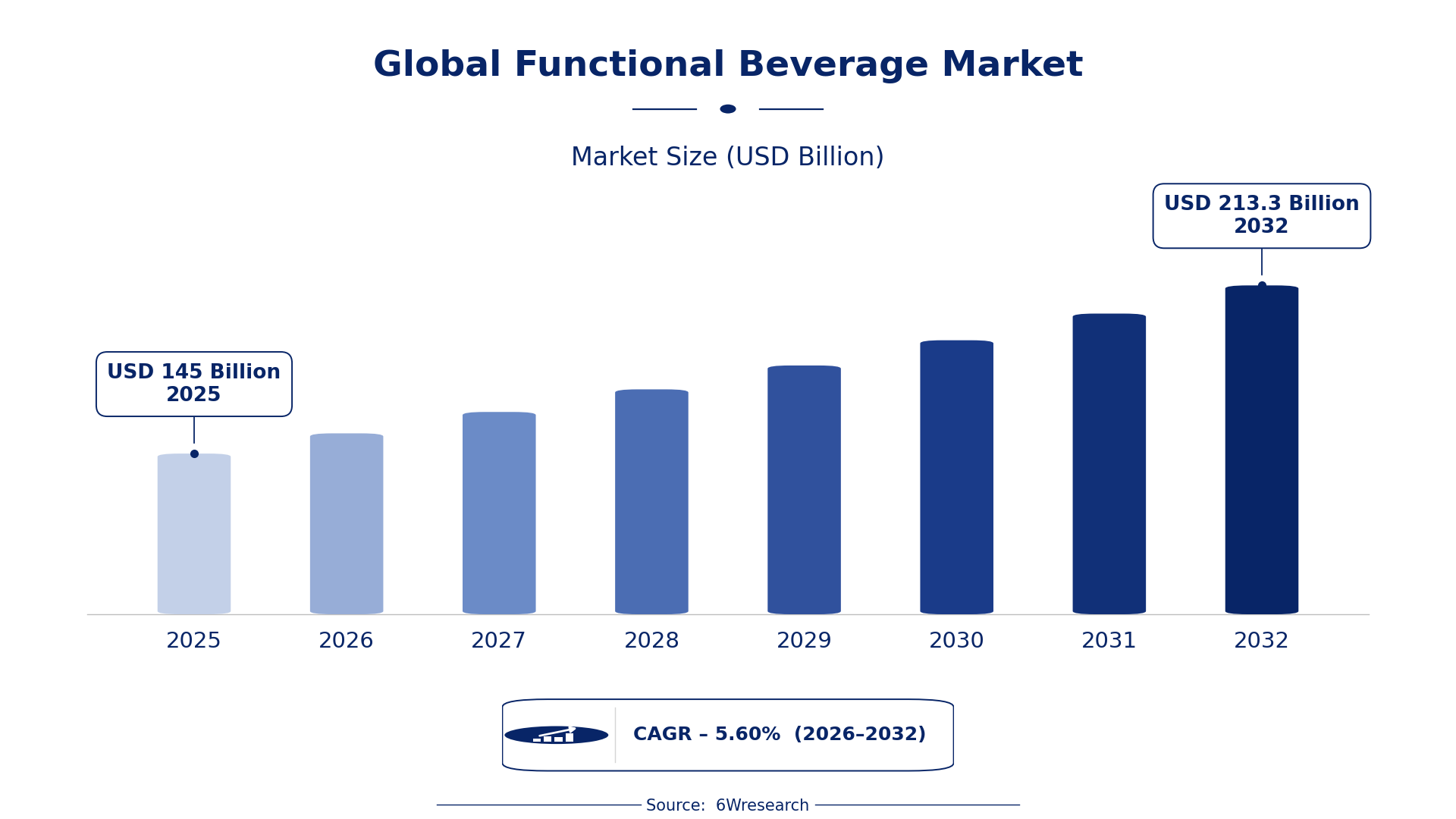
The Global Functional Beverage Market was estimated at USD 145 Billion in 2025 and is projected to reach USD 213.3 Billion by 2032, growing at a CAGR of 5.60% from 2026 to 2032.
Global Functional Beverage Market Synopsis
In the Global Functional Beverage Market, there's a pronounced shift towards personalized nutrition as consumers increasingly seek products tailored to their specific health concerns. This evolution is marked by the rise of beverages enriched with specific functional ingredients, targeting everything from gut health to energy boosts and immune support. Greater focus on dietary supplements within beverages positions functional options as vital solutions for health-conscious consumers.
Moreover, the surge in demand for low-sugar and organic formulations distinguishes this market from traditional beverage offerings. Regulatory scrutiny over health claims is intensifying, compelling manufacturers to innovate responsibly. As companies pivot to include transparency in ingredient sourcing, they are also leveraging e-commerce platforms for wider distribution, enhancing accessibility and consumer engagement.
Global Functional Beverage Market Year-wise Growth Rate and Key Drivers
This graph illustrates the annual growth rates of the Global Functional Beverage Market from 2022 to 2032, highlighting a steady upward trajectory and projected expansion over the forecast period.
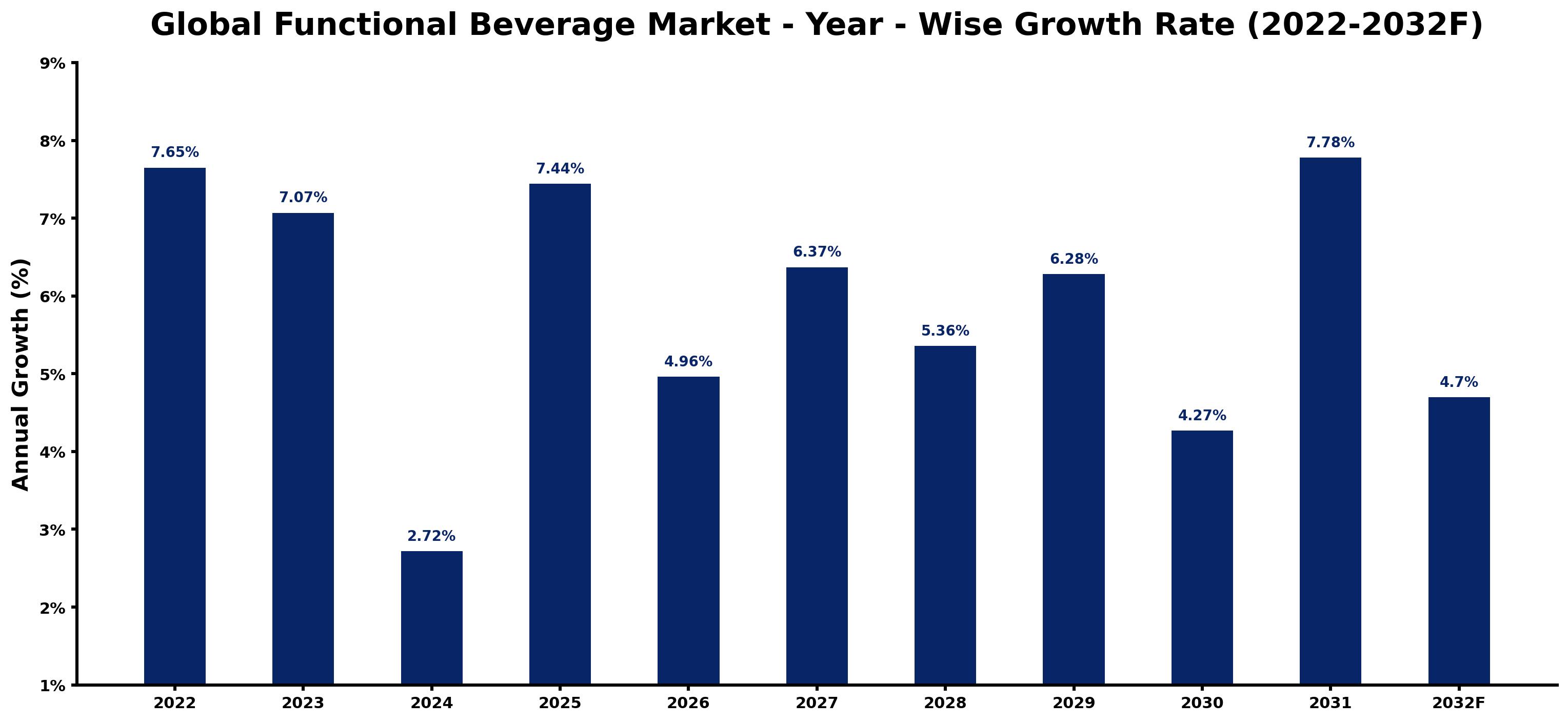
The table below presents the year‑wise growth rates along with the key drivers influencing the market
| Year | Growth Rate (%) | Major Drivers |
| 2022 | 7.65 | Health-conscious consumers increasingly seek functional beverages with added nutritional benefits. |
| 2023 | 7.07 | Growing awareness of health benefits drives consumers to embrace functional beverage options. |
| 2024 | 2.72 | While regulatory frameworks around health claims tighten, functional beverage innovation continues unabated. |
| 2025 | 7.44 | Increased investment in brands enhances the availability of premium functional beverage selections. |
| 2026 | 4.96 | Retail shelf penetration of functional beverages expands across diverse geographic markets globally. |
| 2027 | 6.37 | Consumer preference shifts toward clean-label formulations in the functional beverage segment. |
| 2028 | 5.36 | In developed regions, private-label competition intensifies against established functional beverage brands. |
| 2029 | 6.28 | Rising raw material costs compel brands to refine their functional beverage formulations. |
| 2030 | 4.27 | Manufacturers are prioritizing sustainability in packaging for functional beverage products. |
| 2031 | 7.78 | A shift toward more efficient supply chain practices enhances functional beverage distribution. |
| 2032 | 4.7 | E-commerce platforms expand to effectively showcase innovative functional beverage offerings. |
Note - Market size estimations and growth projections presented in this report are based on 6Wresearch's proprietary research methodology, combining internal industry data, secondary research, and primary validation, updated periodically to reflect current market conditions. As markets evolve rapidly, figures for certain industries may vary slightly and are intended as informed estimates rather than absolute figures. For the most current market sizing, we recommend validating figures with a 6Wresearch analyst.
Global Functional Beverage Market Key Takeaways
Below are some of the specific key takeaways from the market, including:
- The North American region accounted for a remarkable ~48% share in 2025, underscoring its dominance in the market.
- Probiotic drinks are set to grow at a CAGR of 7.2% from 2026 to 2032, outperforming other segments significantly.
- Coca-Cola launched its new functional beverage line, RISE, in 2021, focusing on energy-enhancing drinks with natural ingredients.
- As of 2025, energy drinks represent the largest segment, capturing over 40% of the overall market share, driven by youthful consumer demographics.
- The Asia-Pacific market is estimated to grow at a CAGR of 6.8% from 2026 to 2032, propelled by rising urbanization and health awareness.
Evaluation of Restraints in Global Functional Beverage Market
The Global Functional Beverage Market faces several specific challenges that could impact its trajectory. Regulatory hurdles present a significant barrier, primarily related to health claims. For instance, the FDA mandates stringent guidelines for labeling and advertising beverages as health-enhancing, a process that can cost companies millions and delay product launches. For example, compliance with the FDA's GRAS (Generally Recognized As Safe) process can take several months, imposing additional costs on manufacturers. Furthermore, consumer skepticism regarding the tangible benefits of functional ingredients, coupled with fierce competition from both niche and mainstream brands, poses a daunting challenge for new entrants aiming to carve out a market foothold.
Global Functional Beverage Market Trends
A significant trend reshaping the Global Functional Beverage Market is the rise of immunity-boosting formulations, powered by consumer demand for health resilience. Companies like Nestlé have integrated elderberry and echinacea into their products, responding to consumer interests identified during the COVID-19 pandemic. Moreover, the push for plant-based options is gaining traction, as seen with Pepsico's launch of their "Naked" line of smoothies featuring plant-based ingredients, which has experienced strong sales growth. Lastly, digitized consumer engagement strategies, such as DTC (direct-to-consumer) models, are becoming increasingly prevalent, allowing companies to capture consumer data and customize offerings more effectively, enhancing customer loyalty.
Global Functional Beverage Market Opportunities
The Global Functional Beverage Market presents ample opportunities in specific domains that align with evolving consumer preferences. High demand for CBD-infused beverages has led companies like Truss Beverage Co. to introduce products targeting wellness and relaxation. For example, CBD beverage sales are expected to reach approximately $1.4 billion by 2025, indicating lucrative placement in this segment. Furthermore, emerging interest in ready-to-drink (RTD) coffee and tea infused with adaptogenic herbs offers additional avenues; brands like Four Sigmatic are leading the way with functional mushroom coffee that addresses cognitive health. This expansion encapsulates not only consumer desires for convenience but also the ongoing inclination towards health-oriented innovation.
Global Functional Beverage Market by Type
Energy drinks currently lead the market, commanding a substantial ~40% share in 2025, attributed to their popularity among younger consumers seeking performance enhancement. Probiotic drinks, however, are projected to be the fastest growing, with a remarkable CAGR of 7.2% from 2026 to 2032, primarily driven by an increased focus on gut health and a rise in concerns about digestive issues. Consumer interest in functional benefits and the probiotic ingredients enhance the credibility of these beverages, thus promoting higher consumption rates and market penetration.
Global Functional Beverage Market by Application
The 'Health and Wellness' segment leads the application market, accounting for approx. ~45% share in 2025 due to increasing health concerns and the proliferation of fitness trends. Conversely, the 'Functional Ingredients' sector is emerging as the fastest-growing application, set to achieve a CAGR of 7.5% from 2026 to 2032. This growth is spurred by enhanced consumer knowledge and acceptance of functional ingredients, promoting product diversification and innovative applications across various beverage types.
Global Functional Beverage Market by End User
Adults represent the largest end user group, making up approximately ~56% of the market share in 2025, driven by their increasing focus on health and wellness. However, the 'Athletes' segment is projected to grow fastest, with a CAGR of 8.0% from 2026 to 2032, underscoring the demand for beverage options tailored to performance enhancement and recovery. This segment's growth is supported by sponsors and endorsements within sports communities, driving awareness and consumption of functional beverages designed specifically for athletic performance.
Global Functional Beverage Market by Region
North America holds the largest share of the Global Functional Beverage Market, with around ~48% share in 2025, driven by established consumer behaviors favoring health-conscious choices. Asia, however, is expected to be the fastest growing region, with a CAGR of 6.8% from 2026 to 2032, fueled by rising disposable incomes and a growing urban middle class with increased access to specialty health products. This growing segment is being supported by the expansion of e-commerce platforms and local health initiatives that further stimulate consumer interest.
Government Initiatives in the Global Functional Beverage Market
Government regulations and initiatives play a pivotal role in shaping the Global Functional Beverage Market by establishing guidelines that enhance product quality and consumer safety.
- U.S. Food and Drug Administration (FDA), "Dietary Supplement Health and Education Act," passed in 1994. This act regulates claims related to dietary supplements, impacting how functional beverages are marketed.
- European Food Safety Authority (EFSA), "Nutrition and Health Claims Regulation," implemented in 2007. It ensures that health claims on functional beverages in Europe are scientifically substantiated, affecting product development in this region.
- Health Canada, "Guideline for the Labelling and Advertising of Foods for Special Dietary Use," issued in 2020. This guideline enhances transparency in product labeling, benefiting consumers seeking functional beverages.
- Food Standards Australia New Zealand (FSANZ), "New Food Standards Code," updated in 2021. This regulation addresses new food products, including functional beverages, ensuring safety and compliance within the market.
Future Insights of the Global Functional Beverage Market
Looking ahead, the Global Functional Beverage Market is likely to witness significant transformations driven by technological advancements in formulation processes and increased consumer awareness regarding health benefits. For instance, the introduction of personalized beverages catering specifically to individual health requirements is gaining momentum, as reflected by companies like Coca-Cola with their RISE line targeting energy enhancement. By 2032, supply chain dynamics may shift towards sustainable sourcing practices, promoting ingredients that resonate with evolving consumer narratives around health and transparency.
Global Functional Beverage Market Latest Developments
Several noteworthy developments are shaping the Global Functional Beverage Market landscape, reflecting strategic company initiatives aimed at capitalizing on consumer trends.
- Coca-Cola recently announced the launch of a new line of sparkling probiotic beverages, aimed at enhancing gut health, set to debut in mid-2024, underscoring their commitment to wellness.
- PepsiCo has expanded its product portfolio by acquiring a well-known functional drink brand that focuses on immunity, completed in early 2023, improving its positioning in health-oriented segments.
- Nestlé is investing in research on adaptogenic ingredients, with product trials slated for late 2023, aiming to introduce functional beverages designed for stress relief and cognitive health.
- Danone is restructuring its supply chain to improve ingredient sourcing transparency, projected to finalize in late 2024, aligning with consumer demand for sustainability and ethical products.
Global Functional Beverage Market Key Players and Industry Positioning
The competitive structure of the Global Functional Beverage Market is moderately consolidated, with a mix of large multinational corporations and emerging specialized brands. This dynamic enables established players to leverage significant resources while also fostering niche opportunities for smaller entities focusing on specific health benefits.
| Leading Company | Core Strength | Strategic Focus |
|---|---|---|
| Coca-Cola | Diverse beverage portfolio and global reach. | Expanding functional beverage line. |
| PepsiCo | Strong marketing and innovation capabilities. | Acquisitions in health-focused brands. |
| Nestlé | Research leadership in health and nutrition. | Focus on personalized nutrition solutions. |
| Red Bull | Strong brand presence in energy drinks. | Continuous innovation in energy formulation. |
| Danone | Expertise in dairy and plant-based beverages. | Sustainability in sourcing and packaging. |
In summary, these key players not only define the competitive dynamics of the market but also influence consumer preferences through their ongoing strategic initiatives and innovations.
Key Attractiveness of the Report
- 10 Years of Market Numbers
- Historical Data Starting from 2022 to 2025
- Base Year: 2025
- Forecast Data until 2032
- Key Performance Indicators Impacting the Market
- Major Upcoming Developments and Projects
Key Highlights of the Report:
- Global Functional Beverage Market Outlook
- Market Size of Global Functional Beverage Market, 2025
- Forecast of Global Functional Beverage Market, 2032
- Historical Data and Forecast of Global Functional Beverage Revenues & Volume for the Period 2022-2032
- Global Functional Beverage Market Trend Evolution
- Global Functional Beverage Market Drivers and Challenges
- Global Functional Beverage Price Trends
- Global Functional Beverage Porter's Five Forces
- Global Functional Beverage Industry Life Cycle
- Historical Data and Forecast of Global Functional Beverage Market Revenues & Volume
- Historical Data and Forecast of Global Functional Beverage Market Revenues & Volume By Type for the Period 2022-2032
- Historical Data and Forecast of Global Functional Beverage Market Revenues & Volume By Energy Drinks for the Period 2022-2032
- Historical Data and Forecast of Global Functional Beverage Market Revenues & Volume By Sports Drinks for the Period 2022-2032
- Historical Data and Forecast of Global Functional Beverage Market Revenues & Volume By Probiotic Drinks for the Period 2022-2032
- Historical Data and Forecast of Global Functional Beverage Market Revenues & Volume By Nutraceutical Beverages for the Period 2022-2032
- Historical Data and Forecast of Global Functional Beverage Market Revenues & Volume By Application for the Period 2022-2032
- Historical Data and Forecast of Global Functional Beverage Market Revenues & Volume By Sports and Fitness for the Period 2022-2032
- Historical Data and Forecast of Global Functional Beverage Market Revenues & Volume By Health and Wellness for the Period 2022-2032
- Historical Data and Forecast of Global Functional Beverage Market Revenues & Volume By Functional Ingredients for the Period 2022-2032
- Historical Data and Forecast of Global Functional Beverage Market Revenues & Volume By End User for the Period 2022-2032
- Historical Data and Forecast of Global Functional Beverage Market Revenues & Volume By Adults for the Period 2022-2032
- Historical Data and Forecast of Global Functional Beverage Market Revenues & Volume By Elderly for the Period 2022-2032
- Historical Data and Forecast of Global Functional Beverage Market Revenues & Volume By Athletes for the Period 2022-2032
- Historical Data and Forecast of North America Functional Beverage Market Revenues & Volume By Type for the Period 2022-2032
- Historical Data and Forecast of North America Functional Beverage Market Revenues & Volume By Energy Drinks for the Period 2022-2032
- Historical Data and Forecast of North America Functional Beverage Market Revenues & Volume By Sports Drinks for the Period 2022-2032
- Historical Data and Forecast of North America Functional Beverage Market Revenues & Volume By Probiotic Drinks for the Period 2022-2032
- Historical Data and Forecast of North America Functional Beverage Market Revenues & Volume By Nutraceutical Beverages for the Period 2022-2032
- Historical Data and Forecast of North America Functional Beverage Market Revenues & Volume By Application for the Period 2022-2032
- Historical Data and Forecast of North America Functional Beverage Market Revenues & Volume By Sports and Fitness for the Period 2022-2032
- Historical Data and Forecast of North America Functional Beverage Market Revenues & Volume By Health and Wellness for the Period 2022-2032
- Historical Data and Forecast of North America Functional Beverage Market Revenues & Volume By Functional Ingredients for the Period 2022-2032
- Historical Data and Forecast of North America Functional Beverage Market Revenues & Volume By End User for the Period 2022-2032
- Historical Data and Forecast of North America Functional Beverage Market Revenues & Volume By Adults for the Period 2022-2032
- Historical Data and Forecast of North America Functional Beverage Market Revenues & Volume By Elderly for the Period 2022-2032
- Historical Data and Forecast of North America Functional Beverage Market Revenues & Volume By Athletes for the Period 2022-2032
- Historical Data and Forecast of United States of America Functional Beverage Market Revenues & Volume for the Period 2022-2032
- Historical Data and Forecast of Canada Functional Beverage Market Revenues & Volume for the Period 2022-2032
- Historical Data and Forecast of Rest of North America Functional Beverage Market Revenues & Volume for the Period 2022-2032
- Historical Data and Forecast of Latin America (LATAM) Functional Beverage Market Revenues & Volume By Type for the Period 2022-2032
- Historical Data and Forecast of Latin America (LATAM) Functional Beverage Market Revenues & Volume By Energy Drinks for the Period 2022-2032
- Historical Data and Forecast of Latin America (LATAM) Functional Beverage Market Revenues & Volume By Sports Drinks for the Period 2022-2032
- Historical Data and Forecast of Latin America (LATAM) Functional Beverage Market Revenues & Volume By Probiotic Drinks for the Period 2022-2032
- Historical Data and Forecast of Latin America (LATAM) Functional Beverage Market Revenues & Volume By Nutraceutical Beverages for the Period 2022-2032
- Historical Data and Forecast of Latin America (LATAM) Functional Beverage Market Revenues & Volume By Application for the Period 2022-2032
- Historical Data and Forecast of Latin America (LATAM) Functional Beverage Market Revenues & Volume By Sports and Fitness for the Period 2022-2032
- Historical Data and Forecast of Latin America (LATAM) Functional Beverage Market Revenues & Volume By Health and Wellness for the Period 2022-2032
- Historical Data and Forecast of Latin America (LATAM) Functional Beverage Market Revenues & Volume By Functional Ingredients for the Period 2022-2032
- Historical Data and Forecast of Latin America (LATAM) Functional Beverage Market Revenues & Volume By End User for the Period 2022-2032
- Historical Data and Forecast of Latin America (LATAM) Functional Beverage Market Revenues & Volume By Adults for the Period 2022-2032
- Historical Data and Forecast of Latin America (LATAM) Functional Beverage Market Revenues & Volume By Elderly for the Period 2022-2032
- Historical Data and Forecast of Latin America (LATAM) Functional Beverage Market Revenues & Volume By Athletes for the Period 2022-2032
- Historical Data and Forecast of Brazil Functional Beverage Market Revenues & Volume for the Period 2022-2032
- Historical Data and Forecast of Mexico Functional Beverage Market Revenues & Volume for the Period 2022-2032
- Historical Data and Forecast of Argentina Functional Beverage Market Revenues & Volume for the Period 2022-2032
- Historical Data and Forecast of Rest of LATAM Functional Beverage Market Revenues & Volume for the Period 2022-2032
- Historical Data and Forecast of Asia Functional Beverage Market Revenues & Volume By Type for the Period 2022-2032
- Historical Data and Forecast of Asia Functional Beverage Market Revenues & Volume By Energy Drinks for the Period 2022-2032
- Historical Data and Forecast of Asia Functional Beverage Market Revenues & Volume By Sports Drinks for the Period 2022-2032
- Historical Data and Forecast of Asia Functional Beverage Market Revenues & Volume By Probiotic Drinks for the Period 2022-2032
- Historical Data and Forecast of Asia Functional Beverage Market Revenues & Volume By Nutraceutical Beverages for the Period 2022-2032
- Historical Data and Forecast of Asia Functional Beverage Market Revenues & Volume By Application for the Period 2022-2032
- Historical Data and Forecast of Asia Functional Beverage Market Revenues & Volume By Sports and Fitness for the Period 2022-2032
- Historical Data and Forecast of Asia Functional Beverage Market Revenues & Volume By Health and Wellness for the Period 2022-2032
- Historical Data and Forecast of Asia Functional Beverage Market Revenues & Volume By Functional Ingredients for the Period 2022-2032
- Historical Data and Forecast of Asia Functional Beverage Market Revenues & Volume By End User for the Period 2022-2032
- Historical Data and Forecast of Asia Functional Beverage Market Revenues & Volume By Adults for the Period 2022-2032
- Historical Data and Forecast of Asia Functional Beverage Market Revenues & Volume By Elderly for the Period 2022-2032
- Historical Data and Forecast of Asia Functional Beverage Market Revenues & Volume By Athletes for the Period 2022-2032
- Historical Data and Forecast of China Functional Beverage Market Revenues & Volume for the Period 2022-2032
- Historical Data and Forecast of India Functional Beverage Market Revenues & Volume for the Period 2022-2032
- Historical Data and Forecast of Japan Functional Beverage Market Revenues & Volume for the Period 2022-2032
- Historical Data and Forecast of Rest of Asia Functional Beverage Market Revenues & Volume for the Period 2022-2032
- Historical Data and Forecast of Africa Functional Beverage Market Revenues & Volume By Type for the Period 2022-2032
- Historical Data and Forecast of Africa Functional Beverage Market Revenues & Volume By Energy Drinks for the Period 2022-2032
- Historical Data and Forecast of Africa Functional Beverage Market Revenues & Volume By Sports Drinks for the Period 2022-2032
- Historical Data and Forecast of Africa Functional Beverage Market Revenues & Volume By Probiotic Drinks for the Period 2022-2032
- Historical Data and Forecast of Africa Functional Beverage Market Revenues & Volume By Nutraceutical Beverages for the Period 2022-2032
- Historical Data and Forecast of Africa Functional Beverage Market Revenues & Volume By Application for the Period 2022-2032
- Historical Data and Forecast of Africa Functional Beverage Market Revenues & Volume By Sports and Fitness for the Period 2022-2032
- Historical Data and Forecast of Africa Functional Beverage Market Revenues & Volume By Health and Wellness for the Period 2022-2032
- Historical Data and Forecast of Africa Functional Beverage Market Revenues & Volume By Functional Ingredients for the Period 2022-2032
- Historical Data and Forecast of Africa Functional Beverage Market Revenues & Volume By End User for the Period 2022-2032
- Historical Data and Forecast of Africa Functional Beverage Market Revenues & Volume By Adults for the Period 2022-2032
- Historical Data and Forecast of Africa Functional Beverage Market Revenues & Volume By Elderly for the Period 2022-2032
- Historical Data and Forecast of Africa Functional Beverage Market Revenues & Volume By Athletes for the Period 2022-2032
- Historical Data and Forecast of South Africa Functional Beverage Market Revenues & Volume for the Period 2022-2032
- Historical Data and Forecast of Nigeria Functional Beverage Market Revenues & Volume for the Period 2022-2032
- Historical Data and Forecast of Egypt Functional Beverage Market Revenues & Volume for the Period 2022-2032
- Historical Data and Forecast of Rest of Africa Functional Beverage Market Revenues & Volume for the Period 2022-2032
- Historical Data and Forecast of Europe Functional Beverage Market Revenues & Volume By Type for the Period 2022-2032
- Historical Data and Forecast of Europe Functional Beverage Market Revenues & Volume By Energy Drinks for the Period 2022-2032
- Historical Data and Forecast of Europe Functional Beverage Market Revenues & Volume By Sports Drinks for the Period 2022-2032
- Historical Data and Forecast of Europe Functional Beverage Market Revenues & Volume By Probiotic Drinks for the Period 2022-2032
- Historical Data and Forecast of Europe Functional Beverage Market Revenues & Volume By Nutraceutical Beverages for the Period 2022-2032
- Historical Data and Forecast of Europe Functional Beverage Market Revenues & Volume By Application for the Period 2022-2032
- Historical Data and Forecast of Europe Functional Beverage Market Revenues & Volume By Sports and Fitness for the Period 2022-2032
- Historical Data and Forecast of Europe Functional Beverage Market Revenues & Volume By Health and Wellness for the Period 2022-2032
- Historical Data and Forecast of Europe Functional Beverage Market Revenues & Volume By Functional Ingredients for the Period 2022-2032
- Historical Data and Forecast of Europe Functional Beverage Market Revenues & Volume By End User for the Period 2022-2032
- Historical Data and Forecast of Europe Functional Beverage Market Revenues & Volume By Adults for the Period 2022-2032
- Historical Data and Forecast of Europe Functional Beverage Market Revenues & Volume By Elderly for the Period 2022-2032
- Historical Data and Forecast of Europe Functional Beverage Market Revenues & Volume By Athletes for the Period 2022-2032
- Historical Data and Forecast of United Kingdom Functional Beverage Market Revenues & Volume for the Period 2022-2032
- Historical Data and Forecast of France Functional Beverage Market Revenues & Volume for the Period 2022-2032
- Historical Data and Forecast of Germany Functional Beverage Market Revenues & Volume for the Period 2022-2032
- Historical Data and Forecast of Rest of Europe Functional Beverage Market Revenues & Volume for the Period 2022-2032
- Historical Data and Forecast of Middle East Functional Beverage Market Revenues & Volume By Type for the Period 2022-2032
- Historical Data and Forecast of Middle East Functional Beverage Market Revenues & Volume By Energy Drinks for the Period 2022-2032
- Historical Data and Forecast of Middle East Functional Beverage Market Revenues & Volume By Sports Drinks for the Period 2022-2032
- Historical Data and Forecast of Middle East Functional Beverage Market Revenues & Volume By Probiotic Drinks for the Period 2022-2032
- Historical Data and Forecast of Middle East Functional Beverage Market Revenues & Volume By Nutraceutical Beverages for the Period 2022-2032
- Historical Data and Forecast of Middle East Functional Beverage Market Revenues & Volume By Application for the Period 2022-2032
- Historical Data and Forecast of Middle East Functional Beverage Market Revenues & Volume By Sports and Fitness for the Period 2022-2032
- Historical Data and Forecast of Middle East Functional Beverage Market Revenues & Volume By Health and Wellness for the Period 2022-2032
- Historical Data and Forecast of Middle East Functional Beverage Market Revenues & Volume By Functional Ingredients for the Period 2022-2032
- Historical Data and Forecast of Middle East Functional Beverage Market Revenues & Volume By End User for the Period 2022-2032
- Historical Data and Forecast of Middle East Functional Beverage Market Revenues & Volume By Adults for the Period 2022-2032
- Historical Data and Forecast of Middle East Functional Beverage Market Revenues & Volume By Elderly for the Period 2022-2032
- Historical Data and Forecast of Middle East Functional Beverage Market Revenues & Volume By Athletes for the Period 2022-2032
- Historical Data and Forecast of Saudi Arabia Functional Beverage Market Revenues & Volume for the Period 2022-2032
- Historical Data and Forecast of UAE Functional Beverage Market Revenues & Volume for the Period 2022-2032
- Historical Data and Forecast of Turkey Functional Beverage Market Revenues & Volume for the Period 2022-2032
- Historical Data and Forecast of Rest of Middle East Functional Beverage Market Revenues & Volume for the Period 2022-2032
- Global Functional Beverage Market - Key Performance Indicators
- Global Functional Beverage Market - Import Export Trade Statistics
- Global Functional Beverage Market - Opportunity Assessment By Countries
- Global Functional Beverage Market - Opportunity Assessment By Type
- Global Functional Beverage Market - Opportunity Assessment By Application
- Global Functional Beverage Market - Opportunity Assessment By End User
- Global Functional Beverage Market - Top Companies Market Share
- Global Functional Beverage Market - Top Companies Profiles
- Global Functional Beverage Market - Comparison of Players in Technical and Operating Parameters
- Global Functional Beverage Market - Strategic Recommendations
Markets Covered
The Global Functional Beverage Market report provides a detailed analysis of the following market segments:
By Regions and Countries:
- North America
- Europe
- LATAM
- Middle East
- Asia
- Africa
By Type:
- Energy Drinks
- Sports Drinks
- Probiotic Drinks
- Nutraceutical Beverages
By Application:
- Sports
- Fitness
- Health
- Wellness
- Functional Ingredients
By End User:
- Adults
- Elderly
- Athletes






































