Global IT Staffing Market Highlights
| Market Size (2025) | USD 28 Billion |
| Forecast Size (2032) | USD 42 Billion |
| CAGR | 5.80% |
| Base Year | 2025 |
| Forecast Period | 2026-2032 |
| Largest Region | North America |
| Fastest Growing Region | Asia |
| Largest Segment | BFSI |
| Fastest Growing Segment | Healthcare |
| Leading Companies | Randstad, Adecco, Robert Half, ManpowerGroup, Allegis Group |
Global IT Staffing Market Size & Growth Rate (2026-2032)
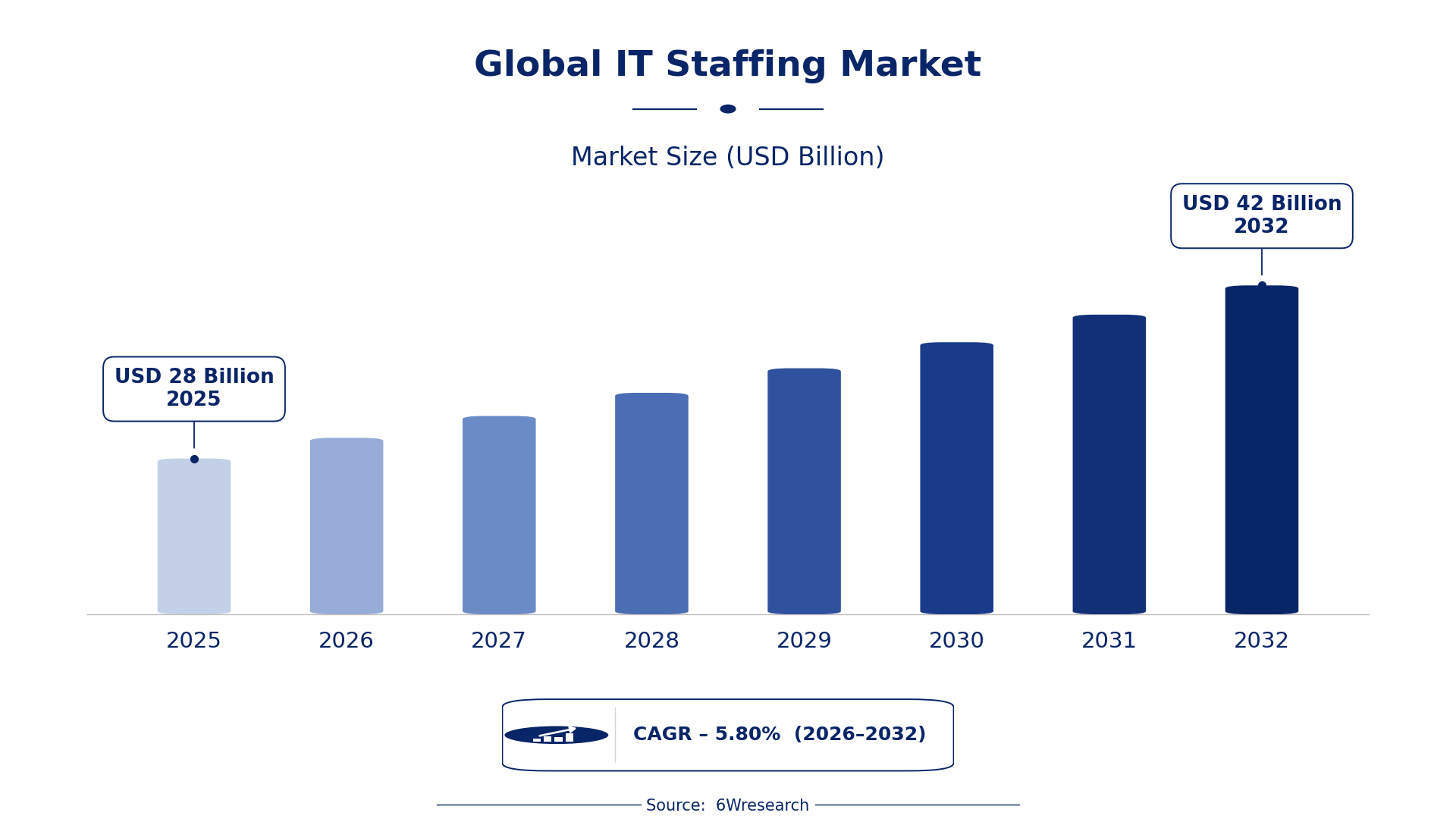
The Global IT Staffing Market was estimated at USD 28 Billion in 2025 and is projected to reach USD 42 Billion by 2032, growing at a CAGR of 5.80% from 2026 to 2032.
Global IT Staffing Market Synopsis
Market dynamics are shifting as organizations reassess their staffing strategies in response to the increasing complexity of IT environments. This reflection is particularly pertinent in sectors such as BFSI and healthcare, where digital transformation necessitates specialized IT talent. The market is becoming increasingly reliant on agile staffing models, enabling companies to scale their workforce fluidly based on project demands.
Additionally, a substantial transition towards remote work and freelance opportunities is redefining traditional recruitment processes. As businesses adapt, the focus on retaining skilled professionals has intensified, directly affecting sourcing strategies. This adaptation influences not only staffing firms but also the corporations they serve, emphasizing the symbiotic relationship between talent availability and industry growth.
Global IT Staffing Market Year-wise Growth Rate and Key Drivers
This graph illustrates the annual growth rates of the Global IT Staffing Market from 2022 to 2032, highlighting a steady upward trajectory and projected expansion over the forecast period.
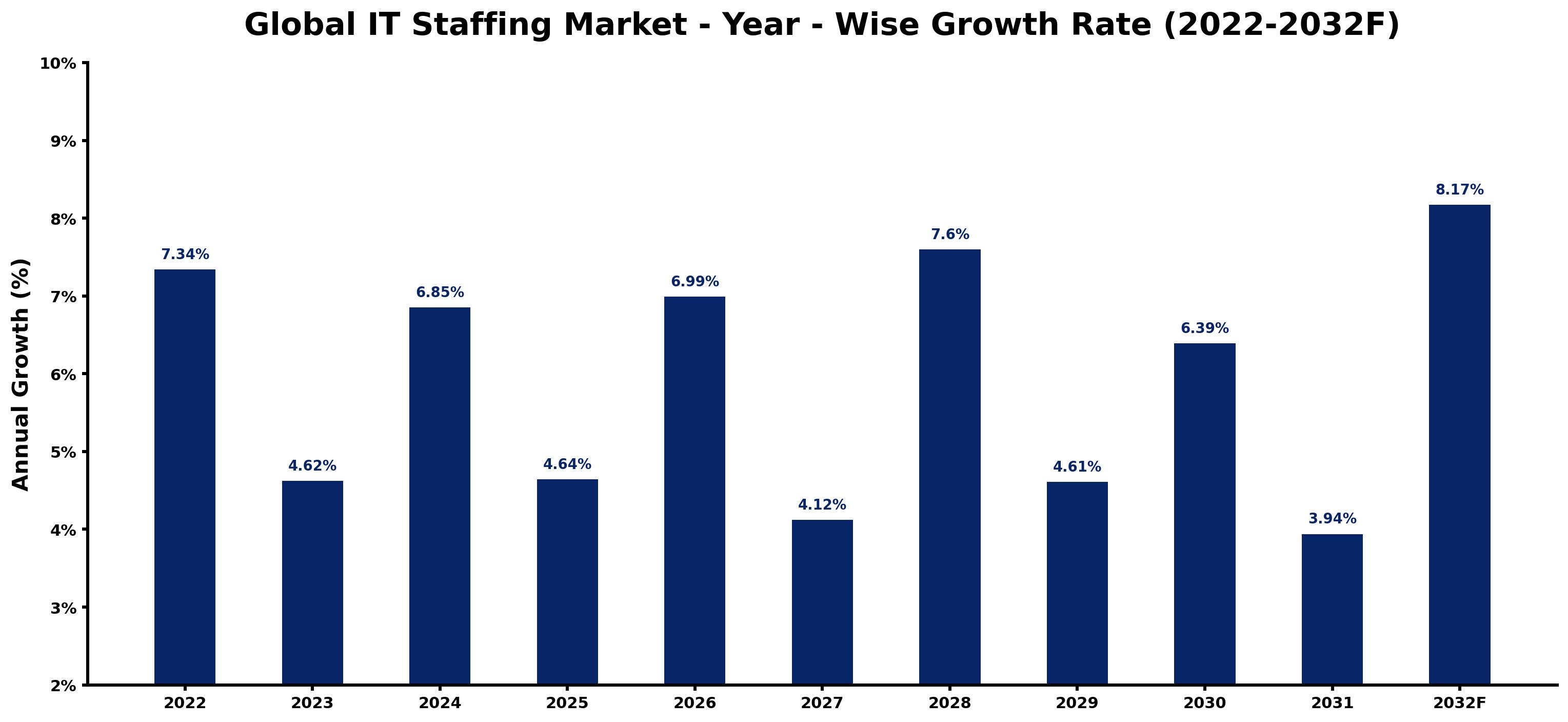
The table below presents the year‑wise growth rates along with the key drivers influencing the market
| Year | Growth Rate (%) | Major Drivers |
| 2022 | 7.34 | In North America, new regulatory measures stimulate growth in IT staffing services. |
| 2023 | 4.62 | Rising recruitment costs prompt firms to optimize IT staffing strategies effectively. |
| 2024 | 6.85 | Telecommunications companies increasingly seek IT staffing solutions to enhance 5G deployment. |
| 2025 | 4.64 | Adopting sustainable practices becomes vital for IT staffing firms to meet ESG goals. |
| 2026 | 6.99 | While demand for specialized IT skills rises, staffing agencies adapt to industry needs. |
| 2027 | 4.12 | Telecom operators adjust hiring practices based on evolving IT staffing market dynamics. |
| 2028 | 7.6 | Increased cloud adoption accelerates the need for agile IT staffing solutions across sectors. |
| 2029 | 4.61 | Staffing agencies enhance operations to address complex supply chain challenges in IT services. |
| 2030 | 6.39 | A shift toward remote work changes the competitive dynamics within IT staffing. |
| 2031 | 3.94 | Edge computing solutions drive expanded IT staffing opportunities across global regions. |
| 2032 | 8.17 | Merging IT staffing firms creates enhanced capabilities to tackle emerging cybersecurity needs. |
Note - Market size estimations and growth projections presented in this report are based on 6Wresearch's proprietary research methodology, combining internal industry data, secondary research, and primary validation, updated periodically to reflect current market conditions. As markets evolve rapidly, figures for certain industries may vary slightly and are intended as informed estimates rather than absolute figures. For the most current market sizing, we recommend validating figures with a 6Wresearch analyst.
Global IT Staffing Market Key Takeaways
Below are some of the specific key takeaways from the market, including:
- The BFSI sector accounts for approximately ~40% share in 2025, underscoring its pivotal role in driving market demand.
- Healthcare staffing is anticipated to witness a robust CAGR of 6.5% from 2026 to 2032, fueled by the uptick in telemedicine and digital health solutions.
- Remote work brings a 30% increase in contractor usage, significantly reshaping staffing models across industries.
- Companies like Allegis Group have reported a focus on niche technology staffing, seeing a 25% rise in demand for AI specialists in 2023.
Evaluation of Restraints in Global IT Staffing Market
Despite its growth, the Global IT Staffing Market faces significant challenges. One noteworthy restraint is the impending regulatory change with the H-1B visa cap, limiting foreign talent influx, a situation which could increase labor costs by as high as 20%. For example, the Immigration and Citizenship Act, which tightened regulations in 2021, has already disrupted staffing patterns, forcing firms to reconsider their talent acquisition strategies. Additionally, fierce competition among staffing firms places downward pressure on profit margins, complicating operational sustainability.
Global IT Staffing Market Trends
A prominent trend in the Global IT Staffing Market is the prevalence of contract-based hiring. Companies are favoring flexible contracts to meet project-specific needs efficiently. For example, in 2023, a leading firm, Randstad, reported that 58% of its placements were contract-based. This shift is part of a broader strategy to optimize workforce management while reducing overhead. Another emerging trend is the integration of AI tools in recruitment processes. Companies like Adecco have invested in AI-driven platforms that streamline candidate selection, enhancing efficiency and precision. Furthermore, an additional trend is the growing emphasis on diversity in tech hiring. Organizations are increasingly mandating diversity-focused hiring policies to foster innovation and promote inclusion.
Global IT Staffing Market Opportunities
Looking ahead, significant revenue opportunities exist within sectors witnessing rapid technological evolution, notably healthcare and cybersecurity. Companies like Zocdoc have begun to scale their IT operations, underscoring a heightened demand for healthcare IT professionals, with observed job openings increasing by 40% over the past year. Additionally, the cybersecurity realm is set to expand; with estimated spending on cybersecurity staffing expected to reach $50 billion by 2025, reflecting an urgent need for specialized talent. This urgency stems from the increasing threats posed by cyber risks, leading organizations to prioritize robust cybersecurity frameworks.
Global IT Staffing Market by End-user Industry
The BFSI sector is the largest segment within the Global IT Staffing Market, commanding approximately ~40% share in 2025. This dominance is largely attributed to stringent regulatory requirements and an ongoing digital transformation. In contrast, healthcare is the fastest-growing segment, with an impressive CAGR of 6.5% from 2026 to 2032. The heightened need for IT professionals in healthcare can be linked to the rise of telehealth services and the digitization of patient records, which necessitate skilled IT support for implementation and management.
Global IT Staffing Market by Region
North America remains the largest region in the Global IT Staffing Market, accounting for approximately ~48% share in 2025, driven by a robust tech ecosystem and a high concentration of enterprise clients. Conversely, Asia is positioned as the fastest-growing region, expected to achieve a CAGR of 7.2% from 2026 to 2032. This remarkable growth is fueled by increasing technological adoption among startups and established firms alike, coupled with favorable government policies promoting technology integration and digital skills development.
Government Initiatives in the Global IT Staffing Market
Regulatory frameworks are evolving to better align with the needs of the IT staffing industry. Governments are implementing various policies aiming to bolster workforce capabilities and streamline talent acquisition processes. These initiatives are critical in nurturing a sustainable staffing ecosystem that meets the dynamic demands of the market.
- U.S. Department of Labor, "Skills for Success Initiative," launched in 2022, aims to enhance training programs for IT professionals, focusing on software development and cybersecurity.
- European Commission, "Digital Europe Programme," underway since 2021, allocates €7.55 billion to promote digital skills and increase the availability of skilled IT personnel across the EU.
- Indian Ministry of Electronics and Information Technology, "National Policy on Electronics," introduced in 2021, encourages investments in the IT sector, particularly in job creation for emerging technology roles.
- Australian Government, "JobTrainer Fund," announced in 2020, focuses on funding vocational training in digital skills, aiming to alleviate IT staffing shortages in critical sectors.
Future Insights of the Global IT Staffing Market
As the Global IT Staffing Market progresses toward 2032, agility in staffing solutions will seize the spotlight. Companies are increasingly expected to pivot toward hybrid operational models, merging remote and in-person talent seamlessly to enhance productivity. A recent initiative by Allegis Group, aimed at integrating AI-driven assessments into recruitment, indicates a shift towards data-centric hiring processes that prioritize skills over geographical constraints. This trajectory suggests a long-term transformation in the workforce landscape, underscoring the necessity for staffing firms to adapt rapidly to technological disruptions.
Global IT Staffing Market Latest Developments
The Global IT Staffing Market is witnessing innovative strategies as companies strive to enhance their market position and meet client demands. Key developments include:
- In early 2023, ManpowerGroup launched a digital talent platform to streamline the recruitment process, aligning skill sets with employer needs, which can significantly improve placement accuracy.
- Recently, Randstad announced a partnership with a leading AI firm to implement machine learning in its recruitment workflow, aiming to reduce hiring timeframes and improve candidate matching.
- In late 2022, Robert Half expanded its geographic reach into Southeast Asia, tapping into local universities to secure emerging talent, bolstering its competitive edge in the region.
- Adecco unveiled a new remote work policy in mid-2023, promoting flexibility to its workforce that aligns with the preferences of today's tech professionals, enhancing retention efforts.
Global IT Staffing Market Key Players and Industry Positioning
The competitive structure of the Global IT Staffing Market is mainly fragmented, with various players catering to unique niches and geographical demands. Major firms like Randstad and Adecco dominate the market with diversified service offerings, while specialized firms also carve out substantial market shares through targeted solutions.
| Leading Company | Core Strength | Strategic Focus |
|---|---|---|
| Randstad | Comprehensive service offerings across various sectors | Technological integration in recruitment |
| Adecco | Strong brand presence and global reach | Enhancing remote work policies |
| Robert Half | Expertise in specialized staffing solutions | Expansion into emerging markets |
| ManpowerGroup | Innovative digital recruitment processes | Focus on skill-based hiring |
| Allegis Group | Niche technology staffing | Investment in AI-driven hiring tools |
The differentiated strategies employed by these companies highlight the various approaches firms are taking to remain competitive in a rapidly changing environment. Their ability to adapt to industry trends will be pivotal in shaping their success.
Key Attractiveness of the Report
- 10 Years of Market Numbers
- Historical Data Starting from 2022 to 2025
- Base Year: 2025
- Forecast Data until 2032
- Key Performance Indicators Impacting the Market
- Major Upcoming Developments and Projects
Key Highlights of the Report:
- Global IT Staffing Market Outlook
- Market Size of Global IT Staffing Market, 2025
- Forecast of Global IT Staffing Market, 2032
- Historical Data and Forecast of Global IT Staffing Revenues & Volume for the Period 2022-2032
- Global IT Staffing Market Trend Evolution
- Global IT Staffing Market Drivers and Challenges
- Global IT Staffing Price Trends
- Global IT Staffing Porter's Five Forces
- Global IT Staffing Industry Life Cycle
- Historical Data and Forecast of Global IT Staffing Market Revenues & Volume
- Historical Data and Forecast of Global IT Staffing Market Revenues & Volume By End-user Industry for the Period 2022-2032
- Historical Data and Forecast of Global IT Staffing Market Revenues & Volume By Telecom for the Period 2022-2032
- Historical Data and Forecast of Global IT Staffing Market Revenues & Volume By BFSI for the Period 2022-2032
- Historical Data and Forecast of Global IT Staffing Market Revenues & Volume By Healthcare for the Period 2022-2032
- Historical Data and Forecast of Global IT Staffing Market Revenues & Volume By Manufacturing for the Period 2022-2032
- Historical Data and Forecast of Global IT Staffing Market Revenues & Volume By Retail for the Period 2022-2032
- Historical Data and Forecast of North America IT Staffing Market Revenues & Volume By End-user Industry for the Period 2022-2032
- Historical Data and Forecast of North America IT Staffing Market Revenues & Volume By Telecom for the Period 2022-2032
- Historical Data and Forecast of North America IT Staffing Market Revenues & Volume By BFSI for the Period 2022-2032
- Historical Data and Forecast of North America IT Staffing Market Revenues & Volume By Healthcare for the Period 2022-2032
- Historical Data and Forecast of North America IT Staffing Market Revenues & Volume By Manufacturing for the Period 2022-2032
- Historical Data and Forecast of North America IT Staffing Market Revenues & Volume By Retail for the Period 2022-2032
- Historical Data and Forecast of United States of America IT Staffing Market Revenues & Volume for the Period 2022-2032
- Historical Data and Forecast of Canada IT Staffing Market Revenues & Volume for the Period 2022-2032
- Historical Data and Forecast of Rest of North America IT Staffing Market Revenues & Volume for the Period 2022-2032
- Historical Data and Forecast of Latin America (LATAM) IT Staffing Market Revenues & Volume By End-user Industry for the Period 2022-2032
- Historical Data and Forecast of Latin America (LATAM) IT Staffing Market Revenues & Volume By Telecom for the Period 2022-2032
- Historical Data and Forecast of Latin America (LATAM) IT Staffing Market Revenues & Volume By BFSI for the Period 2022-2032
- Historical Data and Forecast of Latin America (LATAM) IT Staffing Market Revenues & Volume By Healthcare for the Period 2022-2032
- Historical Data and Forecast of Latin America (LATAM) IT Staffing Market Revenues & Volume By Manufacturing for the Period 2022-2032
- Historical Data and Forecast of Latin America (LATAM) IT Staffing Market Revenues & Volume By Retail for the Period 2022-2032
- Historical Data and Forecast of Brazil IT Staffing Market Revenues & Volume for the Period 2022-2032
- Historical Data and Forecast of Mexico IT Staffing Market Revenues & Volume for the Period 2022-2032
- Historical Data and Forecast of Argentina IT Staffing Market Revenues & Volume for the Period 2022-2032
- Historical Data and Forecast of Rest of LATAM IT Staffing Market Revenues & Volume for the Period 2022-2032
- Historical Data and Forecast of Asia IT Staffing Market Revenues & Volume By End-user Industry for the Period 2022-2032
- Historical Data and Forecast of Asia IT Staffing Market Revenues & Volume By Telecom for the Period 2022-2032
- Historical Data and Forecast of Asia IT Staffing Market Revenues & Volume By BFSI for the Period 2022-2032
- Historical Data and Forecast of Asia IT Staffing Market Revenues & Volume By Healthcare for the Period 2022-2032
- Historical Data and Forecast of Asia IT Staffing Market Revenues & Volume By Manufacturing for the Period 2022-2032
- Historical Data and Forecast of Asia IT Staffing Market Revenues & Volume By Retail for the Period 2022-2032
- Historical Data and Forecast of China IT Staffing Market Revenues & Volume for the Period 2022-2032
- Historical Data and Forecast of India IT Staffing Market Revenues & Volume for the Period 2022-2032
- Historical Data and Forecast of Japan IT Staffing Market Revenues & Volume for the Period 2022-2032
- Historical Data and Forecast of Rest of Asia IT Staffing Market Revenues & Volume for the Period 2022-2032
- Historical Data and Forecast of Africa IT Staffing Market Revenues & Volume By End-user Industry for the Period 2022-2032
- Historical Data and Forecast of Africa IT Staffing Market Revenues & Volume By Telecom for the Period 2022-2032
- Historical Data and Forecast of Africa IT Staffing Market Revenues & Volume By BFSI for the Period 2022-2032
- Historical Data and Forecast of Africa IT Staffing Market Revenues & Volume By Healthcare for the Period 2022-2032
- Historical Data and Forecast of Africa IT Staffing Market Revenues & Volume By Manufacturing for the Period 2022-2032
- Historical Data and Forecast of Africa IT Staffing Market Revenues & Volume By Retail for the Period 2022-2032
- Historical Data and Forecast of South Africa IT Staffing Market Revenues & Volume for the Period 2022-2032
- Historical Data and Forecast of Nigeria IT Staffing Market Revenues & Volume for the Period 2022-2032
- Historical Data and Forecast of Egypt IT Staffing Market Revenues & Volume for the Period 2022-2032
- Historical Data and Forecast of Rest of Africa IT Staffing Market Revenues & Volume for the Period 2022-2032
- Historical Data and Forecast of Europe IT Staffing Market Revenues & Volume By End-user Industry for the Period 2022-2032
- Historical Data and Forecast of Europe IT Staffing Market Revenues & Volume By Telecom for the Period 2022-2032
- Historical Data and Forecast of Europe IT Staffing Market Revenues & Volume By BFSI for the Period 2022-2032
- Historical Data and Forecast of Europe IT Staffing Market Revenues & Volume By Healthcare for the Period 2022-2032
- Historical Data and Forecast of Europe IT Staffing Market Revenues & Volume By Manufacturing for the Period 2022-2032
- Historical Data and Forecast of Europe IT Staffing Market Revenues & Volume By Retail for the Period 2022-2032
- Historical Data and Forecast of United Kingdom IT Staffing Market Revenues & Volume for the Period 2022-2032
- Historical Data and Forecast of France IT Staffing Market Revenues & Volume for the Period 2022-2032
- Historical Data and Forecast of Germany IT Staffing Market Revenues & Volume for the Period 2022-2032
- Historical Data and Forecast of Rest of Europe IT Staffing Market Revenues & Volume for the Period 2022-2032
- Historical Data and Forecast of Middle East IT Staffing Market Revenues & Volume By End-user Industry for the Period 2022-2032
- Historical Data and Forecast of Middle East IT Staffing Market Revenues & Volume By Telecom for the Period 2022-2032
- Historical Data and Forecast of Middle East IT Staffing Market Revenues & Volume By BFSI for the Period 2022-2032
- Historical Data and Forecast of Middle East IT Staffing Market Revenues & Volume By Healthcare for the Period 2022-2032
- Historical Data and Forecast of Middle East IT Staffing Market Revenues & Volume By Manufacturing for the Period 2022-2032
- Historical Data and Forecast of Middle East IT Staffing Market Revenues & Volume By Retail for the Period 2022-2032
- Historical Data and Forecast of Saudi Arabia IT Staffing Market Revenues & Volume for the Period 2022-2032
- Historical Data and Forecast of UAE IT Staffing Market Revenues & Volume for the Period 2022-2032
- Historical Data and Forecast of Turkey IT Staffing Market Revenues & Volume for the Period 2022-2032
- Historical Data and Forecast of Rest of Middle East IT Staffing Market Revenues & Volume for the Period 2022-2032
- Global IT Staffing Market - Key Performance Indicators
- Global IT Staffing Market - Import Export Trade Statistics
- Global IT Staffing Market - Opportunity Assessment By Countries
- Global IT Staffing Market - Opportunity Assessment By End-user Industry
- 0
- Global IT Staffing Market - Top Companies Market Share
- Global IT Staffing Market - Top Companies Profiles
- Global IT Staffing Market - Comparison of Players in Technical and Operating Parameters
- Global IT Staffing Market - Strategic Recommendations
Markets Covered
The Global IT Staffing Market report provides a detailed analysis of the following market segments:
By Regions and Countries:
- North America
- Europe
- LATAM
- Middle East
- Asia
- Africa
By End-user Industry:
- Telecom
- BFSI
- Healthcare
- Manufacturing
- Retail






































