Greece Viscose Filament Yarns Market Size (2020-2030)
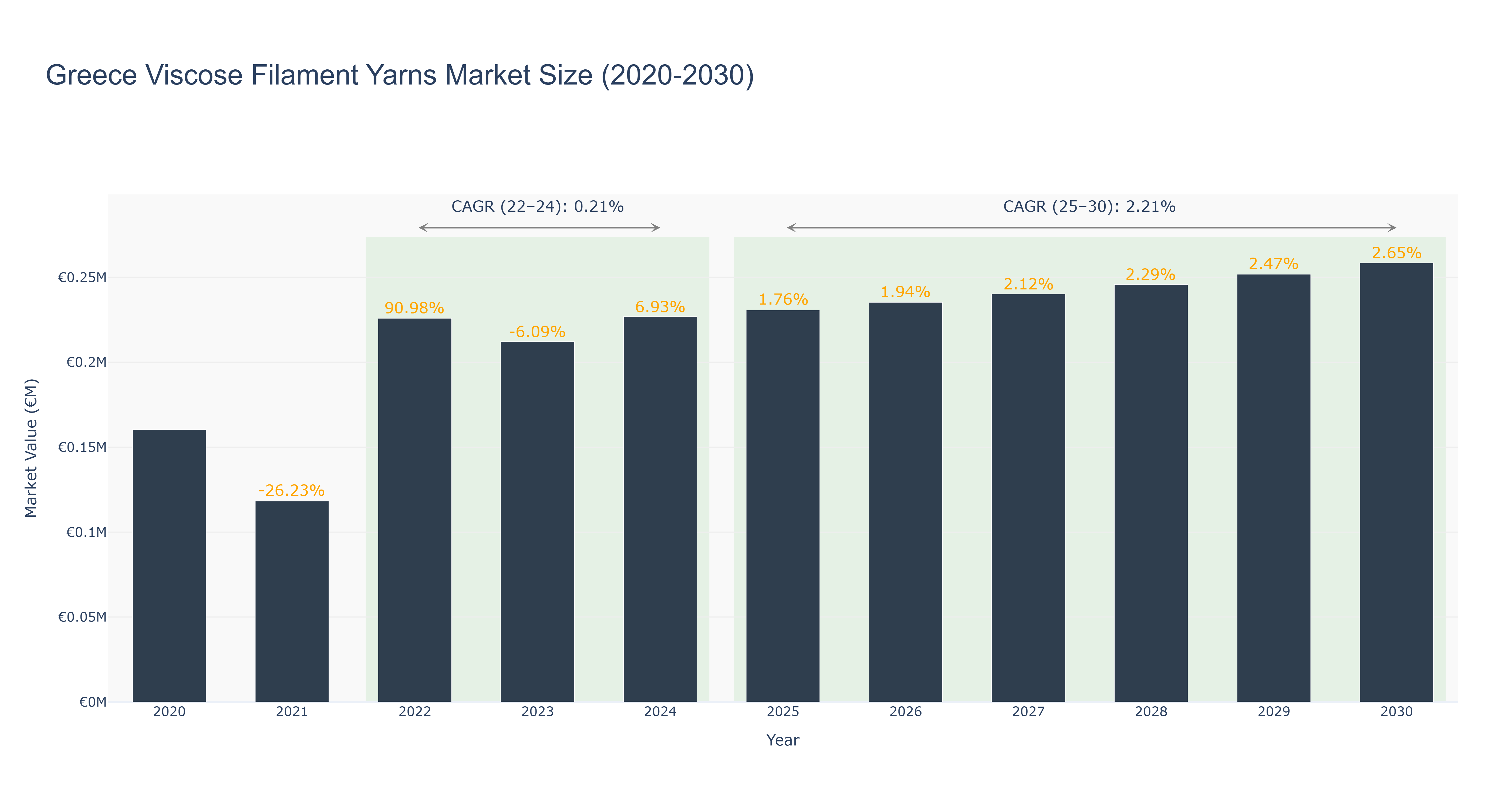
The Greece Viscose Filament Yarns Market experienced a fluctuating trend in recent years. The peak market size of €0.26 million is forecasted for 2030, with steady growth anticipated from 2025 to 2030, showcasing a CAGR of 2.21%. The market size declined from €0.16 million in 2020 to €0.12 million in 2021 due to economic challenges, but rebounded strongly with a 90.98% growth in 2022. The subsequent years saw slight fluctuations, with a consistent upward trajectory. Industry drivers such as increasing demand for sustainable textiles and technological advancements are propelling market growth. Looking ahead, upcoming investments in sustainable manufacturing processes and strategic partnerships with global textile companies are expected to further boost the Greece Viscose Filament Yarns Market.
Greece Viscose Filament Yarns Market: Production & Trade Performance (2019-2025)
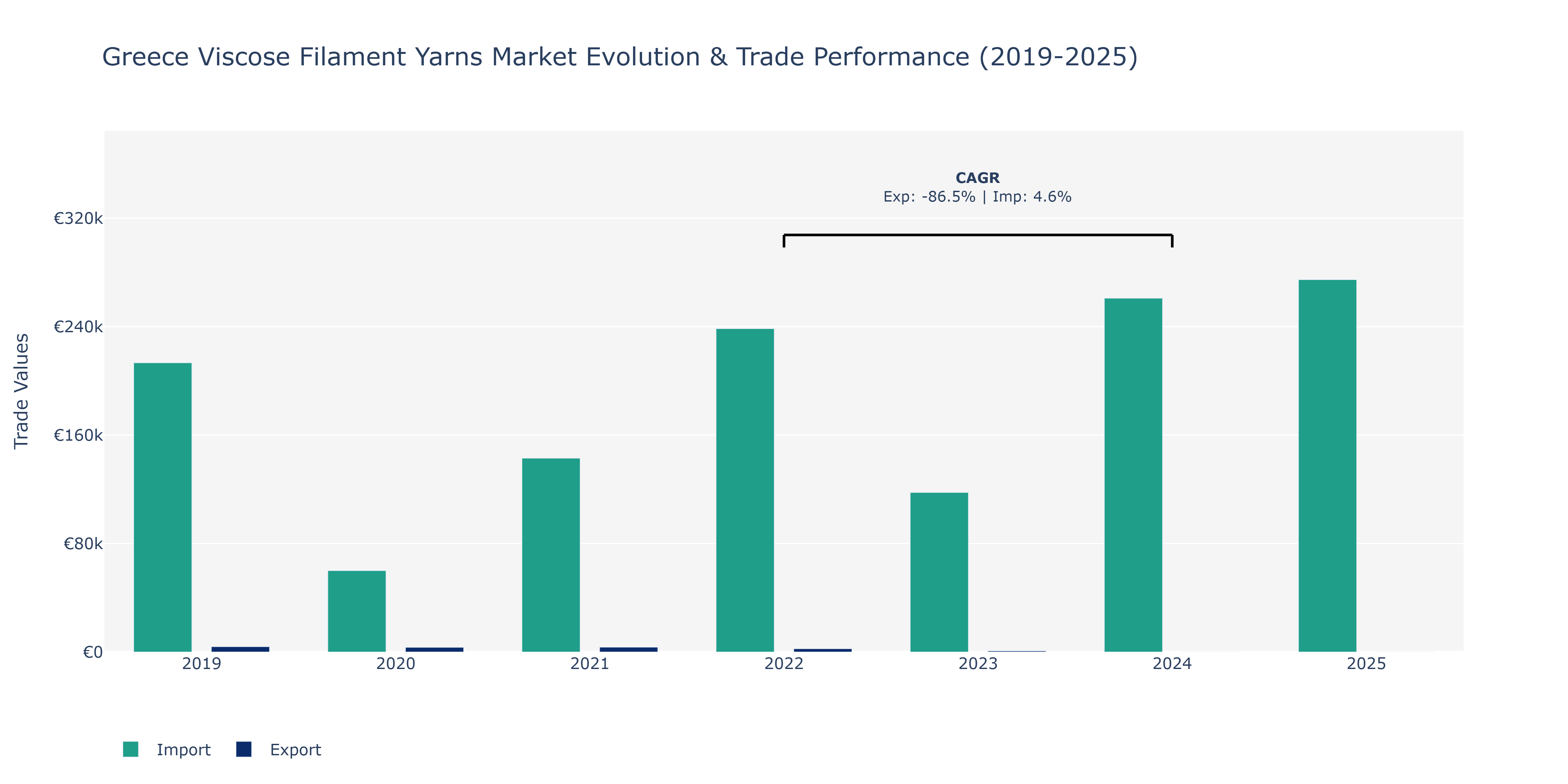
In the Greece Viscose Filament Yarns Market, exports saw a notable decline from €3.96 billion in 2019 to €33 million in 2025. This substantial drop can be attributed to various factors such as changes in global demand, competitive pricing strategies by other market players, and shifts in consumer preferences towards alternative materials. On the other hand, imports fluctuated significantly over the years, with a peak at €260.95 million in 2024 after a steady increase since 2019. This surge in imports could be linked to growing domestic consumption, technological advancements requiring specialized inputs, and international trade agreements impacting the textile industry. The contrasting trends between exports and imports showcase the evolving dynamics of the market, emphasizing the need for local manufacturers to adapt to changing market conditions and enhance their competitiveness in the global textile industry.
Key Highlights of the Report:
- Greece Viscose Filament Yarns Market Outlook
- Market Size of Greece Viscose Filament Yarns Market, 2025
- Forecast of Greece Viscose Filament Yarns Market, 2032
- Historical Data and Forecast of Greece Viscose Filament Yarns Revenues & Volume for the Period 2022-2032F
- Greece Viscose Filament Yarns Market Trend Evolution
- Greece Viscose Filament Yarns Market Drivers and Challenges
- Greece Viscose Filament Yarns Price Trends
- Greece Viscose Filament Yarns Porter`s Five Forces
- Greece Viscose Filament Yarns Industry Life Cycle
- Historical Data and Forecast of Greece Viscose Filament Yarns Market Revenues & Volume By Type for the Period 2022-2032F
- Historical Data and Forecast of Greece Viscose Filament Yarns Market Revenues & Volume By Continuous for the Period 2022-2032F
- Historical Data and Forecast of Greece Viscose Filament Yarns Market Revenues & Volume By Semi-continuous for the Period 2022-2032F
- Historical Data and Forecast of Greece Viscose Filament Yarns Market Revenues & Volume By Application for the Period 2022-2032F
- Historical Data and Forecast of Greece Viscose Filament Yarns Market Revenues & Volume By Garment industry for the Period 2022-2032F
- Historical Data and Forecast of Greece Viscose Filament Yarns Market Revenues & Volume By Auto industry for the Period 2022-2032F
- Historical Data and Forecast of Greece Viscose Filament Yarns Market Revenues & Volume By other for the Period 2022-2032F
- Greece Viscose Filament Yarns Import Export Trade Statistics
- Market Opportunity Assessment By Type
- Market Opportunity Assessment By Application
- Greece Viscose Filament Yarns Top Companies Market Share
- Greece Viscose Filament Yarns Competitive Benchmarking By Technical and Operational Parameters
- Greece Viscose Filament Yarns Company Profiles
- Greece Viscose Filament Yarns Key Strategic Recommendations






































