Hong Kong Kegs Market Top 5 Importing Countries and Market Competition (HHI) Analysis
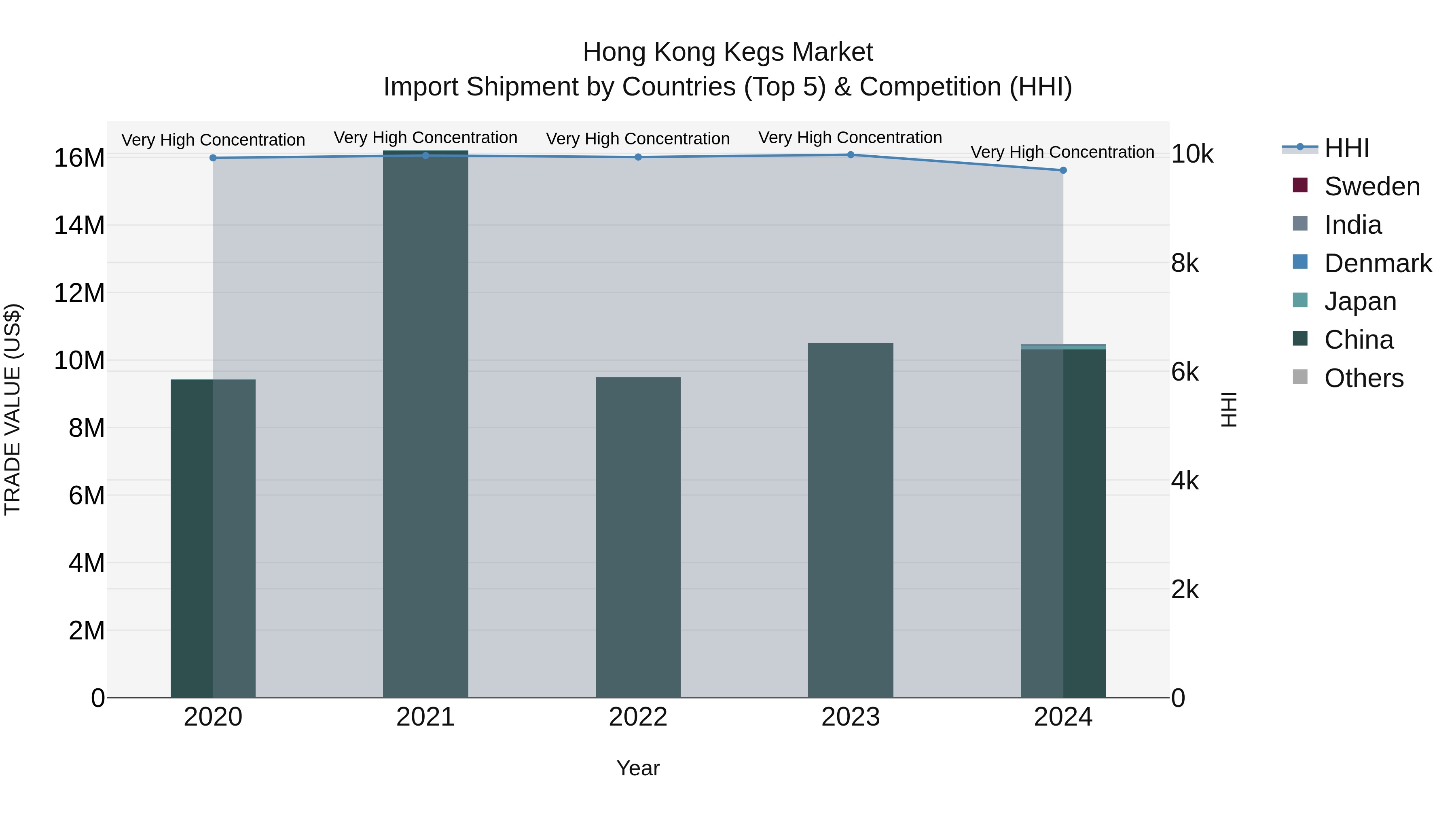
Hong Kong continues to be a key destination for kegs import shipments, with top exporters including China, Japan, Denmark, India, and the USA in 2024. The high concentration of the market, as indicated by the HHI, suggests a competitive landscape dominated by these key players. Despite a modest Compound Annual Growth Rate (CAGR) of 2.62% from 2020 to 2024, the slight decline in growth rate from 2023 to 2024 highlights potential challenges or shifts in the market dynamics. Monitoring these trends can provide valuable insights for stakeholders in the kegs import industry.
Hong Kong Kegs Market Synopsis
The Hong Kong Kegs market is witnessing growth primarily due to the rising popularity of craft beer and the expanding hospitality sector. Kegs are essential for storing and serving draft beer, and the increasing number of microbreweries and bars is driving demand. Additionally, the shift towards sustainable packaging solutions is promoting the use of reusable kegs, which appeals to environmentally conscious consumers. Innovations in keg technology, such as lightweight materials and advanced dispensing systems, are also contributing to market growth.
Drivers of the market
The Hong Kong kegs market is propelled by the booming craft beer industry and the increasing demand for draft beer in bars and restaurants. As local breweries and craft beer establishments continue to emerge, the need for efficient and high-quality keg systems has surged. Moreover, the shift towards sustainable practices has encouraged breweries to adopt reusable kegs, further fueling market growth. The rise in beer festivals and events in Hong Kong also contributes to the growing demand for kegs.
Challenges of the market
In the Hong Kong Kegs market, challenges primarily stem from logistical and regulatory hurdles. The high cost of keg production and transportation can deter small-scale breweries from adopting kegs, limiting their market participation. Additionally, the increasing preference for single-use packaging among consumers poses a threat to the keg system, as it is perceived as less convenient. Moreover, the lack of standardization in keg designs can create compatibility issues among different breweries, complicating the distribution process. Environmental concerns regarding waste management and recycling also add pressure to the keg market, requiring innovative solutions.
Government Policy of the market
The Kegs market in Hong Kong has seen substantial growth, largely due to the booming craft beer industry. Government initiatives aimed at promoting local breweries and supporting the hospitality sector have bolstered the demand for kegs. Regulatory frameworks ensure quality and safety standards for keg manufacturing and usage. Moreover, the promotion of sustainable practices in the beverage industry has led to an increase in reusable kegs, aligning with environmental policies.
Key Highlights of the Report:
- Hong Kong Kegs Market Outlook
- Market Size of Hong Kong Kegs Market, 2024
- Forecast of Hong Kong Kegs Market, 2031
- Historical Data and Forecast of Hong Kong Kegs Revenues & Volume for the Period 2021-2031
- Hong Kong Kegs Market Trend Evolution
- Hong Kong Kegs Market Drivers and Challenges
- Hong Kong Kegs Price Trends
- Hong Kong Kegs Porter`s Five Forces
- Hong Kong Kegs Industry Life Cycle
- Historical Data and Forecast of Hong Kong Kegs Market Revenues & Volume By Material for the Period 2021-2031
- Historical Data and Forecast of Hong Kong Kegs Market Revenues & Volume By Plastic for the Period 2021-2031
- Historical Data and Forecast of Hong Kong Kegs Market Revenues & Volume By Tin for the Period 2021-2031
- Historical Data and Forecast of Hong Kong Kegs Market Revenues & Volume By Stainless Steel for the Period 2021-2031
- Historical Data and Forecast of Hong Kong Kegs Market Revenues & Volume By Capacity for the Period 2021-2031
- Historical Data and Forecast of Hong Kong Kegs Market Revenues & Volume By Up to 20 Liter for the Period 2021-2031
- Historical Data and Forecast of Hong Kong Kegs Market Revenues & Volume By 20 Liter to 40 Liter for the Period 2021-2031
- Historical Data and Forecast of Hong Kong Kegs Market Revenues & Volume By 40 Liter to 60 Liter for the Period 2021-2031
- Historical Data and Forecast of Hong Kong Kegs Market Revenues & Volume By Above 60 Liter for the Period 2021-2031
- Historical Data and Forecast of Hong Kong Kegs Market Revenues & Volume By End Use for the Period 2021-2031
- Historical Data and Forecast of Hong Kong Kegs Market Revenues & Volume By Alcoholic Beverages for the Period 2021-2031
- Historical Data and Forecast of Hong Kong Kegs Market Revenues & Volume By Non-Alcoholic Beverages for the Period 2021-2031
- Historical Data and Forecast of Hong Kong Kegs Market Revenues & Volume By Cooking Oil for the Period 2021-2031
- Historical Data and Forecast of Hong Kong Kegs Market Revenues & Volume By Chemicals for the Period 2021-2031
- Historical Data and Forecast of Hong Kong Kegs Market Revenues & Volume By Others for the Period 2021-2031
- Historical Data and Forecast of Hong Kong Kegs Market Revenues & Volume By Distribution Channel for the Period 2021-2031
- Historical Data and Forecast of Hong Kong Kegs Market Revenues & Volume By Supermarket/Hypermarket for the Period 2021-2031
- Historical Data and Forecast of Hong Kong Kegs Market Revenues & Volume By Commercial Liquor Store for the Period 2021-2031
- Historical Data and Forecast of Hong Kong Kegs Market Revenues & Volume By Others for the Period 2021-2031
- Hong Kong Kegs Import Export Trade Statistics
- Market Opportunity Assessment By Material
- Market Opportunity Assessment By Capacity
- Market Opportunity Assessment By End Use
- Market Opportunity Assessment By Distribution Channel
- Hong Kong Kegs Top Companies Market Share
- Hong Kong Kegs Competitive Benchmarking By Technical and Operational Parameters
- Hong Kong Kegs Company Profiles
- Hong Kong Kegs Key Strategic Recommendations






































