Hungary Automotive Wheel Rims Market Size, Share & Growth Rate
The Hungary Automotive Wheel Rims Market was estimated at USD 271 Million in 2025 and is projected to reach USD 384 Million by 2032, growing at a CAGR of 5.1% from 2026 to 2032. This positive growth trajectory is primarily fueled by the rising production and demand for both passenger and commercial vehicles. Furthermore, increasing consumer preferences for lightweight and aesthetically pleasing wheel rims are contributing to a robust market environment in Hungary.
Hungary Automotive Wheel Rims Market Year-wise Growth Rate and Key Drivers
This graph highlights how the Hungary Automotive Wheel Rims Market has steadily grown over the years, supported by major growth factors.
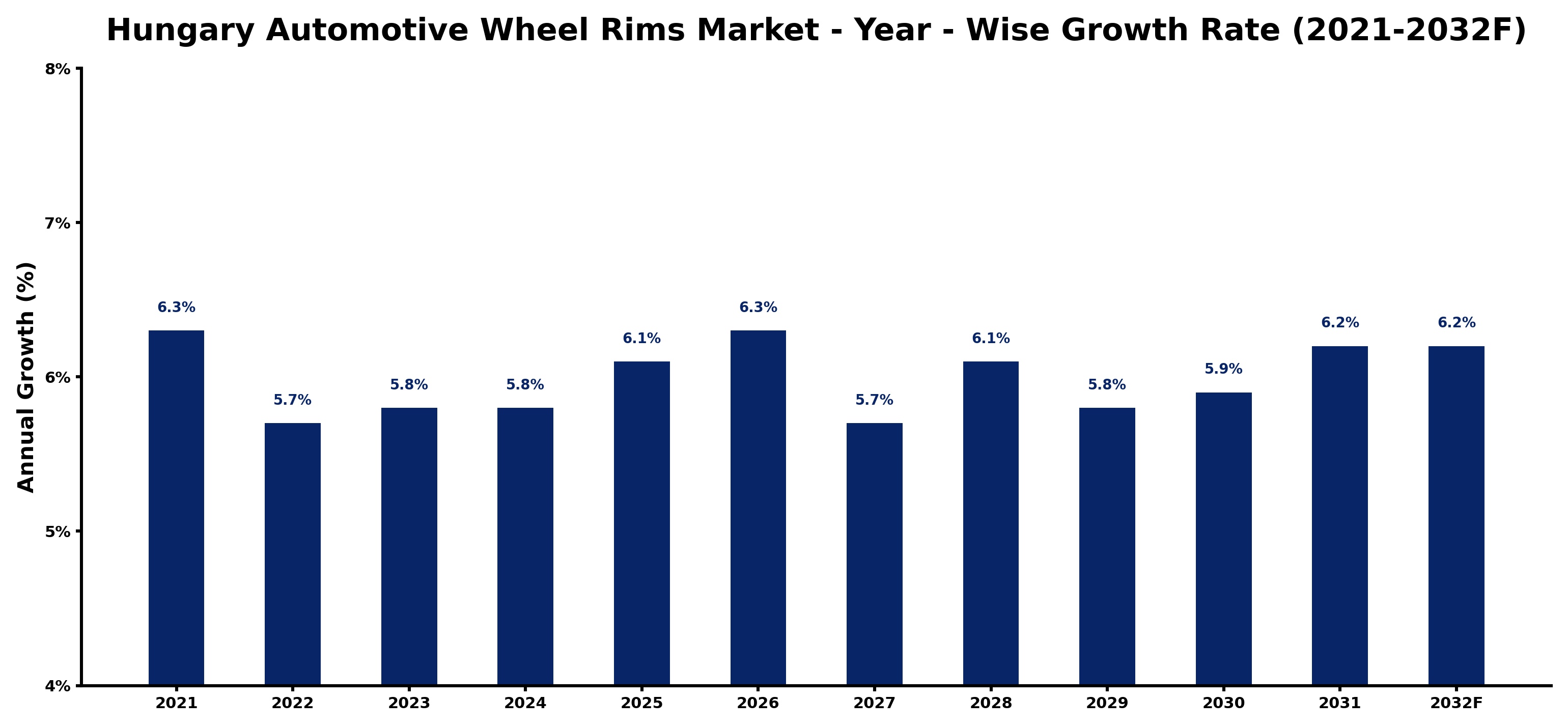
The table below presents the year‑wise growth rates along with the key drivers influencing the market
| Year | Growth Rate | Major Drivers |
| 2021 | 6.3% | Increased vehicle production demand |
| 2022 | 5.7% | Rising consumer preference for customization |
| 2023 | 5.8% | Technological advancements in manufacturing |
| 2024 | 5.8% | Growing electric vehicle market adoption |
| 2025 | 6.1% | Enhanced alloy materials usage growth |
| 2026 | 6.3% | Expansion of aftermarket services availability |
| 2027 | 5.7% | Sustainability trends driving innovation |
| 2028 | 6.1% | Increased focus on lightweight designs |
| 2029 | 5.8% | Rising automotive safety standards influence |
| 2030 | 5.9% | Growth in automotive exports observed |
| 2031 | 6.2% | Urbanization boosting vehicle ownership rates |
| 2032 | 6.2% | Emerging markets expanding consumer base |
Note - Market size estimations and growth projections presented in this report are based on 6Wresearch’s advanced forecasting approach, validated with industry datasets as of June 2026.
Hungary Automotive Wheel Rims Market Synopsis
The primary force currently shaping the Hungary Automotive Wheel Rims Market is the shift towards lightweight materials aimed at improving fuel efficiency. As vehicle manufacturers focus on reducing overall vehicle weight, the demand for advanced, lightweight wheel rim technologies is rapidly increasing, which is critical for both performance and environmental impact.
Another significant factor is the growing aftermarket segment, where consumers are seeking customization options that enhance the aesthetics of their vehicles. This trend is pushing manufacturers to innovate with unique designs and finishes, thereby expanding the market's diversity and appeal.
Hungary Automotive Wheel Rims Market Key Takeaways
- The market is experiencing steady growth, driven by rising disposable incomes and demand for fuel-efficient vehicles.
- Lightweight alloy wheel rims are gaining traction due to their performance advantages and aesthetic appeal.
- Customization options are becoming increasingly important for consumers, encouraging innovation among manufacturers.
- Advanced manufacturing technologies are emerging, including flow forming and rotary forging for enhanced durability.
- Government incentives are stimulating investments and research in the automotive sector, positively impacting the market.
Evaluation of Restraints in Hungary Automotive Wheel Rims Market
Despite the growth potential, the Hungary Automotive Wheel Rims Market faces several restraints. Intense competition among domestic and international manufacturers can lead to price wars, affecting profit margins. Additionally, fluctuating raw material prices often complicate production cost management. The ongoing regulatory changes regarding emissions and vehicle safety necessitate constant innovation and investment. These factors collectively require manufacturers to remain agile and proactive in navigating market dynamics to sustain their competitive edge.
Hungary Automotive Wheel Rims Market Trends
There is a notable trend towards the adoption of eco-friendly materials in the production of automotive wheel rims, driven by growing environmental consciousness among consumers. As manufacturers strive to meet sustainability goals, they are increasingly developing recyclable and sustainable wheel rim options. Additionally, the rise of smart technologies is influencing market dynamics, with manufacturers exploring the integration of sensors for real-time monitoring of tire performance.
Moreover, the popularity of alloy wheel rims continues to surge, not only for their performance benefits but also for their ability to enhance a vehicle's appearance. This dual demand is encouraging manufacturers to explore innovative designs and finishes, aligning with consumer desires for personalization and style.
Hungary Automotive Wheel Rims Market Opportunities
The Hungary Automotive Wheel Rims Market is rich with investment opportunities, particularly in the domain of lightweight alloy wheel rim production. With the automotive industry focusing on fuel efficiency, there is a strong potential for businesses that can provide advanced, lightweight solutions. The aftermarket segment also offers significant avenues for growth, especially for companies specializing in customized and unique wheel rim designs. Additionally, investing in smart wheel technologies can position companies advantageously as the demand for innovative automotive solutions continues to rise.
Government Initiatives in the Hungary Automotive Wheel Rims Market
The Hungarian government has enacted several initiatives to bolster the Automotive Wheel Rims Market. These include regulations aimed at enhancing environmental standards and safety measures for automotive components. Furthermore, the government provides incentives for foreign investments, such as tax breaks and subsidies, to foster domestic manufacturing and improve export competitiveness. Policies that promote research and development in the automotive sector are also in place, encouraging collaboration between industry players and academic institutions to drive innovation.
Future Insights of the Hungary Automotive Wheel Rims Market
Looking ahead, the Hungary Automotive Wheel Rims Market is positioned for consistent growth from 2026 to 2032. The increasing production of vehicles, coupled with rising disposable income levels and demand for vehicle customization, is expected to sustain this upward trajectory. As manufacturers invest in innovative materials and manufacturing processes, the market will likely see new designs that align with trends in lightweight and fuel-efficient vehicles. However, stakeholders must remain vigilant regarding fluctuating raw material costs and evolving regulations, as these factors could influence market dynamics in the future.
Hungary Automotive Wheel Rims Market Latest Developments (May 2025 - June 2026)
Recent developments in the Hungary Automotive Wheel Rims Market indicate a strong focus on sustainability and innovation. Manufacturers are increasingly adopting environmentally friendly practices in their production processes. Additionally, there is a growing trend toward enhancing product offerings with smart technology, such as integrating sensors for tire performance monitoring. This focus on innovation is likely to reshape product lines and customer engagement strategies across the industry.
Hungary Automotive Wheel Rims Market - Key Attractiveness of the Report
- 10 Years of Market Numbers
- Historical Data Starting from 2022 to 2025
- Base Year: 2025
- Forecast Data until 2032
- Key Performance Indicators Impacting the Market
- Major Upcoming Developments and Projects
Key Highlights of the Report:
- Hungary Automotive Wheel Rims Market Outlook
- Market Size of Hungary Automotive Wheel Rims Market, 2025
- Forecast of Hungary Automotive Wheel Rims Market, 2032
- Historical Data and Forecast of Hungary Automotive Wheel Rims Revenues & Volume for the Period 2022-2032F
- Hungary Automotive Wheel Rims Market Trend Evolution
- Hungary Automotive Wheel Rims Market Drivers and Challenges
- Hungary Automotive Wheel Rims Price Trends
- Hungary Automotive Wheel Rims Porter's Five Forces
- Hungary Automotive Wheel Rims Industry Life Cycle
- Historical Data and Forecast of Hungary Automotive Wheel Rims Market Revenues & Volume By Material Type for the Period 2022-2032F
- Historical Data and Forecast of Hungary Automotive Wheel Rims Market Revenues & Volume By Alloy for the Period 2022-2032F
- Historical Data and Forecast of Hungary Automotive Wheel Rims Market Revenues & Volume By Steel for the Period 2022-2032F
- Historical Data and Forecast of Hungary Automotive Wheel Rims Market Revenues & Volume By Carbon Fiber for the Period 2022-2032F
- Historical Data and Forecast of Hungary Automotive Wheel Rims Market Revenues & Volume By Sales Channel for the Period 2022-2032F
- Historical Data and Forecast of Hungary Automotive Wheel Rims Market Revenues & Volume By OEM for the Period 2022-2032F
- Historical Data and Forecast of Hungary Automotive Wheel Rims Market Revenues & Volume By Aftermarket for the Period 2022-2032F
- Historical Data and Forecast of Hungary Automotive Wheel Rims Market Revenues & Volume By Vehicle Type for the Period 2022-2032F
- Historical Data and Forecast of Hungary Automotive Wheel Rims Market Revenues & Volume By Passenger Cars for the Period 2022-2032F
- Historical Data and Forecast of Hungary Automotive Wheel Rims Market Revenues & Volume By Commercial Vehicles for the Period 2022-2032F
- Hungary Automotive Wheel Rims Import Export Trade Statistics
- Market Opportunity Assessment By Material Type
- Market Opportunity Assessment By Sales Channel
- Market Opportunity Assessment By Vehicle Type
- Hungary Automotive Wheel Rims Top Companies Market Share
- Hungary Automotive Wheel Rims Competitive Benchmarking By Technical and Operational Parameters
- Hungary Automotive Wheel Rims Company Profiles
- Hungary Automotive Wheel Rims Key Strategic Recommendations






































