Hungary Calcined Petroleum Coke Market: Import Trend Analysis
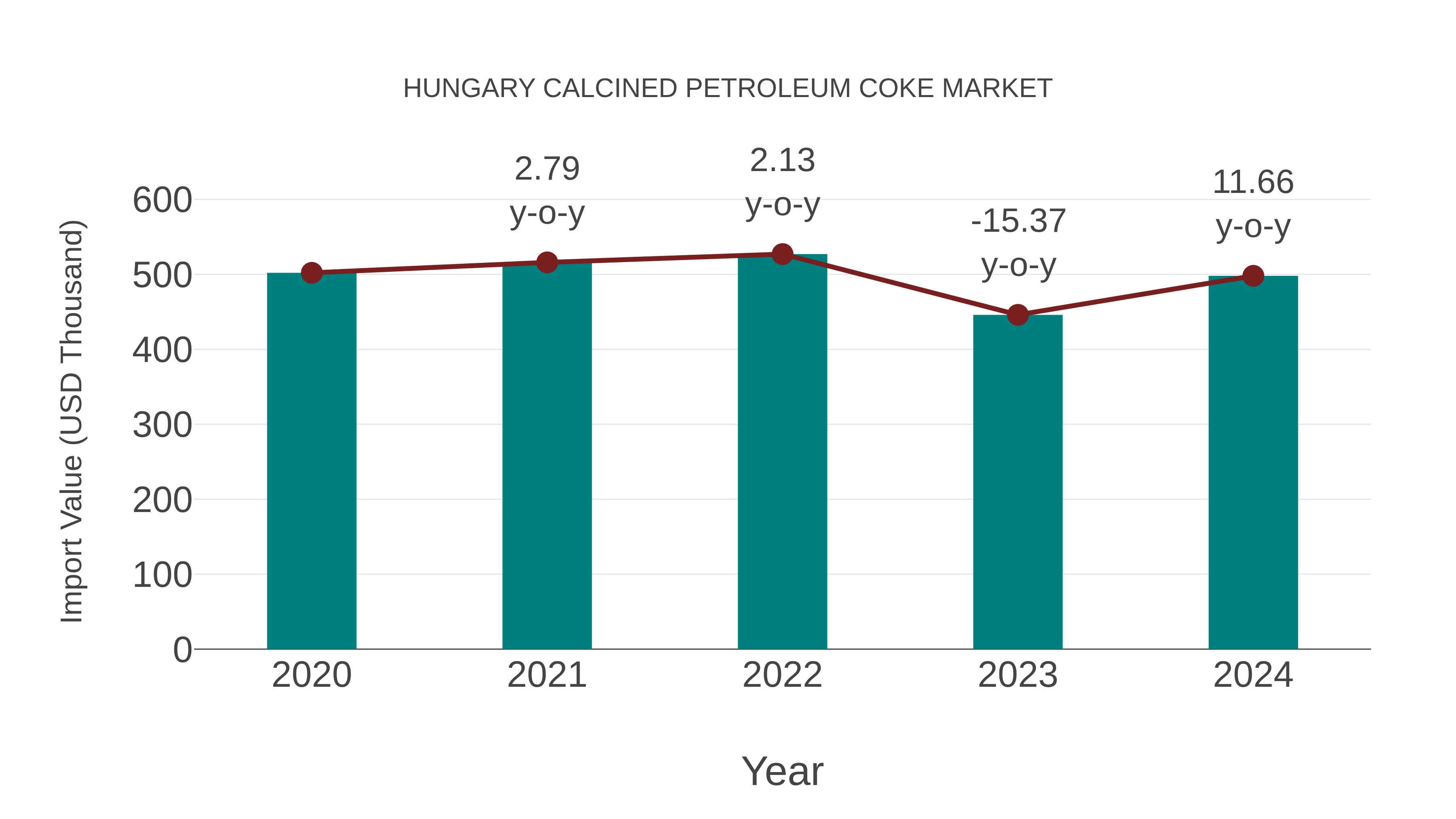
In the Hungary calcined petroleum coke market, the import trend showed a growth rate of 11.66% from 2023 to 2024, while the compound annual growth rate (CAGR) for 2020-2024 was -0.2%. This shift in momentum could be attributed to changes in demand dynamics or evolving trade policies impacting market stability.
Calcined Petroleum Coke Market: Hungary vs Top 5 Major Economies in 2027 (Europe)
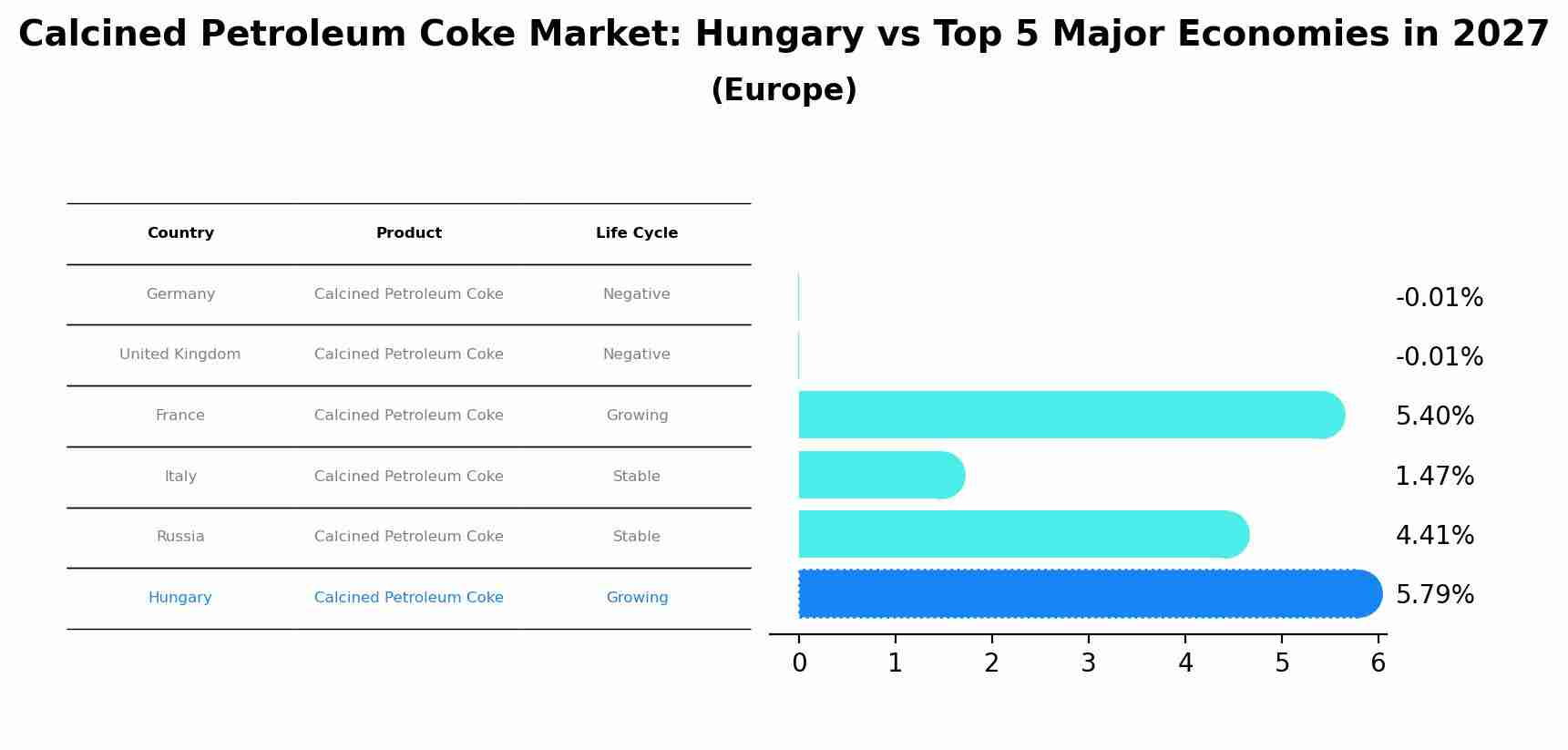
Hungary's Calcined Petroleum Coke market is anticipated to experience a growing growth rate of 5.79% by 2027, reflecting trends observed in the largest economy Germany, followed by United Kingdom, France, Italy and Russia.
Hungary Calcined Petroleum Coke Market Overview
The calcined petroleum coke market in Hungary is influenced by factors such as industrialization, infrastructure development, and the demand from sectors like aluminum production and steel manufacturing. As a key raw material in various industrial processes, calcined petroleum coke plays a crucial role in driving economic growth. Market players are closely monitoring regulatory developments and investing in technological advancements to ensure sustainable production practices and meet environmental standards.
Drivers of the market
The Hungary Calcined Petroleum Coke market is witnessing growth driven by the expanding industrial sector and increasing demand for raw materials in various manufacturing processes. Calcined Petroleum Coke is extensively used as a carbon additive in the production of aluminum, steel, and other metals. With the growing construction and automotive industries in Hungary, there is a rising demand for aluminum and steel products, thereby driving the need for calcined petroleum coke as a crucial input material. Additionally, the favorable properties of calcined petroleum coke, such as high carbon content and low impurities, make it ideal for use in metallurgical applications, further stimulating market growth.
Challenges of the market
The Hungary calcined petroleum coke market faces various challenges amid economic uncertainties and evolving industry dynamics. Fluctuations in crude oil prices and supply chain disruptions impact the availability and cost of raw materials for calcined petroleum coke production, affecting profit margins and market competitiveness. Moreover, environmental regulations and sustainability initiatives necessitate investments in cleaner production technologies and emission control measures, adding to production costs. Additionally, competition from alternative carbon sources and synthetic graphite substitutes poses a challenge for market players to maintain their market position and profitability.
Government Policy of the market
In Hungary, the calcined petroleum coke market is subject to regulations governing energy production, environmental protection, and industrial emissions. Government policies aim to balance the economic benefits of petroleum coke utilization with environmental concerns related to air quality and carbon emissions. Emission standards, waste management regulations, and pollution control measures may affect the production, storage, and transportation of calcined petroleum coke. Investments in cleaner technologies, carbon capture, and renewable energy sources may be incentivized to reduce the environmental footprint of the petroleum coke industry and promote sustainable development.
Key Highlights of the Report:
- Hungary Calcined Petroleum Coke Market Outlook
- Market Size of Hungary Calcined Petroleum Coke Market, 2025
- Forecast of Hungary Calcined Petroleum Coke Market, 2032
- Historical Data and Forecast of Hungary Calcined Petroleum Coke Revenues & Volume for the Period 2022-2032F
- Hungary Calcined Petroleum Coke Market Trend Evolution
- Hungary Calcined Petroleum Coke Market Drivers and Challenges
- Hungary Calcined Petroleum Coke Price Trends
- Hungary Calcined Petroleum Coke Porter's Five Forces
- Hungary Calcined Petroleum Coke Industry Life Cycle
- Historical Data and Forecast of Hungary Calcined Petroleum Coke Market Revenues & Volume By Type for the Period 2022-2032F
- Historical Data and Forecast of Hungary Calcined Petroleum Coke Market Revenues & Volume By Anode Grade for the Period 2022-2032F
- Historical Data and Forecast of Hungary Calcined Petroleum Coke Market Revenues & Volume By Needle Grade for the Period 2022-2032F
- Historical Data and Forecast of Hungary Calcined Petroleum Coke Market Revenues & Volume By for the Period 2022-2032F
- Historical Data and Forecast of Hungary Calcined Petroleum Coke Market Revenues & Volume By End-user for the Period 2022-2032F
- Historical Data and Forecast of Hungary Calcined Petroleum Coke Market Revenues & Volume By Carburizing & Recarburizing for the Period 2022-2032F
- Historical Data and Forecast of Hungary Calcined Petroleum Coke Market Revenues & Volume By Electric Arc & Induction Furnaces for the Period 2022-2032F
- Historical Data and Forecast of Hungary Calcined Petroleum Coke Market Revenues & Volume By Others for the Period 2022-2032F
- Hungary Calcined Petroleum Coke Import Export Trade Statistics
- Market Opportunity Assessment By Type
- Market Opportunity Assessment By End-user
- Hungary Calcined Petroleum Coke Top Companies Market Share
- Hungary Calcined Petroleum Coke Competitive Benchmarking By Technical and Operational Parameters
- Hungary Calcined Petroleum Coke Company Profiles
- Hungary Calcined Petroleum Coke Key Strategic Recommendations






































