Hungary Decorative tile Market Summary
The hungary decorative tile market was estimated at USD 203 Million in 2025 and is projected to reach USD 277 Million by 2032, growing at a CAGR of 5.1% from 2026 to 2032.
Hungary Decorative tile Market Year-wise Growth Rate and Key Drivers
This graph highlights how the Hungary Decorative tile Market has steadily grown over the past five years, supported by major growth factors.
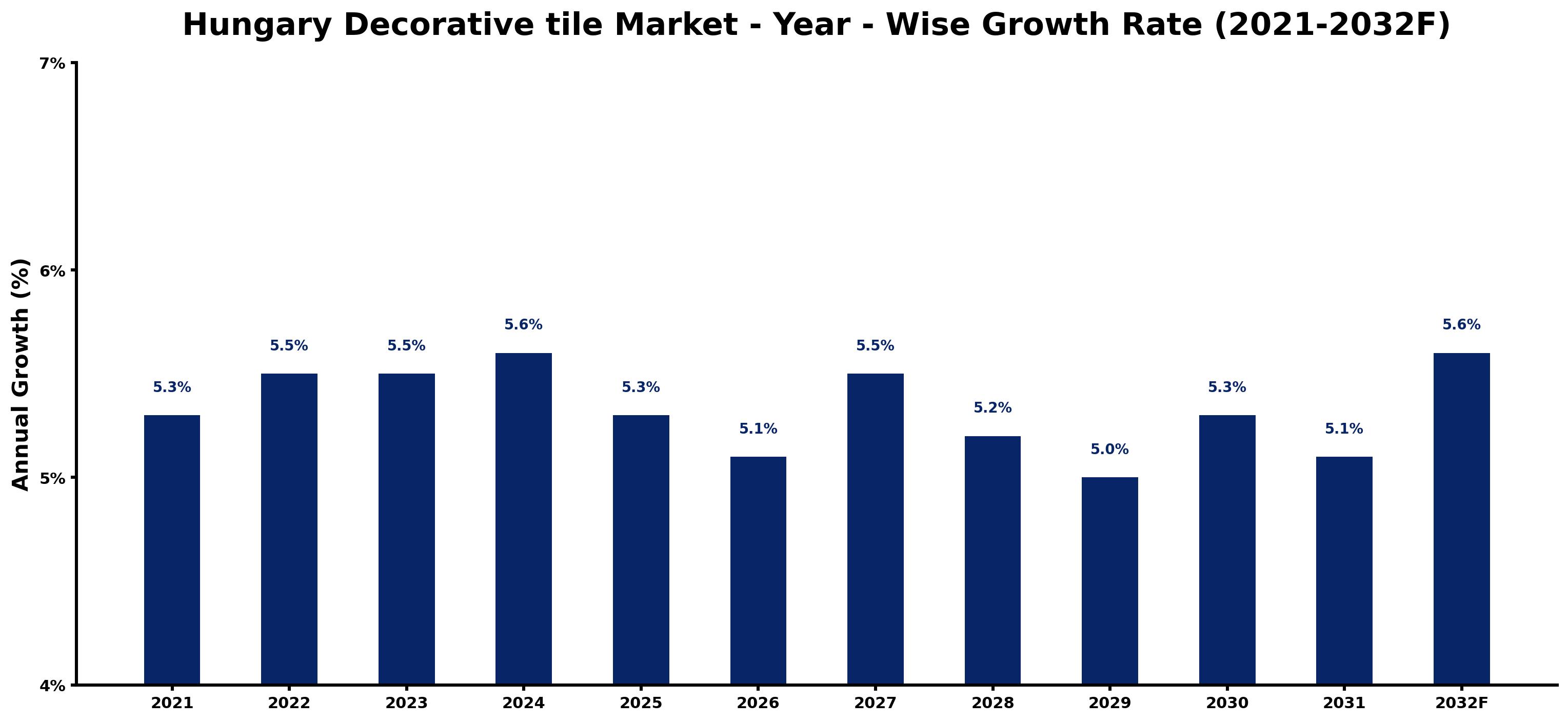
The table below presents the year wise growth rates along with the key drivers influencing the market
| Year | Growth Rate | Major Drivers |
| 2021 | 5.3% | Post-lockdown retail projects sparked renewed interest in home renovation trends. |
| 2022 | 5.5% | A burgeoning real estate sector emphasized aesthetic enhancements in interior spaces. |
| 2023 | 5.5% | Increasing tourism in Hungary fueled demand for decorative tiles in hospitality projects. |
| 2024 | 5.6% | Sustainable materials gained traction, influencing design preferences among consumers. |
| 2025 | 5.3% | Local artisans reemerged, promoting unique, handcrafted tiles with cultural significance. |
| 2026 | 5.1% | Homeowners focused on energy efficiency, impacting tile choices for thermal insulation. |
| 2027 | 5.5% | Urbanization trends led to smaller living spaces, necessitating innovative tile designs. |
| 2028 | 5.2% | E-commerce platforms expanded, making decorative tiles more accessible to consumers. |
| 2029 | 5.0% | Architectural firms increasingly sought partnerships with tile manufacturers for bespoke designs. |
| 2030 | 5.3% | Technological advancements in tile production introduced smart tiles with integrated functionalities. |
| 2031 | 5.1% | Green building certifications became mainstream, promoting eco-friendly tile options. |
| 2032 | 5.6% | Cultural festivals highlighted local craftsmanship, significantly boosting decorative tile sales. |
Note - Market size estimations and growth projections presented in this report are based on 6Wresearch's advanced forecasting approach, validated with industry datasets as of June 2026.
Hungary Decorative tile Market Synopsis
The Hungary Decorative tile Market is projected to reach 5.1% and witness significant growth during the forecast period (2026-2032). This market is characterized by an increasing inclination towards aesthetically appealing interior designs among homeowners and businesses alike. The incorporation of decorative tiles into various spaces is becoming a popular trend, offering both style and uniqueness. The market encompasses a diverse variety of tile options, including ceramic, porcelain, glass, and mosaic tiles, available in numerous patterns, colors, and sizes to meet diverse consumer preferences.
Hungary Decorative tile Market Growth Drivers
Several factors contribute to the growth of the Hungary Decorative tile Market. The rise in disposable income among consumers supports the willingness to invest in home improvements and renovations, driving demand for decorative tiles. Moreover, the booming construction industry plays a crucial role, as these tiles are extensively used across residential, commercial, and institutional projects.
- Homeowners are increasingly opting for decorative tiles to create stylish interior spaces, leading to an uptick in sales.
- Businesses are investing in aesthetic upgrades, making decorative tiles a favored choice for commercial properties such as restaurants and hotels.
- The trend of sustainable living promotes the use of eco-friendly tiles, thus enhancing market appeal.
- Technological advancements, such as digital printing, enable unique and customized tile designs tailored to individual consumer preferences.
- Large format tiles are gaining popularity, providing a modern and seamless feel that appeals to contemporary buyers.
Hungary Decorative tile Market Trends and Opportunities
The Hungary Decorative tile Market is currently witnessing trends that reflect the changing tastes of consumers. A clear shift towards modern and minimalist designs is observed, characterized by a preference for geometric patterns, matte finishes, and neutral color palettes. This evolution in consumer choice presents various opportunities for market players.
- The demand for recycled and ethically sourced materials is on the rise, which can drive innovation in product development.
- Expanded offerings of customizable tile designs allow consumers to personalize their spaces, enhancing market attractiveness.
- Investments in digital technologies facilitate faster design and manufacturing processes, which can lead to increased competitiveness.
- Collaboration with interior designers can help brands tap into high-end markets, delivering unique tile solutions.
- Education and awareness campaigns regarding sustainable materials can foster consumer interest and drive sales.
Hungary Decorative tile Market Challenges and Restraints
While the Hungary Decorative tile Market shows considerable promise, several challenges need to be addressed. Increasing competition poses a significant threat as international manufacturers enter the market, often bringing advanced technologies and cost efficiencies that local players may find difficult to match.
- Fluctuating raw material prices can strain production costs, affecting overall profitability.
- Consumer preferences are evolving rapidly, necessitating quick adaptation from manufacturers.
- Economic uncertainties can lead to reduced construction activity, directly impacting tile demand.
- Changing regulations and local standards can create complexities in production and market entry for new entities.
- An overreliance on traditional styles may hinder the ability to capture emerging market segments seeking modern aesthetics.
Hungary Decorative tile Market Investment Opportunities
The Hungary Decorative tile Market presents various investment avenues that are propelled by a surge in demand for high-quality tiles. The ongoing focus on interior design and renovation indicates that investors should consider opportunities in manufacturing, distribution, and retail within this sector.
- Investing in technology-driven manufacturing can enhance product offerings and operational efficiency.
- Expanding distribution networks can help tap into both urban and rural consumer bases eager for stylish tiles.
- Developing eco-friendly tiles aligns with consumer preferences, presenting an avenue for sustainable profit.
- Exploring partnerships with design firms can lead to innovative solutions and expanded market reach.
- Recognizing the growing demand for decorative tiles in commercial projects can guide strategic investment decisions.
Hungary Decorative tile Market Government Investment and Initiatives
Government policies in Hungary play a pivotal role in shaping the decorative tile market landscape. Efforts aimed at promoting sustainable development and maintaining high-quality standards directly influence market dynamics. The government has instituted various regulations to ensure that decorative tiles comply with safety and environmental guidelines.
- Initiatives designed to support local production of decorative tiles contribute to the enhancement of industry competitiveness.
- Tax incentives encourage businesses to adopt eco-friendly manufacturing processes, supporting sustainability in the tile industry.
- Funding for research and development in new materials and technologies serves to foster innovation among manufacturers.
- Public spending on infrastructure projects indirectly boosts tile demand within the residential and commercial sectors.
- Collaboration with industry stakeholders ensures that government policies are in sync with market needs, promoting effective growth.
Hungary Decorative tile Market Latest Developments (May 2025 - June 2026)
Recent developments in the Hungary Decorative tile Market reflect a dynamic shift towards sustainability and innovative design. Companies have increasingly focused on integrating eco-friendly practices within their manufacturing processes, responding to consumer demand for more sustainable options. Additionally, the emergence of advanced printing technology has allowed for more intricate patterns and designs, appealing to a broader audience seeking customization.
- The rise of online retail platforms has enhanced accessibility for consumers, broadening the market reach.
- Collaborations between manufacturers and design firms have led to the development of unique product lines tailored to specific market trends.
- Heightened competition has prompted existing players to innovate, ensuring a focus on quality and differentiation.
- Market research has identified an increasing consumer preference for larger tile formats, promoting product line expansions.
- Educational initiatives aimed at informing consumers about the benefits of decorative tiles have gained traction, enhancing market engagement.
Hungary Decorative tile Market - Key Attractiveness of the Report
- 10 Years of Market Numbers
- Historical Data Starting from 2022 to 2025
- Base Year: 2025
- Forecast Data until 2032
- Key Performance Indicators Impacting the Market
- Major Upcoming Developments and Projects
Key Highlights of the Report:
- Hungary Decorative tile Market Outlook
- Market Size of Hungary Decorative tile Market, 2025
- Forecast of Hungary Decorative tile Market, 2032F
- Historical Data and Forecast of Hungary Decorative tile Revenues & Volume for the Period 2022-2032F
- Hungary Decorative tile Market Trend Evolution
- Hungary Decorative tile Market Drivers and Challenges
- Hungary Decorative tile Price Trends
- Hungary Decorative tile Porter's Five Forces
- Hungary Decorative tile Industry Life Cycle
- Historical Data and Forecast of Hungary Decorative tile Market Revenues & Volume By Type for the Period 2022-2032F
- Historical Data and Forecast of Hungary Decorative tile Market Revenues & Volume By Ceramic Wall Tiles for the Period 2022-2032F
- Historical Data and Forecast of Hungary Decorative tile Market Revenues & Volume By Vinyl Wall Tiles for the Period 2022-2032F
- Historical Data and Forecast of Hungary Decorative tile Market Revenues & Volume By Stone Wall Tiles for the Period 2022-2032F
- Historical Data and Forecast of Hungary Decorative tile Market Revenues & Volume By Other Types for the Period 2022-2032F
- Historical Data and Forecast of Hungary Decorative tile Market Revenues & Volume By End-users for the Period 2022-2032F
- Historical Data and Forecast of Hungary Decorative tile Market Revenues & Volume By Residential for the Period 2022-2032F
- Historical Data and Forecast of Hungary Decorative tile Market Revenues & Volume By Commercial for the Period 2022-2032F
- Historical Data and Forecast of Hungary Decorative tile Market Revenues & Volume By Application for the Period 2022-2032F
- Historical Data and Forecast of Hungary Decorative tile Market Revenues & Volume By Flooring for the Period 2022-2032F
- Historical Data and Forecast of Hungary Decorative tile Market Revenues & Volume By Wall Coverings for the Period 2022-2032F
- Historical Data and Forecast of Hungary Decorative tile Market Revenues & Volume By Other Applications for the Period 2022-2032F
- Hungary Decorative tile Import Export Trade Statistics
- Market Opportunity Assessment By Type
- Market Opportunity Assessment By End-users
- Market Opportunity Assessment By Application
- Hungary Decorative tile Top Companies Market Share
- Hungary Decorative tile Competitive Benchmarking By Technical and Operational Parameters
- Hungary Decorative tile Company Profiles
- Hungary Decorative tile Key Strategic Recommendations






































