Hungary Fatty Alcohol Market Size (2020-2030)
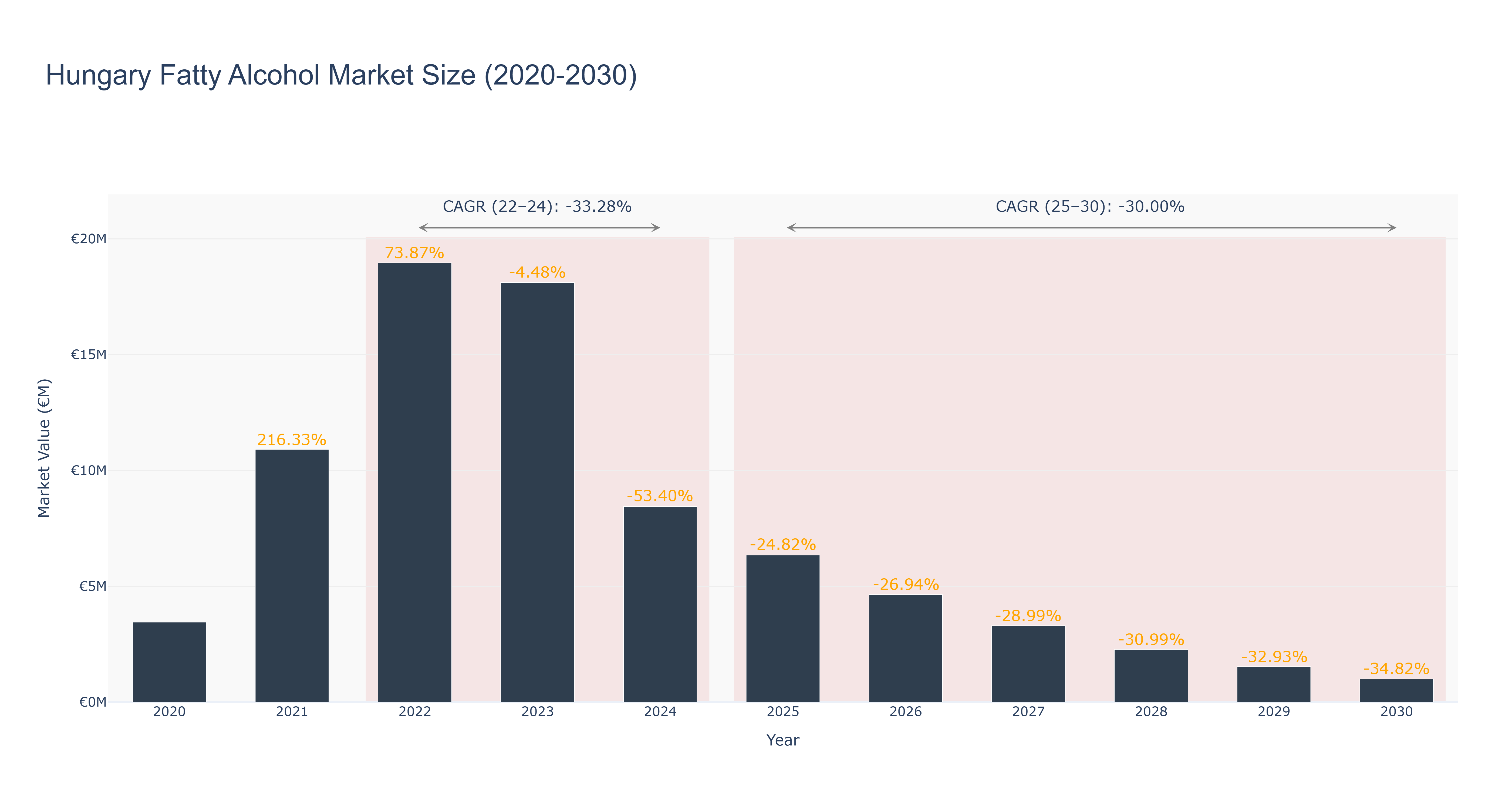
Hungary Fatty Alcohol Market experienced a peak market size of €18.96 million in 2022. The market size declined steadily from 2020 to 2024, reaching €8.44 million, attributed to a negative growth trend. Forecasted market size from 2025 to 2030 shows a further decrease, with the market expected to be at €0.99 million in 2030. The CAGR for the period 2022-24 was -33.28%, while for 2025-30 it is projected to be -30.0%. The downward trend can be attributed to factors such as changing consumer preferences towards alternative products and economic uncertainties. Recent developments in Hungary's renewable energy sector are expected to impact the fatty alcohol market positively in the coming years, with increased focus on sustainable production methods and eco-friendly products driving market growth.
Hungary Fatty Alcohol Market: Production & Trade Performance (2019-2025)

In the Hungary Fatty Alcohol Market, exports experienced fluctuations over the years, starting at €53.27 thousand in 2019, dropping to €12.35 thousand in 2020, and further declining to €7.95 thousand in 2021 before showing a slight recovery to €22.85 thousand in 2022. However, a sharp decrease was noted in 2023 and 2024, with exports falling to €4.43 thousand and €4.71 thousand, respectively. On the other hand, imports surged from €990.4 thousand in 2019 to €4.81 million in 2020, and dramatically rose to €13.38 million in 2021, and peaked at €18.25 million in 2022. Subsequently, a notable decline was observed in imports to €11.97 million in 2023 and to €2.11 million in 2024. The fluctuations in exports and imports can be attributed to various factors, including changes in global demand, international trade regulations, currency fluctuations, and the competitive landscape of the fatty alcohol market. The decrease in imports in 2024 could be influenced by shifts in consumer preferences towards alternative products or changes in domestic production capabilities in Hungary.
Hungary Fatty Alcohol Market Synopsis
The Hungary Fatty Alcohol Market is experiencing steady growth due to increasing demand from various industries such as personal care, pharmaceuticals, and household products. Fatty alcohols are widely used in the manufacturing of cosmetics, detergents, and pharmaceuticals due to their emollient and surfactant properties. The market is witnessing a rise in demand for natural and sustainable fatty alcohols, driven by consumer preferences for eco-friendly products. Key players in the Hungary Fatty Alcohol Market include Sasol Limited, KLK OLEO, Procter & Gamble, and Kao Corporation. The market is expected to continue its growth trajectory, supported by product innovations, expanding applications, and a growing focus on sustainability in the industry.
Hungary Fatty Alcohol Market Trends
The Hungary Fatty Alcohol Market is experiencing growth driven by increasing demand from various industries such as personal care, pharmaceuticals, and cleaning products. The market is witnessing a shift towards sustainable and eco-friendly fatty alcohols, driven by consumer preferences for natural and environmentally friendly products. Manufacturers are focusing on developing bio-based fatty alcohols to meet the growing demand for green alternatives. Additionally, the rising disposable income and changing lifestyles of consumers in Hungary are fueling the demand for premium personal care products, further boosting the market for fatty alcohols. Key players in the market are investing in research and development activities to innovate and introduce new product formulations to cater to evolving consumer preferences, thereby shaping the future growth trajectory of the Hungary Fatty Alcohol Market.
Hungary Fatty Alcohol Market Challenges
In the Hungary Fatty Alcohol Market, several challenges are faced, including fluctuating raw material prices, increasing competition from imported products, and rising environmental concerns related to the production and usage of fatty alcohols. The market is also impacted by changing consumer preferences towards more sustainable and eco-friendly products, leading to a demand for bio-based alternatives. Additionally, regulatory hurdles and compliance requirements further add complexity to the market landscape, requiring companies to navigate through various standards and regulations. Overall, players in the Hungary Fatty Alcohol Market must adapt to these challenges by innovating their products, optimizing production processes, and enhancing sustainability efforts to stay competitive in the market.
Hungary Fatty Alcohol Market Investment Opportunities
The Hungary fatty alcohol market presents promising investment opportunities due to increasing demand from various end-use industries such as personal care, pharmaceuticals, and industrial applications. With growing consumer awareness towards sustainable and eco-friendly products, there is a rising trend towards the use of natural and renewable ingredients like fatty alcohols. Investors can capitalize on this trend by investing in fatty alcohol production facilities or partnering with existing manufacturers to expand their market presence in Hungary. Additionally, the government`s supportive policies and initiatives aimed at promoting the growth of the chemical industry further enhance the attractiveness of investing in the Hungary fatty alcohol market. Overall, the market offers potential for growth and profitability for investors looking to tap into the burgeoning demand for fatty alcohols in various sectors.
Jordan Agar Market Government Policies
The Hungarian government has implemented various policies to regulate the fatty alcohol market, including setting quality standards, imposing import/export controls, and promoting sustainability practices. The government has strict regulations in place to ensure that fatty alcohols meet safety and quality standards before being released into the market. Additionally, there are measures in place to control the import and export of fatty alcohols to protect domestic producers and maintain market stability. The government also encourages sustainable practices within the industry, such as promoting eco-friendly production processes and supporting renewable sources of raw materials. Overall, these policies aim to ensure the competitiveness, safety, and sustainability of the Hungarian fatty alcohol market.
Hungary Fatty Alcohol Market Future Outlook
The future outlook for the Hungary Fatty Alcohol Market appears promising with anticipated growth driven by increasing demand from the personal care, pharmaceutical, and industrial sectors. The market is expected to witness steady growth due to rising consumer awareness about sustainable and eco-friendly products, leading to a shift towards natural ingredients like fatty alcohols. Additionally, the expanding use of fatty alcohols in various applications such as surfactants, emollients, and lubricants is projected to fuel market growth. Technological advancements in production processes and a focus on product innovation to meet evolving consumer preferences are also likely to contribute to the market`s positive trajectory. Overall, the Hungary Fatty Alcohol Market is poised for growth opportunities in the coming years.
Key Highlights of the Report:
- Hungary Fatty Alcohol Market Outlook
- Market Size of Hungary Fatty Alcohol Market, 2021
- Forecast of Hungary Fatty Alcohol Market, 2031
- Historical Data and Forecast of Hungary Fatty Alcohol Revenues & Volume for the Period 2018 - 2031
- Hungary Fatty Alcohol Market Trend Evolution
- Hungary Fatty Alcohol Market Drivers and Challenges
- Hungary Fatty Alcohol Price Trends
- Hungary Fatty Alcohol Porter's Five Forces
- Hungary Fatty Alcohol Industry Life Cycle
- Historical Data and Forecast of Hungary Fatty Alcohol Market Revenues & Volume By Product for the Period 2018 - 2031
- Historical Data and Forecast of Hungary Fatty Alcohol Market Revenues & Volume By C6-C10 for the Period 2018 - 2031
- Historical Data and Forecast of Hungary Fatty Alcohol Market Revenues & Volume By C11-C14 for the Period 2018 - 2031
- Historical Data and Forecast of Hungary Fatty Alcohol Market Revenues & Volume By C15-C22 for the Period 2018 - 2031
- Historical Data and Forecast of Hungary Fatty Alcohol Market Revenues & Volume By Application for the Period 2018 - 2031
- Historical Data and Forecast of Hungary Fatty Alcohol Market Revenues & Volume By Soaps & Detergents for the Period 2018 - 2031
- Historical Data and Forecast of Hungary Fatty Alcohol Market Revenues & Volume By Personal Care for the Period 2018 - 2031
- Historical Data and Forecast of Hungary Fatty Alcohol Market Revenues & Volume By Lubricants for the Period 2018 - 2031
- Historical Data and Forecast of Hungary Fatty Alcohol Market Revenues & Volume By Amines for the Period 2018 - 2031
- Historical Data and Forecast of Hungary Fatty Alcohol Market Revenues & Volume By Others for the Period 2018 - 2031
- Hungary Fatty Alcohol Import Export Trade Statistics
- Market Opportunity Assessment By Product
- Market Opportunity Assessment By Application
- Hungary Fatty Alcohol Top Companies Market Share
- Hungary Fatty Alcohol Competitive Benchmarking By Technical and Operational Parameters
- Hungary Fatty Alcohol Company Profiles
- Hungary Fatty Alcohol Key Strategic Recommendations






































