Hungary Government Cloud Market Size & Growth Rate (2026-2032)
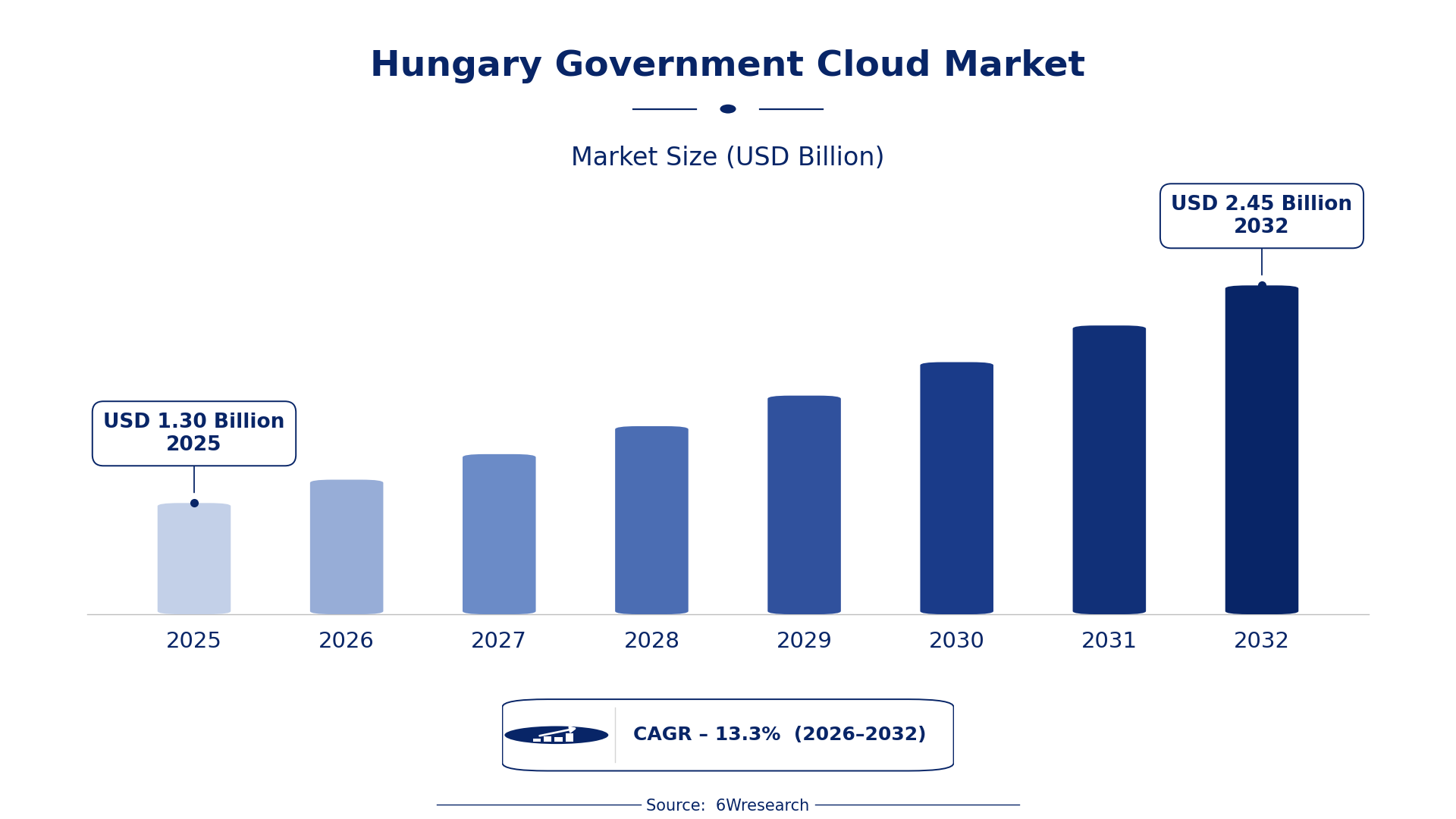
The Hungary Government Cloud Market was estimated at USD 1304 Million in 2025 and is projected to reach USD 2452 Million by 2032, growing at a CAGR of 13.3% from 2026 to 2032.
Hungary Government Cloud Market Synopsis
A critical driver for the Hungary Government Cloud Market is the government’s increasing push for digital transformation. This focus has prompted public agencies to migrate their data and services to cloud platforms, enhancing operational efficiency and improving service delivery to citizens.
As governmental bodies embrace cloud solutions, they are realizing benefits such as cost savings and improved data security. This transition not only supports the modernization of IT infrastructure but also aligns with regulatory compliance needs, setting the stage for a rapidly evolving market.
Hungary Government Cloud Market Year-wise Growth Rate and Key Drivers
This graph illustrates the annual growth rates of the Hungary Government Cloud Market from 2021 to 2032, highlighting a steady upward trajectory and projected expansion over the forecast period.
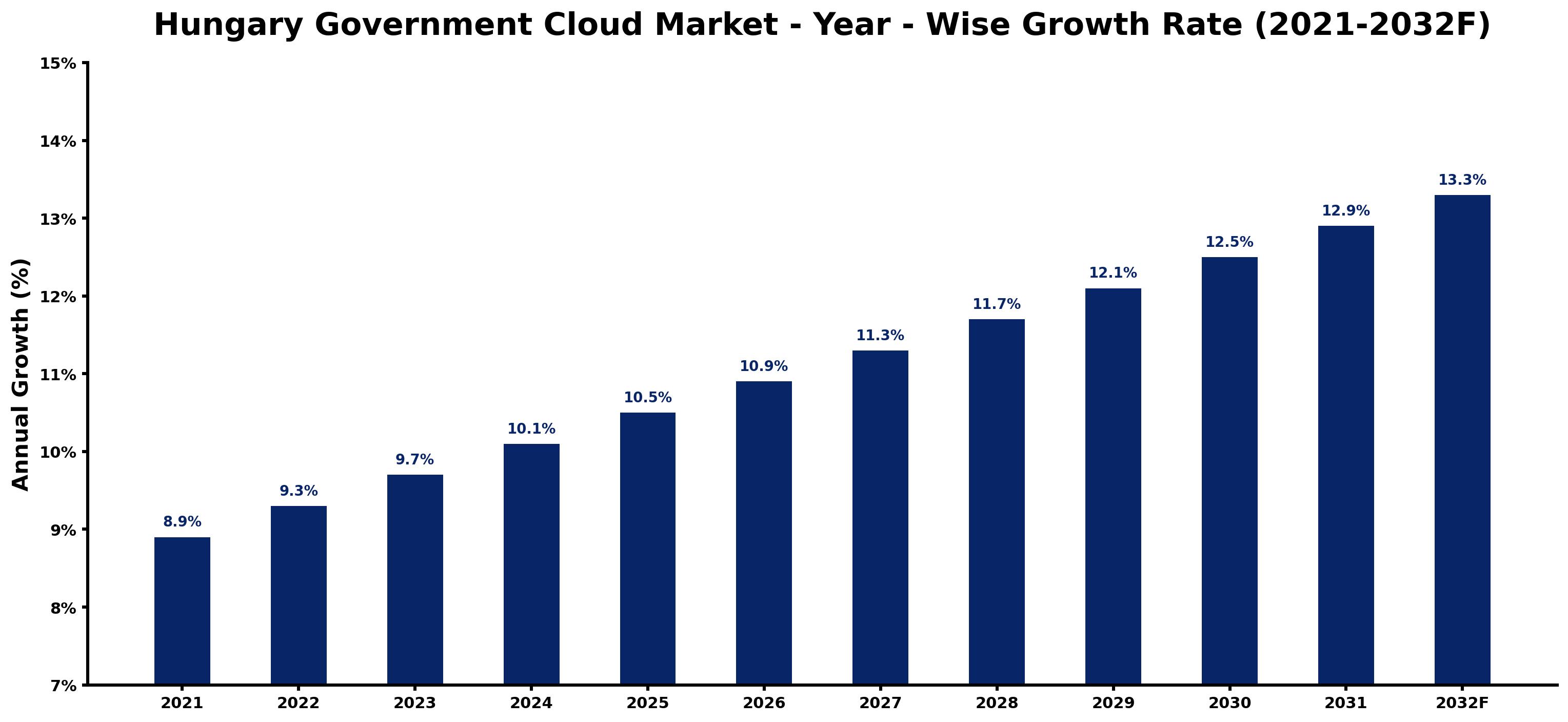
The table below presents the year‑wise growth rates along with the key drivers influencing the market
| Year | Growth Rate | Major Drivers |
| 2021 | 8.9% | Digitalization strategy by Hungarian government initiative. |
| 2022 | 9.3% | Increased funding for public sector IT modernization. |
| 2023 | 9.7% | Adoption of e-government services by municipalities. |
| 2024 | 10.1% | EU recovery funds directed towards cloud infrastructure. |
| 2025 | 10.5% | Enhanced data security regulations driving cloud usage. |
| 2026 | 10.9% | Rise in demand for remote public service delivery. |
| 2027 | 11.3% | Government investment in smart governance technologies. |
| 2028 | 11.7% | Launch of nationwide cloud services training programs. |
| 2029 | 12.1% | Growth in AI projects utilizing government cloud resources. |
| 2030 | 12.5% | New legislation requires public data storage in cloud. |
| 2031 | 12.9% | Increased collaboration with EU on cloud initiatives. |
| 2032 | 13.3% | Rising public awareness of digital service advantages. |
Note: Market size estimations and growth projections presented in this report are based on 6Wresearch's proprietary forecasting methodology, utilizing the latest available industry data, government publications, and primary research inputs.
Hungary Government Cloud Market Key Takeaways
Below are some of the specific key takeaways from the market, including:
- Growing demand for secure cloud solutions is reshaping service delivery in the public sector.
- Government initiatives are driving the adoption of specialized cloud services tailored for public needs.
- Data protection and compliance are paramount, influencing procurement decisions across agencies.
- Investment in cloud-based collaboration tools is rising as remote work becomes more prevalent.
- The market is ripe for innovation, especially in integrating emerging technologies like AI and blockchain.
Evaluation of Restraints in Hungary Government Cloud Market
Despite the promising growth of the Hungary Government Cloud Market, several factors pose challenges. Concerns regarding data sovereignty often deter government agencies from fully embracing cloud technologies. The apprehension about where sensitive data is stored and who can access it creates a barrier to adoption.
Additionally, compliance with complex regulations specific to public sector operations can slow down the migration process. Resistance to change within some government organizations, coupled with a general lack of understanding about cloud benefits, further complicates the landscape.
Hungary Government Cloud Market Trends
The Hungary Government Cloud Market is witnessing a marked trend towards the migration of essential services to cloud platforms. As agencies seek to improve operational efficiency, there’s a growing reliance on cloud-based collaboration tools, especially in light of increased remote working demands.
on top of that, there’s a heightened focus on cybersecurity, with agencies prioritizing secure cloud solutions to protect sensitive information. The integration of emerging technologies such as artificial intelligence and blockchain is also gaining traction, offering opportunities for enhanced transparency and efficiency in government operations.
Hungary Government Cloud Market Opportunities
The Hungary Government Cloud Market presents a range of opportunities for cloud service providers. Tailored solutions that address the specific needs of government agencies can lead to significant growth. As public entities seek to enhance their digital capabilities, the demand for robust cybersecurity measures will also rise.
Investing in emerging technologies like AI and blockchain can further create avenues for innovation. These technologies have the potential to streamline operations and improve service delivery, positioning cloud providers as essential partners in the public sector’s digital transformation journey.
Government Initiatives in the Hungary Government Cloud Market
The Hungarian government is actively shaping the Government Cloud Market through various initiatives aimed at promoting digitalization in public administration. This includes a strategic focus on enhancing efficiency, transparency, and data security across government operations.
- A recently completed initiative involved the introduction of a national digital infrastructure upgrade program to modernize existing IT systems.
- Currently underway is a regulatory framework that mandates compliance with GDPR, ensuring data protection in cloud deployments.
- Planned for the near future is a public-private partnership aimed at expanding access to cloud services for smaller government agencies.
- The government has also launched guidelines to facilitate secure cloud usage among public sector entities.
- Ongoing assessments are being conducted to evaluate the effectiveness of cloud solutions in improving service delivery across various government departments.
Future Insights of the Hungary Government Cloud Market
Looking ahead to 2026-2032, the Hungary Government Cloud Market is set for substantial growth driven by the need for modernization in public services. As agencies increasingly adopt cloud technologies, the focus will shift toward improving data security and disaster recovery capabilities.
The push for cost-effective and scalable solutions will likely encourage further investments in specialized cloud services tailored for the public sector. With government initiatives fostering an environment of innovation, the market will continue to evolve, presenting new opportunities for cloud service providers.
Hungary Government Cloud Market Latest Developments
In the past 12-14 months, the Hungary Government Cloud Market has seen a flurry of activity aimed at enhancing digital services in the public sector. With a strong governmental emphasis on modernization, initiatives to adopt cloud technologies are accelerating.
- A major technology vendor launched a new cloud-based collaboration platform aimed at improving inter-agency communication, completed in Q1 2025.
- Currently ongoing is an initiative focused on upgrading cybersecurity measures across government cloud services, ensuring robust protection against data breaches.
- A planned rollout of a nationwide training program for government employees on cloud technologies is expected to begin in early 2026.
- In mid-2025, a partnership was formed between a leading cloud provider and a government agency to enhance data management practices.
- An ongoing project is assessing the integration of AI tools to streamline administrative tasks within public agencies.
Hungary Government Cloud Market - Key Attractiveness of the Report
- 10 Years of Market Numbers
- Historical Data Starting from 2022 to 2025
- Base Year: 2025
- Forecast Data until 2032
- Key Performance Indicators Impacting the Market
- Major Upcoming Developments and Projects
Key Highlights of the Report:
- Hungary Government Cloud Market Outlook
- Market Size of Hungary Government Cloud Market, 2025
- Forecast of Hungary Government Cloud Market, 2032
- Historical Data and Forecast of Hungary Government Cloud Revenues & Volume for the Period 2022-2032F
- Hungary Government Cloud Market Trend Evolution
- Hungary Government Cloud Market Drivers and Challenges
- Hungary Government Cloud Price Trends
- Hungary Government Cloud Porter's Five Forces
- Hungary Government Cloud Industry Life Cycle
- Historical Data and Forecast of Hungary Government Cloud Market Revenues & Volume By Solutions for the Period 2022-2032F
- Historical Data and Forecast of Hungary Government Cloud Market Revenues & Volume By Cloud Storage for the Period 2022-2032F
- Historical Data and Forecast of Hungary Government Cloud Market Revenues & Volume By Disaster Recovery for the Period 2022-2032F
- Historical Data and Forecast of Hungary Government Cloud Market Revenues & Volume By Identity and Access Management (IAM) for the Period 2022-2032F
- Historical Data and Forecast of Hungary Government Cloud Market Revenues & Volume By Risk and compliance management for the Period 2022-2032F
- Historical Data and Forecast of Hungary Government Cloud Market Revenues & Volume By Others (reporting and analytics, and security and vulnerability) for the Period 2022-2032F
- Historical Data and Forecast of Hungary Government Cloud Market Revenues & Volume By Services for the Period 2022-2032F
- Historical Data and Forecast of Hungary Government Cloud Market Revenues & Volume By Training, consulting, and education for the Period 2022-2032F
- Historical Data and Forecast of Hungary Government Cloud Market Revenues & Volume By Support and Maintenance for the Period 2022-2032F
- Historical Data and Forecast of Hungary Government Cloud Market Revenues & Volume By Integration and Migration for the Period 2022-2032F
- Historical Data and Forecast of Hungary Government Cloud Market Revenues & Volume By Service Model for the Period 2022-2032F
- Historical Data and Forecast of Hungary Government Cloud Market Revenues & Volume By Infrastructure as a Service (IaaS) for the Period 2022-2032F
- Historical Data and Forecast of Hungary Government Cloud Market Revenues & Volume By Platform as a Service (PaaS) for the Period 2022-2032F
- Historical Data and Forecast of Hungary Government Cloud Market Revenues & Volume By Software as a Service (SaaS) for the Period 2022-2032F
- Historical Data and Forecast of Hungary Government Cloud Market Revenues & Volume By Deployment Model for the Period 2022-2032F
- Historical Data and Forecast of Hungary Government Cloud Market Revenues & Volume By Public Cloud for the Period 2022-2032F
- Historical Data and Forecast of Hungary Government Cloud Market Revenues & Volume By Private Cloud for the Period 2022-2032F
- Historical Data and Forecast of Hungary Government Cloud Market Revenues & Volume By Hybrid Cloud for the Period 2022-2032F
- Hungary Government Cloud Import Export Trade Statistics
- Market Opportunity Assessment By Solutions
- Market Opportunity Assessment By Services
- Market Opportunity Assessment By Service Model
- Market Opportunity Assessment By Deployment Model
- Hungary Government Cloud Top Companies Market Share
- Hungary Government Cloud Competitive Benchmarking By Technical and Operational Parameters
- Hungary Government Cloud Company Profiles
- Hungary Government Cloud Key Strategic Recommendations






































