Hungary Higher Education Market Size & Growth Rate (2026-2032)
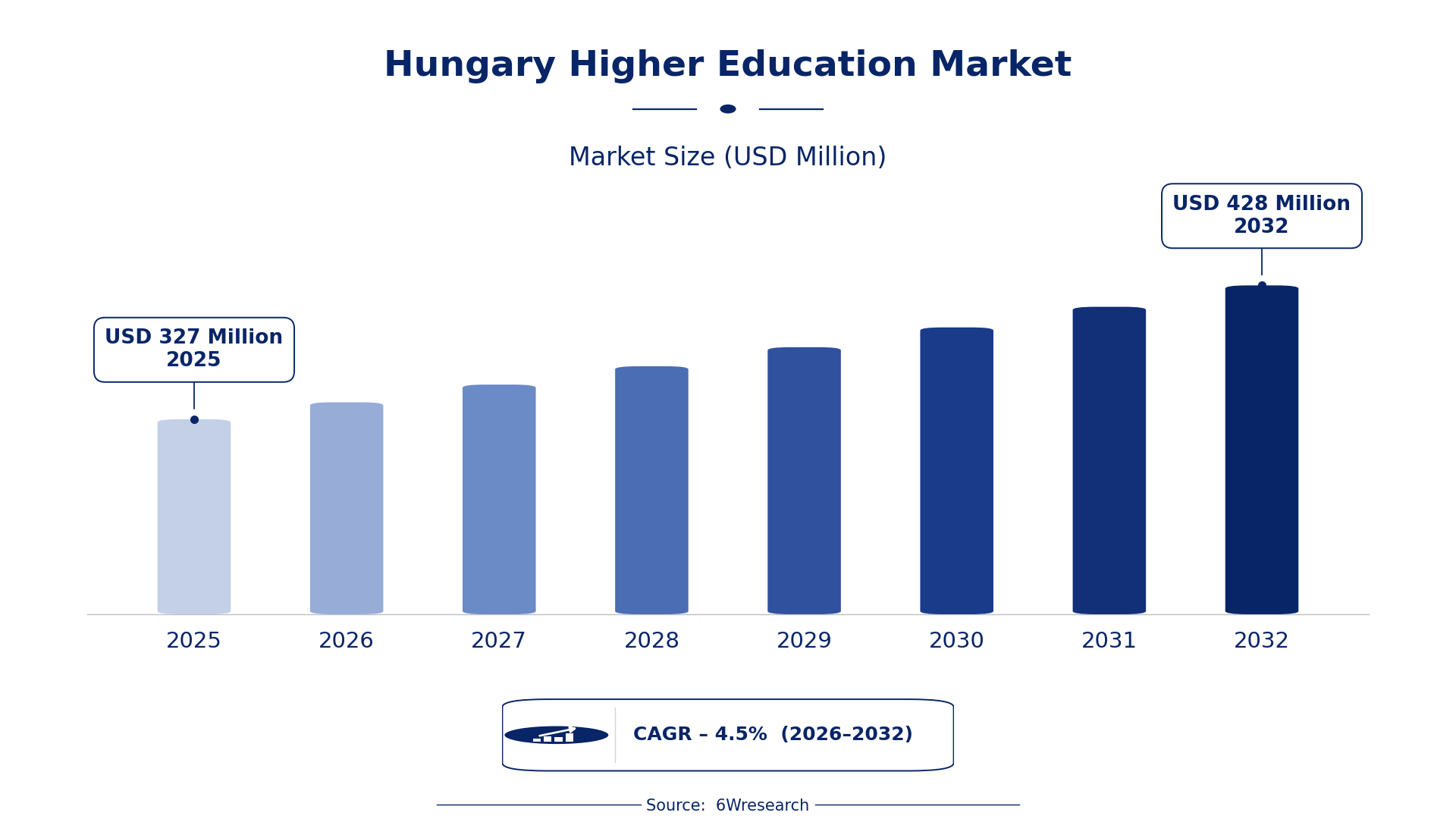
The Hungary Higher Education Market was estimated at USD 327 Million in 2025 and is projected to reach USD 428 Million by 2032, growing at a CAGR of 4.5% from 2026 to 2032.
Hungary Higher Education Market Synopsis
The higher education sector in Hungary is characterized by a strong emphasis on vocational training and research opportunities. Institutions cater to a diverse range of disciplines, from humanities to engineering, ensuring that students gain relevant skills that meet market demands.
Internationalization is a key aspect driving growth in this market. Hungary attracts a considerable number of international students, drawn by its competitive tuition rates and high-quality educational programs. This trend bolsters the reputation of Hungarian institutions globally.
Hungary Higher Education Market Year-wise Growth Rate and Key Drivers
This graph illustrates the annual growth rates of the Hungary Higher Education Market from 2021 to 2032, highlighting a steady upward trajectory and projected expansion over the forecast period.
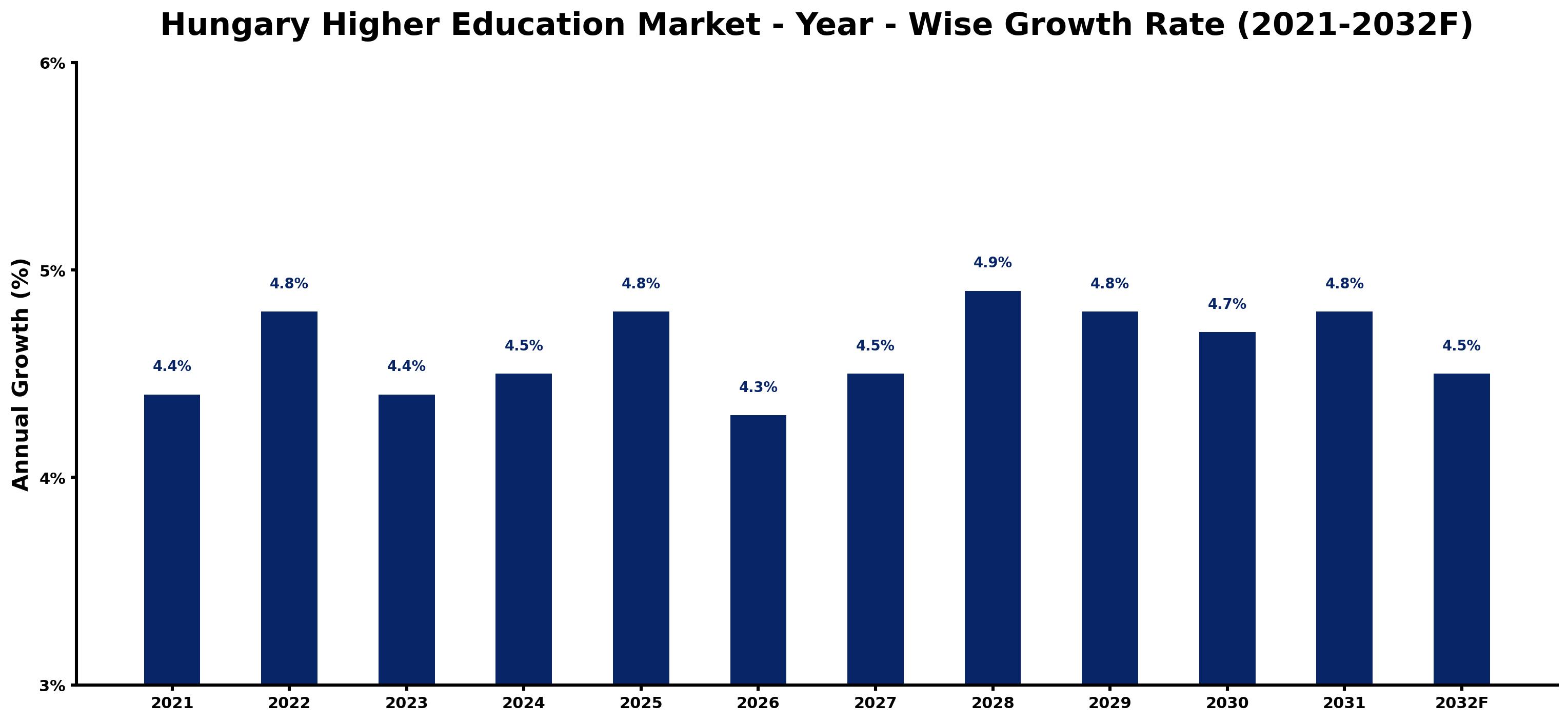
The table below presents the year‑wise growth rates along with the key drivers influencing the market
| Year | Growth Rate | Major Drivers |
| 2021 | 4.4% | Increase in EU funding for higher education initiatives |
| 2022 | 4.8% | Launch of digitalization programs by the Ministry of Education |
| 2023 | 4.4% | Growth in STEM enrollment driven by tech sector demand |
| 2024 | 4.5% | Government grants supporting research and innovation projects |
| 2025 | 4.8% | International collaborations boosting global educational reputation |
| 2026 | 4.3% | Support for dual education models from local businesses |
| 2027 | 4.5% | Rising youth population increasing higher education prospects |
| 2028 | 4.9% | Higher investment in online learning platforms expansion |
| 2029 | 4.8% | Emphasis on lifelong learning initiatives by universities |
| 2030 | 4.7% | Increased scholarship funding for underprivileged students |
| 2031 | 4.8% | Emphasis on interdisciplinary studies reflecting job market needs |
| 2032 | 4.5% | Regional partnerships enhancing skills matching with industries |
Note: Market size estimations and growth projections presented in this report are based on 6Wresearch's proprietary forecasting methodology, utilizing the latest available industry data, government publications, and primary research inputs.
Hungary Higher Education Market Key Takeaways
Below are some of the specific key takeaways from the market, including:
- Robust growth anticipated in the vocational education segment, responding to industry demands for skilled labor.
- International student enrollment is increasing, making Hungary a favorable destination for education.
- Government policies are enhancing funding for universities, fostering innovation and research capabilities.
- Digitalization initiatives are being implemented to modernize curriculum and teaching methods.
- Collaboration between academia and industry is gaining momentum, aimed at aligning educational outcomes with market needs.
Evaluation of Restraints in Hungary Higher Education Market
Despite the positive trends, the Hungary higher education market faces notable restraints. Institutions grapple with budget constraints that limit their ability to innovate and expand programs. Additionally, the need for curriculum relevance is critical, as employers increasingly demand graduates with practical skills. There’s also pressure to maintain inclusivity amidst demographic shifts, ensuring that education is accessible to a broader range of students.
Hungary Higher Education Market Trends
A growing trend in the Hungary higher education market is the increased focus on digital learning platforms. Institutions are adopting blended learning models that combine traditional classroom experiences with online resources. This shift not only enhances learning outcomes but also expands access to education for those in remote areas.
Additionally, partnerships with international universities are becoming more common. Such collaborations enhance the exchange of knowledge, research opportunities, and cultural experiences, further attracting international students.
Hungary Higher Education Market Opportunities
The Hungary higher education market presents numerous growth opportunities. The emphasis on vocational training aligns with labor market needs, providing pathways for students to enter high-demand fields. on top of that, as institutions enhance their research capabilities, there is potential for attracting funding from both domestic and international sources, driving innovation and development.
Government Initiatives in the Hungary Higher Education Market
Government policy is pivotal in shaping the Hungary higher education market. By prioritizing education funding and access, the government seeks to cultivate a skilled workforce that can contribute to national development. Efforts are focused on fostering collaboration between educational institutions and industry, ensuring that the educational offerings remain relevant to market demands.
- A national initiative launched in early 2025 to increase public funding for universities, aimed at enhancing research capabilities.
- Currently ongoing is a student financial aid program designed to improve access and affordability for diverse student populations.
- A regulatory framework introduced in 2025 mandates quality assurance measures for academic programs across all institutions.
- Plans are in place for a public-private partnership expected to enhance technology transfer initiatives by 2028.
- A national digital infrastructure upgrade program is currently underway, focusing on improving online learning resources in higher education.
Future Insights of the Hungary Higher Education Market
Looking ahead to 2026-2032, the Hungary higher education market is expected to evolve significantly. As digitalization continues to permeate educational practices, institutions will likely invest more in technology-driven learning solutions. The focus on vocational education will intensify, aligning curriculum with labor market needs. Collaboration with industry will become increasingly vital, ensuring that graduates possess the skills required in the contemporary workforce.
Hungary Higher Education Market Latest Developments
Recent developments within the Hungary higher education market indicate a strong momentum towards modernization and international collaboration. Institutions are actively seeking partnerships that enhance their global presence and improve academic offerings.
- A major technology vendor launched an online learning platform in early 2025, enhancing access to educational resources for students across Hungary.
- In mid-2025, a leading regional operator announced a partnership with local universities to facilitate research collaborations and internships.
- An initiative aimed at expanding international student recruitment began in late 2025 and remains underway, targeting markets in Asia and Africa.
- A rollout of new vocational training programs is expected to begin in Q3 2026, designed to address specific labor market shortages.
- A national conference on digital transformation in higher education is planned for early 2026, focusing on sharing best practices and innovations.
Hungary Higher Education Market - Key Attractiveness of the Report
- 10 Years of Market Numbers
- Historical Data Starting from 2022 to 2025
- Base Year: 2025
- Forecast Data until 2032
- Key Performance Indicators Impacting the Market
- Major Upcoming Developments and Projects
A focus on digital learning and vocational training is shaping curriculum design, ensuring graduates are equipped with relevant skills for today’s job market.
Key Highlights of the Report:
- Hungary Higher Education Market Outlook
- Market Size of Hungary Higher Education Market, 2025
- Forecast of Hungary Higher Education Market, 2032
- Historical Data and Forecast of Hungary Higher Education Revenues & Volume for the Period 2022-2032F
- Hungary Higher Education Market Trend Evolution
- Hungary Higher Education Market Drivers and Challenges
- Hungary Higher Education Price Trends
- Hungary Higher Education Porter's Five Forces
- Hungary Higher Education Industry Life Cycle
- Historical Data and Forecast of Hungary Higher Education Market Revenues & Volume By Component for the Period 2022-2032F
- Historical Data and Forecast of Hungary Higher Education Market Revenues & Volume By Solutions for the Period 2022-2032F
- Historical Data and Forecast of Hungary Higher Education Market Revenues & Volume By Services for the Period 2022-2032F
- Historical Data and Forecast of Hungary Higher Education Market Revenues & Volume By Deployment Type for the Period 2022-2032F
- Historical Data and Forecast of Hungary Higher Education Market Revenues & Volume By On-premises for the Period 2022-2032F
- Historical Data and Forecast of Hungary Higher Education Market Revenues & Volume By Cloud for the Period 2022-2032F
- Historical Data and Forecast of Hungary Higher Education Market Revenues & Volume By Vertical for the Period 2022-2032F
- Historical Data and Forecast of Hungary Higher Education Market Revenues & Volume By State Universities for the Period 2022-2032F
- Historical Data and Forecast of Hungary Higher Education Market Revenues & Volume By Community Colleges for the Period 2022-2032F
- Historical Data and Forecast of Hungary Higher Education Market Revenues & Volume By Private Colleges for the Period 2022-2032F
- Hungary Higher Education Import Export Trade Statistics
- Market Opportunity Assessment By Component
- Market Opportunity Assessment By Deployment Type
- Market Opportunity Assessment By Vertical
- Hungary Higher Education Top Companies Market Share
- Hungary Higher Education Competitive Benchmarking By Technical and Operational Parameters
- Hungary Higher Education Company Profiles
- Hungary Higher Education Key Strategic Recommendations






































