Hungary Publishing Market Summary
The hungary publishing market was estimated at USD 439 Million in 2025 and is projected to reach USD 589 Million by 2032, growing at a CAGR of 5.1% from 2026 to 2032.
Hungary Publishing Market Year-wise Growth Rate and Key Drivers
This graph highlights how the Hungary Publishing Market has steadily grown over the past five years, supported by major growth factors.
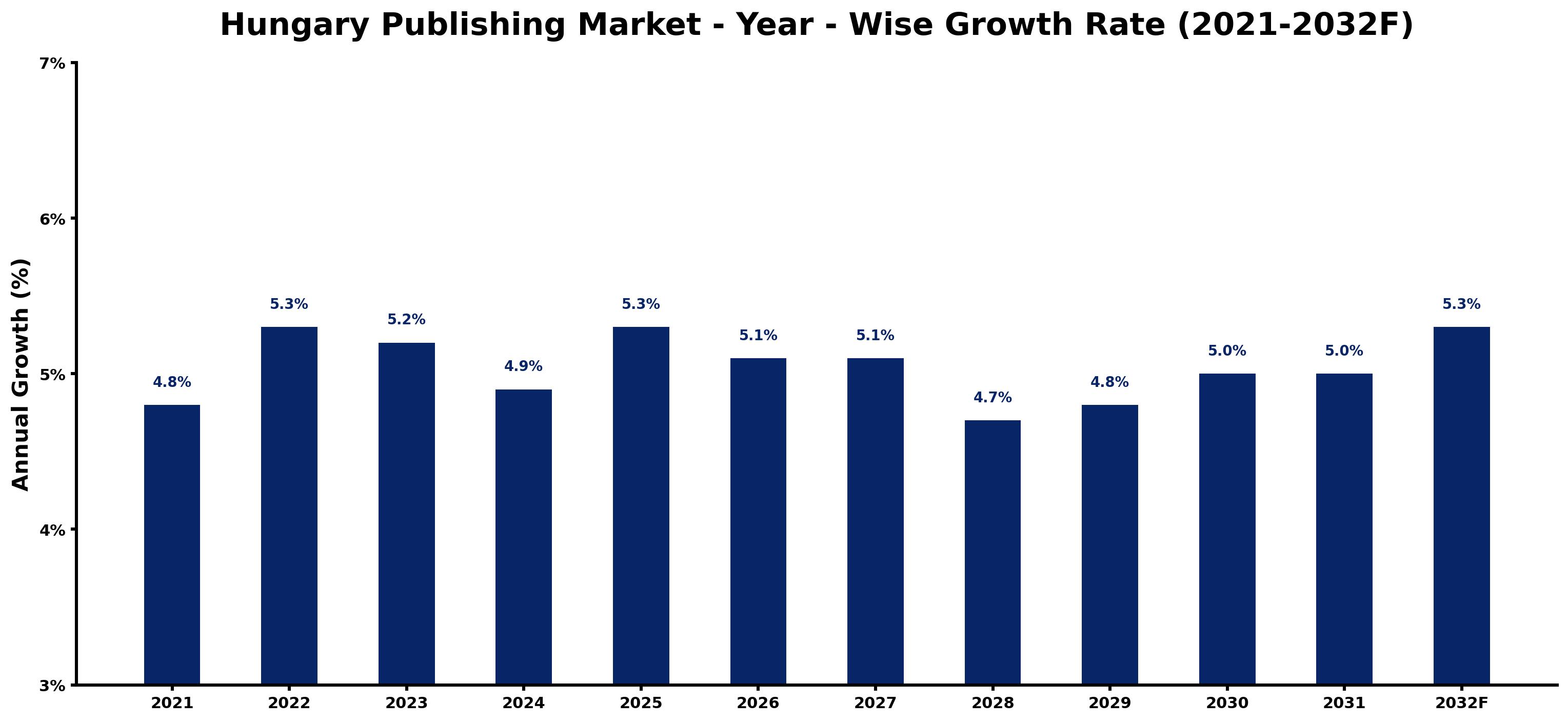
The table below presents the year wise growth rates along with the key drivers influencing the market
| Year | Growth Rate | Major Drivers |
| 2021 | 4.8% | Consumer preferences shifting towards digital publishing formats for convenience and accessibility. |
| 2022 | 5.3% | Educational reforms driving increased demand for diverse educational publishing materials. |
| 2023 | 5.2% | Local authors gaining popularity, influencing trends within the Hungarian literary market. |
| 2024 | 4.9% | Small and independent publishers emerging, promoting niche genres and regional perspectives. |
| 2025 | 5.3% | E-commerce growth facilitating easier access to books and personalized recommendations. |
| 2026 | 5.1% | Increased collaboration between local publishers and international distributors enhancing market reach. |
| 2027 | 5.1% | Sustainability concerns prompting a shift towards eco-friendly publishing practices and materials. |
| 2028 | 4.7% | Technological improvements allowing for innovative multimedia content in traditional publishing. |
| 2029 | 4.8% | Cultural events fostering a surge in interest for Hungarian literature and heritage. |
| 2030 | 5.0% | Digital subscription models gaining traction, altering consumer purchasing behaviors significantly. |
| 2031 | 5.0% | Enhanced literacy programs expanding the reader demographic across different age groups. |
| 2032 | 5.3% | Integration of augmented reality in publishing creating immersive reading experiences for consumers. |
Note - Market size estimations and growth projections presented in this report are based on 6Wresearch's advanced forecasting approach, validated with industry datasets as of June 2026.
Hungary Publishing Market Synopsis
The Hungary Publishing Market is projected to reach 5.1% and witness significant growth during the forecast period (2026-2032). The transformation of this market is primarily driven by digitalization and evolving consumer preferences, where traditional print remains relevant but face increased competition from digital formats. As a result, publishers are actively adapting their strategies to accommodate this shift, investing in digital platforms and exploring innovative content delivery methods.
Hungary Publishing Market Growth Drivers
The Hungary Publishing Market is influenced by several key drivers:
- The rapid growth in demand for digital content and e-books is reshaping consumer expectations, leading to a marked preference for reading on digital devices. As smartphones and tablets become more ubiquitous, access to electronic content is increasingly seen as a necessity.
- Publishers in Hungary are adopting digital technologies to streamline content distribution, allowing them to reach broader audiences more efficiently. This shift has enabled the development of new engagement models that enhance consumer interaction with content.
- The rising popularity of audiobooks and subscription-based services is contributing significantly to revenue growth within the sector. Consumers are drawn to the convenience and accessibility offered by these formats, prompting investments from publishers to develop diverse catalogues that cater to these preferences.
- Online retail channels and social media platforms are emerging as vital tools for publishers to promote and monetize their content. These platforms offer innovative marketing opportunities, enabling publishers to engage directly with consumers and adapt their strategies based on real-time feedback.
- Government support through grants and subsidies plays a crucial role in bolstering the publishing industry. These initiatives are designed to stimulate growth, enhance creativity, and ensure the sustainability of diverse publishing efforts across Hungary.
Hungary Publishing Market Challenges and Restraints
Despite its promising growth, the Hungary Publishing Market faces several notable challenges:
- The ongoing digital disruption necessitates that traditional publishers adapt their business models. Such transformations can be resource-intensive and may require significant shifts in operational strategies.
- Challenges related to piracy and copyright infringement threaten the financial viability of publishers. Protecting intellectual property rights is paramount as digital content becomes easier to replicate and distribute without authorization.
- The evolution of consumer reading habits presents a continuous challenge. Publishers must innovate their content offerings to remain relevant and profitable, often requiring them to diversify and experiment with various formats and genres.
- Establishing effective pricing strategies in a highly competitive market is crucial. Publishers must navigate the balance between affordability for consumers and profitability for themselves, which can be particularly challenging with the rise of free or low-cost digital offerings.
- Additionally, the market's reliance on technology means publishers must stay abreast of technological advancements and consumer trends. Adapting to these changes can be daunting and may necessitate ongoing investments in research and development.
Hungary Publishing Market Government Investment and Initiatives
The Hungarian government plays an integral role in fostering a supportive environment for the publishing sector through various initiatives:
- Policies aimed at promoting freedom of expression ensure that a diverse range of voices is represented in the literary landscape. This commitment underlines the government's recognition of the cultural significance of publishing.
- Government subsidies and grants are essential for supporting the production of literature and academic works. These financial incentives encourage publishers to invest in new projects and nurture emerging authors, contributing to cultural diversity.
- Tax incentives for publishers create a more favorable economic climate for investment in publishing operations. These measures help lower operational costs, making it easier for publishers to innovate and expand their offerings.
- Furthermore, the promotion of copyright laws enhances the protection of intellectual property within the industry. By safeguarding creators' rights, the government helps maintain a healthy marketplace where innovation can flourish.
- Development plans focusing on digital infrastructure improvements also significantly impact the Hungary Publishing Market. Enhanced digital access enables publishers to reach consumers more effectively in an increasingly online-driven marketplace.
Hungary Publishing Market Latest Developments (May 2025 - June 2026)
In the period from May 2025 to June 2026, the Hungary Publishing Market has seen notable developments:
- There has been a marked increase in the launch of digital-only titles, reflecting changing consumer preferences for on-the-go reading options. Publishers are increasingly recognizing the importance of this segment in driving overall revenue.
- Collaboration between publishers and tech companies has become more prevalent, leading to enhanced digital experiences for readers through interactive content and new reading apps.
- Industry events and fairs, despite challenges, are witnessing a resurgence as platforms for networking and showcasing new works, providing opportunities for publishers to connect with broader audiences.
- Initiatives focused on promoting audiobooks have gained momentum, with many publishers investing in high-quality recordings to cater to this growing demographic of listeners.
- Ongoing responses to consumer feedback regarding content types and pricing strategies have led to a more dynamic marketplace, as publishers strive to remain agile in meeting the needs of their audiences.
Hungary Publishing Market - Key Attractiveness of the Report
- 10 Years of Market Numbers
- Historical Data Starting from 2022 to 2025
- Base Year: 2025
- Forecast Data until 2032
- Key Performance Indicators Impacting the Market
- Major Upcoming Developments and Projects
Key Highlights of the Report:
- Hungary Publishing Market Outlook
- Market Size of Hungary Publishing Market, 2025
- Forecast of Hungary Publishing Market, 2032
- Historical Data and Forecast of Hungary Publishing Revenues & Volume for the Period 2022-2032F
- Hungary Publishing Market Trend Evolution
- Hungary Publishing Market Drivers and Challenges
- Hungary Publishing Price Trends
- Hungary Publishing Porter's Five Forces
- Hungary Publishing Industry Life Cycle
- Historical Data and Forecast of Hungary Publishing Market Revenues & Volume By Types for the Period 2022-2032F
- Historical Data and Forecast of Hungary Publishing Market Revenues & Volume By Newspaper for the Period 2022-2032F
- Historical Data and Forecast of Hungary Publishing Market Revenues & Volume By Journals for the Period 2022-2032F
- Historical Data and Forecast of Hungary Publishing Market Revenues & Volume By Catalogues for the Period 2022-2032F
- Historical Data and Forecast of Hungary Publishing Market Revenues & Volume By Magazine for the Period 2022-2032F
- Historical Data and Forecast of Hungary Publishing Market Revenues & Volume By Books for the Period 2022-2032F
- Historical Data and Forecast of Hungary Publishing Market Revenues & Volume By E-Books for the Period 2022-2032F
- Historical Data and Forecast of Hungary Publishing Market Revenues & Volume By Platform for the Period 2022-2032F
- Historical Data and Forecast of Hungary Publishing Market Revenues & Volume By Digital? for the Period 2022-2032F
- Historical Data and Forecast of Hungary Publishing Market Revenues & Volume By Paper for the Period 2022-2032F
- Hungary Publishing Import Export Trade Statistics
- Market Opportunity Assessment By Types
- Market Opportunity Assessment By Platform
- Hungary Publishing Top Companies Market Share
- Hungary Publishing Competitive Benchmarking By Technical and Operational Parameters
- Hungary Publishing Company Profiles
- Hungary Publishing Key Strategic Recommendations






































