Hungary Retail Industry Market Size, Share & Growth Rate
The Hungary Retail Industry Market was estimated at USD 484 Million in 2025 and is projected to reach USD 616 Million by 2032, growing at a CAGR of 3.5% from 2026 to 2032. This growth trajectory is underpinned by several factors including an increase in urbanization, rising disposable incomes, and the ongoing expansion of omnichannel retail solutions. As consumers increasingly embrace digital platforms, traditional retailers are adapting by integrating their physical and online offerings to meet evolving shopping preferences.
Hungary Retail Industry Market Year-wise Growth Rate and Key Drivers
This graph highlights how the Hungary Retail Industry Market has steadily grown over the years, supported by major growth factors.
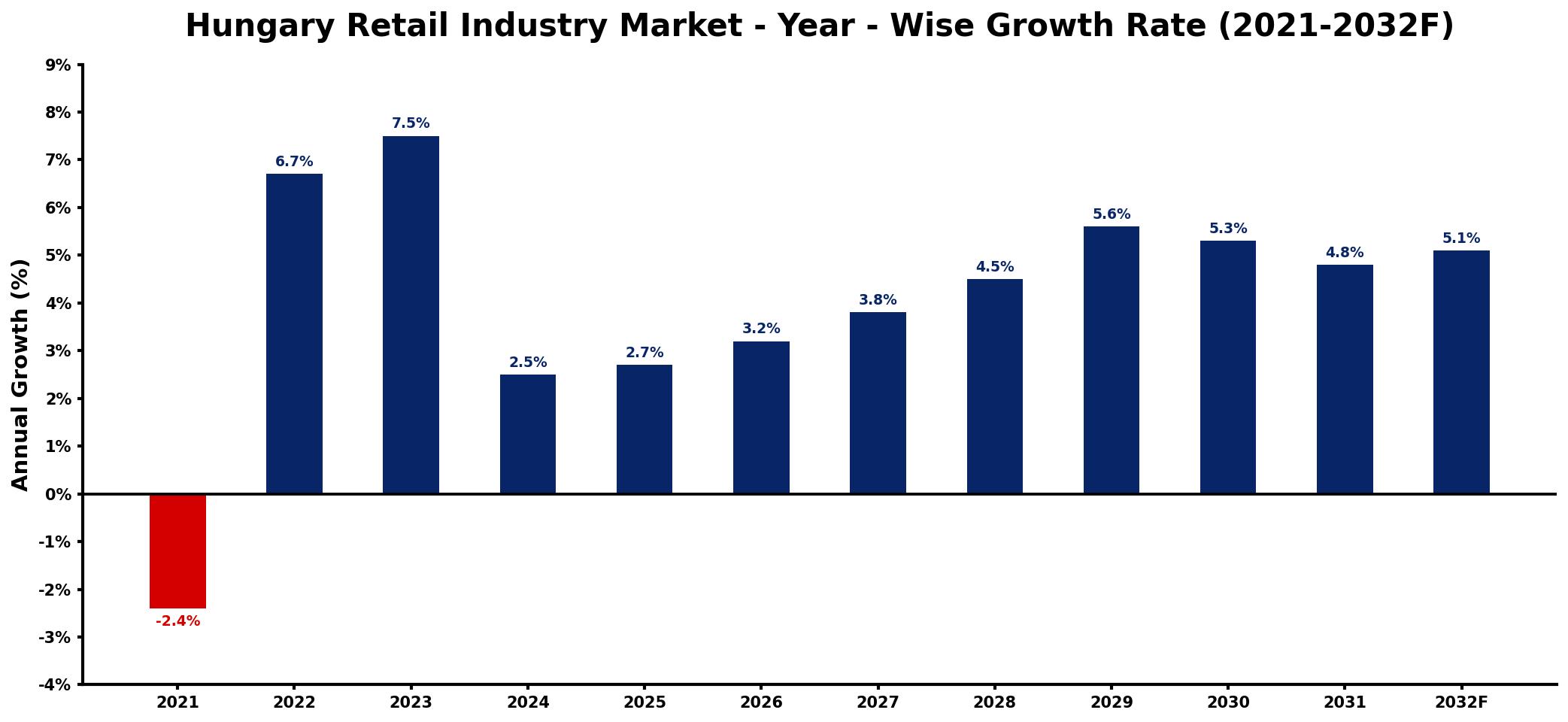
The table below presents the year‑wise growth rates along with the key drivers influencing the market
| Year | Growth Rate | Major Drivers |
| 2021 | -2.4% | consumer spending decreased significantly |
| 2022 | 6.7% | e-commerce adoption accelerated rapidly |
| 2023 | 7.5% | supply chain efficiencies improved noticeably |
| 2024 | 2.5% | new market entrants expanded offerings |
| 2025 | 2.7% | consumer confidence rebounded strongly |
| 2026 | 3.2% | digital transformation initiatives gained traction |
| 2027 | 3.8% | sustainability investments increased substantially |
| 2028 | 4.5% | local sourcing became more popular |
| 2029 | 5.6% | cross-border trade opportunities expanded |
| 2030 | 5.3% | technological innovations enhanced operations |
| 2031 | 4.8% | demographic shifts created new segments |
| 2032 | 5.1% | customer experience strategies evolved significantly |
Note: Market size estimations and growth projections presented in this report are based on 6Wresearch's proprietary forecasting methodology, utilizing the latest available industry data, government publications, and primary research inputs.
Hungary Retail Industry Market Synopsis
In recent years, the Hungary Retail Industry has witnessed notable momentum, primarily driven by a surge in e-commerce and a shift toward experiential shopping. As these dynamics unfold, the market is poised for a period of growth that aligns with international trends, adapting to both local consumer preferences and global retail innovations.
Looking ahead, the market is expected to leverage its diverse retail landscape, which includes food and beverage, fashion, and electronics, enhancing overall consumer experiences. However, challenges such as economic fluctuations and shifting preferences necessitate that retailers remain agile and responsive to maintain competitive advantage in an increasingly digital marketplace.
Hungary Retail Industry Market Key Takeaways
- The market is transitioning to a more digital and omnichannel model, responding to evolving consumer behavior.
- Urbanization and increased disposable incomes are significant drivers of retail growth in Hungary.
- International retail chains continue to expand, intensifying competition within the market.
- Government reforms are enhancing consumer rights and competitive practices in the retail sector.
- Retailers are investing heavily in customer experience enhancements to differentiate themselves.
Evaluation of Restraints in Hungary Retail Industry Market
Despite the favorable growth projections, the Hungary Retail Industry faces several restraints that could hinder its progress. Economic volatility, marked by fluctuating inflation rates and changing consumer spending patterns, poses a risk to sustained growth. Additionally, the shift to omnichannel retailing presents a challenge for many traditional retailers who must invest in technology and training to effectively meet new customer expectations. The regulatory environment, while promoting fair trade, can also impose constraints through complex compliance requirements that may burden smaller retailers. Thus, navigating these obstacles will be essential for players looking to thrive in this dynamic landscape.
Hungary Retail Industry Market Trends
Current trends indicate a significant shift towards sustainable practices in retail, with consumers becoming more conscious of their purchasing decisions. Retailers are responding by incorporating eco-friendly products and sustainable supply chains. Moreover, the rise of mobile shopping and social commerce is reshaping the shopping journey, compelling retailers to invest in user-friendly mobile platforms. Enhanced personalization through data analytics is also becoming a critical factor, as retailers strive to tailor experiences that resonate with individual consumer preferences.
Hungary Retail Industry Market Opportunities
The Hungary Retail Industry presents numerous growth opportunities, particularly in the realm of e-commerce and digital innovation. As online shopping continues to gain traction, retailers can capitalize on this trend by enhancing their digital presence and optimizing their supply chain logistics. Additionally, the increasing demand for experiential retail—where physical stores create engaging customer experiences—presents a unique avenue for differentiation. There is also a significant opportunity in the health and wellness sector, as consumers prioritize healthy lifestyles, creating demand for related products and services.
Government Initiatives in the Hungary Retail Industry Market
The Hungarian government is actively engaged in shaping the retail landscape through policies that enhance consumer protection and encourage competitive practices. Initiatives aimed at simplifying market access for new entrants, alongside regulations that reinforce antitrust laws, are designed to foster a healthier retail environment. Moreover, public spending programs aimed at infrastructure development are also expected to benefit the retail sector, allowing for more efficient logistics and better access to markets.
Future Insights of the Hungary Retail Industry Market
From 2026 to 2032, the Hungary Retail Industry is anticipated to evolve significantly as digital transformation continues to reshape the consumer landscape. Companies that prioritize technological integration and customer-centric approaches will likely outperform their competitors. As consumer demand for personalized and sustainable shopping experiences rises, retailers that embrace innovation while staying aligned with local cultural values will thrive. The future landscape of retail in Hungary is poised for growth, with a strong emphasis on creating holistic shopping experiences that blend online and offline interactions.
Hungary Retail Industry Market Latest Developments (2025 - 2026)
Recent developments within the Hungary Retail Industry have highlighted an ongoing shift towards digital engagement. Retailers are increasingly implementing advanced technologies, such as AI and machine learning, to enhance customer interaction and optimize supply chains. There has also been a notable rise in partnerships between traditional retailers and tech startups, driving innovation and efficiency. Additionally, consumer sentiment appears to be shifting towards brands that demonstrate transparency and sustainability, prompting retailers to adjust their product offerings accordingly.
Hungary Retail Industry Market - Key Attractiveness of the Report
- 10 Years of Market Numbers
- Historical Data Starting from 2022 to 2025
- Base Year: 2025
- Forecast Data until 2032
- Key Performance Indicators Impacting the Market
- Major Upcoming Developments and Projects
Key Highlights of the Report:
- Hungary Retail Industry Market Outlook
- Market Size of Hungary Retail Industry Market, 2025
- Forecast of Hungary Retail Industry Market, 2032
- Historical Data and Forecast of Hungary Retail Industry Revenues & Volume for the Period 2022-2032F
- Hungary Retail Industry Market Trend Evolution
- Hungary Retail Industry Market Drivers and Challenges
- Hungary Retail Industry Price Trends
- Hungary Retail Industry Porter's Five Forces
- Hungary Retail Industry Industry Life Cycle
- Historical Data and Forecast of Hungary Retail Industry Market Revenues & Volume By Product for the Period 2022-2032F
- Historical Data and Forecast of Hungary Retail Industry Market Revenues & Volume By Food and Beverages for the Period 2022-2032F
- Historical Data and Forecast of Hungary Retail Industry Market Revenues & Volume By Personal and Household Care for the Period 2022-2032F
- Historical Data and Forecast of Hungary Retail Industry Market Revenues & Volume By Apparel, Footwear, and Accessories for the Period 2022-2032F
- Historical Data and Forecast of Hungary Retail Industry Market Revenues & Volume By Furniture, Toys, and Hobby for the Period 2022-2032F
- Historical Data and Forecast of Hungary Retail Industry Market Revenues & Volume By Electronic and Household Appliances for the Period 2022-2032F
- Historical Data and Forecast of Hungary Retail Industry Market Revenues & Volume By Other Products for the Period 2022-2032F
- Historical Data and Forecast of Hungary Retail Industry Market Revenues & Volume By Distribution Channel for the Period 2022-2032F
- Historical Data and Forecast of Hungary Retail Industry Market Revenues & Volume By Supermarkets/Hypermarkets for the Period 2022-2032F
- Historical Data and Forecast of Hungary Retail Industry Market Revenues & Volume By Convenience Stores for the Period 2022-2032F
- Historical Data and Forecast of Hungary Retail Industry Market Revenues & Volume By Department Stores for the Period 2022-2032F
- Historical Data and Forecast of Hungary Retail Industry Market Revenues & Volume By Specialty Stores for the Period 2022-2032F
- Historical Data and Forecast of Hungary Retail Industry Market Revenues & Volume By Online for the Period 2022-2032F
- Historical Data and Forecast of Hungary Retail Industry Market Revenues & Volume By Other Distribution Channels for the Period 2022-2032F
- Hungary Retail Industry Import Export Trade Statistics
- Market Opportunity Assessment By Product
- Market Opportunity Assessment By Distribution Channel
- Hungary Retail Industry Top Companies Market Share
- Hungary Retail Industry Competitive Benchmarking By Technical and Operational Parameters
- Hungary Retail Industry Company Profiles
- Hungary Retail Industry Key Strategic Recommendations






































