Hungary Warehousing and Storage Market Size, Share & Growth Rate
The Hungary Warehousing and Storage Market was estimated at USD 140 Million in 2025 and is projected to reach USD 152 Million by 2032, growing at a CAGR of 1.2% from 2026 to 2032. This growth is primarily driven by the countrys strategic position as a logistics hub in Central Europe, which facilitates trade and transportation. Additionally, the increasing outsourcing of logistics services, coupled with advancements in warehouse management technologies, positions Hungary for a steady expansion of its warehousing capabilities.
Hungary Warehousing and Storage Market Year-wise Growth Rate and Key Drivers
This graph highlights how the Hungary Warehousing and Storage Market has steadily grown over the years, supported by major growth factors.
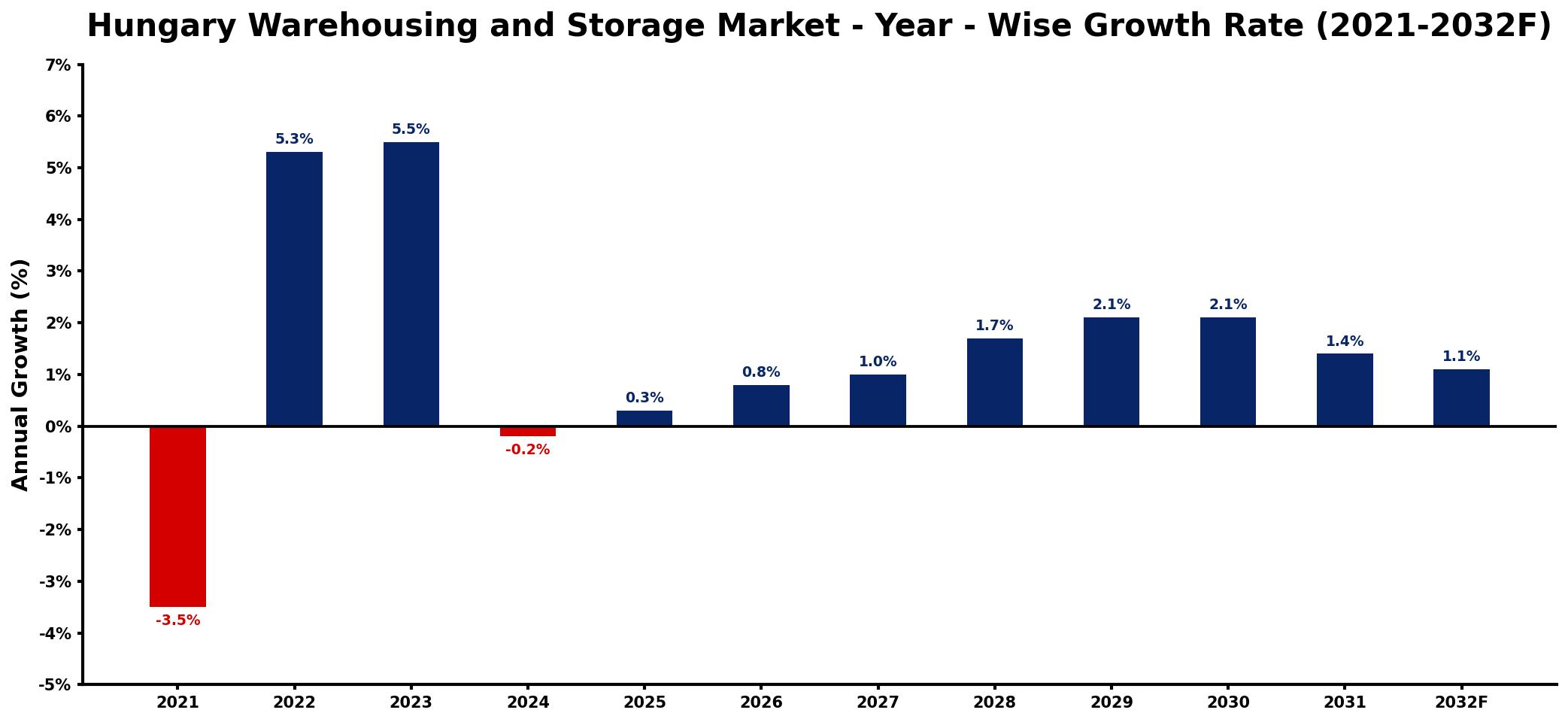
The table below presents the year‑wise growth rates along with the key drivers influencing the market
| Year | Growth Rate | Major Drivers |
| 2021 | -3.5% | decreased retail inventory levels |
| 2022 | 5.3% | rising e-commerce sector demand |
| 2023 | 5.5% | increased logistics investments nationwide |
| 2024 | -0.2% | lower consumer spending patterns |
| 2025 | 0.3% | growing demand for automation |
| 2026 | 0.8% | expansion of regional distribution networks |
| 2027 | 1.0% | increased foreign direct investments |
| 2028 | 1.7% | surge in last mile solutions |
| 2029 | 2.1% | growing adoption of technology |
| 2030 | 2.1% | enhanced supply chain efficiencies |
| 2031 | 1.4% | rising demand for cold chain |
| 2032 | 1.1% | increased focus on sustainability |
Note: Market size estimations and growth projections presented in this report are based on 6Wresearch's proprietary forecasting methodology, utilizing the latest available industry data, government publications, and primary research inputs.
Hungary Warehousing and Storage Market Synopsis
The warehousing and storage landscape in Hungary is rapidly evolving, reflecting the demands of a modern economy that prioritizes efficiency and flexibility. Companies are increasingly seeking innovative storage solutions that not only optimize space but also streamline distribution processes across various sectors.
As e-commerce continues to flourish, the need for sophisticated warehousing facilities is becoming paramount. The expansion of third-party logistics providers is facilitating this shift, offering businesses access to advanced inventory management and fulfillment services, which are crucial in a competitive marketplace.
Hungary Warehousing and Storage Market Key Takeaways
- The market's growth is fueled by Hungary's logistics potential and industrial development.
- Advancements in technology are enhancing inventory management and operational efficiency.
- Increased demand for e-commerce logistics is shaping modern warehousing strategies.
- Strategic government policies aim to improve infrastructure and incentivize investment in warehousing.
- Companies are seeking flexible storage solutions to meet dynamic market needs.
Evaluation of Restraints in Hungary Warehousing and Storage Market
While the Hungary Warehousing and Storage Market exhibits promising growth potential, several challenges must be addressed. A significant concern is the optimization of warehouse space, which directly impacts inventory management and overall efficiency. Labor shortages, particularly in skilled positions, complicate operations, hindering the industry's ability to fully capitalize on technological advancements. Moreover, integrating cutting-edge technologies to automate processes remains a hurdle, as it requires substantial investment and training.
Hungary Warehousing and Storage Market Trends
Current trends in the Hungary Warehousing and Storage Market highlight a strong shift towards automation and smart warehousing solutions. As companies prioritize efficiency, the implementation of advanced Warehouse Management Systems (WMS) and robotics for order fulfillment is gaining traction. Additionally, sustainable warehousing practices are emerging as businesses increasingly focus on environmental responsibility, prompting investments in green technologies and energy-efficient facilities.
Hungary Warehousing and Storage Market Opportunities
The landscape presents genuine growth opportunities, particularly in the realm of e-commerce and logistics outsourcing. Companies are looking for flexible warehousing options that can quickly adapt to changing consumer demands. Additionally, the governments focus on enhancing logistics infrastructure and incentivizing warehouse investments creates a favorable environment for new entrants and existing players to expand their operations and capabilities.
Government Initiatives in the Hungary Warehousing and Storage Market
Government initiatives in Hungary are increasingly shaping the warehousing and storage market. Policies aimed at improving logistics infrastructure include zoning regulations that facilitate warehouse construction, as well as tax incentives for logistics companies investing in storage capacity. Furthermore, public-private partnerships are being promoted to develop strategic warehousing hubs that support regional trade and enhance the overall efficiency of the supply chain.
Future Insights of the Hungary Warehousing and Storage Market
Looking ahead to 2026-2032, the Hungary Warehousing and Storage Market is poised for steady growth, driven by continuous innovations in technology and logistics strategies. As e-commerce continues to expand, the demand for efficient warehousing solutions will remain strong. Companies that successfully integrate automation and embrace sustainable practices are likely to thrive. With ongoing government support and investments in infrastructure, Hungary's position as a vital logistics hub is expected to solidify further, paving the way for a prosperous market outlook.
Hungary Warehousing and Storage Market Latest Developments (2025 - 2026)
The Hungary Warehousing and Storage Market has witnessed notable developments in recent months, with an increase in investments focusing on modernizing logistics infrastructure. Various warehousing facilities are incorporating advanced technologies to enhance operational efficiencies. Additionally, industry stakeholders are actively exploring partnerships to expand their service offerings and cater to the growing demand for e-commerce fulfillment, marking a significant shift in the competitive landscape.
Hungary Warehousing and Storage Market - Key Attractiveness of the Report
- 10 Years of Market Numbers
- Historical Data Starting from 2022 to 2025
- Base Year: 2025
- Forecast Data until 2032
- Key Performance Indicators Impacting the Market
- Major Upcoming Developments and Projects
Key Highlights of the Report:
- Hungary Warehousing and Storage Market Outlook
- Market Size of Hungary Warehousing and Storage Market, 2025
- Forecast of Hungary Warehousing and Storage Market, 2032
- Historical Data and Forecast of Hungary Warehousing and Storage Revenues & Volume for the Period 2022-2032F
- Hungary Warehousing and Storage Market Trend Evolution
- Hungary Warehousing and Storage Market Drivers and Challenges
- Hungary Warehousing and Storage Price Trends
- Hungary Warehousing and Storage Porter's Five Forces
- Hungary Warehousing and Storage Industry Life Cycle
- Historical Data and Forecast of Hungary Warehousing and Storage Market Revenues & Volume By Type for the Period 2022-2032F
- Historical Data and Forecast of Hungary Warehousing and Storage Market Revenues & Volume By General Warehousing and Storage for the Period 2022-2032F
- Historical Data and Forecast of Hungary Warehousing and Storage Market Revenues & Volume By Refrigerated Warehousing and Storage for the Period 2022-2032F
- Historical Data and Forecast of Hungary Warehousing and Storage Market Revenues & Volume By Farm Product Warehousing and Storage for the Period 2022-2032F
- Historical Data and Forecast of Hungary Warehousing and Storage Market Revenues & Volume By Ownership for the Period 2022-2032F
- Historical Data and Forecast of Hungary Warehousing and Storage Market Revenues & Volume By Private Warehouses for the Period 2022-2032F
- Historical Data and Forecast of Hungary Warehousing and Storage Market Revenues & Volume By Public Warehouses for the Period 2022-2032F
- Historical Data and Forecast of Hungary Warehousing and Storage Market Revenues & Volume By Bonded Warehouses for the Period 2022-2032F
- Historical Data and Forecast of Hungary Warehousing and Storage Market Revenues & Volume By End-Use for the Period 2022-2032F
- Historical Data and Forecast of Hungary Warehousing and Storage Market Revenues & Volume By Manufacturing for the Period 2022-2032F
- Historical Data and Forecast of Hungary Warehousing and Storage Market Revenues & Volume By Consumer Goods for the Period 2022-2032F
- Historical Data and Forecast of Hungary Warehousing and Storage Market Revenues & Volume By Retail for the Period 2022-2032F
- Historical Data and Forecast of Hungary Warehousing and Storage Market Revenues & Volume By Food and Beverage for the Period 2022-2032F
- Historical Data and Forecast of Hungary Warehousing and Storage Market Revenues & Volume By IT Hardware for the Period 2022-2032F
- Historical Data and Forecast of Hungary Warehousing and Storage Market Revenues & Volume By Healthcare for the Period 2022-2032F
- Historical Data and Forecast of Hungary Warehousing and Storage Market Revenues & Volume By Chemicals for the Period 2022-2032F
- Historical Data and Forecast of Hungary Warehousing and Storage Market Revenues & Volume By Others for the Period 2022-2032F
- Hungary Warehousing and Storage Import Export Trade Statistics
- Market Opportunity Assessment By Type
- Market Opportunity Assessment By Ownership
- Market Opportunity Assessment By End-Use
- Hungary Warehousing and Storage Top Companies Market Share
- Hungary Warehousing and Storage Competitive Benchmarking By Technical and Operational Parameters
- Hungary Warehousing and Storage Company Profiles
- Hungary Warehousing and Storage Key Strategic Recommendations






































