Hungary Waste Management Market (2026-2032) | Forecast, Analysis, Growth, Industry, Value, Trends, Size, Share, Outlook, COVID-19 IMPACT, Companies & Revenue
Market Forecast By Types (Municipal Waste, Industrial Waste, Hazardous Waste), By Services (Collection Service, Collection & transportation, Storage & handling, Sorting, Disposable Service, Landfills, Recycling, Compositing & anaerobic digestion) And Competitive Landscape
| Product Code: ETC007779 | Publication Date: Jun 2023 | Product Type: Report | ||
| Publisher: 6Wresearch | Author: Ravi Bhandari | No. of Pages: 70 | No. of Figures: 35 | No. of Tables: 5 |
Hungary Waste Management Market Summary
The hungary waste management market was estimated at USD 1139 Million in 2025 and is projected to reach USD 1649 Million by 2032, growing at a CAGR of 6.5% from 2026 to 2032.
Hungary Waste Management Market Growth Rate Analysis (2021-2032)
The Hungary Waste Management market has shown a stable growth pattern, with yearly increases hovering around 6% to 6.7% from 2021 through 2032. Notably, 2021 marked a peak at 6.7%, driven by heightened environmental awareness and robust investments in recycling technologies. Growth modestly declined to 6.4% in 2022, reflecting global economic pressures and supply chain disruptions, yet rebounded to 6.5% in 2023 as infrastructure improvements took precedence. The subsequent years exhibit similar fluctuations, with growth projected at 6.3% in 2024 and gradually stabilizing around 6.1% in 2031. This trend aligns with increasing consumer demand for sustainable waste solutions and Hungary's commitment to energy transition policies, underscoring the sector's resilience and adaptability.
Hungary Waste Management Market Year-wise Growth Rate and Key Drivers
This graph highlights how the Hungary Waste Management Market has steadily grown over the past five years, supported by major growth factors.
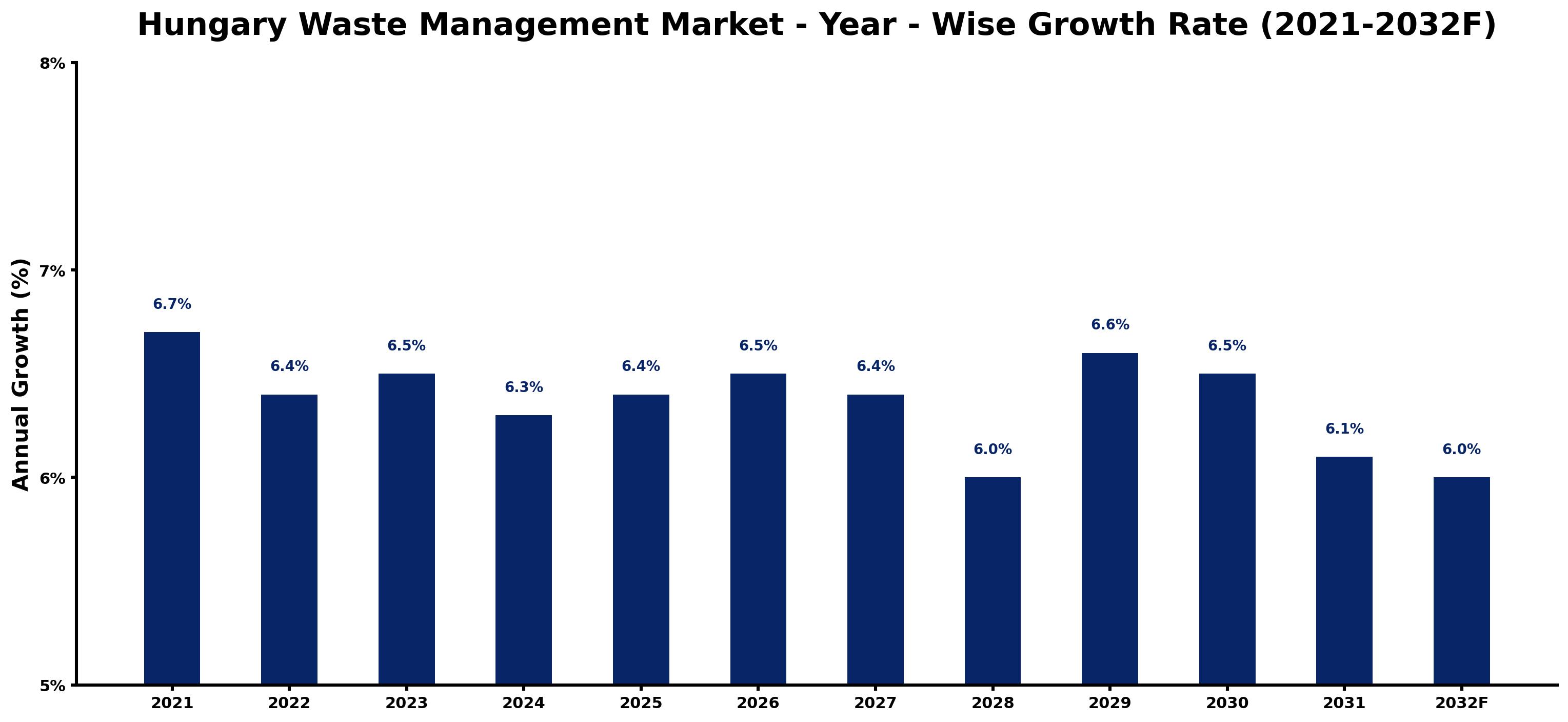
The table below presents the year wise growth rates along with the key drivers influencing the market
| Year | Growth Rate | Major Drivers |
| 2021 | 6.7% | Hungary's increasing urban population necessitates enhanced waste management solutions and infrastructure. |
| 2022 | 6.4% | Local municipalities begin focusing on circular economy practices to optimize resource recovery. |
| 2023 | 6.5% | Public awareness campaigns highlight the importance of sustainable waste disposal methods. |
| 2024 | 6.3% | Investment in innovative recycling technologies becomes essential for waste processing efficiency. |
| 2025 | 6.4% | Partnerships between private companies and municipalities enhance waste collection and recycling rates. |
| 2026 | 6.5% | Emerging waste-to-energy facilities provide alternative solutions for waste disposal challenges. |
| 2027 | 6.4% | Young entrepreneurs introduce startups targeting sustainable packaging, transforming waste generation patterns. |
| 2028 | 6.0% | Technological advancements in waste sorting systems improve operational efficiency across facilities. |
| 2029 | 6.6% | E-commerce expansion leads to an increase in packaging waste, driving innovative solutions. |
| 2030 | 6.5% | Education initiatives in schools embed waste management principles into curricula, fostering future awareness. |
| 2031 | 6.1% | Enhanced landfill regulations further press municipalities to adopt more sustainable practices. |
| 2032 | 6.0% | Collaboration among sectors creates integrated waste management systems that optimize overall effectiveness. |
Note - Market size estimations and growth projections presented in this report are based on 6Wresearch's advanced forecasting approach, validated with industry datasets as of June 2026.
Hungary Waste Management Market Synopsis
The Hungary Waste Management Market is projected to reach 6.5% and witness significant growth during the forecast period (2026-2032). This growth trajectory is largely attributed to increasing environmental awareness among the populace and a corresponding rise in government regulations regarding solid and hazardous waste treatment. Advanced technological solutions that enhance the efficiency and cost-effectiveness of waste disposal processes further fuel this growth. The ongoing public-private partnership initiatives being implemented across Hungary also emphasize sustainability in waste management practices, contributing to the sector's expansion. Moreover, rapid urbanization and industrialization are anticipated to increase the demand for sustainable waste management services in the coming years.
Hungary Waste Management Market Growth Drivers
Several factors are driving the growth of the Hungary Waste Management Market. Firstly, heightened environmental awareness among citizens is prompting a shift toward more responsible waste management practices. This societal change is supported by comprehensive regulations aimed at solid and hazardous waste treatment, ensuring compliance and sustainability.
- The influence of governmental policies on waste segregation and recycling efforts is becoming increasingly significant, fostering a culture of eco-consciousness.
- Technological advancements in waste treatment processes and recycling methods are improving disposal efficiency, thereby attracting investments into the market.
- Public-private partnerships have emerged as vital mechanisms for implementing innovative waste management solutions, facilitating shared expertise and resources.
- Urbanization and industrial growth are escalating waste generation levels, necessitating the development of efficient waste management systems to cope with increasing volumes.
- Research and development in renewable energy resources linked to waste management are poised to create new opportunities and innovations within the industry.
Hungary Waste Management Market Trends and Opportunities
The Hungary Waste Management Market is witnessing notable trends that present lucrative opportunities for stakeholders. The integration of digital technologies in waste management systems is becoming increasingly prevalent, optimizing waste collection and processing activities. Furthermore, the rise of the circular economy is prompting businesses to adopt more sustainable practices, creating demand for innovative waste recycling and recovery solutions. Additionally, consumers are progressively favoring environmentally friendly products, influencing companies to enhance their sustainability profiles.
- The transition toward greener technologies is driving investment in waste-to-energy facilities, which convert waste into reusable energy forms, thus promoting energy sustainability.
- Smart waste management solutions, utilizing IoT and AI, are evolving to improve operational efficiencies in waste collection and monitoring.
- Increased focus on composting and organic waste management is gaining traction, aligned with global trends in sustainable agriculture.
- The development of policies supporting green innovation is encouraging startups and established companies to explore advanced waste processing techniques.
- Collaboration between municipalities and private entities is fostering community engagement and education on waste reduction practices, amplifying the impact of sustainability initiatives.
Hungary Waste Management Market Challenges and Restraints
Despite the promising growth of the Hungary Waste Management Market, several challenges remain that could hinder progress. The initial high capital costs associated with adopting new waste management technologies can deter investment and slow market evolution. Moreover, fluctuating market conditions can impact profitability for waste management companies, compelling them to optimize operational costs without sacrificing service quality.
- The need for extensive infrastructure development to support modern waste management systems often results in prolonged implementation timelines, delaying potential benefits.
- Public resistance to change, particularly regarding new waste collection and disposal methods, can create barriers to effective policy implementation.
- The complexities surrounding regulatory compliance can pose challenges for companies striving to meet evolving environmental standards.
- Inadequate public awareness about the importance of waste management solutions may limit community participation, undermining efforts for effective waste reduction.
- Competition from traditional waste management practices can hinder the adoption of innovative, sustainable solutions, as stakeholders may be hesitant to shift from established routines.
Hungary Waste Management Market Government Investment and Initiatives
The Hungarian government is actively investing in initiatives designed to modernize and improve waste management practices across the country. This includes the implementation of policies aimed at reducing waste generation and promoting recycling through enhanced collection systems. Government investments have fueled significant infrastructure projects that aim to upgrade existing waste treatment facilities and develop new recycling plants.
- Government incentives for adopting green technologies in waste management are encouraging businesses to pursue sustainable practices, aligning with environmental goals.
- Public awareness campaigns led by government entities are fostering a culture of sustainability, educating citizens on proper waste disposal and recycling techniques.
- Regulatory frameworks are being revised to create an enabling environment for innovation in waste processing technologies, enhancing market participation.
- Collaborative efforts between governmental bodies and private sectors are focusing on research and development for new waste-to-energy projects, boosting energy sustainability.
- Long-term strategies aiming for sustainable urban development are emphasizing the role of efficient waste management in achieving national environmental objectives.
Hungary Waste Management Market Latest Developments (May 2025 - June 2026)
Recently, the Hungary Waste Management Market has been characterized by a series of developments aimed at enhancing efficiency and sustainability within the sector. Increased regulatory scrutiny has prompted companies to modernize their waste management practices, focusing on compliance with stricter environmental standards. Furthermore, an upswing in public-private partnerships has seen municipalities collaborating with private firms to undertake innovative waste management projects, thus improving service delivery.
- The introduction of smart waste collection systems has emerged, leveraging data analytics to optimize routes and enhance collection efficiency.
- There has been a notable increase in state funding for research initiatives focused on recycling technologies, facilitating advancements in the sector.
- Public campaigns advocating for waste reduction and recycling have gained momentum, leading to improved community engagement in sustainable practices.
- Technology-oriented firms are exploring new methods for waste conversion and recovery, aligning with global shifts toward a circular economy.
- Collaborative efforts across various sectors are being emphasized to drive innovation, with stakeholders sharing insights to develop comprehensive waste management solutions.
Hungary Waste Management Market - Key Attractiveness of the Report
- 10 Years of Market Numbers
- Historical Data Starting from 2022 to 2025
- Base Year: 2025
- Forecast Data until 2032
- Key Performance Indicators Impacting the Market
- Major Upcoming Developments and Projects
Key Highlights of the Report:
- Hungary Waste Management Market Outlook
- Market Size of Hungary Waste Management Market, 2025
- Forecast of Hungary Waste Management Market, 2032F
- Historical Data and Forecast of Hungary Waste Management Revenues & Volume for the Period 2022-2032F
- Hungary Waste Management Market Trend Evolution
- Hungary Waste Management Market Drivers and Challenges
- Hungary Waste Management Price Trends
- Hungary Waste Management Porter's Five Forces
- Hungary Waste Management Industry Life Cycle
- Historical Data and Forecast of Hungary Waste Management Market Revenues & Volume By Types for the Period 2022-2032F
- Historical Data and Forecast of Hungary Waste Management Market Revenues & Volume By Municipal Waste for the Period 2022-2032F
- Historical Data and Forecast of Hungary Waste Management Market Revenues & Volume By Industrial Waste for the Period 2022-2032F
- Historical Data and Forecast of Hungary Waste Management Market Revenues & Volume By Hazardous Waste for the Period 2022-2032F
- Historical Data and Forecast of Hungary Waste Management Market Revenues & Volume By Services? for the Period 2022-2032F
- Historical Data and Forecast of Hungary Waste Management Market Revenues & Volume By Collection Service for the Period 2022-2032F
- Historical Data and Forecast of Hungary Waste Management Market Revenues & Volume By Collection & transportation for the Period 2022-2032F
- Historical Data and Forecast of Hungary Waste Management Market Revenues & Volume By Storage & handling for the Period 2022-2032F
- Historical Data and Forecast of Hungary Waste Management Market Revenues & Volume By Sorting for the Period 2022-2032F
- Historical Data and Forecast of Hungary Waste Management Market Revenues & Volume By Disposable Service for the Period 2022-2032F
- Historical Data and Forecast of Hungary Waste Management Market Revenues & Volume By Landfills for the Period 2022-2032F
- Historical Data and Forecast of Hungary Waste Management Market Revenues & Volume By Recycling for the Period 2022-2032F
- Historical Data and Forecast of Hungary Waste Management Market Revenues & Volume By Compositing & anaerobic digestion for the Period 2022-2032F
- Hungary Waste Management Import Export Trade Statistics
- Market Opportunity Assessment By Types
- Market Opportunity Assessment By Services?
- Hungary Waste Management Top Companies Market Share
- Hungary Waste Management Competitive Benchmarking By Technical and Operational Parameters
- Hungary Waste Management Company Profiles
- Hungary Waste Management Key Strategic Recommendations
Frequently Asked Questions About the Market Study (FAQs):
The growth is mainly driven by increasing environmental awareness, government regulations, technological advancements, and urbanization.
The government supports the sector through investments in infrastructure, regulatory frameworks, and public awareness campaigns aimed at promoting sustainability.
The market faces challenges such as high technology costs, regulatory compliance complexities, and public resistance to new waste management practices.
Recent trends include the rise of smart waste management technologies, increased emphasis on sustainability, and growing public-private collaborations.
6Wresearch actively monitors the Hungary Waste Management Market and publishes its comprehensive annual report, highlighting emerging trends, growth drivers, revenue analysis, and forecast outlook. Our insights help businesses to make data-backed strategic decisions with ongoing market dynamics. Our analysts track relevent industries related to the Hungary Waste Management Market, allowing our clients with actionable intelligence and reliable forecasts tailored to emerging regional needs.
Yes, we provide customisation as per your requirements. To learn more, feel free to contact us on sales@6wresearch.com
1 Executive Summary |
2 Introduction |
2.1 Key Highlights of the Report |
2.2 Report Description |
2.3 Market Scope & Segmentation |
2.4 Research Methodology |
2.5 Assumptions |
3 Hungary Waste Management Market Overview |
3.1 Hungary Country Macro Economic Indicators |
3.2 Hungary Waste Management Market Revenues & Volume, 2022 & 2032F |
3.3 Hungary Waste Management Market - Industry Life Cycle |
3.4 Hungary Waste Management Market - Porter's Five Forces |
3.5 Hungary Waste Management Market Revenues & Volume Share, By Types, 2022 & 2032F |
3.6 Hungary Waste Management Market Revenues & Volume Share, By Services , 2022 & 2032F |
4 Hungary Waste Management Market Dynamics |
4.1 Impact Analysis |
4.2 Market Drivers |
4.3 Market Restraints |
5 Hungary Waste Management Market Trends |
6 Hungary Waste Management Market, By Types |
6.1 Hungary Waste Management Market, By Types |
6.1.1 Overview and Analysis |
6.1.2 Hungary Waste Management Market Revenues & Volume, By Types, 2022-2032F |
6.1.3 Hungary Waste Management Market Revenues & Volume, By Municipal Waste, 2022-2032F |
6.1.4 Hungary Waste Management Market Revenues & Volume, By Industrial Waste, 2022-2032F |
6.1.5 Hungary Waste Management Market Revenues & Volume, By Hazardous Waste, 2022-2032F |
6.2 Hungary Waste Management Market, By Services |
6.2.1 Overview and Analysis |
6.2.2 Hungary Waste Management Market Revenues & Volume, By Collection Service, 2022-2032F |
6.2.3 Hungary Waste Management Market Revenues & Volume, By Collection & transportation, 2022-2032F |
6.2.4 Hungary Waste Management Market Revenues & Volume, By Storage & handling, 2022-2032F |
6.2.5 Hungary Waste Management Market Revenues & Volume, By Sorting, 2022-2032F |
6.2.6 Hungary Waste Management Market Revenues & Volume, By Disposable Service, 2022-2032F |
6.2.7 Hungary Waste Management Market Revenues & Volume, By Landfills, 2022-2032F |
6.2.8 Hungary Waste Management Market Revenues & Volume, By Compositing & anaerobic digestion, 2022-2032F |
6.2.9 Hungary Waste Management Market Revenues & Volume, By Compositing & anaerobic digestion, 2022-2032F |
7 Hungary Waste Management Market Import-Export Trade Statistics |
7.1 Hungary Waste Management Market Export to Major Countries |
7.2 Hungary Waste Management Market Imports from Major Countries |
8 Hungary Waste Management Market Key Performance Indicators |
9 Hungary Waste Management Market - Opportunity Assessment |
9.1 Hungary Waste Management Market Opportunity Assessment, By Types, 2022 & 2032F |
9.2 Hungary Waste Management Market Opportunity Assessment, By Services , 2022 & 2032F |
10 Hungary Waste Management Market - Competitive Landscape |
10.1 Hungary Waste Management Market Revenue Share, By Companies, 2025 |
10.2 Hungary Waste Management Market Competitive Benchmarking, By Operating and Technical Parameters |
11 Company Profiles |
12 Recommendations |
13 Disclaimer |
Global Go To Market Strategy - 2030
Export potential enables firms to identify high-growth global markets with greater confidence by combining advanced trade intelligence with a structured quantitative methodology. The framework analyzes emerging demand trends and country-level import patterns while integrating macroeconomic and trade datasets such as GDP and population forecasts, bilateral import–export flows, tariff structures, elasticity differentials between developed and developing economies, geographic distance, and import demand projections. Using weighted trade values from 2020–2024 as the base period to project country-to-country export potential for 2030, these inputs are operationalized through calculated drivers such as gravity model parameters, tariff impact factors, and projected GDP per-capita growth. Through an analysis of hidden potentials, demand hotspots, and market conditions that are most favorable to success, this method enables firms to focus on target countries, maximize returns, and global expansion with data, backed by accuracy.
By factoring in the projected importer demand gap that is currently unmet and could be potential opportunity, it identifies the potential for the Exporter (Country) among 190 countries, against the general trade analysis, which identifies the biggest importer or exporter.
To discover high-growth global markets and optimize your business strategy:
Click Here
Pricing
- Single User License$ 1,995
- Department License$ 2,400
- Site License$ 3,120
- Global License$ 3,795

Leadership Perspectives from Industry Events
Search
Thought Leadership and Analyst Meet





Our Clients








6WResearch In News
- India Air Conditioner Market Set for Strong Rebound in 2026 After Weather-Led Correction and GST-Driven Recovery: 6Wresearch
- ADAS in India: How Automatic Emergency Braking, Blind Spot Detection & Driver Monitoring are Transforming Road Safety
- Doha a strategic location for EV manufacturing hub: IPA Qatar
- Demand for luxury TVs surging in the GCC, says Samsung
- Empowering Growth: The Thriving Journey of Bangladesh’s Cable Industry
- Demand for luxury TVs surging in the GCC, says Samsung
Latest Reports
- Poland Fire Protection Systems Market (2026-2032)
- Cape Verde Portable Hand-Thrown Extinguisher Market (2026-2032)
- Canada Portable Hand-Thrown Extinguisher Market (2026-2032)
- Cameroon Portable Hand-Thrown Extinguisher Market (2026-2032)
- Burundi Portable Hand-Thrown Extinguisher Market (2026-2032)
- Burkina Faso Portable Hand-Thrown Extinguisher Market (2026-2032)
- Bulgaria Portable Hand-Thrown Extinguisher Market (2026-2032)
- Brunei Portable Hand-Thrown Extinguisher Market (2026-2032)
- Botswana Portable Hand-Thrown Extinguisher Market (2026-2032)
- Bosnia and Herzegovina Portable Hand-Thrown Extinguisher Market (2026-2032)
Industry Events and Analyst Meet

HIMTEX 2026

India Refining Summit 2026

India EV Show 2026

EV tech India Expo 2026

Auto Tech Asia 2026
Whitepaper
- Middle East & Africa Commercial Security Market Click here to view more.
- Middle East & Africa Fire Safety Systems & Equipment Market Click here to view more.
- GCC Drone Market Click here to view more.
- Middle East Lighting Fixture Market Click here to view more.
- GCC Physical & Perimeter Security Market Click here to view more.


