Iceland Ferro-Alloys Market Year-wise Growth Rate (2021-2031F)
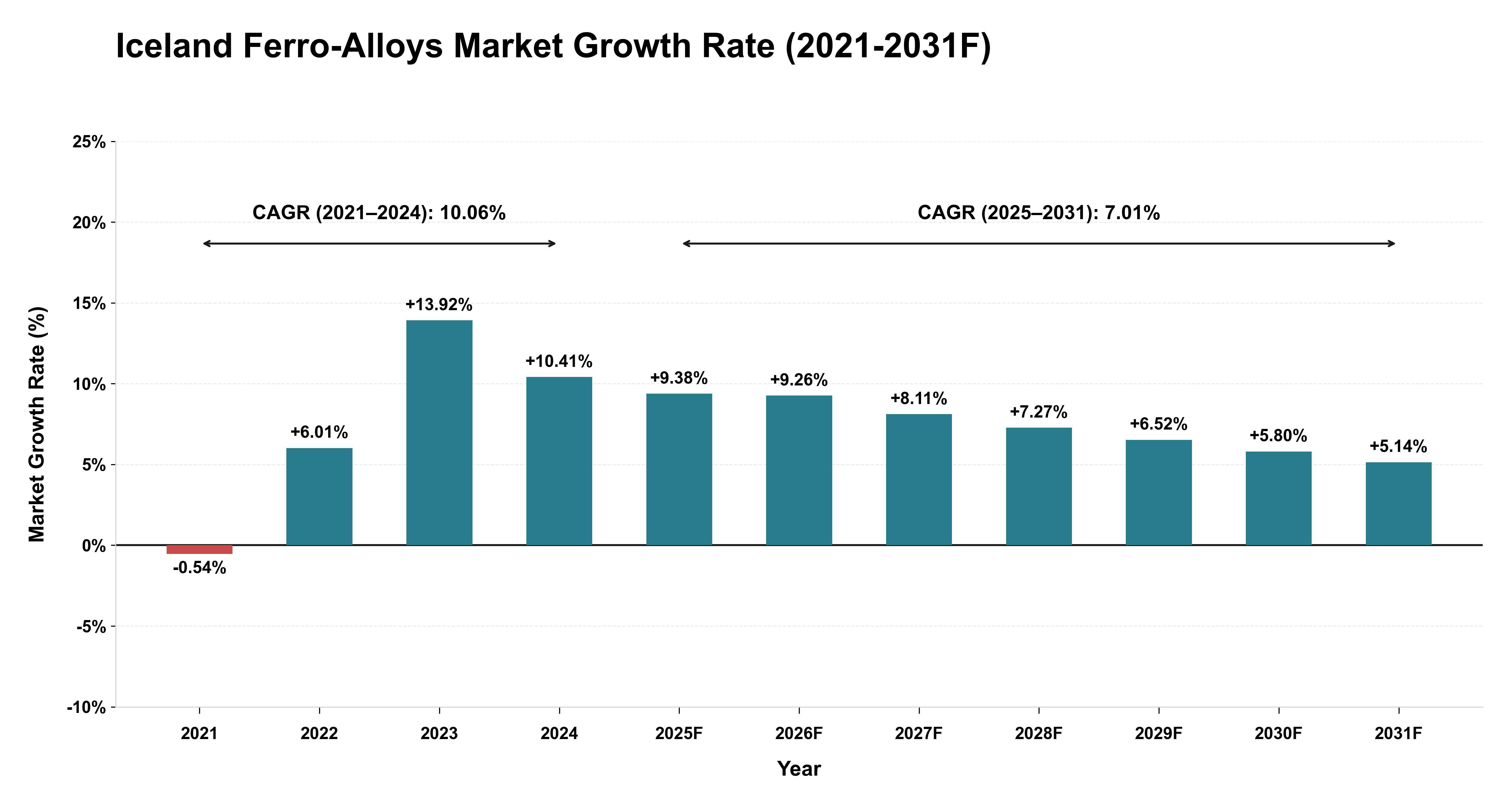
In the Iceland Ferro-Alloys Market, from 2021 to 2024, the industry experienced a mixed performance with a slight decline in 2021 followed by positive growth trends. The years 2023 and 2024 stood out with significant growth rates of 13.92% and 10.41%, respectively, driven by increasing demand from sectors like construction and manufacturing, enhanced supply chain efficiencies, and favorable regulatory environments promoting industrial activities. Looking ahead to the forecast period of 2025-2031, we anticipate a gradual moderation in growth rates, aligning with the forecasted CAGR of 7.01%. This deceleration could be attributed to stabilizing demand dynamics, technological advancements improving production processes, and evolving global trade patterns influencing raw material costs and market competitiveness. Overall, the market is poised for steady expansion albeit at a slightly slower pace compared to the previous years.
Key Highlights of the Report:
- Iceland Ferro-alloys Market Outlook
- Market Size of Iceland Ferro-alloys Market, 2024
- Forecast of Iceland Ferro-alloys Market, 2031
- Historical Data and Forecast of Iceland Ferro-alloys Revenues & Volume for the Period 2021-2031
- Iceland Ferro-alloys Market Trend Evolution
- Iceland Ferro-alloys Market Drivers and Challenges
- Iceland Ferro-alloys Price Trends
- Iceland Ferro-alloys Porter`s Five Forces
- Iceland Ferro-alloys Industry Life Cycle
- Historical Data and Forecast of Iceland Ferro-alloys Market Revenues & Volume By Product Type for the Period 2021-2031
- Historical Data and Forecast of Iceland Ferro-alloys Market Revenues & Volume By Ferrochrome for the Period 2021-2031
- Historical Data and Forecast of Iceland Ferro-alloys Market Revenues & Volume By Ferromanganese for the Period 2021-2031
- Historical Data and Forecast of Iceland Ferro-alloys Market Revenues & Volume By Ferro Silicomanganese for the Period 2021-2031
- Historical Data and Forecast of Iceland Ferro-alloys Market Revenues & Volume By Ferrosilicon for the Period 2021-2031
- Historical Data and Forecast of Iceland Ferro-alloys Market Revenues & Volume By Application for the Period 2021-2031
- Historical Data and Forecast of Iceland Ferro-alloys Market Revenues & Volume By Carbon & Low Alloy Steel for the Period 2021-2031
- Historical Data and Forecast of Iceland Ferro-alloys Market Revenues & Volume By Stainless Steel for the Period 2021-2031
- Historical Data and Forecast of Iceland Ferro-alloys Market Revenues & Volume By Alloy Steel for the Period 2021-2031
- Historical Data and Forecast of Iceland Ferro-alloys Market Revenues & Volume By Cast Iron for the Period 2021-2031
- Historical Data and Forecast of Iceland Ferro-alloys Market Revenues & Volume By Others for the Period 2021-2031
- Iceland Ferro-alloys Import Export Trade Statistics
- Market Opportunity Assessment By Product Type
- Market Opportunity Assessment By Application
- Iceland Ferro-alloys Top Companies Market Share
- Iceland Ferro-alloys Competitive Benchmarking By Technical and Operational Parameters
- Iceland Ferro-alloys Company Profiles
- Iceland Ferro-alloys Key Strategic Recommendations






































