Iceland Non-Alcoholic Beverage Market Year-wise Growth Rate (2021-2031F)
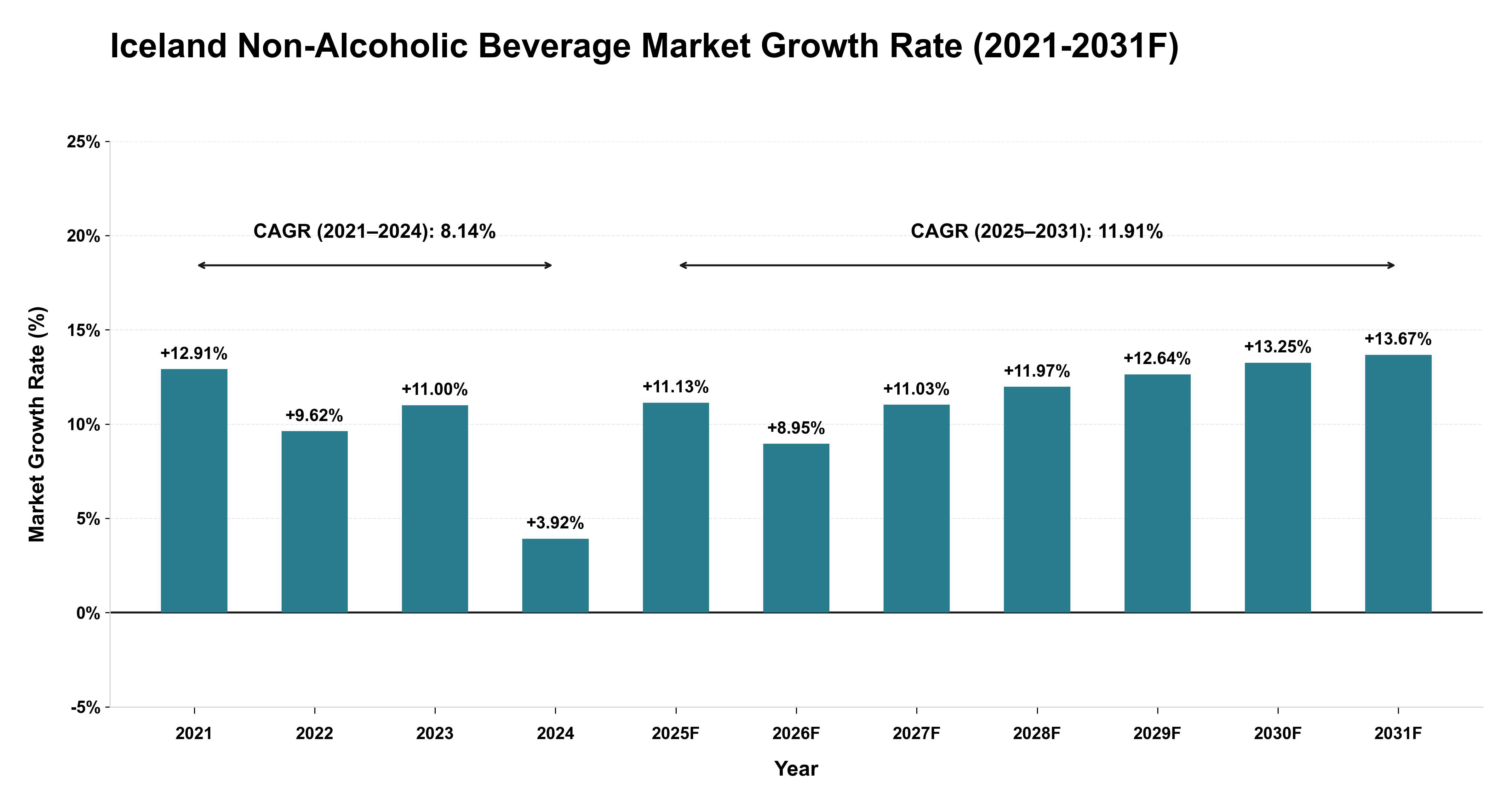
In the Iceland Non-Alcoholic Beverage Market, between 2021 and 2024, the segment experienced a robust historical growth trajectory with fluctuating annual growth rates. The years 2021 and 2023 saw significant accelerations in growth at 12.91% and 11.00% respectively, while growth decelerated in 2024 to 3.92%. This volatility could be attributed to changing consumer preferences, marketing strategies, or even external factors impacting demand. Looking ahead to the forecast period of 2025-2031, a steady acceleration is expected with an increasing CAGR of 11.91%. The forecasted growth rates show a positive trend with a gradual increase from 11.13% in 2025 to a peak of 13.67% in 2031, indicating a promising outlook for the market driven by possibly innovative product offerings, health trends influencing consumption patterns, or strategic pricing strategies by industry players.
Key Highlights of the Report:
- Iceland Non-Alcoholic Beverage Market Outlook
- Market Size of Iceland Non-Alcoholic Beverage Market, 2025
- Forecast of Iceland Non-Alcoholic Beverage Market, 2032
- Historical Data and Forecast of Iceland Non-Alcoholic Beverage Revenues & Volume for the Period 2022-2032F
- Iceland Non-Alcoholic Beverage Market Trend Evolution
- Iceland Non-Alcoholic Beverage Market Drivers and Challenges
- Iceland Non-Alcoholic Beverage Price Trends
- Iceland Non-Alcoholic Beverage Porter's Five Forces
- Iceland Non-Alcoholic Beverage Industry Life Cycle
- Historical Data and Forecast of Iceland Non-Alcoholic Beverage Market Revenues & Volume By Type for the Period 2022-2032F
- Historical Data and Forecast of Iceland Non-Alcoholic Beverage Market Revenues & Volume By Soft Drinks for the Period 2022-2032F
- Historical Data and Forecast of Iceland Non-Alcoholic Beverage Market Revenues & Volume By Juices for the Period 2022-2032F
- Historical Data and Forecast of Iceland Non-Alcoholic Beverage Market Revenues & Volume By Energy Drinks for the Period 2022-2032F
- Historical Data and Forecast of Iceland Non-Alcoholic Beverage Market Revenues & Volume By Functional Beverages for the Period 2022-2032F
- Historical Data and Forecast of Iceland Non-Alcoholic Beverage Market Revenues & Volume By Ingredient for the Period 2022-2032F
- Historical Data and Forecast of Iceland Non-Alcoholic Beverage Market Revenues & Volume By Carbonated Water for the Period 2022-2032F
- Historical Data and Forecast of Iceland Non-Alcoholic Beverage Market Revenues & Volume By Fruit Extracts for the Period 2022-2032F
- Historical Data and Forecast of Iceland Non-Alcoholic Beverage Market Revenues & Volume By Caffeine-Based for the Period 2022-2032F
- Historical Data and Forecast of Iceland Non-Alcoholic Beverage Market Revenues & Volume By Herbal Infusions for the Period 2022-2032F
- Historical Data and Forecast of Iceland Non-Alcoholic Beverage Market Revenues & Volume By Packaging for the Period 2022-2032F
- Historical Data and Forecast of Iceland Non-Alcoholic Beverage Market Revenues & Volume By Bottles for the Period 2022-2032F
- Historical Data and Forecast of Iceland Non-Alcoholic Beverage Market Revenues & Volume By Cans for the Period 2022-2032F
- Historical Data and Forecast of Iceland Non-Alcoholic Beverage Market Revenues & Volume By Tetra Packs for the Period 2022-2032F
- Historical Data and Forecast of Iceland Non-Alcoholic Beverage Market Revenues & Volume By Cartons for the Period 2022-2032F
- Historical Data and Forecast of Iceland Non-Alcoholic Beverage Market Revenues & Volume By Distribution Channel for the Period 2022-2032F
- Historical Data and Forecast of Iceland Non-Alcoholic Beverage Market Revenues & Volume By Supermarkets for the Period 2022-2032F
- Historical Data and Forecast of Iceland Non-Alcoholic Beverage Market Revenues & Volume By Online Stores for the Period 2022-2032F
- Historical Data and Forecast of Iceland Non-Alcoholic Beverage Market Revenues & Volume By Convenience Stores for the Period 2022-2032F
- Historical Data and Forecast of Iceland Non-Alcoholic Beverage Market Revenues & Volume By Specialty Stores for the Period 2022-2032F
- Iceland Non-Alcoholic Beverage Import Export Trade Statistics
- Market Opportunity Assessment By Type
- Market Opportunity Assessment By Ingredient
- Market Opportunity Assessment By Packaging
- Market Opportunity Assessment By Distribution Channel
- Iceland Non-Alcoholic Beverage Top Companies Market Share
- Iceland Non-Alcoholic Beverage Competitive Benchmarking By Technical and Operational Parameters
- Iceland Non-Alcoholic Beverage Company Profiles
- Iceland Non-Alcoholic Beverage Key Strategic Recommendations






































