Iceland Transformers Market Year-wise Growth Rate (2021-2031F)
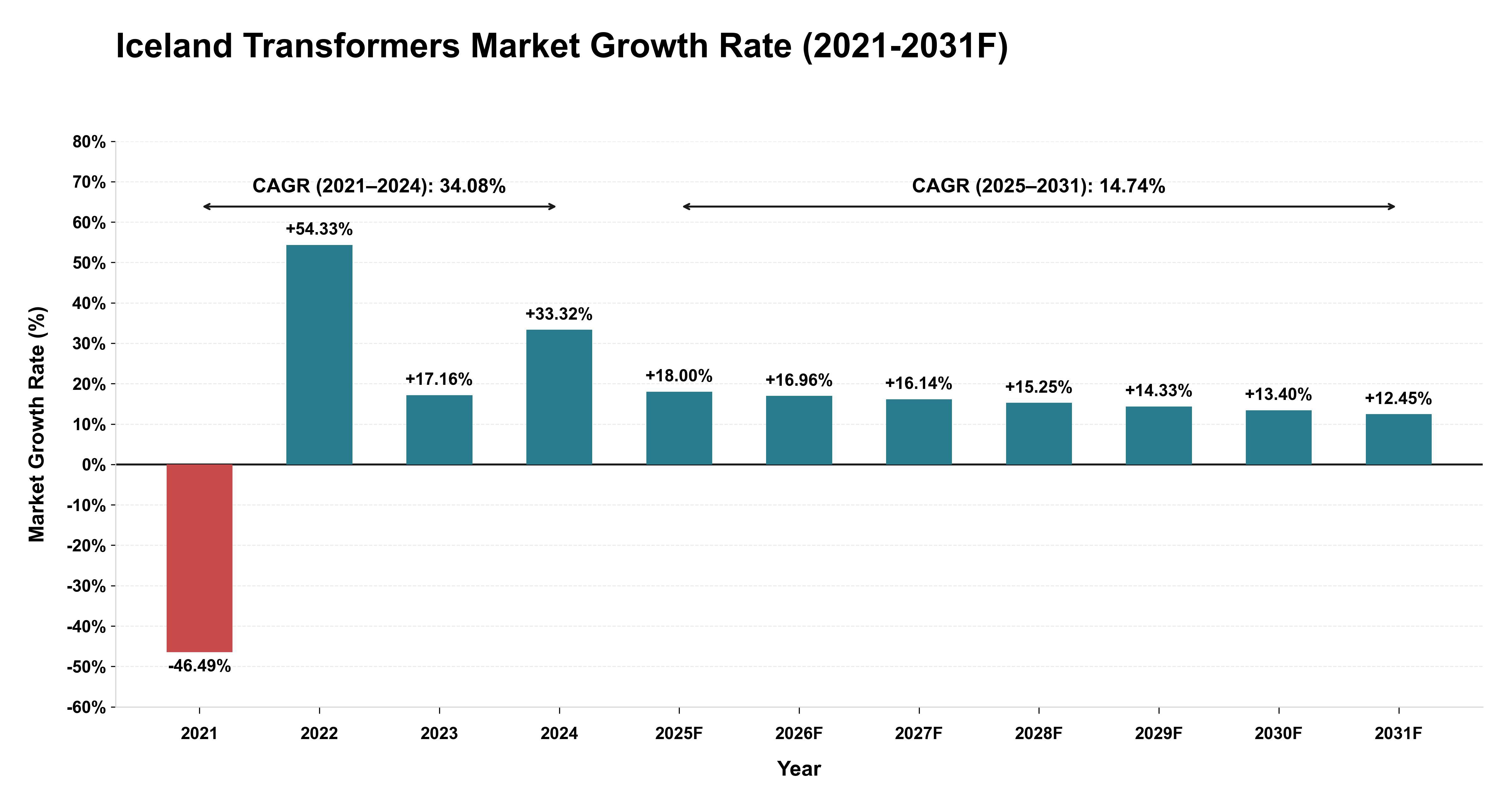
In the period 2021-2024, the Iceland Transformers Market experienced a tumultuous journey, with a sharp decline of -46.49% in 2021 followed by a robust recovery of 54.33% in 2022, indicating a volatile demand-supply dynamic. This was further supported by a steady growth of 17.16% in 2023 and 33.32% in 2024, showcasing resilience and adaptability within the industry. Looking ahead to 2025-2031, the market is poised for more stable growth with an expected CAGR of 14.74%. The gradual deceleration in annual growth rates from 18.00% in 2025 to 12.45% in 2031 reflects a maturing industry adapting to technological advancements and regulatory changes while maintaining a positive growth trajectory driven by increasing demand for energy-efficient transformers in Iceland's evolving economic landscape.
Key Highlights of the Report:
- Iceland Transformers Market Outlook
- Market Size of Iceland Transformers Market, 2025
- Forecast of Iceland Transformers Market, 2032
- Historical Data and Forecast of Iceland Transformers Revenues & Volume for the Period 2022-2032F
- Iceland Transformers Market Trend Evolution
- Iceland Transformers Market Drivers and Challenges
- Iceland Transformers Price Trends
- Iceland Transformers Porter`s Five Forces
- Iceland Transformers Industry Life Cycle
- Historical Data and Forecast of Iceland Transformers Market Revenues & Volume By Cooling for the Period 2022-2032F
- Historical Data and Forecast of Iceland Transformers Market Revenues & Volume By Oil-Cooled for the Period 2022-2032F
- Historical Data and Forecast of Iceland Transformers Market Revenues & Volume By Air-Cooled for the Period 2022-2032F
- Historical Data and Forecast of Iceland Transformers Market Revenues & Volume By Power Ratings for the Period 2022-2032F
- Historical Data and Forecast of Iceland Transformers Market Revenues & Volume By Small Power Transformer for the Period 2022-2032F
- Historical Data and Forecast of Iceland Transformers Market Revenues & Volume By Medium Power Transformer for the Period 2022-2032F
- Historical Data and Forecast of Iceland Transformers Market Revenues & Volume By Large Power Transformer for the Period 2022-2032F
- Historical Data and Forecast of Iceland Transformers Market Revenues & Volume By Applications for the Period 2022-2032F
- Historical Data and Forecast of Iceland Transformers Market Revenues & Volume By Smart Grid for the Period 2022-2032F
- Historical Data and Forecast of Iceland Transformers Market Revenues & Volume By Smart Transformer for the Period 2022-2032F
- Historical Data and Forecast of Iceland Transformers Market Revenues & Volume By Green Energy for the Period 2022-2032F
- Historical Data and Forecast of Iceland Transformers Market Revenues & Volume By Power infrastructure for the Period 2022-2032F
- Iceland Transformers Import Export Trade Statistics
- Market Opportunity Assessment By Cooling
- Market Opportunity Assessment By Power Ratings
- Market Opportunity Assessment By Applications
- Iceland Transformers Top Companies Market Share
- Iceland Transformers Competitive Benchmarking By Technical and Operational Parameters
- Iceland Transformers Company Profiles
- Iceland Transformers Key Strategic Recommendations






































